I'm Sampson, a web developer of more than 25 years, now working on @attentiontoken, @brave, and more. 🇧🇷 Falo Português. You can also find me @jonathansampson
Upstream changes determined the UX. We weren't necessarily fans of how MV3 was being rolled out, so we moved to dampen the impact by ensuring uBlock Origin and other targets would remain supported. That seemed to be the wisest investment of time and resources.
With regards to recovering your data and configurations, were you able to re-enable the extension via the inspector tools? It looks like the extension's official page also shares a couple approaches.
I'd love to know if any of these approaches work for you.
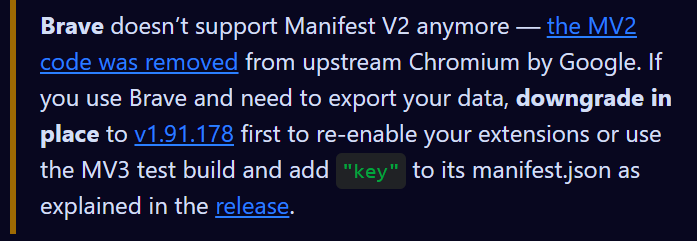
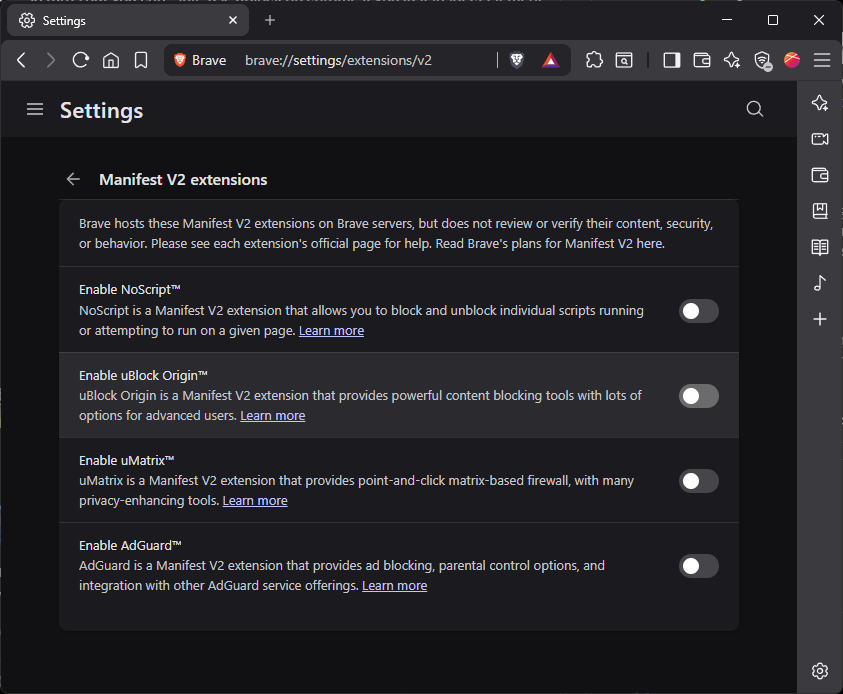
Brave still supports uBlock Origin even though Google aimed to shut it down over manifest requirements. We have it listed in brave://settings/extensions/v2 for any who wish to continue using it. @EccentricHelio, was Tampermonkey also soft-blocked by upstream Chromium changes? From what I can tell, they moved to MV3 long ago.
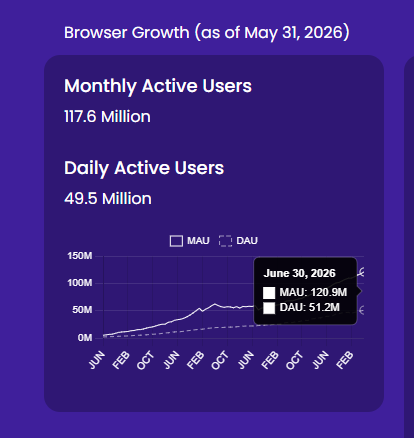
Thank you for the heads up, @TribeResistance. As it turns out, the data was updated, but recently-added server-side rendering logic wasn't showing it as the most recent data; hovering the chart would reveal the latest figures. We forced a rebuilding of that page to resolve the problem in the short term, and will ship an update today to make sure it stays working 🙂
@tread92 @BrendanEich@rebron Local OS solutions on Mac are definitely better than their Windows counterparts too. Brave uses local TTS services in the Speedreader view. Have you tried it?
@BrendanEich @tread92 @rebron Speech Synthesis API is pretty simple to use, but largely limits voices to low-quality options. Options exist for third-party TTS engines, but require sending possibly-sensitive content off to be processed. Can you share more about your scenario/use-case, @tread92?
Today we launched the community-requested Brave Origin: an optional, paid version of our browser that offers Brave's leading privacy protections and ad blocker without its extra features.
Origin is live now on desktop and Android, and coming soon to iOS: https://t.co/bMnPcRUzgN
Chrome (even "Old Chrome") is definitely not what you want. Here's a non-exhaustive list of ways we diverge from vanilla Chromium and Chrome: https://t.co/SxB3jzKeNA. Adblock extensions are limited by what the browser APIs permit, unlike Brave's native, built-in blocking abilities. Google can—and has—modified extension APIs in the past to the detriment of content-control extensions.
@contradecline@CovfefeAnon@brave We have a soft-fork today; you can see many of the ways we diverge from vanilla Chromium and Chrome at https://t.co/0RHgF3CDHh. That said, I would expect the forking to increase with time.
Very sorry to hear about the poor experience; looking into this issue presently. Can you tell me more about how you're testing the bookmark-search feature? For me, it does seem to find items in unexpanded folders. It's very possible that I am not following the same steps, however. I'm searching from the brave://bookmarks/ page, via the field at the top of the page.
@tommithetechie@RehaanMukhtar03@CR1337@mullvadnet Thank you for the cordial exchange. Always happy to chat about what we're building at Brave, what we nailed on first attempt, where we've stumbled, etc. We're just a group of humans trying to build a better Web 😊
Always happy to chat; happy to hear that I was able to clear up a couple items. Let me try a little harder to address your remaining concerns 😊
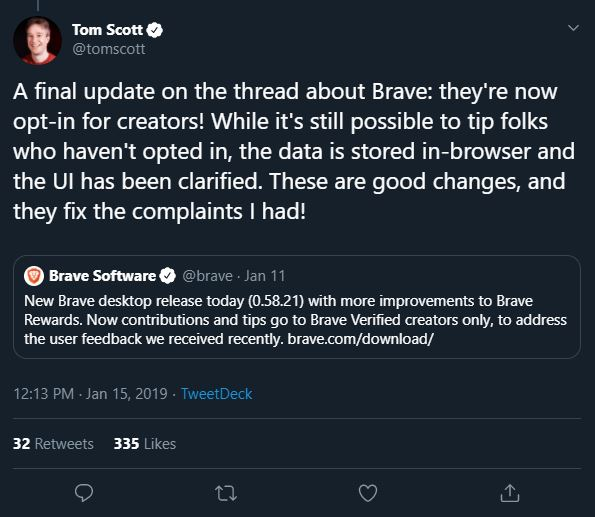
We iterated quickly on Tom's feedback in 2018. Within 48 hours we had an update shipped. Tom reviewed and complimented our changes. Unfortunately, the Tweet (https://t.co/ChvEm2yCJs) was later removed. Including a screenshot (see below).
Regarding the VPN, I am not sure if it was installed during an update, or during the first install following download. The reasoning, IIRC, was to front-load the work so that folks who wanted to use the VPN would not have to endure additional downloads/setup, but would be able to turn-on this inert portion of the browser. There was no impact to privacy.
My apologies for not covering the "bravebot" portion; didn't see that when I was scanning over the list. I am not entirely sure what you're referring to here. I assume you're talking about our crawler, which indexes the Web.
Nobody's data is being sold. Search engines crawl and index the web, enriching data, creating structure and a means for others to find what they need. That data is available unstructured via search engine result pages, and structured via APIs (e.g., so you can query for restaurants in a zip code). What is being "sold" is access to the service that indexed, enriched, and structured the data to begin with.
"…it seems like many issues were fixed after someone else called them out." That was the case with some of the items you listed, absolutely. Some things have to be seen by tens of thousands of folks in order for their flaws to be identified. For example, with regards to the verified content creators UI/UX in 2018, we followed the established pattern of Twitter and other properties at the time. We put a badge on verified properties, but did nothing for unverified properties. That seemed like a good approach, until we shipped the feature. It was then made clear (by Tom and others) that we should explicitly identify unverified properties as such. That feedback was super sensible in retrospect.
We certainly do not wish to erode any trust among the privacy-focused community. That's why I tend to ask folks to consider the privacy impact of these issues. More often than not, there is no privacy impact. When it comes to privacy, a broken Brave stills works better than a working Chrome/Edge/Firefox, etc. Because Brave sets the bar so high, when we fall (when is bound to happen when you attempt difficult things), we fall to the level of our competitors. I would invite you again to scan https://t.co/BxrXddiwOi (a few years old, but not much has changed) to get a sense of what is permitted as acceptable behavior for Brave vs. other leading browsers.
This is an old list of very misleading claims, yet it keeps getting copied and pasted ever so often.
The 2016 proposal for replacing third-party, tracking-enabled advertisements was a proposal. It was part of the larger effort to save content creators from a race to the bottom, in terms of revenue needed to continue making the Web so awesome. Third-party ads were getting more invasive, and users were increasingly shifting towards blocking all ads (including first party, harmless ones). The model was never implemented in that manner—ads were never placed on websites.
Regarding the inclusion of a search engine 10 years ago, it was a normal GitHub issue following typical community feedback from early users. It should come as no surprise that the CEO himself was personally working on GitHub Issues at that time; even with over 100M monthly active users, he is still one of our most active team members when it comes to community-support and helping to handle feedback/requests.
In 2018 we launched Brave Payments, and distributed BAT grants to our users. Those free grants could then be earmarked for popular content creators. Brave never solicited donations on behalf of anybody. That said, our UI/UX did have some holes (as most early designs do), and we worked swiftly to patch them within 48 hours. The results won the explicit approval of Tom Scott, etc.
In 2020 we had a bug affect an affiliate code on one or two domains, tops. Brave was never injecting affiliate codes across various websites, as claimed in your list. The affiliate option was presented among suggested URLs in the address bar drop-down. A bug in the pattern-recognizing code caused the suggestion to appear even when a fully-qualified domain name had been typed into the address bar. This was caught, patched, and resolved before Brave made any revenue.
You're correct that in 2020 the Brave new tab page started showing sponsored images. These are high quality wallpaper-style advertisements which help fund the development of the Brave Browser, and other offerings. No user data is involved in this apparatus; no tracking takes place. It's a privacy-preserving method of ensuring we are able to continue building the most secure, privacy-respecting popular browser possible.
In 2021 there was a TOR/DNS bug. Worth mentioning Brave's private windows are optionally enhanced by TOR, a privacy feature other browsers lack. We also have CNAME decloaking to stop third-party trackers from masquerading as first-party resources—another privacy feature not found in other browsers. These were implemented years apart, and did indeed have a conflict which could cause DNS requests to leak. The bug was identified, and patched in our nightly build. It was fast-tracked to the release branch shortly thereafter.
In 2022 you say we explored discouraging uses from disabling sponsored messages; I'm not sure what you are referring to here. That said, I'll 100% discourage users from disabling sponsored images, as they are privacy-respecting, non-invasive, high-quality, and help us to keep churning out industry-leading software. That said, you can disable them if you like directly from the new tab page 😊
In 2023 we saw the inert VPN service issue. Brave wasn't "caught", as this would imply we were up to no good, attempting to get away with something nefarious. Mind you, if that were the case, we wouldn't develop our code in the open—https://t.co/teLAuc7wxS. There was really no felt-impact here as the service was dormant. That said, when concern was voiced, we took action to modify the approach to packaging this optional feature: https://t.co/F3cXab0lFr.
In 2024 we announced changes to the shields around fingerprint protection. Again, this was a security feature you won't find in other popular browsers, and was used by much less than 1% of our own users. We blogged about the decision—citing clear reasoning, I believe—here: https://t.co/sNZwMBPbi0.
The creator of PrivacyTests did go on to work with us here at Brave for a period of time. The testing platform was already established, and quite popular. It makes sense why a browser would hire somebody so focused on testing, doesn't it? 😊 Never was Brave given an advantage; we sometimes trailed competing browsers on some tests.
The web team and I even retroactively added footnotes to https://t.co/MrEh0F1KOG on pages referencing PrivacyTests. The footnote noted the creator's (then) involvement with Brave. Again, nothing nefarious. In fact, we went out of our way to engineer a mechanism for adding a universal footnote solution, just to be super transparent.
When you review Brave's history, you don't really find much in the way of dirty deeds or nefarious acts. There are certainly a couple noteworthy issues (e.g., the DNS leak in TOR windows, due to conflicts with CNAME decloaking), but I think this is to be expected when you step out in front of the pack, and attempt things that nobody else is willing to try.
This is certainly the adventurous spirit that will result in others watching as you fall on your face, but it's also the type of boldness that brings over 110M MAUs on board, results in you having the "most private" popular browser on the market (see https://t.co/BxrXddiwOi), and shifts an entire industry towards greater privacy for users.
Always happy to discuss any specifics. Our code is open, and so too are we 😊
This is possible today with Brave using Grok as a custom search engine.
Navigate to brave://settings/searchEngines, scroll down to Site Search and select Add. In the fields, insert "Grok", ":gr" (or whatever shortcut you prefer), and "https://t.co/Tx06PqqTGv", respectively. Save the entry. You can then set it as the default handler of your queries via ⋮ and "Make default".
From then on, type a query into the address bar (optionally preceded with your custom shortcut) and it will result in a dedicated Grok tab with incoming response.
@seelawrie@ClawiAi Plans receive $5 in free credits each month, and support configurable usage limits. As such, you can set your limit to $5/mo, and use only the free credits.
Could you elaborate on the first point (i.e., opening new tab instantly). If you press Ctrl+T (Windows), you should not only create a new tab, but also be switched to it. The same is true for clicking the New Tab button in the toolbar. Are you seeing something different, or perhaps have a different scenario in mind?
We've pushed an update to remove the brave wallet flag, leaning instead on the more reliable policy-approach (or runtime flag) for disabling the feature. Thank you again for catching and reporting the buggy behavior. Please do let us know if you run into any other issues! https://t.co/MkSVJBYxJP
As noted in other responses, there is a policy-based approach which is far more effective. Details about that policy are here: https://t.co/UcOHsAiSCe.
The policy approach was more recently added to the source than the flag approach. I suspect we added the flag prior to much of the subsequent maturation of the native wallet, which resulted in later commits not including flag-checks as aggressively as earlier commits. Either way, my sincere appreciation again for the feedback. Working on this issue now.