As promised, I made a daily challenge/puzzle/game inspired by the success of Wordle: Ordered Ops
My friends are already better than me.
8️⃣9️⃣➡️5️⃣0️⃣ in 00:00:33⌚
https://t.co/MyjtSxSYrm
there's an easier and better way to achieve Bernie's objectives to collectivize ownership of AI.
buying or seizing AI lab equity won't work.
- buying: the taxpayer is paying a wildly marked up rate in the trillions and will be perceived as a bailout
- seizing: do I even have to explain why this is a bad idea?
giving the government 50% of the equity in the leading AI labs creates an incentive to crystallize them as the forever winners. a sovereign AI fund will want to protect its rents and will dramatically reduce competition in the sector through regulation. this is a very bad idea.
so how to share the wealth? (if you had to)
a government-run initiative to distill frontier models into open source models.
the American consumer can then use frontier models for the commodity cost of the inference. a large share of the OAI/Anthropic margin gets handed directly to the consumer in the form of a surplus. no tricky accounting of who deserves what. no weird airdrops. consumers of AI benefit in proportion to their usage.
right now, China is sort of doing this, but they are slowing down because open source models don't monetize well, if at all. so there is actually a case to be made for the government to underwrite the creation of such a product, since it is a public good.
Bernie's own stated objectives aren't met by an AI sovereign wealth fund.
if he wants to break oligarchic control as he claims, a 50% state ownership guarantees a durable oligarchy rather than busting it. distillation does the opposite by collapsing the moat and pricing power of leading AI labs. his goals also contradict themselves. reducing concentration trades off against creating an endowment for the US taxpayer. if he wants to maximize the value of the fund, that means ensuring that OAI/Anthropic/etc do well.
Q: won't distillation destroy competitiveness of leading labs?
A: it already happens, and they are still competitive. people will still pay for bleeding edge models while using trailing open source ones. but if the labs threaten to take over the economy, you could make the case that some of their margin should be stripped away
Q: would the major labs continue to train new models if the government was funding open source clones?
A: if we reach a situation where it becomes politically necessary to reduce AI lab power, they can afford to take a little more time in between models.
**the above is a thought experiment, not a policy suggestion**
while I am not advocating for state control over AI, if it does become the case that there is a massive populist backlash to power concentrating with the AI labs (let's say OAI/Anthropic each become $10- 20T companies), and something _must_ be done about them, a government-sponsored open source approach would be more efficient and beneficial to the average American than nationalizing the labs.
Watching UCLA get eliminated today brought back some memories.
When I played at UCLA, we lost to a team we should have beaten on paper.
Season over.
I remember being shocked.
Then I learned one of the most important lessons baseball can teach:
The game doesn't reward potential.
It rewards performance.
Nobody gets extra runs because they're ranked #1.
Nobody advances because they're supposed to win.
Nobody gets a pass because they had a great season.
You have to earn it every single day.
That's what makes baseball beautiful.
And brutal.
The best team doesn't always win.
The team that performs usually does.
Tough ending for the Bruins.
Credit to St. Mary's.
They played great baseball and earned the opportunity to keep playing.
Thank you for reading,
Jermaine Curtis
Maybe I’m a bitter fan but I know I absolutely don’t want to watch a reality show that targets 6 to 11 year olds. Again, the core identity of the show has been lost. The show used to be people willing to do anything to win 1 million dollars, now it’s a friendship show for kids who want to go camping.
This would fix a lot of things.
First things first, revenue sharing would be 50/50, which would be huge for both sides.
The cap being where it is would be a strong starting point, especially with the current CBT sitting around $244 million. The floor being at $171.2 million would force a lot of teams to raise payroll significantly, but I’m sure small-market owners would be more open to that if it meant every team had a more even competitive edge in free agency.
One idea I think could work really well for both players and owners is a homegrown-player cap discount.
If a player is called up through your system and stays with your organization, that player should not count 100% against the cap when you extend them. If only 40–60% of that contract counted against the cap, you would see a lot more loyalty in the sport. Teams would have a stronger reason to keep their own players, and players would have more reason to think twice before testing the open market.
That would change the loyalty aspect of baseball in a massive way.
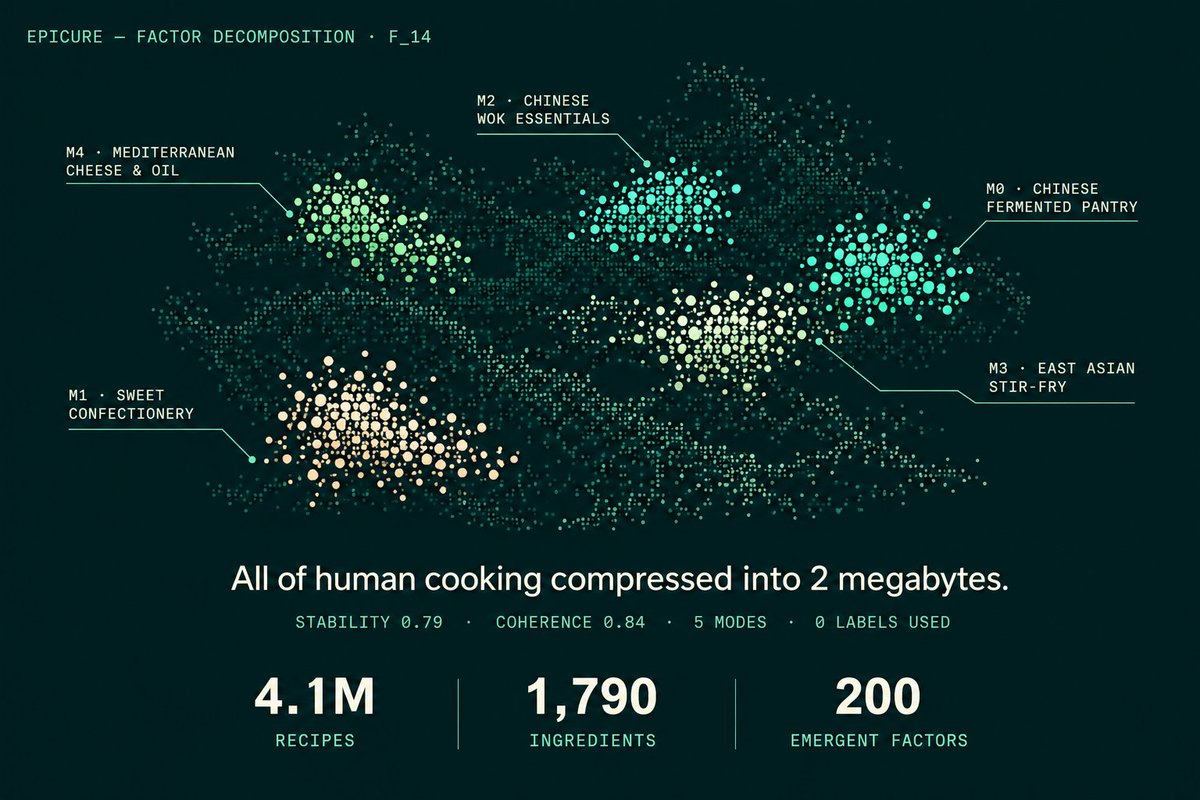
Launching our new paper on arXiv: we trained the largest multilingual food model ever built.
4.1M recipes. 7 languages. 1,790 ingredients. 300 dimensions.
All of human cooking compressed into 2 megabytes.
"This is BS! ... Detroit got smoked." - Chandler Parsons
CP & Lou Williams are adamant that the Cavs fouled the Pistons on the last play to end regulation 🗣️
"It's unacceptable." - LW
@MichelleDBeadle | @ChandlerParsons | @TeamLou23
2006: Facing a 64 win team with a championship core in the 2nd round, LeBron leads the series in PPG, but the next 4 highest scorers were all on the other team.
2026: Facing a 64 win team with a championship core in the 2nd round, LeBron leads the series in PPG, but the next 3 highest scorers were all on the other team.
The unluckiest great player in sports history.
The University of Michigan has netted $2B on a first round investment in OpenAI, expected to IPO later this year. Just think of all the NIL they could buy.
Further reinforcing that Michigan won the last truly consequential edition of The Game in 2023. The stakes will never come close to being as big as they were that afternoon.
So many sports announcers live a long life, but don't seem to emphasize diet or exercise.
Bob Uecker ()90, Tim McCarver (81), Dick Enberg (82). Vin Scully (94), Mel Allen (83). Red Barber (84). Ernie Harwell (92). Even Harry Carey lived to 83 as a lifelong alcoholic.
It's a fun job. Not a lot of stress. No need to retire. Longevity is more than metrics