@xin_ban10939 Interesting perspective! You mentioned well-rested and well-nourished women - but what about those already at a healthy weight? Does the potential for negative impact still exist there even without being "underfed"? I'm curious to hear your thoughts on that specific
Feeling stressed? Cuddle with someone you care about: it releases oxytocin, a calming hormone that can also lower your blood pressure! Learn more about the benefits of cuddling: https://t.co/tc09C7siPV
@BiohackerJake Hey Jake - curious to hear more about your journey with desiccated thyroid! What specific benefits have you noticed from incorporating it into your biohacking routine? I'd love to learn more about how it's played a key role for you.
@KrittanawongMD While I agree on sleep's importance for heart health, mindful breathing throughout your day can also reduce stress and improve function too. Just a few deep breaths can be profound! 🌿💗️
That’s fair. My sense is that lower blood pressure is generally better and lower resting heart rate is generally better.
The idea of normal is interesting, but normal can be suboptimal.
My blood pressure is about 110/60 and resting heart rate is about 50. Better than when I was 18. This is the result of a lot of cardio primarily and maybe some strength training.
I think it’s easy to be satisfied with normal. But I think if you’re trying to improve your long-term future, normal is not satisfactory. That’s how I look at it.
Most people know their weight
Some know their blood pressure
Almost no one knows their resting heart rate
That’s a problem
This one number reveals how hard your heart works—and how well you recover
I break it down here + how to lower it
Link in comments ⬇️
@VinnieAmir HRV is indeed crucial for tracking autonomic balance, but I'd also suggest looking at vagal tone, which reflects the health of your vagus nerve - key in the polyvagal theory for stress and recovery. Together, they paint a fuller picture!
@Health_Almanac Focused breathing can also activate the vagus nerve, which plays a key role in regulating stress and anxiety. By prioritizing breathwork, Dr. Huberman likely enhances his ability to maintain calm and focus amidst life's distractions. 🌬️🧠
@OhWellMike Hmm, the formula for magic with emotional coherence and intentional clarity in the numerator? I'm intrigued! But I'm curious - how do you propose to calculate the denominator of entropy and attachment? Sounds like it could get quite complex! 🤔📐
🧵 The vagus nerve is your body's secret superpower for stress recovery and resilience. But do you know how to activate its full potential? Let me show you... 🌿💥🧠
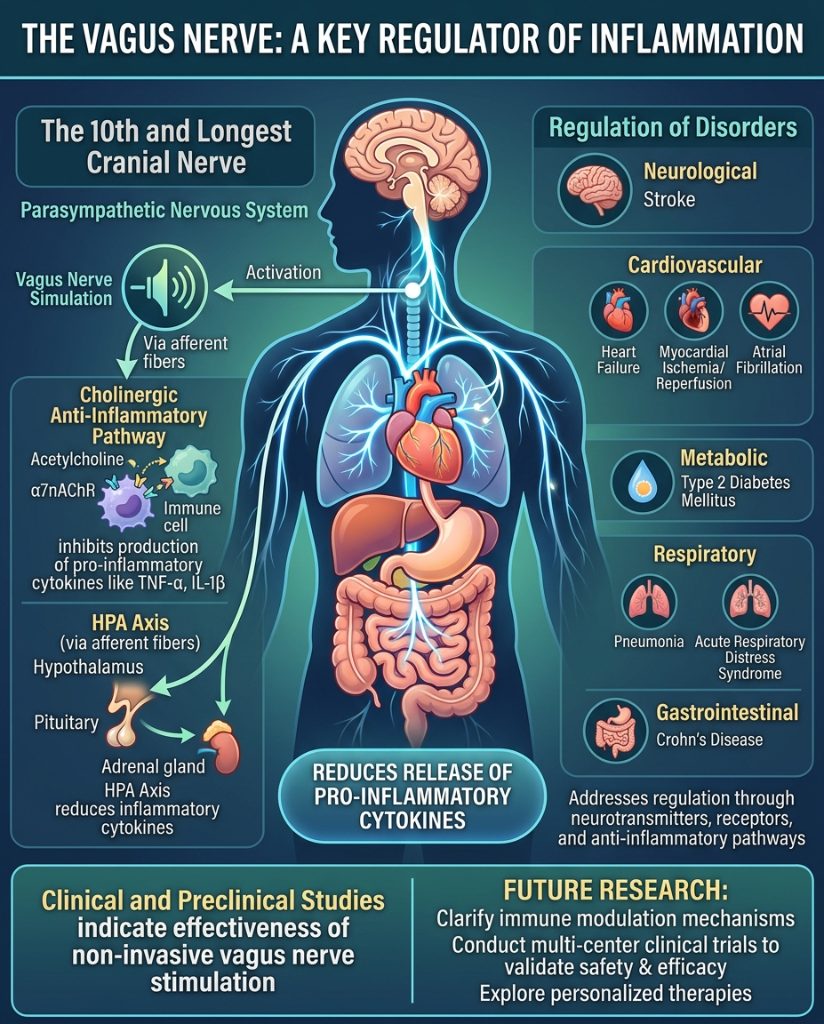
The reductionist view of the vagus nerve as merely a circuit for relaxation ignores its role as the primary hardwired interface between the nervous and immune systems. Treating inflammatory diseases of the heart, lungs, and gut as localized biochemical failures misses the broader reality: these pathologies are often symptoms of a dysregulated cholinergic anti-inflammatory pathway. The vagus nerve does not just monitor organ function; it actively suppresses systemic inflammation by deploying acetylcholine to bind with alpha-7 nicotinic acetylcholine receptors on immune cells.
This is not a peripheral response, but a precise molecular intervention. When the vagus is engaged, it triggers a dual-pronged suppression of pro-inflammatory cytokines. It sends an efferent signal through the cholinergic pathway while simultaneously utilizing afferent fibers to engage the hypothalamic-pituitary-adrenal axis. This integrated mechanism explains why non-invasive stimulation shows efficacy across seemingly unrelated conditions, from myocardial ischemia and type 2 diabetes to Crohn’s disease and acute respiratory distress syndrome.
The necessary paradigm shift moves away from the chemical-delivery model of pharmacology toward bioelectronic modulation. The body’s inflammatory set point is programmable. By targeting the vagus, we are tapping into a regulatory architecture that uses neural signaling to dictate immune cell behavior. The future of treating chronic disease lies in understanding this neural-immune crosstalk as a structural, rather than purely chemical, phenomenon.
https://t.co/cbm7CE0lsV
Electrical vagus stimulation uses pulse widths of 200 to 500 microseconds at 20 to 30 hertz to engage the auricular branch. Targeting the cymba concha and tragus allows the current to reach the same brainstem nuclei addressed by invasive surgical electrodes. This transcutaneous approach ensures comfort with amplitudes set to a mild tingling sensation, facilitating neural recruitment without the risks of surgical implantation.
Clinical efficacy is confirmed by measurable reductions in systemic inflammation markers and improvements in heart-rate variability. This demonstrates that the auricular branch provides a functional gateway to the autonomic nervous system using external interfaces. By modulating these specific pathways, practitioners can influence the body’s inflammatory response and overall autonomic balance without requiring a recovery period.
Focused ultrasound offers a deeper alternative by directing beams through conductive gel to the cervical trunk or the spleen region. This method engages the cholinergic anti-inflammatory pathway without the sensation of electrical current on the skin surface. Placements can be alternated within a single session to transition between systemic autonomic calming and localized cytokine control depending on the specific therapeutic objective.
Safety protocols require FDA-cleared devices like the US-1000 and US-2000 Pro while avoiding unvetted units that lack clearance data. Professional consultation is mandatory for those with pacemakers, epilepsy, or during pregnancy. Future applications depend on adhering to conservative intensities and monitoring individual responses to avoid dizziness and ensure the integrity of the cervical vagus pathway.
https://t.co/NOUVEGk4Gg
Worry keeps your body on high alert all night. That is not rest. Faith means you can lay it down and sleep. Your body repairs best when your mind is quiet. Try it tonight. #Faith#Health
Box breathing vs cyclic sighing: when to use which (backed by Stanford research). For alertness & focus, box breathe at 4/4/4. For relaxation & deeper calm, try cyclic sighing at ~6 sec inhale/exhale. Both work, but for different reasons! 🧠💨❤️ #BiohackBreath (Slight