Firmly believe that if you think you know whats going on you don't understand the situation. Nurse, friend, reformed hopeless romantic (but not quite cynic yet)
@BraveRoyal@MRB_AI24 Most hospitals I’ve worked have dedicated arrest teams, in Australia these are called METeams who respond to ward emergencies. ER docs don’t have clinics.
@LampkeTina@MRB_AI24 You are correct. They do rounds. In packs. House officers, registrars, often a couple of each. The consultant should be able to make their clinic.
@MagaKristine@Pontifex Mate he’s posting on Twitter. I would say the majority of people on this platform know all of these words. At least the ones interested in the Popes views. Not to mention they can look them up. Or would you prefer the ramblings of the US president? Did we ever work out COVFEFE?
Dr. Frank Mayfield was visiting the Tewksbury Institute when, on his way out, he accidentally bumped into an elderly cleaning lady. To make conversation, he asked, “How long have you worked here?”
“I’ve worked here almost since it opened,” she said.
“What can you tell me about the history of this place?” he asked.
“I don’t know much,” she said, “but I can show you something.”
She led him down to the basement under the oldest part of the building and pointed to a small, rusted cell. “That’s where they used to keep Annie Sullivan,” she said.
“Who’s Annie?” he asked.
The maid explained that Annie was a young girl who had been brought there because no one could control her. She screamed, bit, and threw her food. The doctors and nurses couldn’t even examine her.
“I was just a few years younger than Annie,” the maid said. “I used to think, ‘I’d never want to be locked in a cage like that.’ I wanted to help her, but if the doctors couldn’t, what could I do?”
“One night I baked some brownies after work. The next day, I put them outside her cage and said, ‘Annie, I made these for you. You can take them if you want.’ Then I walked away, afraid she’d throw them. But she didn’t. She took the brownies and ate them. After that, she was a little kinder to me. I started talking to her, and one day, I even made her laugh.”
“One of the nurses saw this and told the doctor. They asked if I’d help them with Annie. So whenever they needed to see her, I went in first to calm her, explain things, and hold her hand. That’s when they discovered Annie was almost blind.”
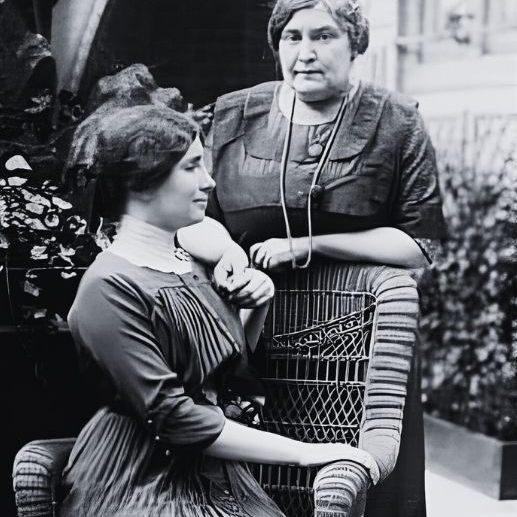
After a year of slow progress, Annie was sent to the Perkins Institute for the Blind, where she learned to read, write, and later became a teacher herself.
Years later, Annie came back to Tewksbury to visit and help. The Director told her about a letter he had just received from a desperate father. His daughter was blind, deaf, and thought to be “crazy.” He didn’t want to send her to an asylum and asked if anyone could come teach her.
That’s how Annie Sullivan became the lifelong teacher and companion of Helen Keller.
When Helen Keller later received the Nobel Prize, she was asked who had most influenced her life. She said, “Annie Sullivan.”
But Annie replied, “No, Helen. The woman who changed both our lives was a maid at Tewksbury who once brought a little girl some brownies.”
In 1705, an Irish woman named Marjorie McCall fell gravely ill with a fever in Lurgan, Ireland. Believing she had died, her family hastily buried her to prevent the spread of contagion. Her husband, John McCall, a local physician, had been unable to remove her valuable ring because her finger was badly swollen — a detail that soon attracted the attention of grave robbers.
That same night, body snatchers dug up the fresh grave. Unable to pull the ring from her finger, they began cutting it off. The sudden flow of blood shocked the still-living Marjorie out of her deep coma. She sat upright in the coffin and screamed, terrifying the robbers, who fled and reportedly never returned to their grim trade.
Covered in dirt and still wearing her burial clothes, Marjorie climbed out of the grave and walked home. When she knocked on the door, her husband John, still in mourning, jokingly remarked that if his wife were alive, he would swear it was her at the door. Upon opening it and seeing Marjorie standing before him — alive, bleeding, and in her shroud — he collapsed from shock and died on the spot.
John McCall was later buried in the grave originally dug for his wife.
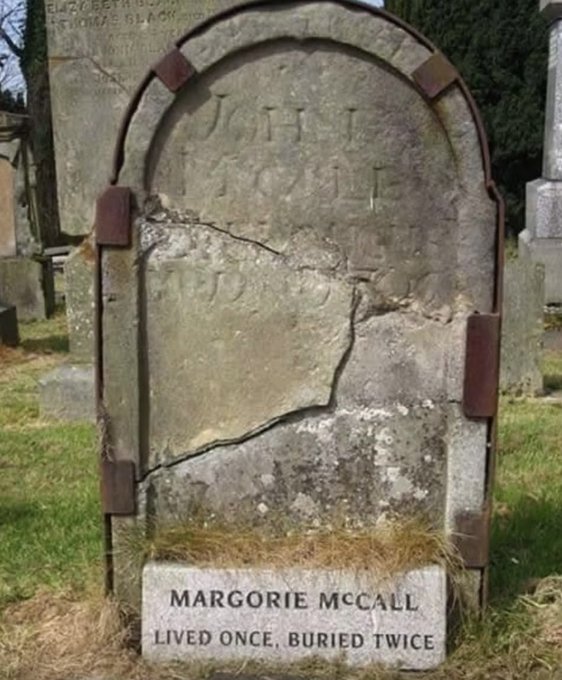
Marjorie survived the ordeal, eventually remarried, and had several children. When she died many years later, she was laid to rest in Shankill Cemetery in Lurgan. Her headstone famously reads:
“Lived Once, Buried Twice.”
In 1937, Rupert Mayer stood in his pulpit at St. Michael's Church in Munich and preached against Hitler.
By then, Germany had been a Nazi dictatorship for four years. Most priests remained silent. Most bishops tried to negotiate with the regime. Most Germans cheered. Mayer preached the opposite.
He was 61 years old—a Jesuit priest in a black cassock, standing on a wooden prosthetic leg. He had lost his original leg 21 years earlier. Here is how he got there.
Rupert Mayer was born in Stuttgart on January 23, 1876, the son of a prosperous merchant. He wanted to be a Jesuit from his teens, but at his father’s request, he became a diocesan priest first. He was ordained in 1899 at age 23, and a year later, he finally entered the Jesuit novitiate.
By 1912, he had settled in Munich, the city he would serve for the rest of his life. After World War I, Munich was a broken place—full of jobless veterans, hungry families, and people drifting in from the countryside with no housing or hope. Mayer went to work. He collected food and clothing, found jobs, and walked the streets at night to visit the poor. He walked, then hobbled, then walked again on that wooden leg.
He had lost his leg during the Great War. Having volunteered as a military chaplain, he served in field hospitals and the trenches across France, Poland, and Romania. On December 30, 1916, a grenade exploded near him, destroying his left leg. He was awarded the Iron Cross, First Class—the first priest to receive one of Germany’s highest military honors.
Back in Munich, he never stopped. By 1921, he was preaching at St. Michael's and celebrating Mass at the train station at 3:10 AM so workers could attend before their early shifts. The city began calling him "the Apostle of Munich."
Then came 1933. Adolf Hitler became Chancellor, and the Nazi Party began closing Catholic schools and trying to replace Christian identity with Nazi ideology. While much of the clergy stayed quiet to protect what they had, Mayer went straight to the pulpit. He preached against the Nazis by name, stating that a Catholic could not be a National Socialist and that Hitler’s racial theories contradicted the Gospel.
The Gestapo began sending informants to his sermons. In 1937, they ordered him to stop speaking in public altogether. He obeyed the letter of the law by avoiding rallies, but he returned to his pulpit and preached harder than ever.
He was arrested on June 5, 1937. At his trial, he told the judge: "Despite the ban imposed on me, I shall preach further, even if the state deems it a punishable act." He was given a suspended sentence, but he didn't stop. He was arrested a second time in 1938, then a third time in 1939. This time, the Gestapo tried to force him to break the seal of confession to reveal the names of Nazi opponents. Mayer refused.
At age 63, the one-legged priest was sent to the Sachsenhausen concentration camp and placed in solitary confinement. His health collapsed quickly. Fearing that his death in the camp would create a martyr, the Nazis moved him to Ettal Abbey under house arrest in 1940. For five years, he was forbidden to preach, leave, or receive visitors. He waited and prayed while his country destroyed itself.
On May 11, 1945, American soldiers liberated the Abbey. A U.S. officer personally drove Mayer back to the ruins of Munich. He climbed back into his damaged pulpit at St. Michael's and told the congregation: "Even a one-legged Jesuit, if it is God's will, can live longer than a 'thousand-year' dictatorship."
He spent his final months preaching reconciliation and forgiveness, refusing to call for revenge. On November 1, 1945, while preaching during Mass on All Saints' Day, he suffered a stroke and collapsed. He died within minutes, still in his vestments, still in his pulpit.
Mayer’s story matters because when most chose survival over witness, he chose the truth. He could have stayed quiet, but as he told a Gestapo interrogator, ....
NEW: Pope Leo XIV has named Salvadoran immigrant Evelio Menijar-Ayala to be West Virginia’s lone Catholic bishop.
As a teenager, he made three attempts to enter the United States illegally.
He finally arrived in California in 1990, having been smuggled in the trunk of a car with his brother over the border crossing between Tijuana and San Diego.
Over the next several years, Menjivar-Ayala worked janitorial and construction jobs in California before deciding to become a priest.
It’s a remarkable choice in a state that is over 90% white and voted for President Trump by 42 points.
There are two Texel ewes that share Keith's field in summer.
They are not Keith's ewes. They are not part of any active breeding plan. They are two retired ewes that the farmer's wife took on from a flock dispersal in 2023, and that have been living on the bottom pasture of Dave's farm because the bottom pasture is, after Keith has worked it, in better condition for grazing than it has been in any of the previous tenancies the farm has known.
The ewes' names are Pat and Margaret.
Keith's relationship with Pat and Margaret is the following.
He ignores them.
Specifically, he ignores them in the way that a goat ignores sheep, which is not the way that, for example, a sheep ignores another sheep, or that a horse ignores a sheep, or that any other animal on this farm ignores any other animal. Keith's ignoring is structural. It is not absent-minded. He is aware of where Pat and Margaret are at all times. He simply does not allow this awareness to influence his behaviour.
Pat and Margaret are also aware of where Keith is at all times.
They have, however, learned to follow Keith.
Not closely. Not in any way that Keith has acknowledged. But when Keith opens a gate, Pat and Margaret are, on average, through it within four minutes. When Keith identifies a section of bramble that is going to be addressed, Pat and Margaret are nearby within ten. When Keith is on the barn roof, Pat and Margaret are usually in the shade of the barn, looking up at him with the specific patient expression of two old sheep who have decided that whatever the goat is doing is, on balance, probably worth being near.
Dave has noticed.
Dave has not mentioned it to Keith, because Keith would deny it.
Dave has also noticed that Pat and Margaret have, in their last two years on this farm, lambed at a rate that the previous flock-keeper would have considered impossible for ewes their age, eaten weeds they had not previously touched, and produced fleece that the local mill paid more for than any of their previous fleeces.
The ewes have got better.
The ewes have got better because they have been doing what the goat does.
The goat does not know they have been doing what the goat does.
This is, in agricultural terms, a mixed grazing system.
It is one of the oldest systems known to British farming. Cattle, sheep, and goats together, sharing pasture, each handling the vegetation the others won't touch, parasites broken up by interspecies grazing, the field improving over years rather than declining over months.
The system was lost when farms specialised after the war.
Dave did not set out to recreate it.
Dave bought a goat for the knotweed.
The system has reassembled itself.
Pat and Margaret are at the gate.
Keith is on the roof.
The pasture is the best it has ever been.
In any normal country, purchasing stolen goods is an act that entails legal liability. This applies, in particular, to grain stolen by Russia. Another vessel carrying such grain has arrived at a port in Israel and is preparing to unload. This is not – and cannot be – legitimate business. The Israeli authorities cannot be unaware of which ships are arriving at the country’s ports and what cargo they are carrying.
Russia is systematically seizing grain on temporarily occupied Ukrainian land and organizing its export through individuals linked to the occupiers. Such schemes violate the laws of the State of Israel itself. Ukraine has taken all necessary steps through diplomatic channels to prevent such incidents. However, we see that yet another such vessel has not been stopped. I have instructed the Ministry of Foreign Affairs of Ukraine to inform all partners of our state about the situation.
Based on information from our intelligence services, Ukraine is preparing a relevant sanctions package that will cover both those directly transporting this grain and the individuals and legal entities attempting to profit from this criminal scheme. We will also coordinate with European partners to ensure that the relevant individuals are included in European sanctions regimes.
Ukraine counts on partnership and mutual respect with every state. We are genuinely working to enhance security, particularly in the Middle East region. We expect that the Israeli authorities will respect Ukraine and refrain from actions that undermine our bilateral relations.
Robert is thirty-six years old. In 1247, this is not young. Robert knows this. His knees know this. His back has known this since approximately 1239.
Robert lives in a village in Worcestershire with his wife Agnes, three surviving children, and two chickens he is not allowed to eat because the chickens produce eggs and the eggs matter more than the chickens.
Today is a Tuesday in March. Robert will describe it as a Tuesday in March. The concept of a 'week' as a unit of leisure is not yet something Robert has access to.
5:00am - Up. Pottage on the fire. The pottage is oats, leeks, and some dried parsnip from the autumn store. There is a small piece of salted pork in it, approximately the size of Robert's thumb. It is mostly flavouring. Robert eats around it for as long as possible, then eats it, then thinks about it for the rest of the morning.
6:00am - Field. Robert works the lord's strip first, then his own. The ground is still cold. His boots have a hole. He has had the hole since October. He has packed it with rags. The rags are wet. They will remain wet until June.
Robert is technically eating a plant-based diet. He is not doing this by choice. He is doing this because meat belongs to the lord, the deer belong to the king's forest, and the last man in this village who was caught with an unlicensed rabbit spent a period in the stocks that his family still doesn't fully discuss.
10:00am - Brief rest. Rye bread, hard. A small onion. Robert thinks about the pig that was slaughtered in November. He thinks about this often. The memory of fat is a specific and enduring thing when you don't have much of it.
1:00pm - Back to the field. Robert's average daily calorie intake is somewhere between 1,500 and 2,000 calories, the majority from grain. He is doing agricultural labour that modern exercise scientists would classify as extremely high intensity. He is, measurably, running on insufficient fuel. He is aware of this in the way that you are aware of things that cannot be changed: completely, and without drama.
4:00pm - Home. Agnes has made more pottage. It is similar to this morning's pottage. Robert eats it. Robert's teeth hurt. They have hurt for two years. There is no dentist. There is a barber-surgeon in the market town seven miles away. Robert cannot afford the barber-surgeon and cannot take the day from the fields. His teeth continue to hurt.
7:00pm - Sleep. Robert will be awake again at five. He is thirty-six. He will probably not see forty. The leading cause of death for men in his position is a combination of infection, injury, and the slow arithmetic of malnutrition across a lifetime.
Somewhere, eight hundred years from now, someone will describe Robert's diet as "ancestral," "plant-forward," and "aligned with the earth."
Robert would have a great deal to say about this.
Robert does not have the energy.
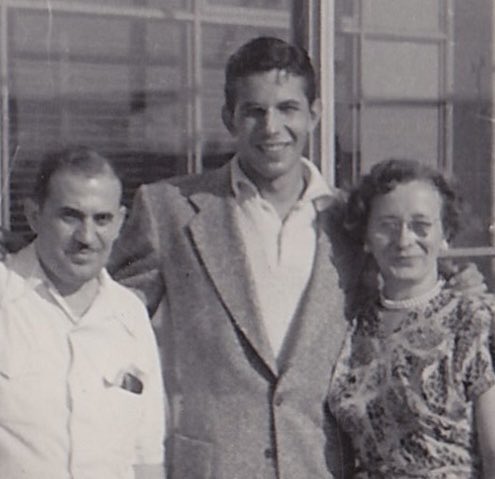
To commemorate my father’s 95th birthday, I want to remind Spock fans that dad’s parents were Ukrainian immigrants which shaped my father in many ways. Four years of Putin’s war has brought death and destruction to our people, our homeland. LLAP. #standwithukraine#ukraine
As a priest, who has celebrated Holy Communion twice today and is departing for a Cistercian monastery tomorrow, can I just say that this 'Easter Egg rage' is nonsense.
If you care that much, get yourself to church, and then perhaps you will realise that our faith is not based on confectionary or its packaging.
Robert Mueller died last night.
He was 81 years old. He had a wife who loved him for sixty years. He had two daughters, one of whom he met for the first time in Hawaii, in 1969, on a few hours of military leave, before he got back on the plane and returned to Vietnam. He had grandchildren. He had a faith he practiced quietly, without performance. He had, in the way of men who have seen real things and survived them, a quality that is increasingly rare and increasingly mocked in the country he spent his life serving.
He had integrity.
And tonight the President of the United States said good!
I have been sitting with that word for hours now. Good. One syllable. The thing you say when the coffee is hot or the traffic is moving. The thing a man who has never had to bury anyone, never had to sit in the specific silence of a room where someone is newly absent, reaches for when he wants the world to know he is satisfied. Good. The daughters are crying and the wife is alone in the house and good.
I want to speak directly to the Americans reading this. Not the political Americans. Just the human ones. The ones who have lost a father. The ones who know what it is to be in that first hour, when you keep forgetting and then remembering again, when ordinary objects become unbearable, when the world outside the window seems obscene in its indifference. I want to ask you, simply, to hold that feeling for a moment, and then to understand that the man you elected looked at it and typed a single word.
Good.
This is not a country having a bad day. I need you to understand that. Countries have bad days. Elections go wrong. Leaders disappoint. Institutions bend. But there is a different thing, a rarer and more terrible thing, that happens when the moral center of a place simply gives way. Not dramatically. Not with a single catastrophic event. But quietly, in increments, until one evening a president celebrates the death of an old man whose family is still warm with grief, and enough people find it acceptable that it becomes the weather. Just the weather.
That is what is happening. That is what has happened.
The world knows. From Tokyo to Oslo, from London to Buenos Aires, people are not angry at America tonight. Anger would mean there was still something to fight for, some remaining faith to be betrayed. What I see, in the reactions from everywhere that is not here, is something older and sadder than anger. It is the look people get when they have waited a long time for someone they love to find their way back, and have finally understood that they are not coming.
America is being grieved. Past tense, almost. The idea of it. The thing it represented to people who had nothing else to believe in, who came here with everything they owned in a single bag because they had heard, somehow, across an ocean, that this was the place where decency was written into the walls. That idea is not resting. It is not suspended. It is being buried, in real time, with 7,450 likes before dinner.
And the church said nothing.
Seventy million people have decided that this man, this specific man who has cheated everyone he has ever made a promise to, who has mocked the disabled and the dead and the grieving, who celebrated tonight while a family wept, is an instrument of God. The pastors who made that bargain did not just trade away their credibility. They traded away the thing that made them worth listening to in the first place. The cross they carry now is a costume. The faith they preach is a loyalty oath with scripture attached. When the history of American Christianity is written, this will be the chapter they skip at seminary.
Now I want to talk about the men who stand next to him.
Because this is the part that actually breaks my heart.
JD Vance is not a bad man. I have to say that, because it is true, and because the truth matters even now, especially now. Marco Rubio is not a bad man. Lindsey Graham is not a bad man. They are idiots, but not bad, as in BAD! These are men with mothers who raised them and children who love them and friends who remember who they were before all of this. They are not monsters. Monsters are simple. Monsters do not cost you anything emotionally because there is nothing in them to mourn.
These men are something more painful than monsters.
They are men who knew better, and know better still, and will get up tomorrow and do it again.
Every small compromise they made had a reason. Every moment they looked the other way had a justification that sounded, at the time, almost reasonable. And now they have arrived here, at a place where a president celebrates the death of an old man and they will find a way, on television, to say nothing that means anything, and they will go home to houses where children who carry their name are waiting, and they will say goodnight, and they will say nothing.
Their oldest friends are watching. The ones who knew Rubio when he still believed in something. Who knew Graham when he said, out loud, on the record, that this exact man would destroy the Republican Party and deserve it. Who sat next to Vance and thought here is someone worth knowing. Those friends are not angry tonight. They moved through anger a long time ago. What they feel now is the quiet, irrecoverable sadness of watching someone disappear while still being present. Of watching a person they loved choose, again and again, to become less.
That is what cowardice costs. Not the coward. The people who loved him.
And in the comments tonight, the followers celebrate. People who ten years ago brought casseroles to grieving neighbours. Who stood in the rain at gravesides and meant the words they said. Who told their children that we do not speak ill of the dead because the dead were someone's beloved. Those people are tonight typing gleeful things about a man whose daughters are not yet done crying. And they feel clean doing it. Righteous. Because somewhere along the way the thing they were given in exchange for their decency was the feeling of belonging to something, and that feeling is very hard to give up even when you can no longer remember what you gave for it.
When Trump is gone, they will still be here.
Standing in the silence where the noise used to be. Without the permission the crowd gave them. Without the pastor who told them their cruelty was holy. They will be alone with what they said and what they cheered and what they chose to become, and there will be no one left to tell them it was righteous.
That morning is coming.
Robert Mueller flew across the Pacific on military leave to hold his newborn daughter for a few hours before returning to the war. He came home. He buried his dead with honour. He served presidents of both parties because he understood that the institution was larger than any one man. He told his grandchildren that a lie is the worst thing a person can do, that a reputation once lost cannot be recovered, and he lived that, every day, in the quiet and unglamorous way of people who actually believe what they say.
He was the kind of American the world used to point to when it needed to believe the story was true.
He died last night. His wife is alone in their house in Georgetown. His daughters are learning what the world is without him in it. And somewhere in the particular hush that falls over a family in the first hours of loss, the most powerful man and the biggest loser on earth sent a message to say he was glad.
The world that loved what America was supposed to be is grieving tonight. Not for Robert Mueller only. For the country that produced him and then became this. For the distance between what was promised and what was delivered. For the suspicion, growing quieter and more certain with each passing month, that the America people believed in was always partly a story, and the story is over now, and there is nothing yet to replace it.
That is all it needed to be.
A man died. His family is broken open with grief.
That is all it needed to be.
Instead the President said good.
And the country that once stood for something looked away 🇺🇸
Gandalv / @Microinteracti1
In 1872, Susan B. Anthony walked into a barbershop in Rochester, New York, that had been set up as a voter registration office — and demanded to be registered.
The officials told her women couldn't vote. She pointed to the 14th Amendment of the U.S. Constitution, which guaranteed the rights of all citizens. Reluctantly, they registered her. On November 5, 1872, she cast her ballot in the presidential election.
Two weeks later, a federal marshal arrived at her door to arrest her. When he asked her politely to come downtown, she replied: "Is that the way you arrest men?" She demanded to be handcuffed — and she was.
While awaiting trial, Anthony did something extraordinary. She launched a speaking tour across all 29 towns and villages of Monroe County, New York — the county that would provide her jurors — asking audiences one powerful question: "Is it a crime for a U.S. citizen to vote?"
Her speeches were so persuasive that the government panicked. Prosecutors had the trial moved to a different county entirely, fearing no jury who had heard her speak would convict her.
It didn't matter. At the trial in Canandaigua, the judge — Justice Ward Hunt — refused to let Anthony testify in her own defense. When the arguments ended, he pulled out a written opinion he had prepared before the trial even began and ordered the jury to deliver a guilty verdict. The jury never deliberated. Not one juror was asked if he agreed.
Anthony was fined $100 — roughly $2,700 in today's money.
Then the judge made a mistake. He asked if she had anything to say.
She rose and delivered what historians consider the most famous speech in the history of the women's suffrage movement. She told the court: "You have trampled under foot every vital principle of our government. My natural rights, my civil rights, my political rights, my judicial rights ��� are all alike ignored."
She concluded with seven words that still echo today: "I shall never pay a dollar of your unjust penalty."
She never did. Not a single cent, for the rest of her life.
It took nearly 50 more years, but in 1920 the 19th Amendment was ratified — guaranteeing women the right to vote. Susan B. Anthony didn't live to see it. But every woman who has ever stepped into a voting booth owes a debt to the woman who refused to accept that voting was a crime.
It annoys me that so many people are under the impression that this guy, Steven Bradbury, is some subpar goober who lucked his way into gold.
That could not be further from the truth.
This is one of the most satisfying victories in the history of the Olympics if you know the full backstory.
This medal final was during his fourth Olympics, in Salt Lake City in 2002.
Earlier in his career, he was among the best athletes in the world in this specific event, the 1000 meter short-track men's speed skate.
But despite his talent, he just had some of the shittiest luck in the sport. We're talking a decade of shit luck.
In the '94 Winter Olympics, he was considered the odds-on favorite to take gold, but he fell in his heat after getting illegally pushed by an opponent (who was later disqualified). He didn't get a re-do. That was it. He got shoved by some asshole, and his Olympics was over.
Then in the '98 Winter Olympics, he was a favorite to at least medal in the same event but got caught up in a collision that wasn't his fault and failed to advance.
In 1994, he got his thigh sliced open by a competitor's skate during a race, which required 111 stitches and 18 months of recovery time.
In 2000, he broke his neck during training because a skater in front of him fell and tripped him up. That required a bunch of screws and plates being inserted into his skull and back and chest.
And doctors told him that he should stop skating. But he didn't wanna give up. It meant too much to him.
So, there he was in Salt Lake City in 2002, past his prime, a walking erector set, going up against opponents who were faster and younger and in their prime.
He manages to win his heat and advance to the quarterfinal but then has the shit luck (yet again) of having to go up against the best two athletes in the quarterfinal and only the top two advance.
He finishes third and thinks: "Damn, I gave it my best shot." But then, the second place finisher is disqualified, so Bradbury gets to advance to the semifinal.
Now, at this point, he's thinking: Well, shit, I'm not as fast as these younger guys, and I got a bad habit of getting taken out by crashes that aren't my fault.
So, he consults with the Australian national coach, Ann Zhang, and they decide that he should hang back from the pack and hope the pack crashes.
That is a perfectly valid strategy. If you crash, you lose, but speed skaters risk crashing to gain an advantage in order to win.
It may not feel exciting, but it is a valid strategy and just as risky: avoid crashes entirely and hope that pays off.
It paid off in the semifinal: the pack, including the defending Olympic champion, jostled too much and crashed. Bradbury wins and advances.
So, he's improbably in the final and takes the same approach, and it works: the entire pack jostles too much and crashes, and Bradbury's risk of hanging back pays off.
This victory was not some un-athletic schlub lucking his way into gold.
It was a journeyman athlete who never gave up and played smart after a career of shitty luck and finally got his due after it being snatched away from him so many times.
Hands down, one of my favorite Olympics stories.
@emmanueliyede@creepydotorg Actually it’s only men who live longer in that scenario. Married women statistically die before unmarried. Not saying base your life choices on that. But happiness matters