I just published a review of @AndrewYang's book! Please let me know what you think #YangGang Review of ‘The War on Normal People’ https://t.co/8MruOd32NG
In Minnesota, leaving a house is a ceremony longer than the visit.
I learned this at a dinner.
At 8:00 the host slapped his knees and said "welp."
I understood this to mean we were leaving. I stood. I put on my coat.
I was raised to honor a signal.
I was the only one standing.
"Welp" is not the end.
"Welp" is the announcement that, at some point in the coming hours, an end will be considered.
At 8:15 we were still discussing a cousin's new truck.
At 8:40 we had migrated to the front door, where a second and entirely separate conversation began, richer than the first, because now everyone was standing and therefore relaxed.
At 9:05 the door was open. Cold air came in.
Nobody acknowledged the cold air.
To acknowledge it would be to admit that leaving was physically possible, and this would be rude.
At 9:20 we stepped onto the porch, which unlocked a third conversation.
At 9:45 the host remembered he had something for us. He went back inside. We waited.
When he returned with a jar of pickles, the giving of the pickles required its own farewell.
I have timed the Japanese goodbye.
A bow and a closing door. Clean. Efficient.
Cold, I understand now. So cold.
Here, the goodbye is the party.
The visit was only the excuse to earn the goodbye.
At the car, at 10:10, the host took my hand in both of his and said, "Well, we won't keep ya."
They had kept me for two hours past "welp."
I have never felt more kept.
I have never wanted less to leave.
Now, when I host, I say "welp" at eight o'clock, and I mean by it: please, for the love of everything, stay until midnight.
Nobody has left my house on time since.
It is the proudest I have ever been of a failure.
@CrazyVibes_1 That Swedish Prime Minister - Olof Palme - was later assassinated, in a case that was never solved. By odd coincidence, the father of a childhood friend of mine was one of the suspects.
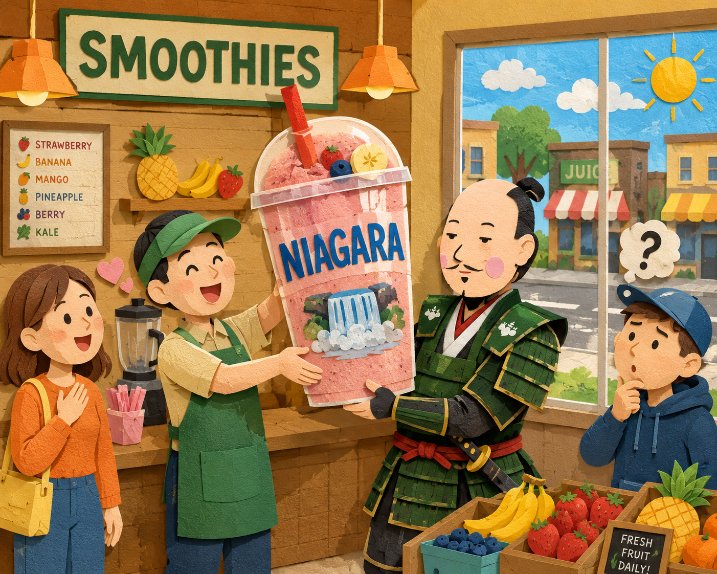
The blender drowned out the world. Above it, the boy asked for a name to write on the cup.
I gave him the one that has outlasted empires.
"Nobunaga."
He nodded, wrote, and set the cup on the line with a shout:
"NIAGARA!"
A waterfall. He had heard the name of a man who burned temples, and written down a honeymoon destination.
(For one breath, eight hundred years went over the edge with it.)
I let it stand. His face was far too pleased to wound.
"Yes," I said. "Niagara."
And if I was to be named for a waterfall, then I would do what waterfalls do. I would give everything, and keep none of it.
Be like the falls: pour out all you have, hold nothing back, and ask for none of it in return.
So I carried my smoothie like a man entrusted with a river. I wiped a spill before a toddler could slip in it. I righted the napkin tower an old man had knocked askew. When a teenager came up a dollar short and went red to the ears, I covered it before the line could notice, and told her, gravely, that the House of Niagara does not let small droughts go unanswered.
She laughed. She had no idea what I meant. Neither, in full, did I.
A woman watched me return three carts and bow to the door on my way out.
"Sir — are you alright?"
"I have never been better," I said. And it was true. It is a fine thing to have a name to live up to.
At the threshold I raised my cup to the little shop and said, with the weight of a man who has stood beneath real waterfalls:
"A name falls on you from above. All that matters is whether you catch it with both hands."
The boy behind the counter grinned. "...come back soon, Niagara."
I will.
You cannot choose what they pour on you. Only how you carry the water.
Look, he was a brutal dictator. His elections were a farce, and he brutally cracked down on anyone who opposed him.
I was excited to see him taken down. It's an objectively good thing that he's no longer in power.
The problem is, whenever we do this kind of regime change, the puppet government we replace him with proves powerless (or unwilling) to stop the rise of terrorists and criminals that truly take over the country.
Chaos and destabilization ensue, which often leads to people fleeing to the US and other countries as refugees in even greater numbers.
Over time, we discover that the reasons we were told that removing him was necessary were exaggerations and outright lies, and that the real reasons had more to do with access to oil, toppling a government that wasn't part of the petrodollar system, and expanding global domination.
We also discover that our own intelligence and enforcement agencies helped give rise to the terrorists and criminals who took over on the streets. Blowback from that in the future is all but assured.
If we put boots on the ground, we're now risking the lives of our loved ones, not to mention all the innocent civilians who will die. All over something we should've never stuck our noses into.
The American taxpayer gets stuck with the bill, and the only people who truly benefit are oil companies, defense contractors, and central bankers.
And that's why I was wrong to support the overthrow of Saddam Hussein in 2003.
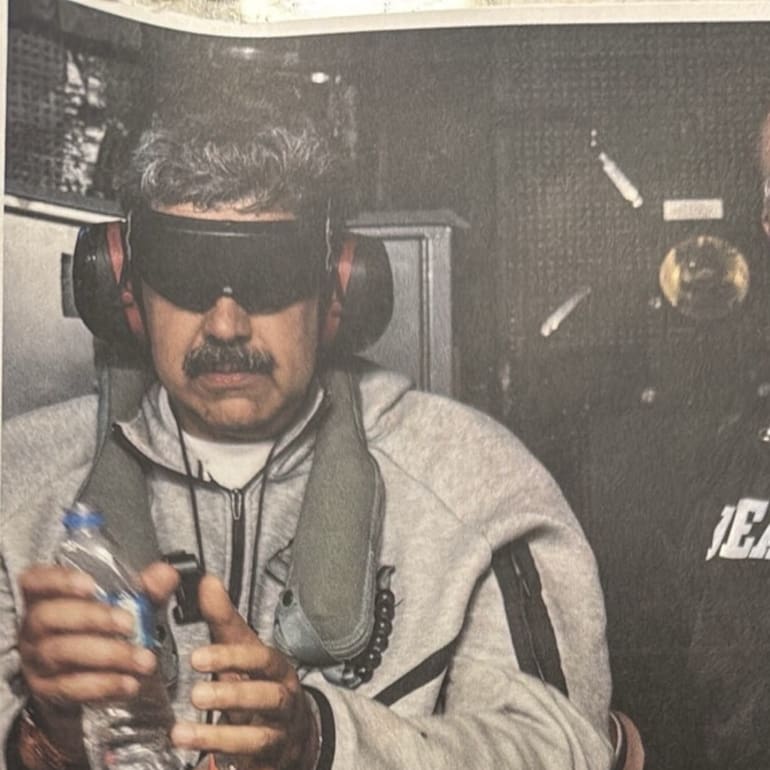
Picture unrelated.
@wokesocieties@ComicDaveSmith Sometimes other countries don't respond to provocations, so it doesn't escalate. Do we want world peace to depend on countries like Iran taking the high road every time while we attack them?
No it's sad for me that we live in a lawless world that is ruled by tyrants.
It's sad for me that we are ruled by chaotic despots who can invade a sovereign nation and abduct its leader and suffer no consequences.
It's sad for me that the people with their hands on the steering wheel of the fate of our species are a bunch of sociopathic thugs who can smash and rob any country they please with total impunity.
It's sad to me that our planet's population is subject to the whims of a globe-spanning empire which topples governments, wages wars, sponsors genocides, targets civilians with starvation sanctions, backs proxy conflicts, drops bombs, brainwashes entire nations with propaganda, uses its military and economic might to bully and cajole states into bowing to its dictates, and sows suffering, destruction and death around the world every moment of every day.
It's sad for me that these are the people who are making the decisions which will determine humanity's path into the future. The future of our society. The future of our planet's resources. The future of our technological innovation. The future of our ecosystem. The future of our militaries. The future of our nuclear weapons.
That is what is sad for me. I have no special emotional attachment to Maduro as an individual, but I do have a strong emotional attachment to the possibility of a healthy world emerging in the future.
And as things stand right now it's looking pretty dark.
I find that sad.