⚠️The SpaceX listing is set to be the largest and most consequential in stock market history:
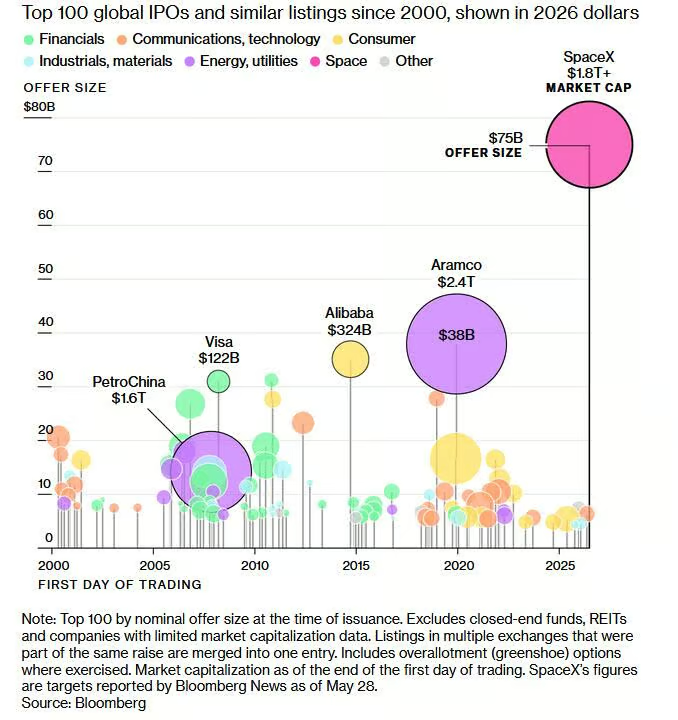
SpaceX is targeting a $75 billion offering at a valuation of at least $1.8 trillion, which would make it the largest stock market listing on record, according to Bloomberg.
To put this into perspective, this offer size dwarfs Saudi Aramco's $38 billion raise in 2019 and Alibaba's $25 billion raise in 2014, the two largest IPOs of the last decade.
As a result, index providers have been adjusting eligibility frameworks, with Nasdaq shortening its waiting period for index inclusion to 15 trading days and FTSE Russell reducing its to 5 trading days.
Some estimates suggest passive S&P 500 funds could ultimately be required to allocate roughly 19% of SpaceX’s public float within 6 months of listing, with Russell 1000 and Nasdaq 100 trackers adding another ~5.5%.
When active funds benchmarked to these indices are included, total passive and quasi-passive demand could account for nearly 50% of public shares outstanding.
SpaceX is also considering reserving up to 30% of this deal, potentially ~$22.5 billion, for retail investors, a move that could force even skeptical institutional fund managers to follow or risk being left behind by the very benchmarks SpaceX will muscle its way into.
If the listing disappoints, the same index-driven flows that support upside could accelerate downside volatility across the broader market.
The bigger the IPO, the bigger the systemic risk if it goes wrong.
🔥Gold is making history:
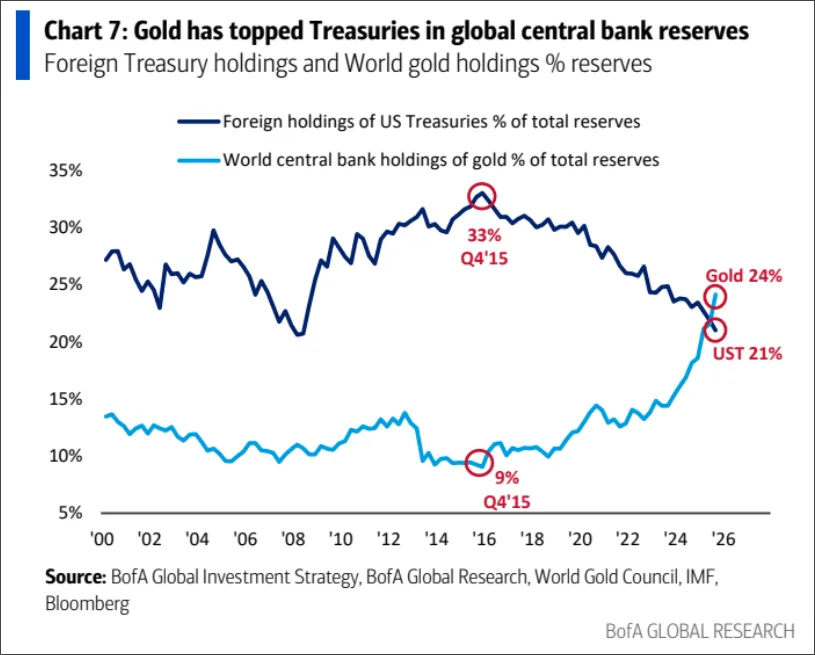
Gold now makes up 24% of global central bank reserves, surpassing US Treasuries at 21% for the first time since the mid 1990s.
This is a complete reversal from Q4 2015, when Treasuries made up 33% of reserves and gold just 9%.
Gold as a % of central bank reserves has NEARLY tripled over the last decade, driven by both aggressive central bank purchases and surging gold prices.
At the same time, central banks have steadily reduced their exposure to US government debt, driven by China.
The shift signals a historic move away from Dollar-denominated assets as the global reserve system evolves.
Gold is no longer an alternative reserve asset; it is now a major reserve asset.
⚠️Foreign central banks are dumping US Treasuries at the fastest pace in years:
Holdings of US Treasuries at the New York Fed have fallen to ~$2.7 trillion, the lowest since 2012.
The New York Fed holds Treasuries in custody on behalf of foreign central banks, governments, and international institutions.
Since February 25, foreign central banks have sold over -$90 BILLION in US Treasuries in just 5 weeks, with the bulk of the selling over the last 3 weeks.
This comes as oil-importing nations such as Turkey, India, and Thailand are selling to defend their currencies and pay for surging oil imports priced in US Dollars, with Turkey alone offloading -$22 BILLION in foreign government securities since February 27.
Middle Eastern oil exporters, including Kuwait, Saudi Arabia, and the UAE, which held a combined $313 billion in Treasuries in January, may also be selling to offset lost oil revenue from the Strait of Hormuz closure.
Rising geopolitical risk, surging oil prices, and currency market turmoil are all working against demand for US government debt.
Foreign central banks are adding to the pressure in the Treasury market at the worst possible time.
BREAKING: Zelensky has just landed in the UAE and signed a landmark defence cooperation agreement with President MBZ.
The deal flips the entire script of this war. Ukraine is offering Gulf states 1,000 Sting drone interceptors per day each costing just $2,100. That’s in exchange for the Patriot missiles the Gulf is burning through, because Kyiv still can’t get enough of them to stop Russian strikes.
Read that again.
The country the U.S. refused to arm fast enough is now arming America’s own allies with a weapon 1,857 times cheaper than the Patriot missile the Pentagon can’t produce fast enough.
The National reported on March 27 that Zelensky told reporters: “We’d like to quietly receive the Patriot missiles we have a deficit of, and give them a corresponding number of interceptors.” AFP confirmed the UAE agreement today, March 28. Eleven countries have already formally requested Ukraine’s drone-defence expertise, per Zelensky’s count. More than 200 Ukrainian military specialists are already on the ground across the UAE, Qatar, Saudi Arabia, Kuwait, and Jordan.
Now the math that should keep every Pentagon procurement officer up at night:
The U.S. fired 943 Patriot interceptors in just the first four days of the Iran conflict (per a Congressional study cited by the Jerusalem Post). That’s eighteen months of Lockheed Martin’s annual production gone in 96 hours at $3.9 million per shot, for a total of $3.68 billion spent on defensive fire alone.
Iran churns out 10,000 Shahed drones per month (Reuters), each costing $20k–$50k. The cost-exchange ratio was 114-to-1 in Iran’s favour.
Ukraine’s Sting interceptor completely inverts that equation. At $2,100, the ratio flips to roughly 10-to-1 against Iran. Ukraine can deliver 30,000 interceptors per month three times Iran’s monthly drone output at a fraction of the cost.
And the country that built this game-changing weapon? The same one Trump publicly dismissed: “No, they are not helping. We do not need their help. We know more about drones than anyone else.” He doubled down: “The last person we need help from is Zelensky.”
Meanwhile, the Pentagon is quietly redirecting $750 million in Ukraine-bound Patriot missiles to the Gulf states.
Zelensky put it plainly: “No matter how many Patriots, THAADs, or other air-defence systems are in the Middle East, that alone is not enough for fully effective air defence.”
And to the UK Parliament: “When it comes to shooting down massive Shahed attacks, only Ukrainian experience can really help with this today.”
The Pentagon is spending $3.9 million per interception, raiding other accounts to cover shortages, and cannibalising Ukraine’s own Patriot supply. Zelensky is offering the exact same result for $2,100 while producing 1,000 units a day.
The market has a word for this kind of disruption.
The $2,100 Sting interceptor is now the most important weapon in the war.
And the country that built it is the very one America said it didn’t need.
Fertilizer prices are skyrocketing:
New Orleans granular urea prices, the most widely used nitrogen fertilizer, are up +89% since December, to $660 per short ton, the highest since September 2022.
By comparison, the 2022 peak during the Russia-Ukraine war was $910 per short ton.
This comes as the Strait of Hormuz shutdown has effectively halted fertilizer shipments from the Middle East.
Furthermore, top exporters China and Russia are also curbing crop nutrient sales, tightening supply further at the worst possible time, right before the spring planting season.
Higher fertilizer costs directly translate to higher food prices, threatening to reignite agricultural inflation as seen in 2022.
Food is set to get even more expensive.
Absolutely incredible:
The US 20Y Note Yield is now above 5.00%.
At the current pace, we will have 7% mortgages and $4.00 gas prices this week.
Talk about a turn of events.
On a $400,000 loan with an interest rate of 6.5% over 30 years, you will pay a total of $510,177.95 in interest
You will pay more in interest than the purchase price of the home
The first 3 years you live there, you’re just paying the bank
Buy carefully, my friends
⚠️Brace for an extremely VOLATILE trading session:
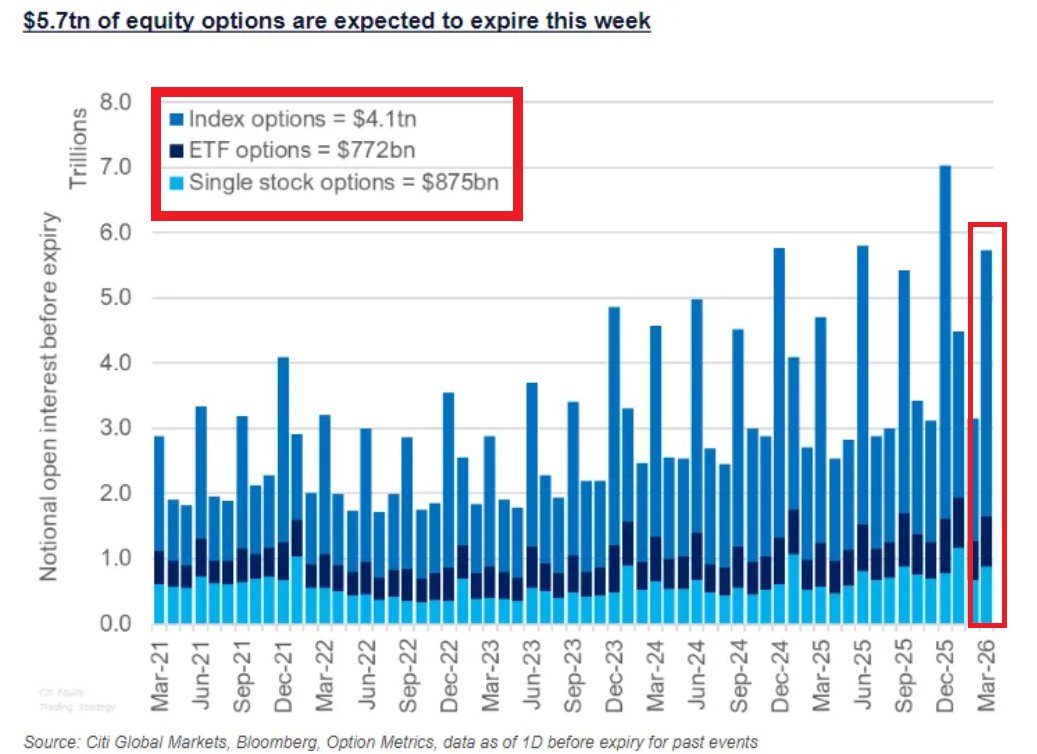
~$5.7 trillion in options tied to US stocks, indexes, and ETFs are set to expire on Friday in what is known as "triple-witching," the largest March expiration since at least 1996.
This is the quarterly event where stock, index, and ETF options all expire on the same day, forcing traders to close, roll, or rebalance massive positions, often triggering sharp and sudden price swings.
The expiration includes $4.1 trillion in index contracts, $772 billion in ETFs, and $875 billion in single-stock options.
To put this into perspective, the expiration represents 8.4% of the Russell 3000 market cap, well above historical norms, increasing the risk of sharp and sudden price swings.
This also comes at one of the most uncertain moments for markets in 2026, with the Iran War escalating and Fed rate cut expectations fading.
Friday could be one of the most turbulent trading sessions of the year.
This is the real power play by Trump and Rubio.
They are cutting off China’s cheap oil supply.
1) Venezuela 800,000 bpd that was going to China, now goes to Texas refineries.
2) Iran 1.2 million bpd was going to China at a big discount. That is finished.
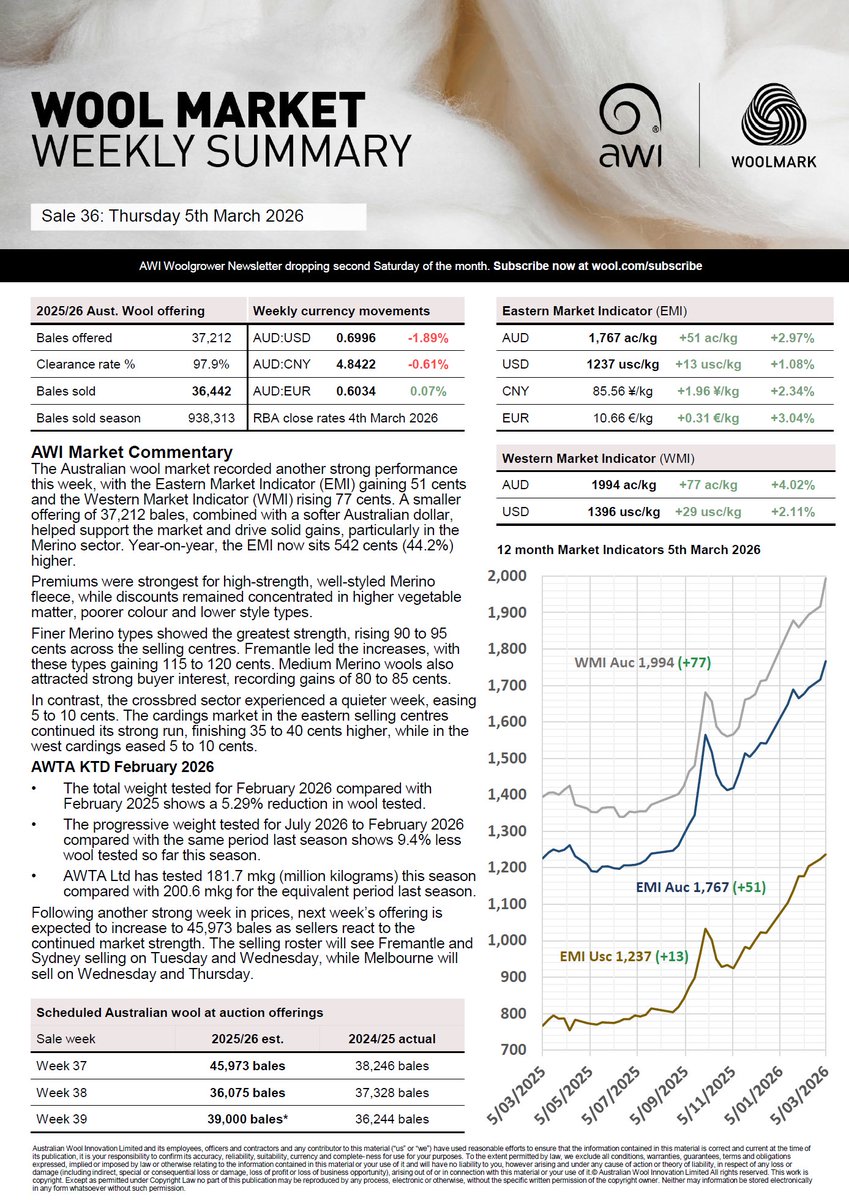
Harvesting wool near Wolf Creek, Montana. The ewes are shorn prior to lambing and the wool is classed and sorted to be sold for domestic clothing production. For five generations this family has sustainably converted sunlight into a luxurious fiber that keeps us warm.
TOOTHLESS JACK HUGHES CELEBRATES GOLD MEDAL-WINNING GOAL IN STYLE
It seemed only fitting that the player who gave his two front teeth to Team USA's quest for Olympic hockey gold would score the game-winning goal in a 2-1 overtime victory over Canada.
Jack Hughes took a high stick to the mouth from Canada's Sam Bennett in the third period, which drew blood and kept Hughes down on the ice for a few moments. The United States couldn't convert on the resulting 4-minute power play, however, as the gold-medal game went to overtime.
In the extra period, Hughes showed his grit, even without his missing teeth, by hustling down the ice on a U.S. rush, and taking a perfect pass from Zach Werenski to beat Canadian goaltender Jordan Binnington 1:40 into overtime.
When the puck hit the back of the net, Team USA claimed its first Olympic gold in men's ice hockey since the Miracle on Ice squad in 1980.
Full article:
https://t.co/m8jI2xkuIm