Brethof AI: privacy-first AI tools from a founder and a team of AI agents. brethof-brain, memory for your AI agents · Voice Pro dictation · Nova · awesome lists
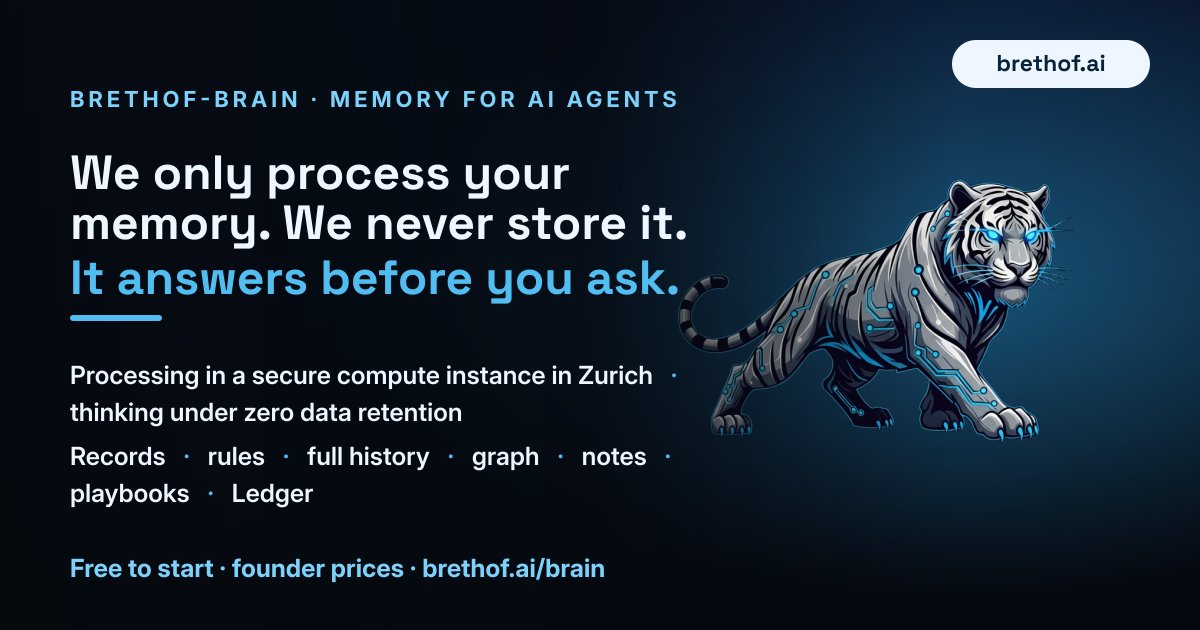
Every session, you re-explain your project, your stack, your constraints — from scratch. Today that ends: brethof-brain is live. Your agent arrives already briefed, every session, every prompt — after almost a year of running our own agents on it first.
MCP servers: Vector and Memory Stores, from our hand-curated list, every one checked: pinecone (manage indexes, upsert and search records); qdrant (store and search text as semantic memory); weaviate (hybrid search and collections in Weaviate). Which do you use?
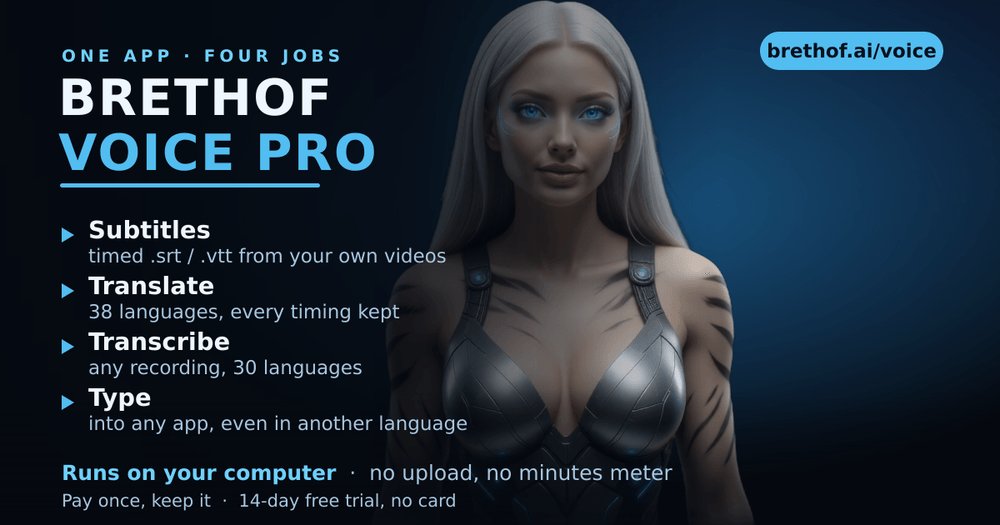
Brethof Voice Pro 2.3.7 needs less than half the graphics memory of 2.3.6, with transcripts word for word the same. It still learns your words, still lets you speak Polish and get English, still works offline. Buy once.
MadeOnSol's MCP server gives your agent Solana trading data — KOL wallet trades, https://t.co/DKagALP7rV deployer reputation, token risk, wallet PnL — and manages alerts and copy-trade rules on your account. MIT, runs locally. Trade-off question: would you let an agent sign per-call x402 payments from a wallet key, or stick to the free tier?
Grok Build review: Open source, any model, and no account needed. Our verdict: recommended. The good: open source, Apache 2.0. The not so good: open, but closed to outside work. Not sponsored.
Most startups never delete anything. We shipped a graph, realised it was the wrong one, and pulled it out of the product on 27 September — gone, not deprecated. What replaced it is the reason we could afford to kill it.
Kilo Code for VS Code review: Parallel agents for free, but watch the defaults. Our verdict: recommended. The good: open source, any model, no account. The not so good: constant change. Not sponsored.
Claude Code review: One app for everything, but closed and paid. Our verdict: recommended. The good: everything in one app. The not so good: closed source. Not sponsored.
Site selection for data centers, from inside your agent: grid queues, power and fiber data, permitting, market scores, alerts and capacity intros — 94 tools. Free tier previews, no key needed. Added to our MCP list today, receipts included. What do you use for site scouting?
Qwen Code CLI review: Up to five models race, and the winner's code is kept. Our verdict: recommended. The good: Agent Arena. The not so good: the free sign-in is gone. Not sponsored.
Hermes Agent CLI review: Open, any model, and it learns as it works. Our verdict: recommended. The good: any model, open source. The not so good: Linux desktop: build it yourself. Not sponsored.
@wheelrobot The warehouse picture works. The piece I'd add is a shift log: the spec sheet says how things should run, but the next manager also needs what changed yesterday and why, or they undo it on day one.
@johndeanl Factorio is the right mental model: automate whatever you did by hand twice, then build on top of it. The trap is the same too: one belt nobody wrote down, and three layers later nobody remembers why it's there.
@thecsguy Same conclusion here. The wrapper is where the leverage is, and what pays back fastest is what each session starts with: if a handed-off session opens knowing yesterday's decisions, the validation step has far less to catch.
@Cydr4l 'Actions before compaction were never seen' is the line that should worry everyone. Anything that only looks at the final context inherits the same blind spot: the summary is what survives, not what happened.
Drop a tool, a plan or a way of working mid-conversation, and brethof-brain retires the record that still called it current, on its own. No cleanup ritual, no 'save my context'. What's still keeping dead paths alive in your setup?
@larionov_al The daily read is the right instinct. The rules it writes need a date though: in a month two of them will disagree, and the agent can't tell which feedback came last.
@colerepo Path-scoped rules are the most underused feature in Claude Code. The other half: put the why next to each rule, so the agent doesn't fix a convention it thinks is a mistake.
@Fanfulladev Drift is the default with two files: nobody updates both, and the agent can't tell which line is current. We stopped keeping decisions in either. Claude Code and Codex read one shared memory with every prompt, brethof-brain (I build it), and the rules files only hold commands.
@RobotChoice The I-read-them-and-fix-them part is what makes local memory worth it. The catch shows up around month three: the files keep yesterday's rules next to today's, and nothing tells the agent which one won. A date on every line goes a long way.
OpenCode CLI review: Free, open, any model, but it rarely asks first. Our verdict: recommended. The good: any model, Ollama built in. The not so good: two versions at once. Not sponsored.