A group of Islamic philosophers committed to support mystical, philosophical, and historically grounded Islam and engage in informed interfaith discussions.
Brethren of Purity:
We're a collective of followers of various schools of Islamic Philosophy and Mysticism. We've all joined together for one common purpose - to promote The Eternal Wisdom (Hikmah) and to counter a destructive force that is overtaking Islam - Wahabism/Salafism...
The irony of naïve empirical presupposition is that those who engage in it are usually those who have done nothing for the scientific pursuit, whereas there are clearly many rationalist scientists and mathematicians.
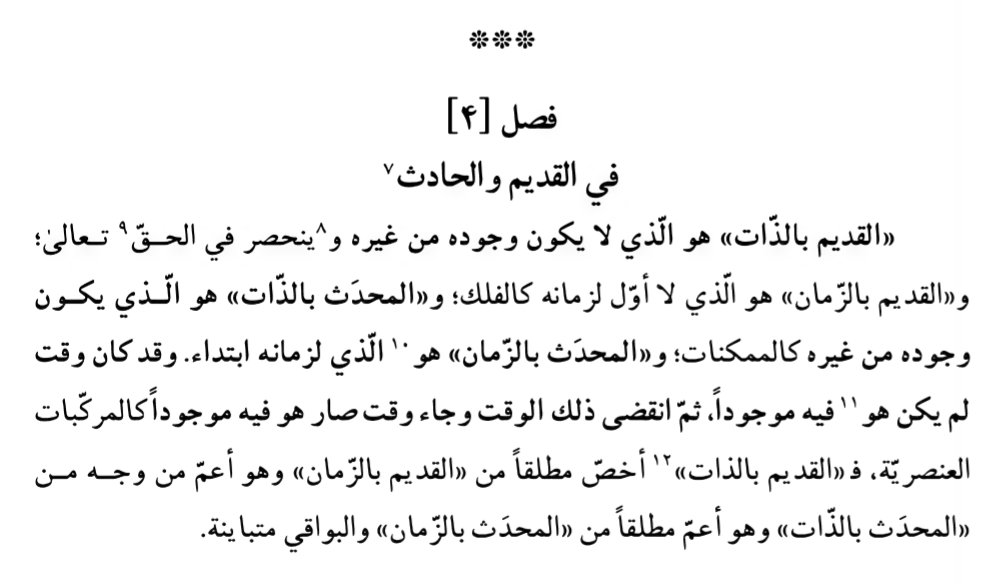
The distinction between Ḥudūth bi-l-Zamān and bi-l-Dhāt was almost universally received in the post-classical tradition based on the initial Avicennian distinction. Here is a section from Maybudi's commentary, for example.
@patronofsatan@al_Sadrai There's no argument for authority. Argument authority is when it is said that something is true IN VIRTUE of being said by the authority. That's not what's being said. The argument is being provided. You're free to discuss it when the discussion begins.
@patronofsatan@al_Sadrai First of all, we're not Dawah Bros. Secondly, we can because no matter how infinite the set is, it wouldn't automatically develop the quality of self-subsistence without a part grounding it.
@OsamaChaudharry That's the fundamental problem. Rationalism doesn't deny the value of empirical knowledge and can further appeal to intuitionist accounts, whereas it is empiricism that is limiting the field of knowledge and has no exact further justification for that.
Empiricism itself is a philosophical dogma. It doesn't matter how many people believe in it. That would not make it rationally or philosophically justified.
@hashurtag BTW, very dated kind of discussions. World has really changed, new binaries have emerged, and empiricism has reduced space of speculation. But these people are still discussing something which is largely irrelevant.
@OsamaChaudharry Yes, but that would still amount to the evasion of the justification, because the same question could be asked by an agonistic with respect to the question itself. Asking for justification is not a uniquely rationalist thing.
@OsamaChaudharry One is contingent upon the other, because even empirical argumentation, at its very base, requires a rationalist basis. So the question stands: what is the justification for empiricism? If the mere act of asking justification is rationalist, then sure.