To the Americans:
I've travelled all over the world. I've familiarized myself with many places, and met many people. And I'm a Canadian, although I’m privileged to reside once again in the States.
And here's something I've noticed, and it’s a key element of America's continuing greatness:
You bloody Americans value success, and you believe in its existence.
This is something that doesn't really happen anywhere else in the world. Even in other free democracies—the United Kingdom; Finland, Sweden, and Norway; Australia, New Zealand and Canada; Germany, France, and the Netherlands (great countries all)—a counterproductive cynicism too often reigns.
Success is equated with exploitation.
Ambition is looked upon with contempt.
This happens sometimes in the United States too—particularly among the miserable progressives, who confuse their resentment, ingratitude and unearned skepticism with wisdom.
But in your great country, by and large, striving is admired and success celebrated.
This means that more people strive and succeed in the US than anywhere else. And it's increasingly obvious. You remain stunningly more innovative and productive than any people anywhere else on the planet.
And so I say, as all should who are fortunate enough to live in the western world, let alone America:
Thank God for the United States.
Thank God for the wisdom of its founders.
Thank God for its faith in the free market and in the natural rights of man.
Happy birthday, you damn Yankees and Southerners.
Long may your admirable country dominate the world.
Long may your freedom and hope provide an example to those suffering everywhere at the hands of their malevolent states.
May your two and a half centuries of unparallelled success be just the beginning.
Your country is the light of the world, and the city on the hill.
Thank God for the USA.
Happy 250th.
Dr. Jordan B. Peterson
I hadn’t read the Declaration of Independence since high school history class. Ah, yes, history class! In fact we had American history throughout the tenth grade, then world history during our junior year. When I listen to the TikTok crowd spew the nonsense they champion today, I think how easily their knuckle-headed thinking could have been cured with a few good history classes. Alas, I don’t see much hope for the future, as long as the teachers in our urban areas are in the clutches of politicians and unions with a far different agenda from real education.
Now rereading the document for the first time in decades (shame on me for taking so long), I had forgotten that the bulk of the text is a list of grievances suffered by the American colonists at the hands of the king and various elements under his tyrannical regime. What has truly stunned me these 250 years later, however, is how familiar these grievances feel in our contemporary situation. Let’s take a peek at the exact text, and see if anything feels uncomfortably close to home (the “He” refers to King George, of course, and I will use the original spelling and punctuation):
“He has refused to Assent to Laws”
Hmm, every “sanctuary state” governor today for starters…
“He has made Judges dependent of his Will alone”
Hmm, activist judges anybody?
“He has erected a multitude of New Offices, and sent hither swarms of Officers to harass our people”
Hmm, 87,000 new armed IRS agents. Ring a bell?
“For imposing Taxes on us without our Consent”
Hmm, ever looked at your tax bill?
“…transporting large Armies of foreign Mercenaries to compleat the works of death, desolation and tyranny…”
Hmm, thirty million military-age males pouring across our open borders from 2020 to 2024…
“He has excited domestic insurrections amongst us”
Hmm, BLM and Antifa riots…
SHORT VERSION: LEAVE US ALONE!
The very essence of the Declaration of Independence is a concerted celebration of God’s gift of our “unalienable” right to “Life, Liberty, and the pursuit of Happiness.” It was argued, researched, debated yet again, drafted by Jefferson, then edited by Adams, Franklin, and others. Together the bravest men stood together against the storm of tyranny and gambled it all. As I reread it today, I literally shed tears at those miraculous words:
“And for the support of this Declaration, with a firm reliance on the protection of Divine Providence, we mutually pledge to each other our Lives, our Fortune and our sacred Honor.”
And then, of course, there were those who shed more than tears. They shed their blood, watched their homes burn, and too many gave the ultimate sacrifice. Whether they formed local militias or joined the Continental Army, colonists now dedicated to the cause, gambled their very lives. One of those Americans was my ninth generation ancestor. He fought in one of the most consequential battles of the American Revolution, the Battle of Cowpens. I am forever honored that his blood runs in my veins.
I know that this will be a joyful and glorious weekend for all of you, God willing. It should also be, if I may presume to say, a solemn one as well. The sacrifices made by simple men and women those many years ago have made these precious rights and this glorious day possible. Take a moment and honor them in your heart. I know I will.
In September of 1814, America was once again in trouble.
The young republic was only thirty-eight years old. The War of 1812 had gone badly. British troops had marched into Washington, burned the Capitol, set the White House ablaze, and now turned their sights toward Baltimore. If Fort McHenry fell, the harbor would be open, the city would likely follow, and another devastating blow would be dealt to the fragile nation.
Amid this uncertainty, a young American lawyer named Francis Scott Key sailed under a flag of truce to the British fleet. He had come to negotiate the release of a friend, a physician the British had captured.
He succeeded.
The British agreed to free the doctor.
But there was a catch.
Because Key and his companions had seen too much of the British fleet and learned too much about its plans, they were not allowed to return to shore. Instead, they were detained aboard a ship in the harbor and forced to watch the coming battle from behind enemy lines.
On the morning of September 13, the bombardment began.
For the next twenty-five hours, British warships unleashed somewhere between 1,500 and 1,800 bombs and rockets upon Fort McHenry. These were the “bombs bursting in air” and the “rockets’ red glare” of the song—not poetic embellishments, but terrible realities.
Key stood on the deck through the endless day and the long, terrifying night. Every explosion lit the darkness for a fleeting instant before the smoke swallowed everything again. Somewhere beyond that wall of fire stood the fort. Somewhere beyond it flew an American flag if it still flew at all.
He could not see.
He could only listen.
As long as the guns continued firing, there was reason to hope. The British would not waste ammunition on a fort that had already surrendered.
Then, just before dawn…
The guns fell silent.
For the first time all night, there was only stillness.
It was the most frightening sound of all.
Had the fort finally fallen? Had the defenders surrendered? Had the flag been torn down in the darkness while no one could see?
There was nothing to do but wait.
As the first light of September 14 slowly pushed back the smoke, Francis Scott Key strained his eyes toward the distant fort.
Then he saw it. Not a British flag.
The American flag. Still there. Still flying.
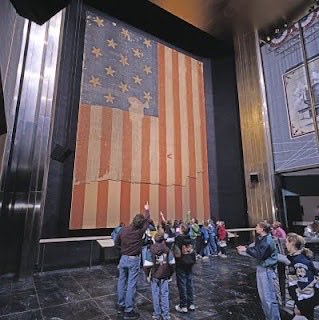
That flag was no ordinary banner. Months earlier, the fort’s commander had commissioned a Baltimore flagmaker, Mary Pickersgill, to sew a flag so enormous “that the British would have no difficulty seeing it from a distance.” It measured roughly thirty by forty-two feet, carried fifteen stars and fifteen stripes, and was so large it had to be assembled on the floor of a brewery because no ordinary room could contain it.
That was the Star-Spangled Banner.
The very flag Key saw through the morning mist.
The very flag that still survives today in the Smithsonian.
Overcome by what he had witnessed, Key reached into his pocket, pulled out an envelope, and began writing. The words came from a heart that had spent an entire night fearing his country might disappear with the dawn.
He first titled the poem Defence of Fort M’Henry.
Within days it was printed and circulating throughout the country. Before long, people began singing it to a melody they already knew—an old British tune called “To Anacreon in Heaven,” originally written for a London social club. There is something beautifully ironic in that: America’s most beloved patriotic song borrowed the melody of the very nation it had just survived. It also explains why the anthem is so notoriously difficult to sing. It was never written for ordinary voices gathered in stadiums or school assemblies.
The song spread quickly and became one of America’s favorite patriotic hymns, but it would wait more than a century before receiving official recognition. Not until 1931 did Congress declare “The Star-Spangled Banner” the national anthem of the United States.
Possibly Trump’s greatest speech yet:
“You can be loyal to Karl Marx, or you can be loyal to America. You can be a Communist, or you can be a Patriot. You cannot be both.”
Inject this into me veins!
I’m granting nepo baby @TuckerCarlson permission to publish the text messages he claims to have stating that I told him “President Trump shut down the investigation into Butler.”
Those were his words, and he should show he has a pair of balls and publish them.
Spoiler alert 🚨:
He won’t. Because they don’t exist. I’ve already shown you the messages which say the opposite. I’m really sorry if you’re still dumb enough to fall for this Times Square “Rolex” salesman’s act.
The editors of the world's most prestigious medical journals are sounding the alarm, and nobody is listening.
"We have peer reviewed, high impact editors in most of the journals that are the most high impact, saying that they don't believe what is being published in those journals is trustworthy anymore."
"The BMJ, The Lancet, all of those editors have come out and said, we have a huge problem. We can't replicate this research and we actually don't even know who did the research."
"Everywhere we've looked for corruption, we've found it."
Emily Kaplan, co-founder of the Broken Science Initiative.
@broken_science
New York: it's hot out there, and the power grid is working overtime to keep us cool.
Set your AC to 78 degrees, turn off lights/electronics you're not using, and unplug what you can.
Our City is doing its part too: maintaining the 78 degrees rule in our buildings, dimming/turning off our lights during peak electricity demand, asking private partners to do the same, and powering down non-essential equipment.
A stable grid means the AC stays on, and lives are saved. Let's ease demand — and get through the heat — together.
Like many others, I have been alarmed by the success of certain politicians in our country who identify as extreme socialists or communists.
This is not a matter of classical liberals triumphing over standard-issue conservatives; this is the victory of people who stand athwart the fundamental principles that undergird our country.
There are many reasons why I detest Communism, but I want to draw attention to just one issue of supreme importance.
Karl Marx said that the first critique is the critique of religion. He meant that, before a complete re-working of the politics and economics of a society can take place, religion has to be taken down.
This is because religion, as he saw it, is the “opium of the masses,” a drug taken to dull our sensitivity to the suffering caused by economic exploitation. As long as the suffering populace is lured into complacency by fantasies about God's providence and the promise of eternal life, they will never rise up and throw off their chains.
But there is a second reason why the elimination of religion is of paramount significance for Marx.
Communism aspires to be a totalizing system, involving the government's control over education, entertainment, communication, politics, and especially economics.
What stands resolutely athwart this ambition is religion, which declares that all of these societal expressions are finally under the judgment of God. So, if you want Communism to succeed, religion has to be stamped out.
If you doubt me on any of this, I would encourage you to read the recent histories of China, Russia, Cuba, Nicaragua, Vietnam, Cambodia, and Venezuela. Revisit those histories and tell me I'm wrong about the attack on religion.
Might I encourage my fellow believers in God not to be complacent in the face of this very troubling development in the American body politic?