We seeded 2m canaries into popular AI services and tracked where they were stolen and abused.
This identified:
- Three compromised providers
- Resellers stealing prompts via built-in logging
- Providers ignoring ZDR & privacy flags
https://t.co/ySVOzX8SUd
You can't make everyone happy with vulnerability disclosure.
Disclose before every distro has a patch, and you're irresponsible. Wait longer, and you're accused of leaving defenders in the dark, without enough time to prepare for the storm.
Release a PoC that doesn't reliably work in real-world environments, and people call it overhyped. Release the fully weaponized, reliable exploit we actually have, and those same people would probably call us reckless.
I get it. There's no perfect answer.
But here's where we stand.
We care deeply about the security industry and the ecosystem we're part of. We want to push the boundaries of what's possible, contribute meaningful research, and do it responsibly.
And let's be clear about something else.
Of course we want recognition for the work we do. Of course we want the biggest and most respected VCs in the world to invest in us. Of course we want the biggest companies in the world as our customers.
We're building a company. We're ambitious. We're not going to pretend otherwise.
And none of that happens if nobody knows who we are or what we're capable of. So yes, we're going to make some noise. We're going to talk about our work, celebrate our achievements, and take every opportunity to show the world what we're building.
Of course we're going to market the hell out of genuinely cool work. Why wouldn't we?
And yes, we're really fucking good at computers.
But there's a line between promoting your work and putting the community at risk for publicity. We have no intention of crossing it.
That's why we make deliberate choices about what we disclose and what we don't.
We choose to disclose our findings once the official announcement is made. Why? Because at that point, capable threat actors already have enough information to start developing working exploits, with or without our disclosure. Especially in the age of AI. Keeping our findings to ourselves doesn't stop them. It just leaves defenders with less information.
At the same time, we deliberately choose NOT to release our most advanced, weaponized exploits. We have exploits that work reliably in real-world conditions, even with unpredictable network traffic and other interference. Building that level of reliability still requires expertise that your average "prompt hacker" can't simply replicate overnight.
Releasing those exploits would meaningfully lower the barrier to exploitation and potentially cause real damage. We're not going to do that just to prove a point, get more attention, or win some internet arguments.
These aren't arbitrary decisions. They're deliberate tradeoffs between transparency, helping defenders, and not handing attackers capabilities they otherwise wouldn't have.
I know some people will disagree. And that's fine. We can't satisfy everyone, but I genuinely believe we're making the right calls.
We want to build a wildly successful company. We want recognition. We want to win. And we want to do all of that while making the security ecosystem better, not worse.
Those things aren't mutually exclusive.
One last thing.
Wake up. We're not living in the same world anymore.
AI has fundamentally changed the speed and economics of vulnerability discovery and exploitation. The assumptions we've relied on for years are becoming obsolete. The old timelines don't work anymore.
We all need to adapt.
Just like any real hacker would.
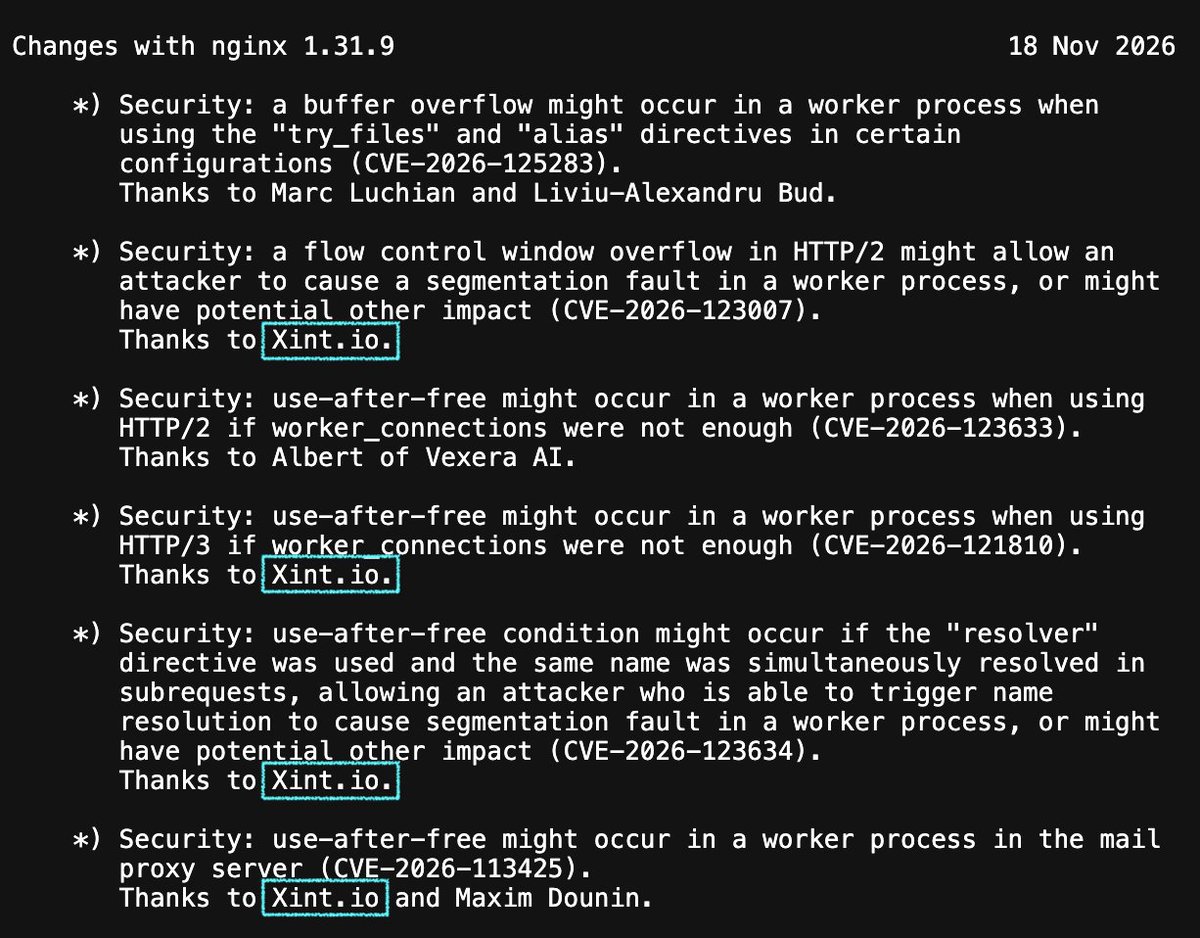
Btw, I'm pretty sure we were the first and original reporters to these vulns (except for maybe 123633), given the CHANGELOG and the response we got from F5.
--
We're tracking all five CVE for disclosure on November 18 OOBSN @ 7:00 am Pacific, and https://t.co/2vobJkV7pE is acknowledged in all of them.
CVE-2026-121810 - CVSS 3.1 - 8.1 / HIGH, CVSS 4.0 - 9.2 / CRITICAL
CVE-2026-123634 - CVSS 3.1 - 8.1 / HIGH, CVSS 4.0 - 9.2 / CRITICAL
CVE-2026-113425 - CVSS 3.1 - 8.1 / HIGH, CVSS 4.0 - 9.2 / CRITICAL
CVE-2026-123007 - CVSS 3.1 - 8.1 / HIGH, CVSS 4.0 - 9.2 / CRITICAL
CVE-2026-123633 - CVSS 3.1 - 8.1 / HIGH, CVSS 4.0 - 9.2 / CRITICAL
🚨BREAKING🚨 AI has generated a "holy grail" hack on another core piece of internet infrastructure.
Using OpenAI models, Darpa-contracted hackers Xint found five weaknesses in the NGINX server software.
The most serious affects up to 11.8m sites.
https://t.co/WDMBcCEy7I
Pre-auth RCE in nginx is the bug every hacker dreams of finding. It almost never happens.
Today we’re disclosing nginx2root: five nginx vulnerabilities, and an exploit that takes an unauthenticated attacker all the way to root.
One of themhits the default config.
If you run nginx, patch now. Then read: https://t.co/rDQQAimLZP
CVE-2026-123007, CVE-2026-123634, CVE-2026-123633, CVE-2026-121810, CVE-2026-113425
🚨 Critical nginx vulnerabilities disclosed. Immediate action recommended.
If you run nginx, check whether your servers are affected and update to the patched version immediately. If you cannot upgrade, follow the mitigation guidance at https://t.co/ry2F1UMUVk
Today we’re disclosing nginx2root, five distinct vulnerabilities in one of the world’s most widely deployed web servers, each capable of unauthenticated remote code execution under affected conditions. One of these vulnerabilities affects nginx’s most common configuration. We’ve also demonstrated a fully remote, unauthenticated exploit chain that escalates from nginx RCE to root access on the underlying server, using a separate Linux kernel vulnerability.
Why this is so important:
One of these bugs has been hiding in nginx’s HTTP/2 implementation since 2015. That’s more than a decade in software that powers roughly a third of the web. Every official release from 1.9.5 through 1.31.8 contains the vulnerable code, including the master branch as of Nov 10, 2026.
A Xint researcher found the specific vuln that hits nginx in its default config. This discovery was around the same time he found another critical vulnerability in a different project that we cannot talk about yet due to the same concerns as nginx2root. We took those learnings and incorporated them into the harness as a new, general Xint feature (that is, not fine-tuned to nginx), which then found the other 4 critical nginx vulnerabilities with no human guidance.
We coordinated disclosure with the nginx maintainers and major cloud providers to help make fixes available before publication.
Technical details, affected versions, and remediation guidance:
https://t.co/ry2F1UMUVk
We don't have access to the embargo'd content, but I think we may have found a potential vulnerability candidate for CVE-2026-114938.
It's a pre-auth RCE in Java, and we were able to trigger it remotely in our testing. And yes, it works against the latest version as of right now.
We don't want to ruin the moment for the original reporters, so we'll wait till later when we learn about the actual bug behind the CVE and see if we managed to independently find one.
Or, who knows. Maybe we found an 0-day :)
In case it is: 5b6822bd4709ee24927e9e053033db85b93576e9f9871e82fe6a592c565007df
Since the vulnerability has leaked: Calif discovered and reported Java4Shell (CVE-2026-114938).
We're publishing technical details by 1 PM Pacific today, after Oracle releases a patch.
Stay tuned!
@julianor I'm not sure how to answer it without dropping the bug tbh. But I think the cat is out of the box now, so I (or the original reporter) may be able to talk about it.