In the @WSJ today, I review Brink Lindsey's "The Permanent Problem" which argues that capitalism has failed to bring "spirtual riches."
Lindsey misunderstands what an economic system is for, and his "solutions" would make us materially poorer.
https://t.co/9dODM2MdXo
Peter Huber's The Cure in the Code (2013), which grew out of a series of City Journal essays, was a visionary book. Huber's target was the FDA's drug-approval approach, which he saw as trapped in a mid-20th-century model of blockbuster drugs, tested on large, statistically averaged populations. That model made sense when diseases were understood as uniform conditions affecting everyone roughly the same way. But the scientific revolution in genomics and molecular medicine—accelerating today because of AI—has destroyed that assumption. The same disease can be driven in two different patients by different molecular mechanisms, requiring different treatments. The regulatory environment, Huber argued, had to catch up to science so its full potential could be liberated and targeted therapies developed.
Underlying the book was Huber's philosophy, which might be called techno-Hayekian: an embrace of abundance and optimism (precision medicine represents the same kind of technological cornucopia for which he advocated in his other work on energy or communications); anti-centralization and the importance of markets and prices; and the cost of too much precaution in regulation. Huber was always keenly aware of the hidden moral cost of delay—in the context of therapuetics, every year an approval process drags on, identifiable patients die from withheld treatments.
Many of the reforms Huber championed have since gained traction. The FDA now makes far greater use of accelerated approval pathways and real-world evidence than it did when The Cure in the Code appeared. Congress's 2016 21st Century Cures Act reflected many Huber-championed ideas, encouraging adaptive trial designs and greater reliance on modern forms of evidence. The agency itself increasingly speaks the language of genomics and personalized medicine.
Yet Huber would likely argue that the regulatory system remains only partially reformed. Drug development still depends heavily on lengthy and expensive clinical trials. The underlying tension he identified remains unresolved: scientific knowledge is advancing at digital speed; regulatory institutions adapt at bureaucratic speed.
That tension will become even more pronounced in the age of artificial intelligence. As AI accelerates drug discovery and enables increasingly granular forms of precision medicine, the gap between what science can discover and what regulators can efficiently evaluate may widen. Huber's central question therefore remains as relevant today as in 2013: can a regulatory system designed for the medicine of the twentieth century successfully govern the medicine of the twenty-first?
The Cure in the Code contains rich discussions of the the history of public health, too--the great triumphs of 19th and early 20th century public health (sanitation, the germ theory of disease, and so on) were fundamentally statistical and population-level interventions, he explains--discovering that contaminated water spreads cholera, for example, meant a hideous scourge to urban humanity could be contained.
Anyway, all this is to say that Huber's book is well-worth revisiting in 2026.
Just left a meeting at @samhsagov. The winds of change are here. No more permissive harm reduction. The nation is now focused on getting people off drugs, rebuilding families and promoting recovery. The days of the harm reductionist are in the rear view mirror. @KeithNHumphreys
beautiful and tragic. Market St, mid-1990s. look how clean it was! thriving stores, shoppers, private cars. now it's all gone. this is why elections are so important.
Why Doesn’t San Francisco Want to Deport Drug Dealers? my 2025 City Journal story about our insane sanctuary law - and how every supervisor and the mayor supports it. https://t.co/mElCU05bdw
EXCLUSIVE: Honduran drug gangs have taken over the streets of San Francisco. We spent three nights documenting "the Hondos," who have cornered the market for fentanyl and meth—and who will slash you with a machete if you oppose them.
NEW: A foreign drug gang has taken over an entire neighborhood in downtown San Francisco and turned it into an open-air drug market.
City Journal reporters spent 3 days and nights in the Tenderloin, and what they discovered is shocking.
In the Tenderloin, the Hondos rule.
“Punish crime. End of story.”
Lefty Tech Rag Panics As Manhattan Institute Pivots From Killing DEI To Crushing NGO-Funded Riots
@zerohedge@TylerDurden https://t.co/ecTelIW0ru
Progressive San Francisco has ceded control of streets to Honduran fentanyl crews. With no immigration enforcement and repeat offenders quickly released, the result has been machete attacks and human misery, with record OD deaths. It’s time to end the policies enabling this chaos. Read Rufo, Thorpe, and Choe: https://t.co/AP7TvwEUmo
¿Por qué los intelectuales odian el capitalismo? - Jesús Huerta de Soto
Bertrand de Jouvenel, en su análisis sobre la relación entre los intelectuales y el capitalismo, sostiene que muchos de ellos tienden a rechazar el sistema capitalista debido a su naturaleza impersonal y a la percepción de que promueve desigualdades.
De Jouvenel argumenta que este rechazo se origina en el deseo de los intelectuales de tener un papel central en la sociedad, algo que el capitalismo no necesariamente les garantiza. Jesús Huerta de Soto amplía esta crítica al señalar que el odio de los intelectuales hacia el capitalismo se fundamenta en cuatro factores: ignorancia, soberbia, resentimiento y envidia. La ignorancia se manifiesta en una falta de comprensión de cómo el capitalismo fomenta el bienestar general; la soberbia, en una actitud de superioridad moral frente al mercado; el resentimiento, por no ser reconocidos como actores clave en el sistema; y la envidia, hacia quienes prosperan bajo un modelo que privilegia el mérito y la innovación.
Estas críticas reflejan un profundo desacuerdo con los principios de la economía de mercado, que valora la descentralización y la competencia, en contraposición al control centralizado que muchos intelectuales prefieren.
@AaronBastani@Geiger_Capital This essay from over a decade ago by Guy Sorman reflects on Japanese demographics (which put the country on the road to extinction) but also its cultural cohesion. https://t.co/JBCl74ADEk
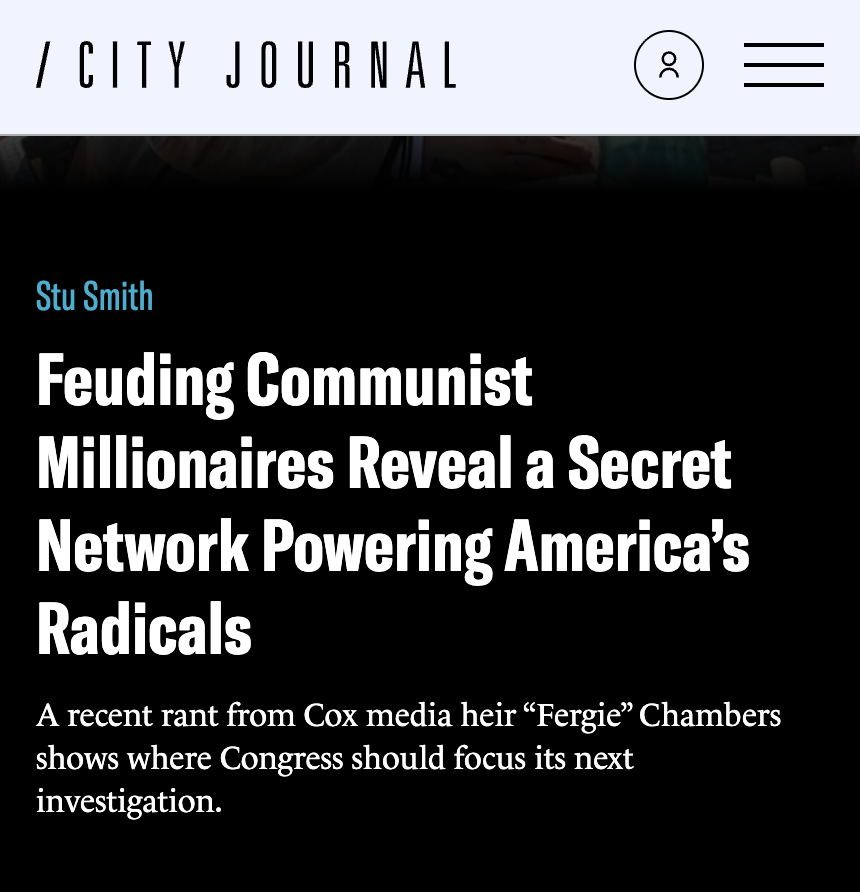
This @thestustustudio story is complicated, but the pay-off is that there might be a Lenin-style vanguard party trying to take over the entire American far Left?
For those who don't know: the American radical protest movement—think fire bombs, not just marches—is largely funded by two millionaires. One is Fergie Chambers, the American-born, Tunisia-based heir to the Cox fortune and self-identified communist. The other is telecom billionaire Neville Roy Singham, also American but a Shanghai-based member of the Chinese Communist Party.
A few weeks ago, Chambers lit into Singham on social media. According to Chambers, Singham has been trying to aggressively muscle into any protest activity on the ostensibly decentralized radical left. Singham's goal, in Chambers's telling, is to place a diffuse, anarchistic movement under the iron rule of his main organizing vehicle, the Party for Socialism and Liberation (PSL).
I've always thought of the PSL as a sort of kooky group that posters on campuses. But it sort of seems like they're the vanguard party of Singham's planned communist revolution?
And, with Singham abroad and beyond the reach of law enforcement, they're also the perfect place for lawmakers concerned about far-left radicalism to start investigating...
https://t.co/DCdTpy38VN
Make Britain Great Again, says Tom Ough, in his superb City Journal debut.
Richard Burton, the remarkable adventurer, spy, and polymath, embodied the raw agency of Victorian Britain, Ough writes in a vivid narrative on Burton’s life. Burton charted the unknown and bent the world to his formidable will. Today’s Britain,
by contrast, is a nation of slow-moving bureaucrats and “managed decline,” paralyzed by supranational courts, NIMBYs, and demographic surrender.
Britain traded parliamentary sovereignty and national ambition for governs safety nets and internationalist nostrums. The result has been stagnation, mass immigration against public will, and a growing sense of political and cultural futility.
High-agency nations like Lee Kuan Yew’s Singapore took charge of their destiny, and Britain could learn some lessons. Britain still has the talent, the territories, and the rich history, Ough believes, but it’s past time to reduce the bureaucracy, liberalize planning (more housing now!), unleash energy abundance, and pursue bold frontiers.
Relearn the Burton spirit: “Do what thy manhood bids thee do.”
Britain can be great again—if it chooses.
Read: https://t.co/BciPKM8aTH
He travelled to Bosnia where he volunteered for an Al Qaeda offshoot.
Congress would be within its rights not to seat him.
Our enemies should have no expectation they can infiltrate us from within.
If Graham Platner, James Talarico, and Hasan Piker represent the best and brightest of the Democratic Party's rising stars, I think Republicans have a lot to feel good about for the foreseeable future.