@AravSrinivas It’s really Cool but they really need to build a proper harness. Running python scripts to get
Emails classified isn’t gonna work for the average user. I don’t know why Jev or OpenAI or perplexity now doesn’t have a cool harness…
MIT's Max @Tegmark says P(doom) falls "way way way way down" if one thing changes. What is it?
A) Binding safety standards before release
B) Interpretability of neural nets
C) Nothing, the race can't be stopped
D) Something else, tell me below
https://t.co/W9Ortr9FP8
MIT's Max @Tegmark says P(doom) falls "way way way way down" if one thing changes. What is it?
A) Binding safety standards before release
B) Interpretability of neural nets
C) Nothing, the race can't be stopped
D) Something else, tell me below
https://t.co/W9Ortr9FP8
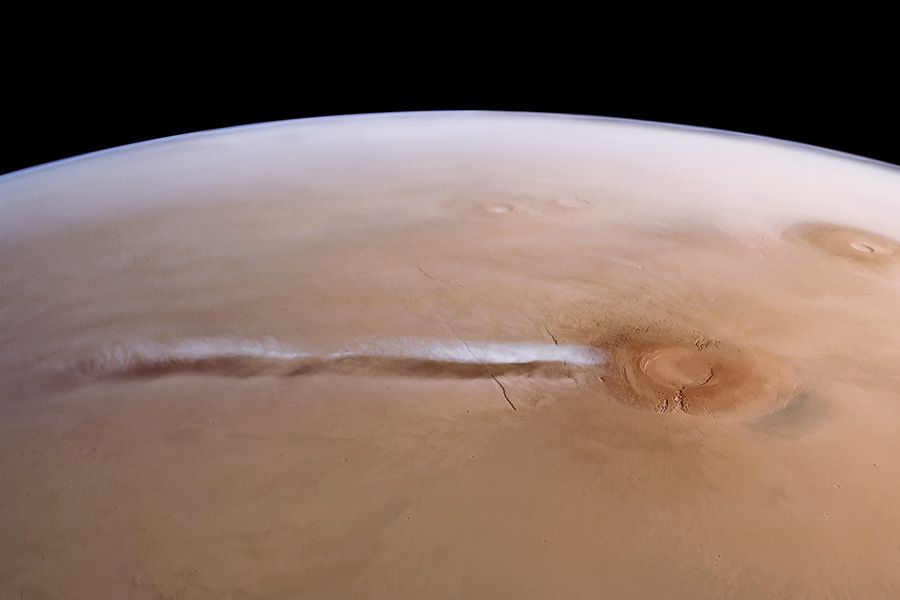
A Cloud Made of Thin Air
Every cloud we have ever seen, on Earth, Venus or Mars, needs a seed: a speck of dust or soot for water to condense on.
Over Arsia Mons, a Martian volcano about 20 kilometers tall, ESA’s Mars Express orbiter has watched a thin cloud stretch some 1,800 kilometers downwind every morning for a few months around the southern summer solstice. A team led by Jorge Hernández-Bernal of Sorbonne University now reports in Nature Geoscience that the volcano drives air up to 45 kilometers high and chills it by 30 degrees Celsius in minutes, so the water vapor becomes wildly supersaturated with no dust up there to grab onto, and it condenses all by itself. It may be the first time anyone has caught a seedless cloud in the act.
Mars keeps teaching us about limits, which is the heart of my talk “A T. rex on Mars”: the physics of a world decides what can grow there, from ice crystals to minds. Some ideas come out of thin air, and on Mars, so do clouds.
Read more: Sky & Telescope →https://t.co/gMXvJQteEX