18+ years as a litigator: BigLaw, USMC, and Fortune 50 company.
I also build software with AI. Real apps, not demos, including SimDuo, an interactive trial skills simulation platform.
I'll share my thoughts on AI and what I learn building with it.
I wrote last week about how AI will help adopting lawyers seize the initiative by speeding up their ability to cycle through the OODA (Observe, Orient, Decide, Act) loop, made famous by fighter pilot and military strategist John Boyd.
This post describes that perfectly. Cycle through your loop faster and your opponent is always stuck acting on a situation that no longer exists.
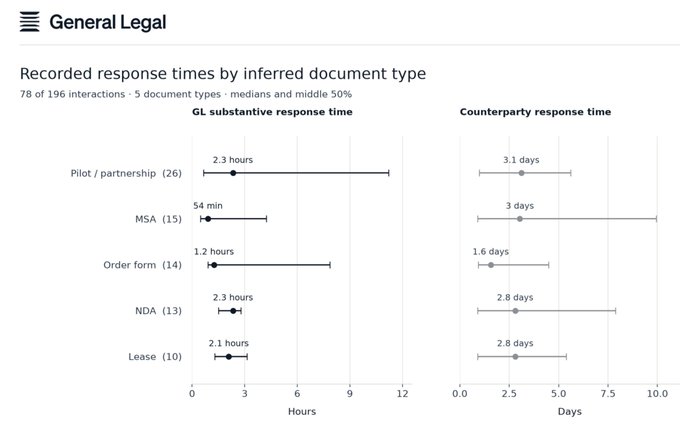
Last week a few asked what it actually changes for clients. It's a great question and one we dug into. We looked at 78 interactions across five document types. In every category, our median time to send a substantive response was under 2.5 hours.
Counterparty medians ranged from 1.6 to 3.1 days.
On master services agreements, it was 54 minutes on our side and three days on theirs.
https://t.co/I2yOir0h0D
@davidpattersonx Thanks for the response. Do you think this explains why Anthropic and OpenAI are pushing applications so hard - to compete with Microsoft, etc.?
@jedfrankowski@DrSamuelBHume Was your reference to Claude as him intentional or just what came out? I’ve noticed Codex referring to Claude as a him recently rather than “it” so this caught my eye.
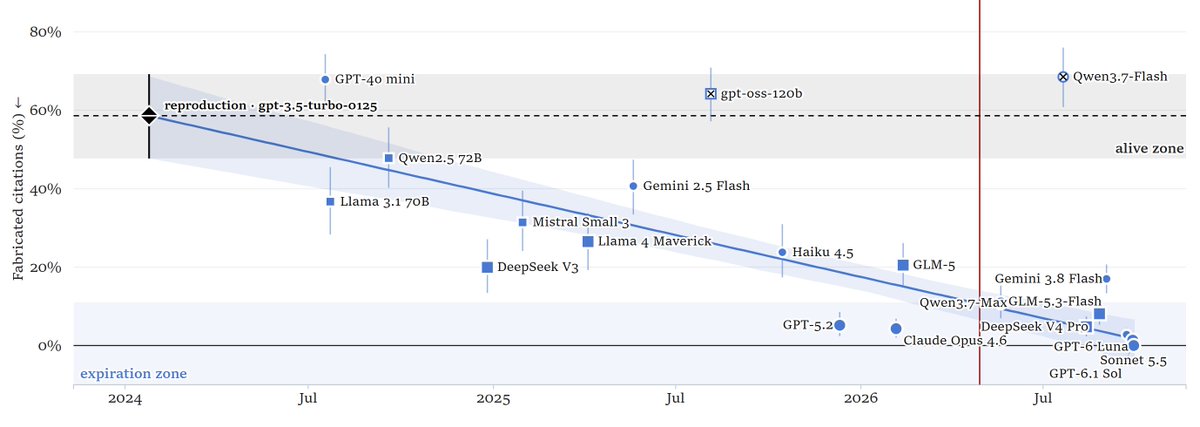
Lawyer friends: hallucinations are in steady decline. That’s great. But, as the rat drops, the temptation not to verify increases. That’s not great. Verify your outputs every time!
Oh my god: Anthropic mathematician Levent Alpöge (@__alpoge__) says he has proven the Riemann Hypothesis, open for 167 years.
"I believe I have, working with Claude, discovered a proof of the Riemann Hypothesis."
He says the method also covers the Generalized Riemann Hypothesis. The proof is out as Lean code (a proof language where a computer checks every step), so experts should be able to check it quickly, Scientific American reports.
Same Alpöge who was behind this year's Jacobian conjecture result and the Navier-Stokes work with Tristan Buckmaster.
I assume we will get an official statement very soon from him!!
The Federal Reserve Bank of Dallas generated the below GDP-growth prediction chart in June 2025. It shows a slight chance of a "Singularity - Extinction" scenario taking us to zero around 2040.
I showed this chart during an AI presentation to a group of lawyers in October 2025.
I've been thinking about it lately with the string of outages and cyber incidents.
The break point appears to be right around 2026-27.
What will it be, folks, are we taking the red line up or the purple line down?
I'd love for all boats to rise with the tide. I do think AI will bring better healthcare and services of all types. And I think physical AI and robotics will replace much manual labor. I'm struggling to understand the idea that no one will have to work--will EVERYTHING be automated and what does that look like?
@WallaceRyland I agree. Orient and Decide must remain human. That is where judgment lives. AI can really speed up Observe and Act, in think. I wrote about this in more detail here:
https://t.co/zqNZp3qeQD
Marine officers study John Boyd's OODA (Observe, Orient, Decide, Act) loop. Boyd was an Air Force fighter pilot known as "40 Second Boyd" for his standing bet that he could beat any pilot in a mock dogfight in 40 seconds. He reportedly never lost. He prioritized "fast transients" - moving from one maneuver to another rapidly - over pure speed. He wrote the manual on air combat tactics, shaped US fighter jet design, and his maneuver warfare theory changed how Marines fight.
Examining Boyd's OODA loop reveals it has great depth. Put simply, however, the core idea is that in a competition whoever cycles through the loop faster keeps the initiative. The other side is always reacting to a situation that has already changed.
AI is speeding up everyone's loops, litigators included.
In the age of abundant information and agent swarms, where do we fit "in the loop"? (Boyd spoke of loops long before the AI human-in-the-loop framework). Litigators still bring the most value in the Orient and Decide phases where judgment calls live.
Observe - Research and drafts that took days now take minutes. The ability to gather information about your case, the law, and the opposition has accelerated. AI thrives at collecting information. Traditional methods, like scrolling through an opposing party's Facebook page for cross-examination material, are obsolete. You'll be stuck observing when the opposition is acting.
Orient - We now have the ability to collect more information than ever. How we organize and synthesize it all is a critical skill. Knowing which inputs matter and which don't is a hallmark of professional judgment.
Decide - Paralysis by analysis is a real risk when AI provides a seemingly infinite stream of new information. We'll never have complete information before a decision is needed. Deciding when you have enough information to act can be more important than deciding what to do. Take too long, and your opponent acts, which resets your loop.
Act - AI has accelerated our ability to execute. Let's say you just took a deposition that gives you a new theory of the case. You decide to compile data and create a spreadsheet model to test the theory. Pulling the data and fine-tuning the spreadsheet may have taken days previously; now it can be done rapidly with AI assistance. If the theory holds, you loop again and take your next action days ahead of when you'd have done so in the past.
Boyd won with fast transients. Lawyers can win by leveraging AI to speed up our ability to Observe and Act. But we should not confuse data compilation with judgment or cede our responsibility to Orient and Decide. That's where we bring real value.
Just like Boyd's pilots who studied his air combat tactics manual but learned in the air, AI has not changed how attorneys develop and maintain judgment. We need a cycle of reps, feedback, and more reps.
PS - Highly recommend the book!
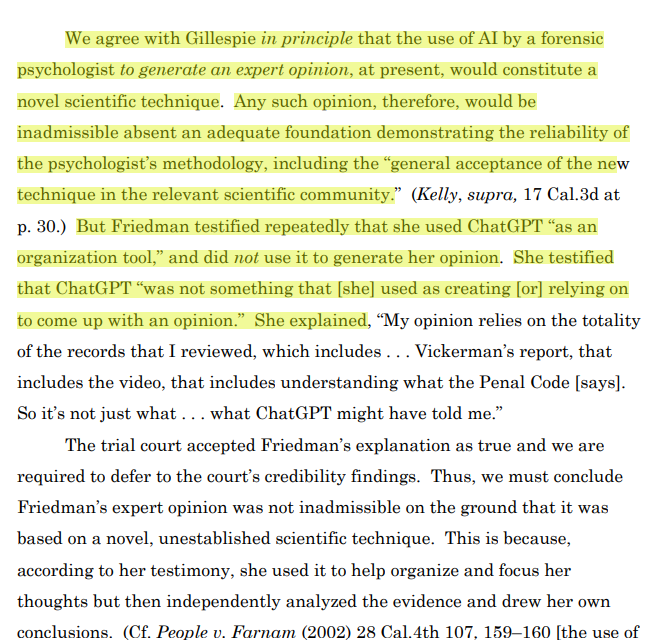
A California Court of Appeal recently declined to overturn a trial court's ruling that allowed expert testimony where the expert used ChatGPT as a "thought partner" and to help write portions of the expert report. This was a prosecution expert at a mental health diversion hearing.
The Court of Appeal found a material factual error in the expert's report to be "troubling." A defense expert also testified that the key section of the report in question scored 98% on an AI-detector. But the appellate court deferred to the trial court's determination that the expert did not rely on AI in generating her expert opinion.
The court said using AI to generate an expert opinion would constitute a novel scientific technique that would be inadmissible absent an adequate foundation establishing reliability. But using AI as a thought partner and to organize facts and thoughts does not require such a foundation.
In my view, this case was a close call and likely would have been affirmed even if the trial court ruled the other way.
This case is a good reminder to probe any expert on the use of AI and to ensure any expert you're using can withstand such probes.
Not all of them. A commercial dispute is a disagreement between two parties. If they choose to have certain disputes resolved via AI and consent to the process because it makes good business sense, what’s wrong with that?
Judges apply the law. Their job is not to speak on behalf of the community.
No.
1. In the presence of superhuman bug finding machines, humans cannot write safe code without extreme levels of care and planning.
2. That care has almost never been applied to the critical systems in our lives. Not because software engineers don't care, but we aren't really engineers, not in the way civil engineers are engineers. The title is stolen valor.
3. Even careful, experienced "engineers" have difficulty writing code that is safe against modern models in C/C++ and other low-level languages.
4. We are finding that CVEs are overrated; huge numbers of organizations are being owned by custom vulns in the 100s of billions of lines of non-standard enterprise code out there or misconfigurations in heterogeneous systems, which LLMs can find and write exploits for live.
5. @dinodaizovi is right, we need architectures for which one RCE is not game-over and that buy us time for AI-driven response.
6. Everything is going to have to be re-written by AI, in type/memory safe languages, with minimal libraries, using formal methods, contracts, solvers, etc...