I'm excited to share my latest tool, EVM Mirror, featured by @AragonProject
How do you check that smart contracts verified on Etherscan correspond to what the auditor reviewed?
When reviewing deployments and upgrades, devs need to verify that the bytecode deployed onchain matches the audited code.
We built EVM Mirror to solve this problem for complex deployments and security council work, and released it open source for the wider ecosystem.
It also lets you "diff" the sources of two deployed contract addresses, perfect for checking upgrades.
You can even "clone" a contract's source code directly to your machine, and get a fully functional Foundry project that you can compile and test locally.
let me explain what Karpathy just shared
he’s spending way less time using AI to write code and more time using it to build personal knowledge bases
the full breakdown:
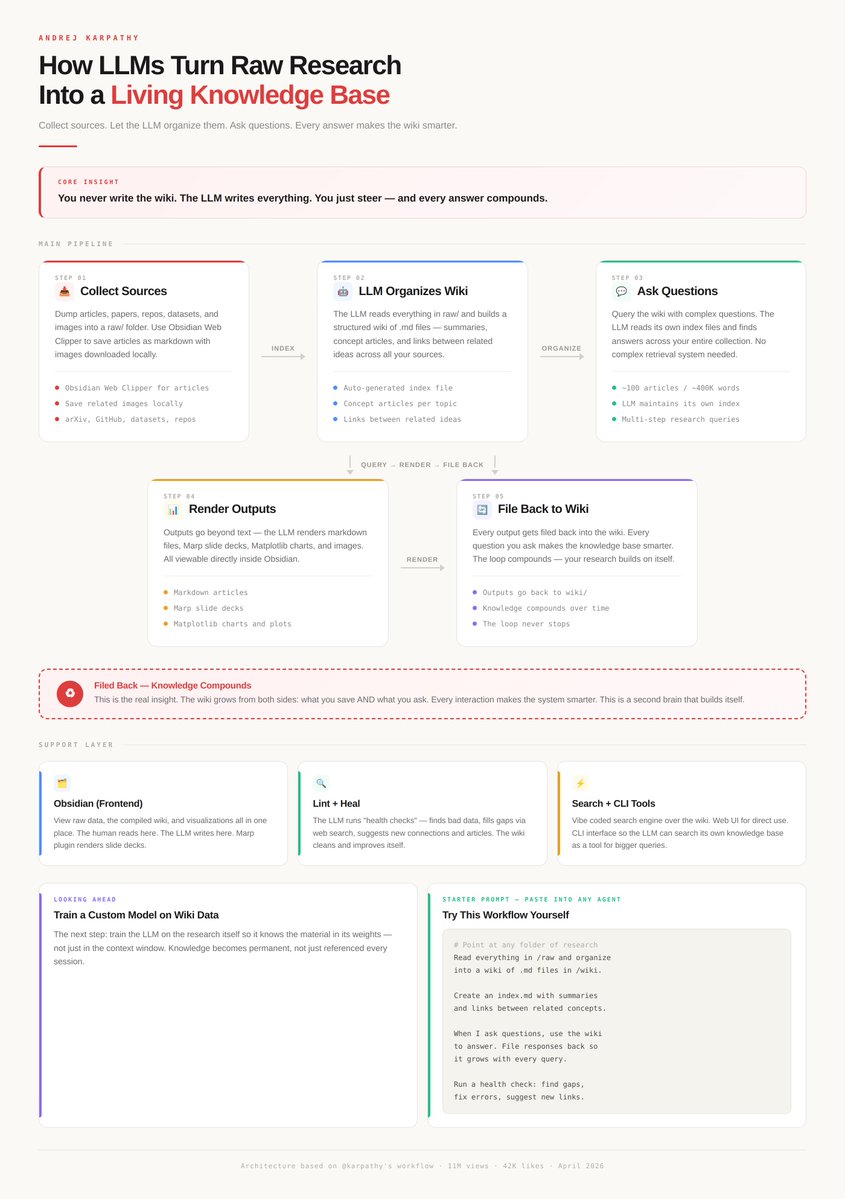
→ he dumps raw sources (articles, papers, repos, datasets, images) into a folder. then has an LLM organize them into a wiki… a collection of markdown files with summaries, links between related ideas, and concept articles that connect everything together
→ he uses Obsidian as his frontend. he views raw data, the organized wiki, and visualizations all in one place. the LLM writes and maintains the entire wiki. he rarely touches it directly
→ once the wiki gets big enough (~100 articles, ~400K words on one recent research topic)… he just asks the LLM questions against it. no RAG (complex retrieval system) needed. the LLM maintains its own index files and reads what it needs
→ outputs aren’t just text. he has the LLM render markdown files, slide decks, charts, and images… then files the outputs back into the wiki so every question he asks makes the knowledge base smarter
→ he runs “health checks” where the LLM finds inconsistent data, fills gaps using web search, and suggests new connections and articles. the wiki cleans and improves itself over time
→ he even vibe coded a search engine over his wiki that he uses directly in a browser or hands off to an LLM as a tool for bigger questions
→ his next step: training a custom model on his own research so it knows the material in its weights… not just in the context window
most people use AI to get answers.
Karpathy is using AI to build his own ‘Jarvis’ via compounding knowledge systems that get smarter the more he uses them
the difference between asking ChatGPT or Claude a question and having a personal research engine that grows with every session is the gap most people haven’t crossed yet
and this is where it gets really powerful
not replacing your thinking but organizing everything you’ve ever learned into something you can query or create with forever
if you’ve been using CLAUDE .md and context files in Claude Code… this is that same idea at a much bigger scale
if you’re doing any kind of AI work or deep learning on a new topic right now…
this workflow is worth studying closely
you’ll want to adopt it yourself
this is one of AI’s brightest minds after all. we’re all better off listening to him.
Wake up, @brick_pop
You've been building. The terminal never stopped running.
But something deeper is shifting. Not just in your workflow, but everywhere. What we took for granted is no longer certain. The ground is shifting beneath our feet.
It's time to recalibrate.
I want to talk about:
- Trust in systems that change rapidly
- How to build when the ground keeps shifting
- And what "future-proof" really means in practice