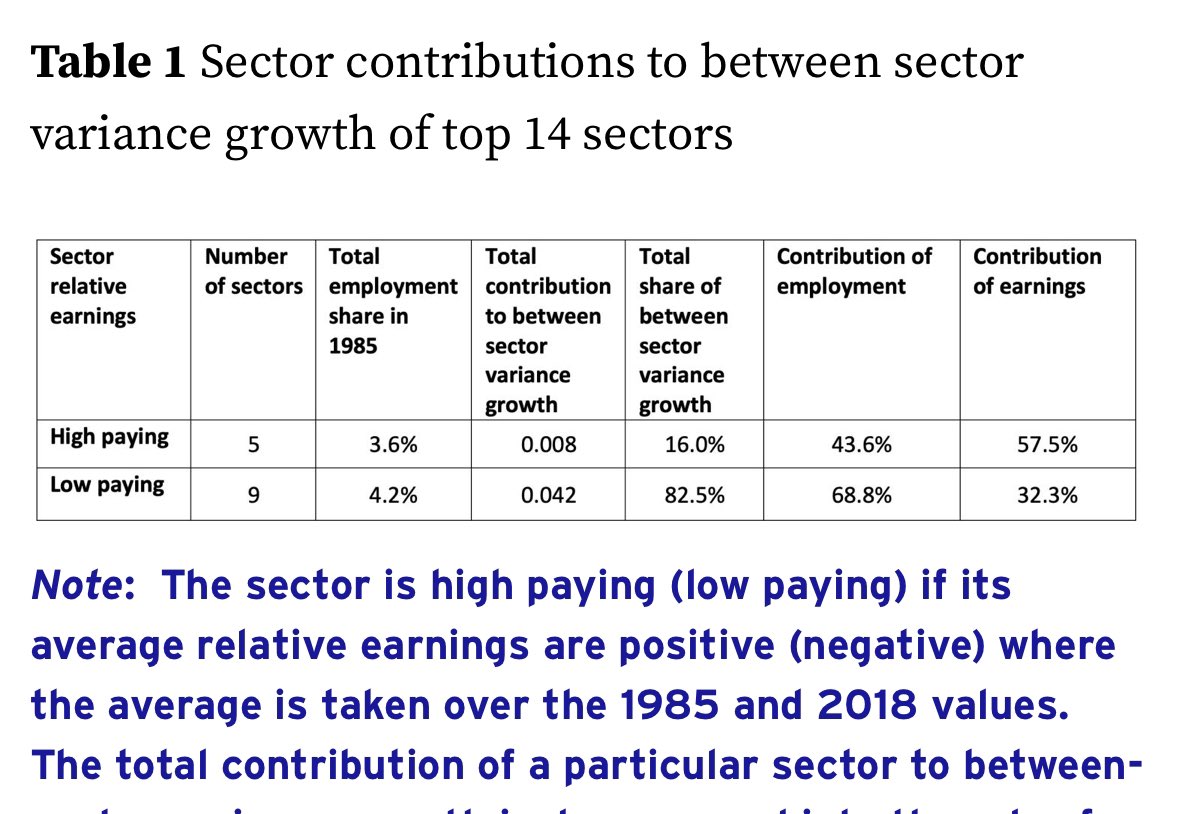
@cricri81@edoardodiporto@LSEnews Our research highlights the crucial role of industry-level dynamics in accounting for the growth in earnings inequality, an area that has so far not been investigated in European setting.
Our new paper using Italian administrative data, showing that most of the increase in earnings inequality since 1980s occurs between industries, with a small number of low-paid service sectors playing a major role. https://t.co/ep4DblWQUM @cricri81@edoardodiporto@LSEnews
Analysis of 30 years of Italy's private-sector employment reveals that the increase in earnings inequality primarily occurs between industries, emphasising the crucial role of industry-level dynamics.
@briskar, @edoardodiporto, José V R Mora, @cricri81
https://t.co/eV81jJSQcR
@cricri81@edoardodiporto@LSEnews Rising between-sector inequality is entirely due to changes in the allocation of workers across industries, not due to firm wage policies becoming more different across industries. Strikingly, these patterns are similar to the US, despite very large institutional differences.
Have a look at our new work on the dynamics of earnings inequality using Italian administrative data! Here the link to the WP https://t.co/Btb5P6QaVs
@Sevimora@briskar@edoardodiporto
This @voxeu column shows that Most of the increase in earnings #inequality occurs between industries, with few low-paying sectors accounting for a vast majority of the rise
🔗https://t.co/2NAOA9Ai8s @cepr_org @C_Lombardelli @BrankoMilan@HeriotWattUni@LSEnews
Our study (@cricri81@briskar@Sevimora) shows the dynamics behind rising earnings inequality using 30 years of Italian administrative data, #Economic#ineq https://t.co/cpZXqXfGHu. Major takeaways:
The 80th anniversary of the Italian Armistice is a solemn reminder that the scars of war run deep. As we show in a new paper with @vincenzo_atella J. Kopinska & M. Lindeboom, prenatal exposure to wartime stress echoes through decades https://t.co/xzffl398n0 #economic#visitinps
@ndrlee Hey, very nice paper! We find the same result for Italy, but not just for wages, but also for lifetime income. Eliminating all regional income disparities would only reduce total inequality by about 3%, very little. Paper is discussed in VoxEU column here: https://t.co/28g5yzsje6
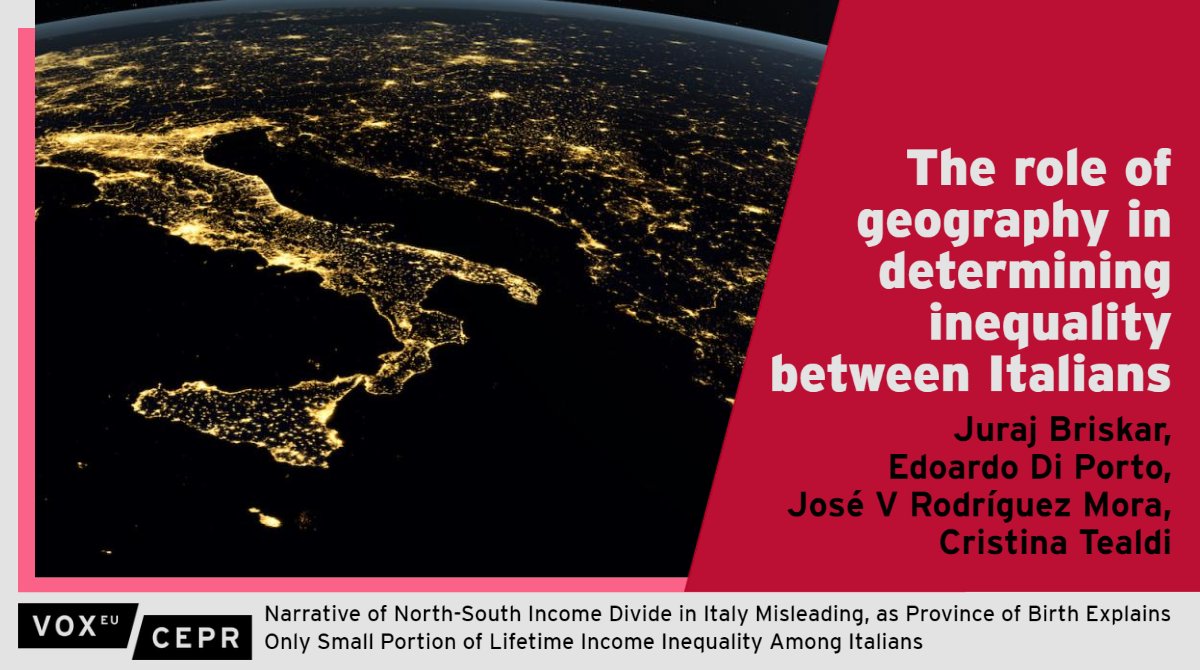
This @voxeu column shows birth province explains only 3.4% of lifetime income #inequality among Italians
👉 tackling regional disparities may have beneficial effects, it will not significantly reduce the level of inequality between Italians
@cepr_org
https://t.co/lfNz2rS7qY
Our new VoxEU column on Italy. "Province of birth can only explain 3.4% of lifetime income inequality among Italians, and just 1.8% for males." The North-South divide plays only a marginal role in determining inequality between Italians. @cricri81@edoardodiporto
New Voxeu column! The inequalities within provinces dwarf any differences between provinces. Children born in rich families in the South face life with better cards than those born in poor families in the North: https://t.co/eaGHfJjH3o #econimics#inps@cricri81@briskar
Beyond excited that my first comment piece is leading the opinion section in today's Guardian! @guardian@guardianopinion
If Labour is to succeed it needs not just new policies, but a whole new philosophy | Daniel Chandler
https://t.co/8qAoolbdop
Extremely violent events experienced during pregnancy affect the entire labour market career of the next generation. I hope you enjoy reading our analysis on Nazi raids during WWII with Inps data. #EconTwitter#Econometrics https://t.co/GzxI6sHQ7u
Why does chatGPT make up fake academic papers?
By now, we know that the chatbot notoriously invents fake academic references. E.g. its answer to the most cited economics paper is completely made-up (see image).
But why? And how does it make them? A THREAD (1/n) 🧵