🚨 Digital Asset just raised $355M led by a16z. 🚨
But the amount isn't the most interesting part.
Look at the investors:
ADIA 🇦🇪
BNP Paribas 🇫🇷
HSBC 🇬🇧
SBI 🇯🇵
Hanwha 🇰🇷
Apollo 🇺🇸
Citadel Securities 🇺🇸
CME 🇺🇸
Tradeweb 🇺🇸
I genuinely can't remember another blockchain raise that onboarded this many institutional players at once, with such geographic diversity.
US.
Europe.
Middle East.
Asia.
And according to @YuvalRooz, many of them aren't just investors.
They're prospective users.
That's a huge distinction.
Because institutions don't invest in infrastructure for the narrative.
They invest because they expect to use it.
And the biggest problem in finance isn't tokenization.
It's coordination.
The value isn't putting an asset onchain.
The value is making assets, collateral, cash, stablecoins, and financial applications interoperable across institutions.
That's what creates network effects.
That's what created modern capital markets.
And that's what created DeFi.
I know that many people have viewed Canton as a US-centric institutional chain.
Looking at this cap table, that thesis is becoming increasingly difficult to defend.
This raise looks less like a financing event...
...and more like the formation of a global institutional network.
Very happy to be part of this ecosystem as both builder and validator with @Avicenne_Studio 🫡
Composability without operational confidentiality does not scale for institutional finance.
Canton was designed for that combination.
@Tokenoya on why selective disclosure is the architectural requirement, and why that changes where institutional liquidity concentrates.
And Canton is quietly winning on the institutional side.
That’s why, as a go-to partner on Canton, @Avicenne_Studio is growing its DAML developer team.
If you’re interested or know someone who might be, my DMs are open 🙌
If you only watch one moment from the @YuvalRooz vs @gluk64 debate, watch this one.
This is where the whole Canton vs ZK narrative breaks.
A few days after the LayerZero / rsETH situation, Alex (ZKsync) basically says:
“This can happen on Canton too.”
Issuer gets compromised.
Assets get minted.
Systemic risk.
Same story.
On paper, it sounds right.
But it’s actually mixing two completely different problems.
LayerZero was a connection failure.
1 validation point fails → everything trusts it → system breaks.
That’s a bridge / infra problem.
Canton doesn’t work like that.
There’s no single actor pushing state to everyone.
State changes require multiple parties.
And more importantly:
You validate what you’re part of.
The real thing that bothered me in his argument is this:
He keeps going back to
“What if the issuer gets compromised.”
But that’s not a Canton problem.
That’s just how RWAs work.
USDC, bonds, tokenized assets… same thing.
If the issuer is compromised, supply can be impacted.
You don’t solve that with “more decentralization.”
You solve that with structure.
Where Canton actually changes things is not if something breaks.
It’s how you realize it broke.
On Canton:
• you don’t rely on a hidden operator.
• you don’t rely on some proof you don’t understand.
• you don’t just ping an RPC and hope it’s right.
You are part of the validation.
So if something changes, you see it.
Not after.
Not indirectly.
Not through a proof.
Now compare that with ZK / L2 setups.
This is not even opinion, it’s literally in L2Beat’s ZKsync review.
Contracts can be upgraded.
In some cases instantly (emergency path).
So the flow is:
System changes.
Funds can be drained.
A proof is posted.
Everything still looks valid.
From the outside, nothing looks wrong.
But the rules changed under you.
That’s the trade-off people don’t want to talk about.
ZK / L2:
You get clean global state, nice composability.
But you’re trusting operators, upgrades, and proofs you don’t control.
Canton:
You lose the “one global state” simplicity.
But you gain explicit validation and no hidden execution layer.
And honestly the funny part is people calling Canton “less decentralized” because the trust is explicit.
But are fine with systems where:
• someone can upgrade contracts.
• users don’t validate anything.
• and everything depends on a proof.
That’s not removing trust.
That’s just making it harder to see.
For me the real question is simple:
Do you want risk you can see,
or risk that looks fine until it’s not?
Because if we’re serious about scaling this to real markets,
This distinction actually matters.
Most people still get this wrong:
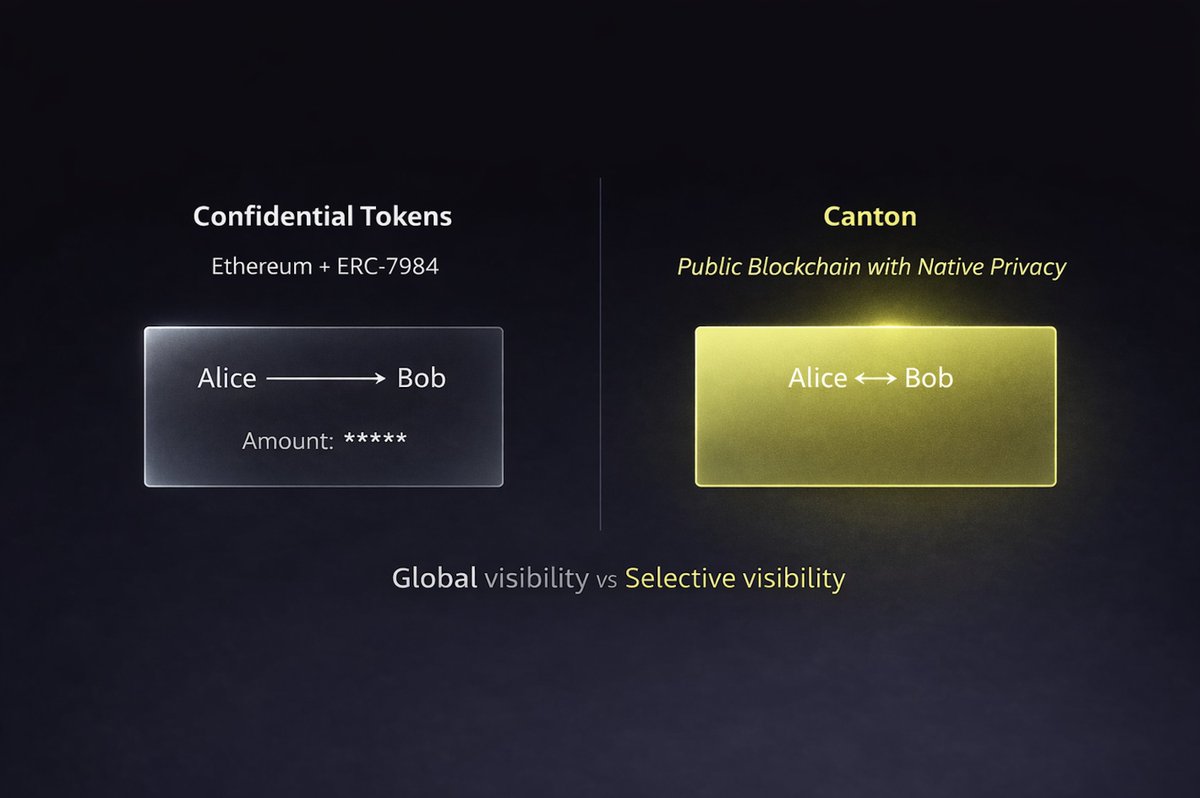
confidential tokens and blockchains with native privacy do NOT solve the same problem.
And if you’re building for institutions, this difference is everything.
Take ERC-7984 and Canton.
Both aim to bring privacy to on-chain finance.
But they operate at completely different layers.
ERC-7984 is about making public blockchains more confidential.
You keep Ethereum’s global state, but encrypt sensitive data like balances and transfer amounts.
So instead of seeing:
→ Alice sent 1,000 USDC to Bob
You see:
→ Alice sent ***** to Bob
This is a major improvement.
But the system itself doesn’t change.
Transactions are still visible.
Addresses are still visible.
Flows are still traceable.
You’re not removing transparency.
You’re reducing data leakage within a transparent system.
Canton takes a different approach.
It doesn’t try to hide data.
It removes the assumption that data should be globally visible in the first place.
There is no shared global state.
Data is only distributed to involved parties.
Each participant has a scoped view of the ledger.
Transactions are not universally broadcast.
That means you don’t just hide amounts.
You control:
• who sees the asset
• who sees the transaction
• who sees the logic
• who even knows the transaction exists
This is not “confidential DeFi”.
This is institutional-grade privacy at the infrastructure level.
The difference is simple:
ERC-7984 hides what happened.
Canton controls who knows it happened.
And this difference has real implications.
You cannot recreate Canton’s privacy model on Ethereum.
Because public chains require global verification.
Some data will always remain visible.
But Canton introduces another constraint.
The moment assets leave its environment and move to public chains, they inherit a different data model.
Private assets become observable.
Selective visibility becomes global transparency.
This is the real gap today.
Not a lack of bridges.
A lack of privacy-preserving asset representations across chains.
Confidential tokens like ERC-7984 are a key piece of the answer.
They allow assets to remain partially shielded even on public rails.
But they don’t replicate Canton’s model.
They adapt it.
The future is not choosing between both.
It’s combining them.
• Canton for private execution and ownership
• Cross-chain infrastructure like LayerZero for distribution
• Confidential token standards for controlled exposure
The real challenge is not moving assets across chains. It’s preserving their properties when they arrive.
That’s where most of the industry is still early.
And where the biggest opportunities are being built.
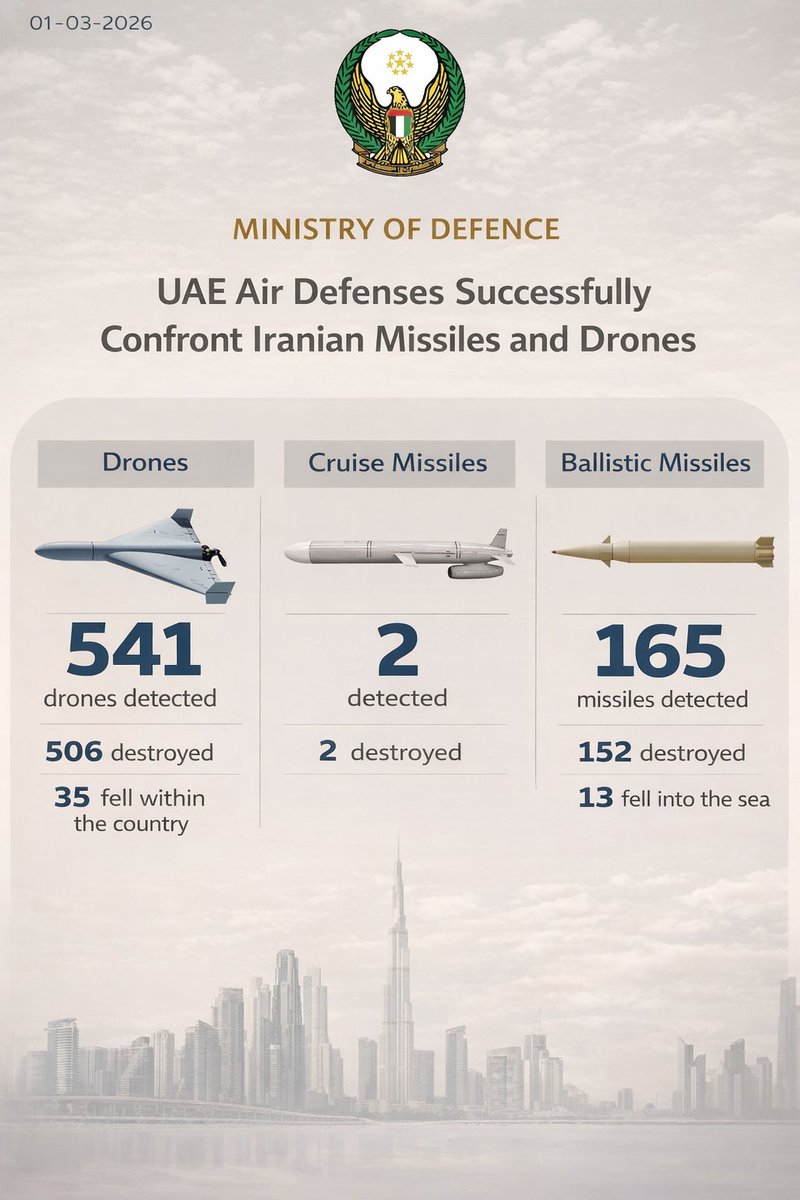
Nice iftar with my friends here in Dubai.
No one stressing. No panic. Just good food, good convo and a Burj view.
And yes for the ones asking… the Burj is still up.
Apparently influencers are getting paid by the UAE to say everything is fine.
As far as I know, I’m not an influencer.
And I’ve never received $1 from anyone.
I’m just living here.
We’re still working.
Still going out.
Still living our lives normally.
Please guys, stop spreading narratives from your couch in another country.
Reality on the ground is a lot less dramatic than your timeline.
La Juventus aurait conclu un accord avec Hans Hateboer. Le joueur aurait même fait ses adieux à ses coéquipiers.
L'Atalanta en demanderait seulement 25 M€.
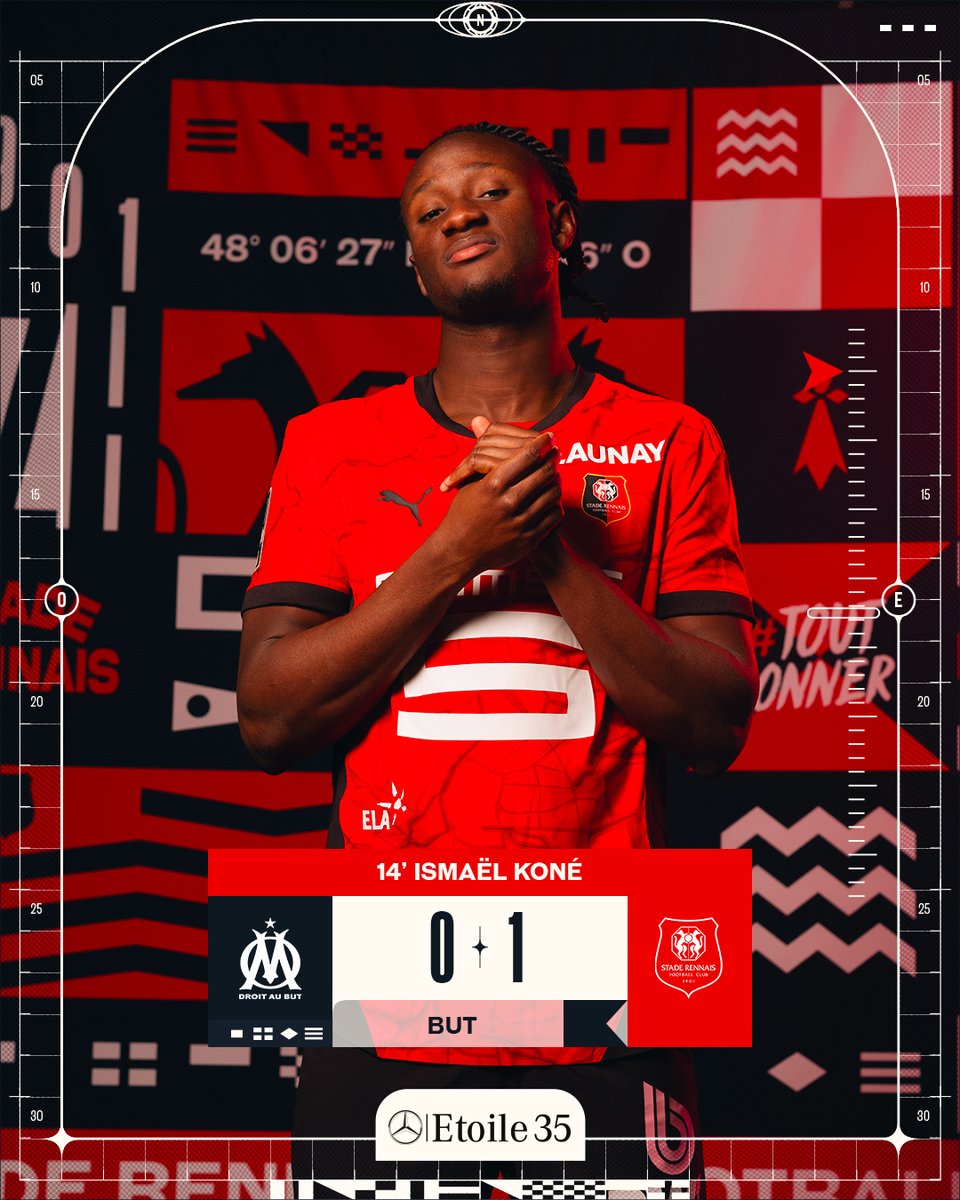
21' : 𝙇𝙀 𝘽𝙐𝙏 𝙍𝙊𝙐𝙂𝙀 𝙀𝙏 𝙉𝙊𝙄𝙍 🔥
Seko Fofana décale Quentin Merlin, le latéral délivre un centre précis pour Estéban Lepaul : premier match, premier but 🫡
#SCOSRFC 0-1