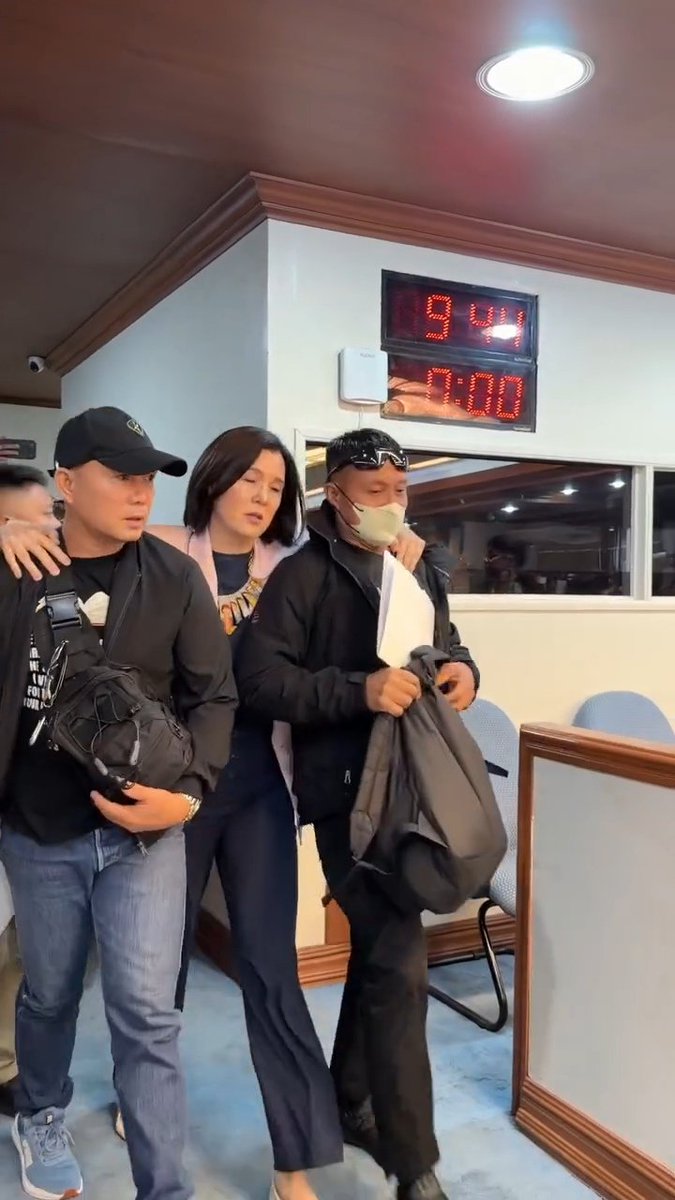
Senator Pia Cayetano seems less interested in clarifying the bill and more interested in undermining Senator Risa Hontiveros. The problem is that the very points she keeps insisting are “not written” are actually in the bill and have already been explained repeatedly during the sponsorship and interpellation.
A healthy debate is supposed to illuminate issues, not create confusion where none exists. Instead of listening to the answers being given, Pia repeatedly interrupts, talks over the sponsor, and turns what should be a constructive exchange into an unnecessary spectacle.
Parliamentary courtesy exists for a reason. It allows senators to disagree without sacrificing respect and decorum. Senator Risa maintained her composure throughout the discussion, but it was difficult not to notice the constant interruptions and confrontational tone coming from the other side.
Debate is welcome. Disagreement is welcome. But basic respect should never be optional.
Frankly, the lack of parliamentary courtesy was glaring. It came across as rude, disrespectful, and completely unnecessary.
Win Gatchalian voted YES to:
- TRAIN Law
- extensions of Duterte's Martial Law
- Anti-Terror Law
- Maharlika Fund
- requesting ICC for house arrest of Duterte
- oust De Lima & halt the drug war probe
- abstained on the burial of Marcos Sr. in LNMB
All of which Risa voted NO to.
I received some shocking news this week.
I tested positive for gonorrhea.
The doctor told me I can’t fuck anyone for 2 weeks.
Unfortunately, I will not be able to follow the doctor’s orders since we play against TL tomorrow.
NOT FROM MEMBERS OF THE MEDIA
Contrary to Senator Alan Peter Cayetano's claim, it was not members of the media who applauded and cheered for him during his press conference at the Senate on Thursday, but rather his own staff and several guests in attendance.
"First time akong napalakpakan ng media, walang bayad 'yon," he said after claiming that he had managed to unite various political groups, which he alleged are now aligned with the administration.
Cayetano also maintained that he remains Senate president, despite the recognition by Malacañang and the House of Representatives of Senator Win Gatchalian’s leadership as acting Senate president. | via Malou Escudero/Pilipino Star Ngayon
This error fundamentally just destroyed everyone’s credibility. This is not just a clerical error. This is a material error that no one can ever commit if they are speaking truth, if the act really did happen. HAHAHAHAHAHA
EXPLANATION
Why Avelino vs Cuenco 1949 is enough for a quorum of 12
Normally, the Senate has 24 senators, so quorum is 13.
Senate PH Rule II says that for Senate officers: they are elected by “majority vote of all its members.”
So if all 24 are counted, 12 is not enough.
But the anti-Cayetano camp’s argument comes from Avelino v. Cuenco, 1949.
In that case, the Supreme Court accepted the idea that because one senator was outside the country and could not participate, the Senate could be treated as having only 23 participating members. That made 12 a majority.
The Supreme Court said that “an absolute majority (12)” of the Senate “less one (23)” could be quorum, and Justice Feria explained that the count may be based on “actual members or incumbents” who are not incapacitated or outside the Senate’s jurisdiction.
Applied today: if Jinggoy Estrada is unable to participate because he is arrested, they can argue the working Senate is 23, not 24.
So 12 becomes quorum under Avelino logic.
Now add the Cayetano issue.
A Senate President is not the owner of the Senate.
The Senate Rules say the Senate normally meets at 3 PM on weekdays, unless the Senate decides otherwise.
If a session is postponed, the Senate President must consult the Majority and Minority Leaders. And the Senate President cannot just suspend or adjourn a session by himself without a motion or resolution approved by senators present, except in the specific postponement situation.
So if Cayetano refuses to preside or tries to stop the chamber from functioning, the anti-Cayetano camp can say - the chair cannot kill the chamber.
That is also consistent with Avelino v. Cuenco, 1949.
In that case, the Senate President abandoned the chair and did not attend.
Worse, Cayetano not only was absent, he did not designate a Presiding Officer either - the Senate is not functioning.
The anti-Cayetano senators continued, and the case records say the deliberate abandonment made it necessary for the remaining members to continue “in order NOT TO PARALYZE the functions of the Senate.”
So the anti-Cayetano camp’s legal theory is basically this:
(1) The Senate is bigger than Former SP Cayetano.
(2) If he refuses to preside, and enough senators are present, the Senate can still function.
(3) If Jinggoy cannot participate, Avelino gives them an argument that 12 is quorum.
(4) Once quorum exists, the Senate can act on its internal organization, including committees per the Senate Rules.
They are on stronger ground when reorganizing committees, because committees are part of Senate internal organization.
Rule X says permanent committees are formed by the Senate after organization, including the Committee on Rules (take notice, yan ang unang call to motion ni Sotto).
So what did Cayetano did wrong?
Essentially by refusing to attend the Senate or any of the presiding officers (ie: Former Pro Tempore Legarda, and Former Majority Leaders), the situation became more and more similar to Avelino v. Cuenco, 1949.
The former Majority could even argue that Avelino v. Cuenco, 1949 is a "special circumstance" . However, the similarities between then and now became more apparent with the former Majority leaders absence and made the arguments of the anti-Cayetano camp stronger.
With this, the new Majority got their quorum and they rearranged leadership.
So why only the leaderships and not the actual Senate Presidency?
So the pro-Cayetano camp can ask: "If you truly have quorum, and the majority of all members, why not also elect a Senate President?"
Short answer: Because of the Constitution.
The Constitution makes electing a new Senate President more sensitive because it specifically requires a “majority vote of all its respective Members” for that office.
The Constitution then separately says each House may choose “such other officers as it may deem necessary.”
For Senate President:
The Constitution itself sets the rule. The Senate President must be elected by “a majority vote of all its respective Members.”
For President Pro Tempore and other officers:
The Constitution does not give a specific voting threshold. It only says each House may choose “such other officers as it may deem necessary.” (Sec. 16)
It also says each House may determine its own rules.
That is where Senate Rule II comes in:
the Senate used its rule-making power to say its officers, including the President Pro Tempore, Secretary, and Sergeant-at-Arms, are elected by majority vote of all members.
LOGICAL DIFFERENCE:
So the Constitution does not dictate the definition of "all members" for other Senate officers - only for the Senate President.
Thus, the dictation and definition of "all members" lies on Senate Rules per the Constitution Sec. 16, "...as they deem necessary..."
But with Avelino v. Cuenco 1949 coming in...
The Senate PH has already defined "majority of all members" to be "active members of the Senate - that could participate"
In the ruling,
Justice Feria said the count may be based on the Senate’s “actual members or incumbents,” excluding those unable to discharge their duties because of death, incapacity, absence from jurisdiction, or other causes making attendance impossible (ie: arrest).
Feria treated the Senate as having 23 actual members, so 12 became a quorum and majority.
Sa workplace, ganyan ang mga boss na EVIL. Pag gumuho ang lahat, isisisi sa ibang tao. Always remember, pag pumalpak ang project, concerted effort yan ng buong team, hindi lang ng iisang tao. Bakit ba nabibigyan ng pwesto sa society ang ganitong uri ng hayup? Yes hayup ito. Dahil hindi marunong makipagkapwa tao🙄
Bwisit din ako sa mga tao na nanduduro. Wala talagang edukasyon! 🧐
For the fourth time in Philippine history, the Senate convenes as an impeachment court. Unless Senator Bato Dela Rosa surfaces again, 23 Senator-Judges will decide whether VP Sara Duterte will be removed from her office and be perpetually disqualified from public office. 2/3 of the Senate or 16 votes is required to convict the VP. #BantaySenado
A bit of impeachment trial history:
- The shortest impeachment trial on record was the aborted one against VP Sara in 2025 lasting only a day when the Senate voted to remand the Articles of Impeachment back to the House instead of proceeding to full trial.
- The impeachment trial of Supreme Court Chief Justice Reynato Corona in 2011, lasting around five months, remains the only completed and successful impeachment conviction in Philippine history.
- The first time the Senate convened as an impeachment court was in the case of President Joseph Estrada whose trial in December 2000 was interrupted on its 23rd day after the Senate vote NOT to open the infamous “second envelope” triggered walkouts by prosecutors, mass protests, and eventually the resignation of Estrada.
Bato completely shattered Alan Peter Cayetano’s independent rebrand by blabbing the entire secret coup script on camera.
By admitting he resurfaced exclusively to act as APC’s crucial "13th vote," he exposed that the leadership shakeup was never about integrity.
It was a desperate, calculated move to hijack the Senate, stall the incoming impeachment court, and shield Sara Duterte from accountability.
APC tried to play statesman, but Bato exposed him as a scheming puppet.