There is a strange idea in some environmentalist circles that human population is the main cause of ecological breakdown, and that humans have an *intrinsically* negative impact on ecosystems. Both claims are incorrect.
First, human ecological impact is entirely a function of the system of production and provisioning. It depends on what is being produced, under what conditions, and how the yields of production are distributed.
For instance, an economy that uses mostly public transit, renewable energy, multi-unit housing and plant-based protein can meet human needs with a fraction of the impact of an economy that produces a lot of SUVs, fossil fuels, mansions and industrial beef, and which allocates a bunch of totally unnecessary production to service the fantasies of overconsuming elites.
Remember, we know it is possible to provide decent living standards (DLS) for 8.5 billion people with 30% of current global energy and material use, by ensuring efficient technologies and focusing production on socially necessary goods and services.
That much is fairly straightforward. But one might say that, even so, every person will always have some negative impact. This too is incorrect. Again, it depends entirely on the production system, and specifically, what people are mobilized to do.
Under capitalism, labour is mobilized overwhelmingly to produce things that are profitable to capital. But labour could just as easily be mobilized instead for regeneration. Using straightforward public finance mechanisms, we can fund massive programmes to reforest barren lands, regenerate degraded ecosystems, restore biodiversity, advance agroecological methods, etc.
Under these conditions, it is possible for societies to not only have minimal negative impact on ecology, but to have a net-positive impact, actively improving ecological indicators.
People buy into the myth of the intrinsic destructiveness of humans because we have come to take capitalism for granted. But it is 100% possible to organize production and labour differently.
Under capitalism, we are compelled to produce whatever is most profitable to capital, even if it is destructive to humans and nature. Under conditions of economic democracy, we can produce what we know is necessary for well-being and ecology.
"Until the general public...understands that our planetary house is on fire, why it’s on fire and that humanity possess all the tools needed to extinguish the fire... there simply will not be enough public pressure to get governments to change course."
https://t.co/sxoJKnNxfm
Here’s a quick roundup of highlights from research we published in 2023, on climate change, capitalism, colonialism, degrowth and post-capitalist futures. As always, free PDFs are available via the link at the end of the thread. 🧵
If you think about it, it’s insane that most people never take an extended break from work as a mature adult.
Like a lot of you, I never took more than a 2 week break in my whole career. And even then I was plugged in—there was always something “urgent” to tend to.
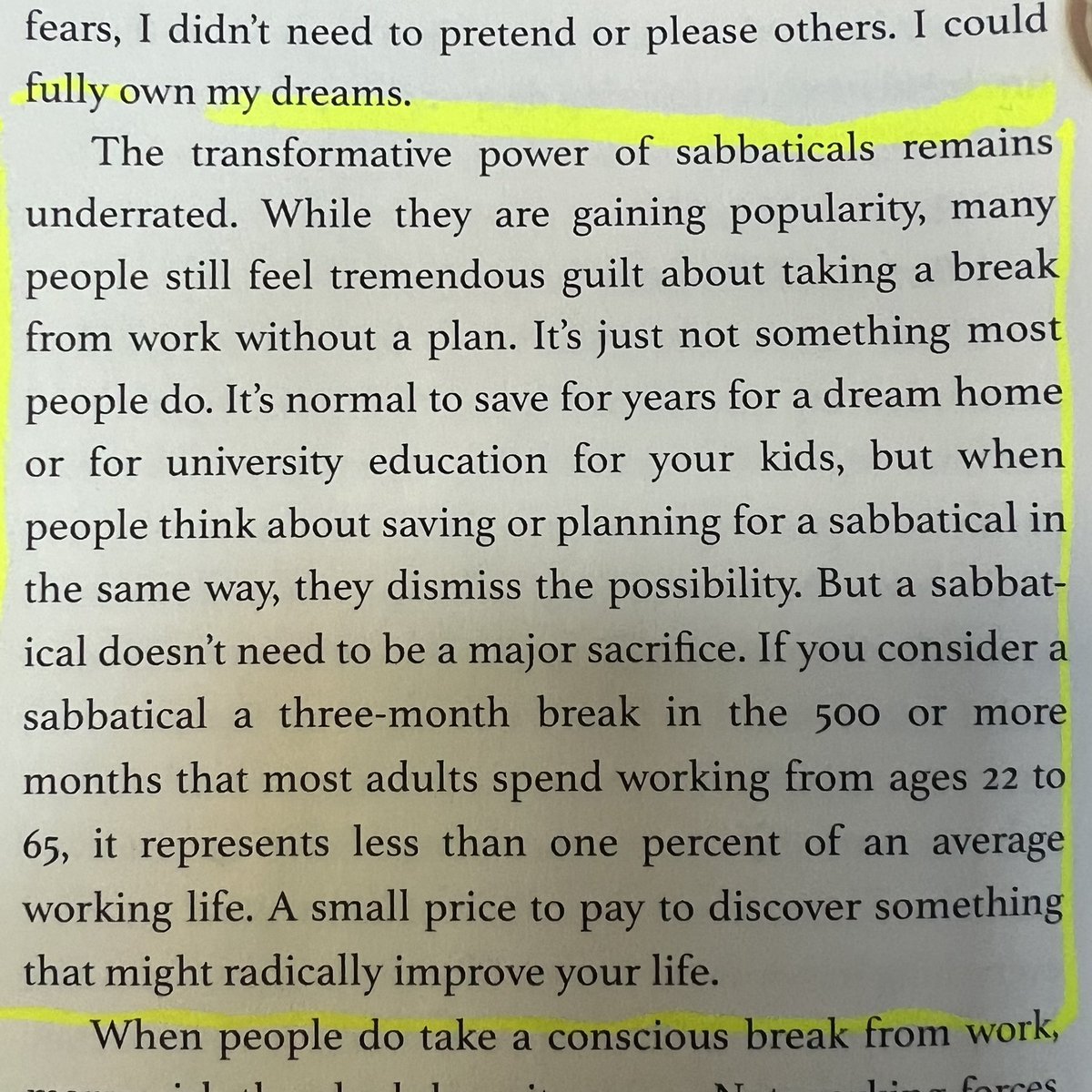
As @p_millerd says in this excerpt from his *outstanding* new book, Good Work, we save and plan for years to buy a house or pay for education (both of which are important) but don’t do the same for something that has a very high probability of being life-changing.
“By taking a break and learning to follow their interests, people start to ask new questions, ones that plant the seeds for a much bigger vision of life.”
Related, I just began an extended break—better late than never! (And more details soon.)
P.S. I can’t recommend Good Work enough—it’s on Amazon.
If you think about it, it’s insane that most people never take an extended break from work as a mature adult.
Like a lot of you, I never took more than a 2 week break in my whole career. And even then I was plugged in—there was always something “urgent” to tend to.
As @p_millerd says in this excerpt from his *outstanding* new book, Good Work, we save and plan for years to buy a house or pay for education (both of which are important) but don’t do the same for something that has a very high probability of being life-changing.
“By taking a break and learning to follow their interests, people start to ask new questions, ones that plant the seeds for a much bigger vision of life.”
Related, I just began an extended break—better late than never! (And more details soon.)
P.S. I can’t recommend Good Work enough—it’s on Amazon.
This week we’re celebrating 10 years of “I Lived!” This song has been a beautiful encouragement to us through all that life brings, and we hope it has been that for you all as well. 🫶
"What everyone is missing about climate change is that it's not about saving the planet or about science: it's about people. Earth will survive – it'll be different, but it will carry on. Humans are the ones at risk." https://t.co/iJeJ6gYsPg
In this new paper we calculate the unequal exchange of labour between the global North and global South. The results are quite staggering. You'll want to look at this... 🧵
https://t.co/fEbCmRZuyJ
I wrote a new Preface to THE DIVIDE for the Korean edition that was just published. It briefly summarizes how capitalist imperialism works, and I made it available here. Enjoy! https://t.co/leM7khkW4x
Brilliant speech by @nssylla in Havana, on the limits of international reformism and the need for global South governments to take steps toward unilateral decolonization: https://t.co/oCIqKBRWVZ
I don’t know about you, but I’d much prefer a habitable planet than to let billionaires hoard as many zeroes as possible before they manage to destroy us all