Congratulations to Zimbabwe on being elected for a two-year term on the U.N. Security Council.
Zimbabwe's credentials:
🇿🇼 Torture
🇿🇼 Child labor
🇿🇼 Tainted elections
🇿🇼 Jails critics and journalists
🇿🇼 Authoritarian rule over decades
A judge has temporarily blocked the National Science Foundation from dismantling a globally significant weather and climate research center in Colorado https://t.co/jvwHaKJYv7
Italy economy was not destroyed by the euro.
Before the euro, Italy could hide weak competitiveness through repeated lira devaluations.
Since the 1980s, Italy has gradually fallen behind its main European peers in productivity growth. The IMF describes Italy as having suffered from sluggish productivity growth for nearly three decades.
After the euro, that currency-devaluation escape valve disappeared.
From that point, Italy had to compete through:
→ Higher productivity — stagnant for nearly three decades
→ Meritocratic and more competitive firms — Italy remains dominated by very small firms, many passed from parents to children or through insider networks, weakening professional management, meritocracy and scale.
→ Stronger R&D and innovation — Italy has a smaller VC market, weaker startup ecosystem and lower innovation intensity than Europe’s leading economies
→ Better technology adoption — one of Italy’s biggest weaknesses is the very slow adoption of new technologies by firms
→ Lower bureaucracy and stronger institutions — Italy remains held back by excessive administrative complexity, slow justice, powerful lobby networks and the persistent influence of organised crime in parts of the economy
→ A more sustainable state — high public debt, persistent fiscal deficits, demographic decline and rising pension pressures limit Italy’s ability to invest in growth
The euro did not sink Italy. It removed the ability to hide stagnation behind currency devaluation.
Javier Milei:
“Se per vivere dell'arte hai bisogno di sussidi statali, non sei un artista, sei un impiegato pubblico.
E se inoltre sei uno strumento di propaganda politica, stai facendo politica, non stai facendo arte”.
L'Italia è l'esempio più chiaro di come un paese ricco possa distruggersi attraverso decenni di cattiva gestione. Dalla fine degli anni '90, l'Italia ha avuto una crescita della produttività quasi a zero. I salari reali sono stagnanti. E il debito pubblico è al 137% del PIL
Italy is the clearest example of how a rich country can slowly destroy itself through decades of bad management.
Since the late 1990s, Italy has had almost zero productivity growth.
Real wages have stagnated. And public debt is now around 137% of GDP, projected to move toward 139% overtaking Greece as the highest in the eurozone.
It is the result of 25 years of
1. Low innovation and very low adoption of new technologies
2. Family and insider succession in many companies, weakening meritocracy
3. Underdeveloped VC industry, startup ecosystem and R&D base
4. Political capture by lobbies and organised crime
5. Extreme administrative, judicial and business bureaucracy
6. Political fragmentation
7. Demographic collapse
No country can remain rich forever if productivity does not grow, debt keeps rising and politics only manages decline instead of reversing it.
Leonardo reported a jump in first-quarter orders that beat analysts’ estimates, extending its streak of contract wins leading up to the abrupt ouster of CEO Roberto Cingolani https://t.co/lwNKNVkqJZ
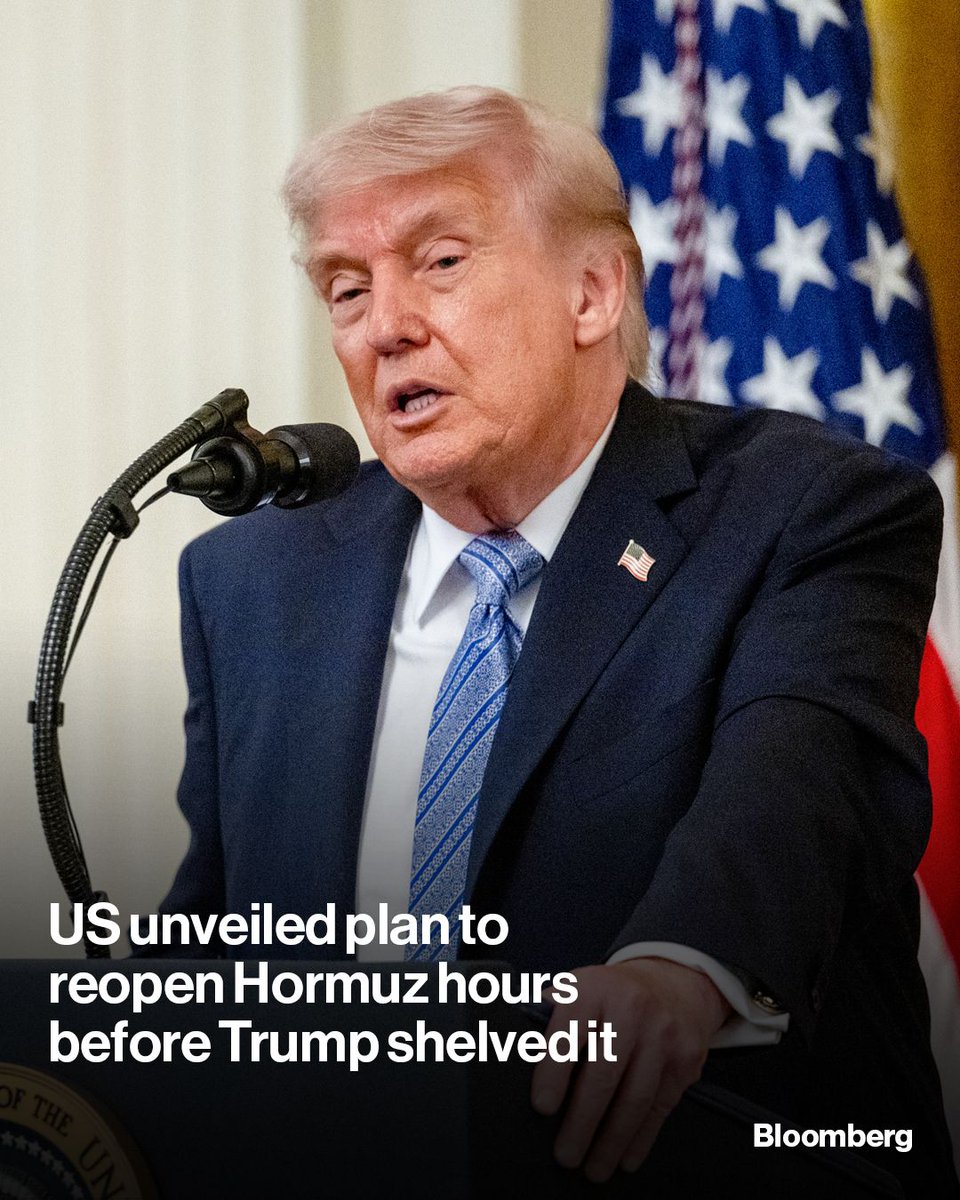
Top US officials spent Monday and Tuesday offering new details on the role the US military will play in helping ships pass through the Strait of Hormuz.
Hours later, President Donald Trump shelved the operation entirely after being warned it risked escalating a conflict he is eager to bring to an end. https://t.co/881piN8jht
📷: Daniel Heuer/Bloomberg
With Italian salaries having stagnated for decades, Milan's house-price-to-income ratio (a popular metric of housing affordability) is now worse than London's. https://t.co/XTvwA9wbL6
“ Nixon aveva ragione in No More Vietnams: Quando l’America combatte, combatta per vincere con forza schiacciante. Non mandare mai truppe senza interessi vitali in gioco. Una volta impegnati, mantieni la parola data agli alleati. La pace arriva attraverso la forza, non la debole
South Vietnam didn’t fall because it was beaten. It fell because it was betrayed.
Fifty-one years ago today, April 30, 1975, the last American helicopter lifted off the Saigon embassy roof.
We had won. Nixon and Kissinger’s Paris Peace Accords forced the North to recognize South Vietnam’s sovereignty. America promised air power and supplies if they violated it. The ARVN was finally ready to defend itself.
Then Watergate. Democrats won huge majorities in 1974. They slashed aid by over 75%, banned any U.S. response to Soviet rearmament of the North, and watched as the Communists violated every agreement.
No bullets. No gas. No tires for their Jeeps.
South Vietnam collapsed—not from lack of courage, but abandonment by the same Democrats that sent our sons to die there a decade earlier.
What followed wasn’t peace. It was hell.
The Domino Theory wasn’t wrong. Cambodia and Laos fell. Pol Pot—praised by the American left as “Cambodia’s George Washington”—murdered 1/3 of his own people.
A million sent to re-education camps in Vietnam. Half a million murdered. Two million boat people fled; nearly half a million drowned.
I was eight, standing in a church hall in Arkansas, looking up at a South Vietnamese flag on a refugee’s lapel. I just wept and said “I’m sorry” over and over.
We should all still be sorry.
This wasn’t inevitable. It was engineered in Washington.
Just like the fall of China in 1949. Christian anti-Communist leaders betrayed by Democrats in both cases—Chiang by Truman, Diem by JFK—then the deluge.
Nixon was right in No More Vietnams: When America fights, fight to win with overwhelming force. Never send troops without vital interests at stake. Once committed, keep your word to allies. Peace comes through strength, not weakness.
We forgot those lessons.
In 2021, Biden gave us Saigon 2.0 in Kabul. Allies abandoned. Billions in weapons to the enemy.
Desperate people clinging to aircraft. Women enslaved again. Credibility shattered. Then came Ukraine.
It’s dangerous to be an American ally when Democrats hold power.
The men who fought in Vietnam—American and South Vietnamese—were heroes. They didn’t lose. They were betrayed.
Fifty years on, remember why Saigon fell. Honor that noble cause. Resolve: No more Vietnams. No more Afghanistans. No more betrayals.
America must lead with strength, clarity, and resolve. Freedom isn’t free. The price of abandoning it is always paid in blood.
I wrote a longer essay detailing this. You should read it. Link in my bio.
Never forget.
The US has pivoted to a full economic blockade of Iran. You can tell it's highly effective by the state of agitation in Iran, which has descended into infighting on how to deal with this. Economic warfare isn't perfect, but it's better than actual war...
https://t.co/swG2f6AUgF
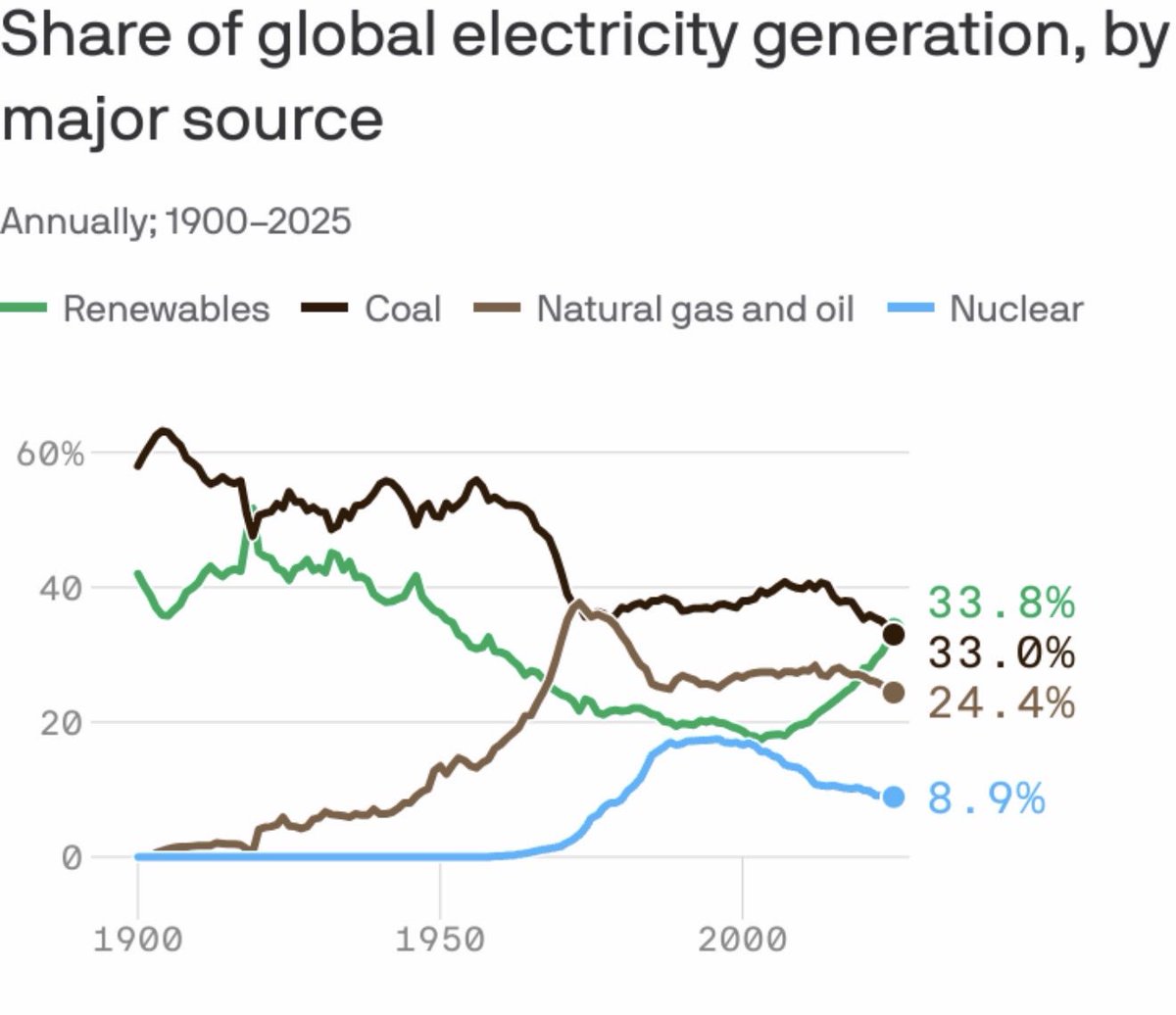
Solar met 75% of global electricity demand growth in 2025. Clean power covered all new demand, so fossil generation didn’t rise for the first time since 2020.
Solar electricity is on track to become by far the biggest source of power.
le nazioni beneficiarie devono impegnarsi per mercati più liberi, tasse più basse, diritti di proprietà più forti, contratti eseguibili, tribunali affidabili e un vero coinvolgimento con il capitale privato — altrimenti niente più soldi americani.
Trump just blew up the Deep State’s foreign-aid racket.
Trump & Rubio’s new “Trade Over Aid” policy is simple and revolutionary: no more blank checks or "Forever Aid".
Instead, recipient nations must commit to freer markets, lower taxes, stronger property rights, enforceable contracts, reliable courts, and real engagement with private capital — or no more U.S. money.
Real aid should make itself unnecessary. Just like there should be no Forever Wars, there should be no Forever Aid.
After World War II we turned Europe and Japan, and later South Korea and Taiwan, into economic powerhouses through exactly these principles. We know what works.
But in much of the Third World, Democrats applied the same condescending socialist model they used in America's inner cities, creating permanent dependency and bureaucratic empires.
As in Detroit, they enrich NGOs and Deep State bureaucrats and contractors by keeping people poor.
Trump promised Commerce Not Chaos. Capitalism over socialism. Strong, self-reliant partners instead of dependent clients. He's applied that to alliances and trade deals. Now he's going after foreign aid.
No nation was ever subsidized into greatness. Men, families, and countries rise by building, producing, and trading — not by waiting for the next check from Washington.
Our help should actually help.
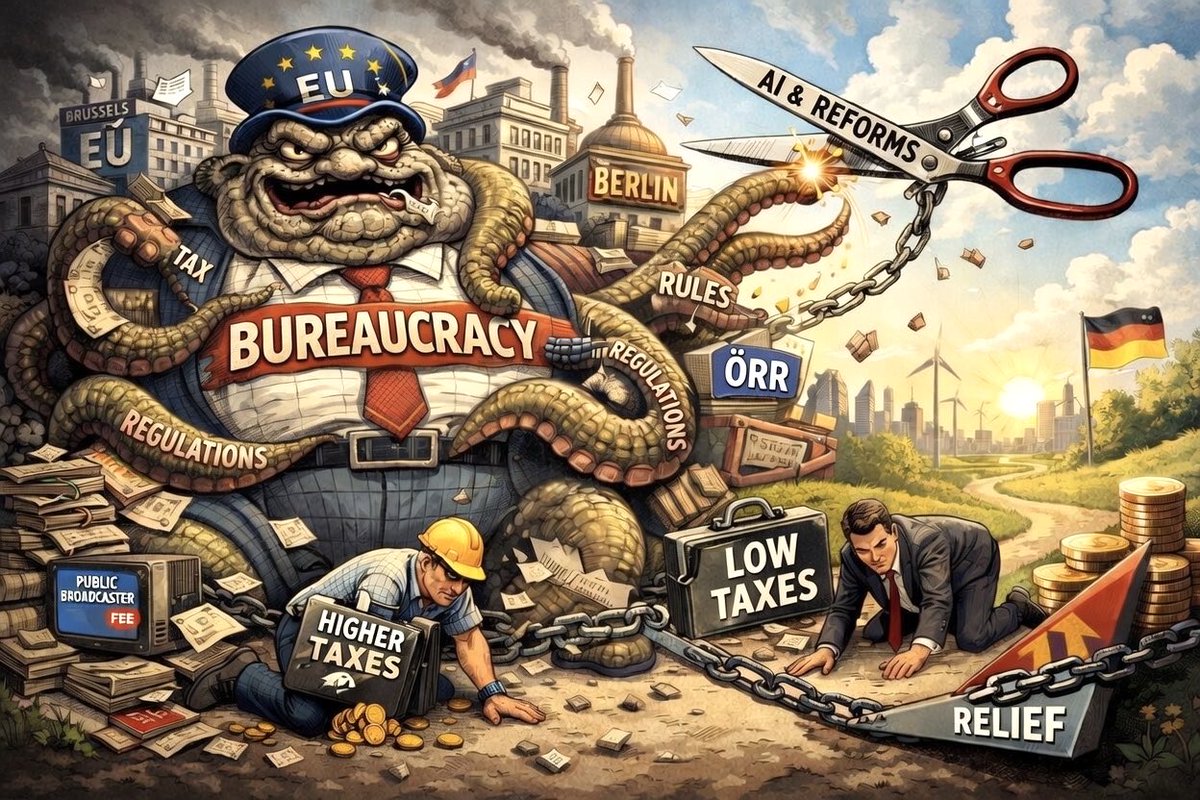
La burocrazia statale della Germania non è più solo sovradimensionata. È diventata un sistema gonfio che sta lentamente strangolando il paese. La Germania oggi impiega circa 5,5 milioni di persone nel settore pubblico
…
E con quei soldi cosa fare? Un vero sollievo fiscale…
Germany’s state bureaucracy is no longer just oversized. It has become a bloated system that is slowly strangling the country. Germany today employs roughly 5.5 million people in the public sector across all levels, from the EU to the federal government, the federal states, the districts, and the municipalities, with hundreds of thousands more in public broadcasters, regulatory agencies, welfare administrations, foundations, and all the surrounding para-state structures.
The full annual cost per public sector employee, including salary, social contributions, pensions, and overhead, averages around 80,000-85,000 euros. That means Germany is burning through roughly 500 billion euros every single year just to feed an apparatus that produces little real economic value and instead exists primarily to regulate, control, prohibit, redistribute, and administer itself.
This is not a normal state anymore. It is a self-service machine for unelected bureaucrats and their public-sector interests. And while the overall economy weakens, industry leaves, energy costs remain absurd, and taxpayers get squeezed harder every year, this nine-to-five apparatus just keeps growing.
A serious, aggressive reform program based on AI, digitalization, ruthless task elimination, and structural downsizing could easily cut this bloated system by 45%-50% or more. That would mean shrinking the public workforce from 5.5 million to roughly 2.8-3 million people. The direct personnel savings alone would amount to 200-230 billion euros per year.
But that is only the beginning. Germany is drowning in regulation. More than 40,000 EU and national rules crush companies, self-employed people, and ordinary citizens with compliance burdens, documentation requirements, reporting chains, and legal uncertainty. If 70%-80% of these rules were abolished or radically simplified, another 90-120 billion euros per year could be saved.
Add to that the abolition or privatization of the public broadcasters and the closure of countless ideological agencies, foundations, and redundant entities, and another 12-18 billion euros would be freed up. In total, Germany could realistically save 300-370 billion euros every year, and in a genuinely ambitious scenario even more than 400 billion.
That is roughly 7%-8.5% of GDP. Real money. Not symbolic reform. Not cosmetic trimming. Real money currently being wasted on a control apparatus that has become totally detached from the productive economy.
And what could be done with that money? Real tax relief. The top income tax rate plus the solidarity surcharge could be cut from 45% to roughly 25%. The entry rate could fall to 10%. For ordinary workers, that would mean a reduction of around 35%-45% in the effective tax burden. Corporate taxation, currently around 29%-32% in total, could be reduced to 15%. That would make Germany investable again. It would reward work, entrepreneurship, and productivity instead of punishing them.
Germany does not have a revenue problem. It has a massive spending problem and a bureaucracy problem of historic proportions. As long as politicians refuse to cut this dead weight with the same enthusiasm they show when raising taxes, productive citizens and companies will continue to be bled dry to finance a system that mainly exists to preserve itself.
The equation is simple: cut the bureaucracy in half, and taxes on productive people and businesses can fall by 30%-45% without touching core state functions. Everything else is just political fraud.