I've had access to Strawberry/OpenAI o1 for a month. It is amazing in many ways, still limited in others, and a sign of the future that we should be paying attention to. https://t.co/FPe4J4xqLu
Private schools are promoting advance fee payment as a way to avoid VAT on school fees under a future Labour government.
We're concerned that schools and parents are taking a risk they don't understand, and it could all become a big mess. Thread:
@British_Airways you cancelled flight BA893, giving no options to rebook. How do I even know you’re working to rebook on a different flight if I’m unable to reach you by phone and you are not responding on Twitter or Messenger, the only places I was able to find for messaging???
Prove you can do hard things
When a teenager asks why they need to learn calculus, what should you say?
You know they will never use it in adulthood, outside of certain career choices.
You could say, “It’ll help you get into college,” but then they’re left wondering why college cares if you know calculus.
And once they’re in college, maybe you could say, “To get a good job,” but why would a potential hirer care how you did in multivariate calculus if your job doesn’t require any knowledge of calculus?
But I recently realized there is a very good reason to take Calculus. It’s to prove you can do hard things.
The ability to do hard things is perhaps the most useful ability you can foster in yourself or your children. And proof that you are someone who can do them is one of the most useful assets you can have on your life resume.
Our self-image is composed of historical evidence of our abilities. The more hard things you push yourself to do, the more competent you will see yourself to be.
If you can run marathons or throw double your body weight over your head, the sleep deprivation from a newborn is only a mild irritant.
If you can excel at organic chemistry or econometrics, onboarding for a new finance job will be a breeze.
But if we avoid hard things, anything mildly challenging will seem insurmountable.
We’ll cry into TikTok over an errant period at the end of a text message. We’ll see ourselves as incapable of learning new skills, taking on new careers, and escaping bad situations.
The proof you can do hard things is one of the most powerful gifts you can give yourself.
My goal with our kids is to avoid lying to them as much as possible.
I won’t tell them that calculus is super important or even that grades are super important. The truth is, they aren’t, so long as you have other plans.
Calculus is a great way to prove you can do hard things if you have no other proof to show.
But if you’re learning programming and building apps in your free time, or winning soccer championships, or writing a novel, then you are doing hard things. Probably harder than Calculus.
This is also why there’s so much survivorship bias and bad advice in the “C students hire A students” trope. Most C students are not doing other hard things instead of school. They’re just goofing off, so they end up working for the A student.
But some C students are getting C’s because they’re obsessed with other projects. Hard projects. And that obsession with doing hard things lets them blow past their Excellent Sheep peers over time.
So if you have a C student who’s obsessed with something hard, you probably don’t have to worry. If they’re getting high and watching TikTok, well…
I don’t particularly care what grades my kids get once they start school. But I do care that they consistently prove to themselves they can do hard things. If Calculus is how they want to do it, fine, but there are many, many more options.
And if you’re not someone who knows they can do hard things, find a way to prove it to yourself.
Build a habit, learn a skill, create something, whatever it is that turns your default stance on challenges from “that seems hard” to “I can figure it out.”
Create proof you can do hard things.
Not going to lie, I feel pretty awful about the AI racing dynamics playing out right now. I think it's a really bad thing, and that AI companies should agree to slow down the growing rate of compute acquisition. I'm not saying they should stop doing research.
On the other hand, we need them to do research now more than ever. We need to do research on understanding how these systems actually work, so we can understand how to build them safely.
The problem is that doing this takes time, and the rate of improvement in these systems is insane. GPT-2 was only *four years ago*. If you're not familiar with, or don't really remember, GPT-2 examples, go look some up. They were so impressive four years ago and now they're easily embarrassed by open source models that anyone can access today.
OpenAI didn't release the full sized model of GPT-2 because they were concerned it might not be safe given the huge jump in capabilities it exhibited compared to previous language models. I think they were right to exercise caution here - just four years later, and we have LLMs capable of explaining complex scientific concepts, teaching you to program, or summarizing basically any few pages of text better than most grad students.
And now, that rate of progress is poised to *speed up*, because a bunch of big actors just started pumping tons of money into the space, because of ChatGPT - and probably because of image models too, but I suspect ChatGPT had a larger impact on this than all the image models combined. And yeah, LLMs are a big deal. They're not just hype. I'd recommend start learning to use them well, because I think they'll be really useful tools (they already are if you know how to use them). And also, releasing these systems is absolutely pouring fuel on the fire.
The race is on, and it's incredibly important we don't race. Racing is so bad for humanity. Racing is bad for you and me personally. Racing is gambling with everyone alive today and all our descendants. There has never been an erosion of the commons so tragic as this. This is significantly worse than climate change. This is significantly worse than the nuclear arms race during the cold war, during which ~120,000 nuclear warheads were created.
If you don't already see it, it's hard for me to describe why this technology is different than any other technology. Here's one approach: we've never been able to get any other animals or technology to talk coherently. We've selectively bred animals for thousands of years, but we've never gotten animals that can speak fluently. Parrots can speak a few words or phrases, chimps can learn some sign language, but nothing even remotely approaching ChatGPT. We've had automated bots online before, but they were way dumber than chimps or parrots, and only useful for very narrow things.
Now we've trained a system to talk. We've trained it to understand things. Like go ask ChatGPT something and then go ask a ten year old the same thing. Ask it to play games or write poetry or make up a story. Ask it to help you think through a problem, or to give you advice on your life. Tell it about a friend's problem, and first write down what advice you would give, and then ask it and compare. See how a ten year old does on these tasks (I bet worse on most, better on some). These are real cognitive capabilities. We've created AI systems capable of understanding what we're asking for, of reasoning about things. I cannot emphasize enough how insane this is.
As previously noted, i really read everything that #ZoltanPozsar puts out...His Aug 24th piece was terrific again. In this #thread I summarize the most important takeaways: 🧵
@hulu_support how can I cancel my subscription when I’m unable to login (“your login has been blocked”) despite my credentials being correct? I can’t even get in touch with support because I can’t log in!!!
@British_Airways how can I ever book a flight for my family if your website stops me from booking and asks me to call you but my calls are hung up because you are “too busy”?
Things are moving so damned fast as all digital assets start move onto blockchains... this trend will see big up and downs but the next 10 years will be a total revolution in trust-based ownership and transfer of digital assets and value.
https://t.co/OxJQmfJ4Bn
To combat illegal parking in their neighborhood, 66 households in Shenyang installed a massive chain lock made with 66 personal padlocks to their gate—each resident can open the gate w/ their own keys. This turns out to be a true, decentralized, free *blockchain*
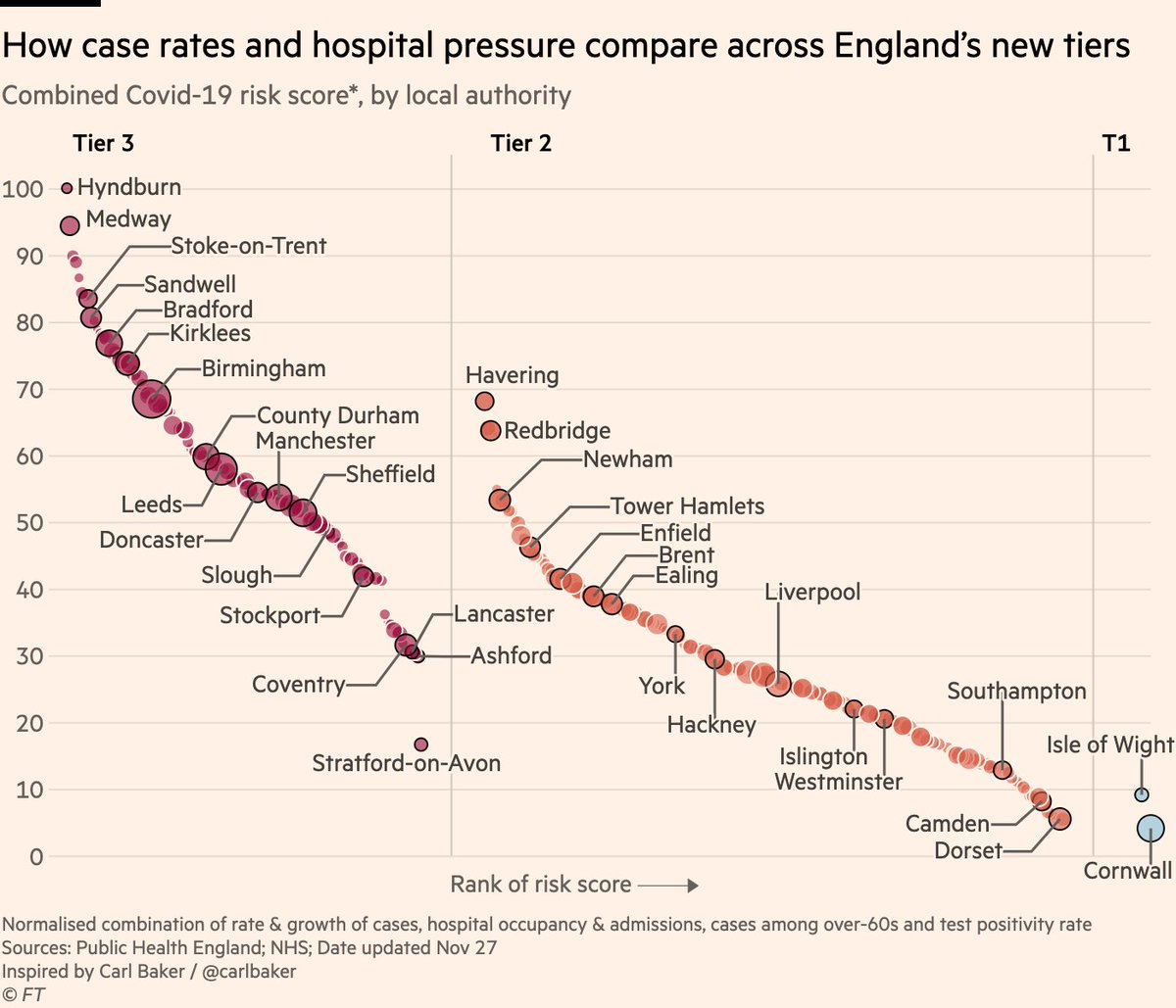
NEW: here’s the definitive chart on which parts of England have been hard-done-by or "let off" by the new tiers.
This one combines all the metrics the govt says it’s using:
• Cases (overall rate, rise or fall, and over-60s)
• Hospital occupancy & admissions
• Positivity rate
4/ I actually find it amazing to be able to work with the team on my own schedule and for the rest of the team to be able to do the same, allowing us to be productive when we actually are, instead of when it is expected