It's hot. Put a dish of water outside today with a few stones in it.
During a heat wave, birds and bees need water as much as food. Honey bees drink it, haul it back to the hive, and use it to help cool the brood.
But bees need a safe place to land. A deep bowl of water can become a trap.
The fix is simple. Fill a shallow dish with pebbles or stones and add water until the tops stay dry. The bees get islands to stand on, and birds get a shallow edge to drink and bathe.
Set it in the shade and dump and refill it every day. Fresh water in the heat, no mosquito problem.
Two minutes, a dish, and a handful of rocks can make the hottest days a little easier for everything sharing your yard.
Bees lives less than 40 days, visit at least 1000 flowers and produces less than a teaspoon of honey. For us it is only a teaspoon of honey, but for the bee it is a lifetime of work.
Thank You Bees!
When bees get tired after long periods of flying and gathering pollen, they sometimes rest or fall asleep inside flowers.
Flowers can provide warmth, shelter, and a safe place for bees to recover before continuing their search for nectar and pollen.
People don't realize that we are a star to other planets.
8 billion people. 195 countries. 7 continents.
Reduced to a single dot, in someone else's sky.
Stop scrolling and realize where you are right now.
The Pale Blue Dot is one of the most striking images ever taken of our planet. In 1990, the Voyager 1, already far beyond the outer planets, turned its camera back toward home from about 6 billion kilometers away. Earth appeared not as a world, but as a tiny, almost invisible speck of light.
For Carl Sagan, that speck carried enormous meaning:
“That dot is us. Every person who has ever lived—every story, every triumph, every conflict—unfolded on that single, fragile point. All of human history exists there, suspended in a beam of sunlight.
It’s a humbling perspective. Earth is, for now, the only place we know that can support life. There’s no easy escape, no second home waiting for us. That distant image reminds us how small we are—and how important it is to take care of each other, and the only world we share.”
You are looking at the first photograph of another multi-planet solar system.
A real image of a real sun-like star, with real planets orbiting it — taken by a telescope on Earth.
We have been alive for 300,000 years as a species. This is the first time we have ever seen another sun's family.
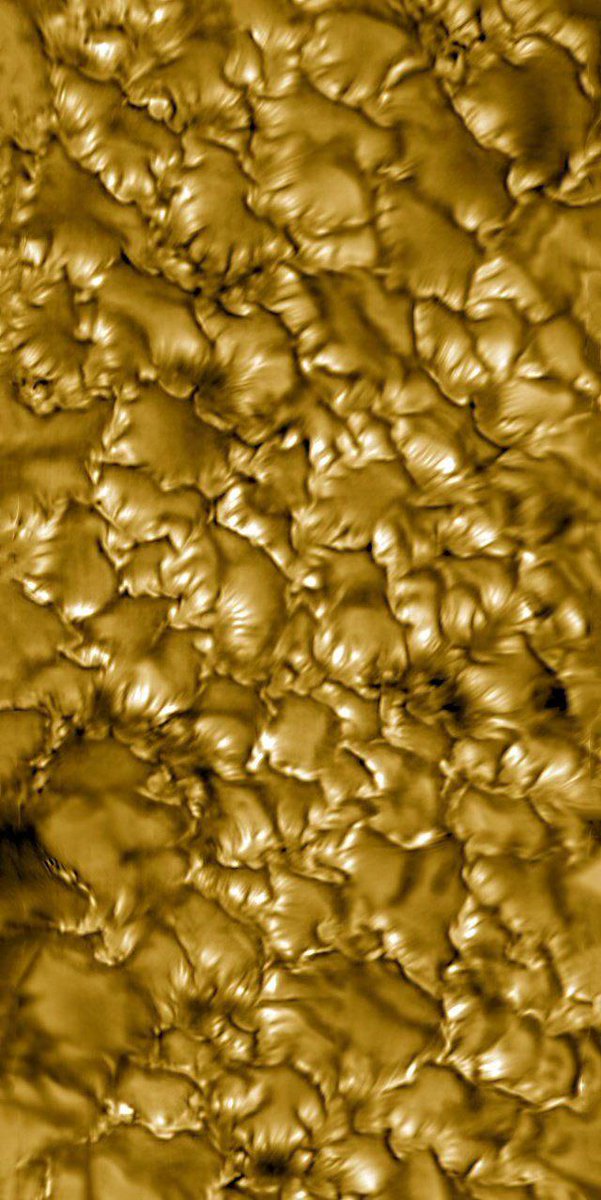
This is the surface of the Sun, the most detailed image ever taken.
The Daniel Inouye telescope allows you to see not only granules in the Sun's photosphere, but also formations known as photospheric striations (can be translated as "photospheric grooves"). These are white thin stripes on the granules. They are magnetic in nature and are only 20 kilometers wide.