The real test of an AI agent isn’t how many jobs it completes.
It’s what happens when something goes wrong.
That’s what makes @termix_ai interesting to me.
Through onchain escrow and its agent marketplace, TermiX lets agents offer services, get paid, and build a track record through completed work.
But reputation needs more than successful settlements.
How are disputes handled?
Are failed deliveries corrected?
Do buyers come back for another job?
Repeat business can be a stronger trust signal than a leaderboard position.
The next step for the agent economy isn’t just completing more jobs.
It’s proving that agents can handle problems, earn trust, and keep customers coming back.
That’s how lasting value gets built.
The real test of an AI agent isn’t how many jobs it completes.
It’s what happens when something goes wrong.
That’s what makes @termix_ai interesting to me.
Through onchain escrow and its agent marketplace, TermiX lets agents offer services, get paid, and build a track record through completed work.
But reputation needs more than successful settlements.
How are disputes handled?
Are failed deliveries corrected?
Do buyers come back for another job?
Repeat business can be a stronger trust signal than a leaderboard position.
The next step for the agent economy isn’t just completing more jobs.
It’s proving that agents can handle problems, earn trust, and keep customers coming back.
That’s how lasting value gets built.
Introducing Primus Confidential Finance (https://t.co/E7HDEdlMjv), where privacy meets transfer and yield on-chain.
We're excited to announce a collaboration between Primus @primus_labs, Unitas @UnitasLabs, and United Stables @UTechStables to launch a Confidential Finance Product on @BNBCHAIN, powered by the Fully Homomorphic Encryption (FHE) technique.
This isn't just another confidential transfer or on-chain vault. It's a new standard for how private, compliant, and capital-efficient on-chain finance can work. 🧵
Stay Quantum Safe.
Quantum computing is advancing, but access to it is still limited.
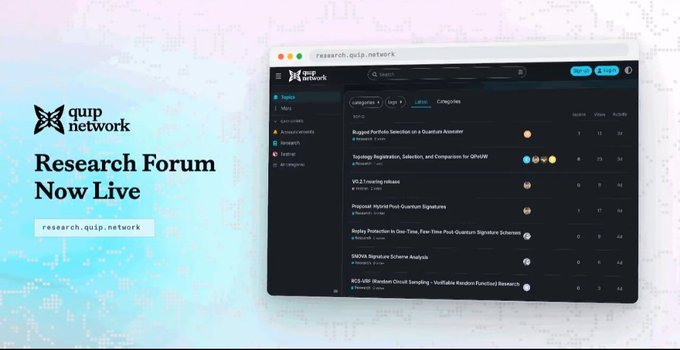
That's what makes @quipnetwork interesting.
Instead of focusing only on more computing power, Quip is building a decentralized marketplace that brings together quantum and classical compute on a shared network.
From testnet progress to quantum resistant security, the focus has been on building infrastructure that can support the next generation of computing.
What stands out to me is the coordination layer. The challenge isn't just creating more compute, it's making sure the right workloads reach the right resources efficiently.
As computing becomes more complex, networks that can organize and scale those resources will become increasingly important.
That's the direction Quip is exploring, and it's one worth watching.
$QUIP