Devoted technologist and inventor. When someone says something you’re trying to do is impossible, you are on the right track! b64=TmV3IEtleX4+MHgyRTQ5QTFFOQ==
One of my personal favorite features announced at WWDC will I suspect be a sleeper hit: container machines, allowing your Mac to run a lightweight, persistent Linux environment with your home directory and repos automatically mounted: https://t.co/dOBdfOOVxC
WE DID IT ! We just sent the first layer 1 blockchain transaction over lora radio. No internet. no cellular. no satellite.
193 bytes, signed with ed25519, validated locally, on real hardware. @lilygo9 t-beam to lilygo t-beam, 868 mhz, two years of work landing in a single packet.
What does this actually mean ?
The entire crypto industry talks about decentralization and builds everything on top of an internet connection. as if it's never occurred to anyone that a government would cut that connection the second it serves them. @web3privacy has been screaming about this for years. They're right..
580 million people hold crypto. three trillion dollars on chain. all of it depends on a server somewhere being online. wait until they cut your internet. your wallet won't be drained. it'll just be worth nothing.
Arxia removes that dependency at the protocol layer. block lattice consensus. orv stake-weighted voting. crdt reconciliation when partitions reconnect. unique nonce per wallet, signed receiver field, four-tier finality with explicit caps so you always know what guarantee you're holding. 34 of 34 protocol tests passing. fully open source.
What we aim for ? A layer 1 that doesn't die when the network does. a wallet that works in a blackout, a war zone, a kill switch event, a solar storm, a protest where they pull the plug. the blockchain that runs when the internet is dead.
today we proved the radio leg works. next is the mesh, the field deployment, the public testnet, the ido, the mainnet.
@LoRaAlliance
🚨 BREAKING: Someone just built a tool that lets you talk to your codebase like it's a database.
It's called GitNexus.
One command turns your repo into a queryable knowledge graph:
npx gitnexus analyze
Now you can ask questions no search tool could answer before:
"What breaks if I change this function?"
"Which execution flows touch authentication?"
"What's the blast radius of my uncommitted changes?"
Here's why this is different from code search:
Code search finds text matches.
GitNexus finds relationships.
It indexes:
→ Every function, class, method, interface
→ Every import, call, inheritance chain
→ Every execution flow from entry point to completion
→ Every functional cluster with cohesion scores
Then exposes 7 MCP tools so your AI agent can query it:
> impact - "47 functions depend on this, here's the risk by depth"
> context - "This function is called by 8 things, calls 3 things, participates in 2 execution flows"
> detect_changes - "Your uncommitted changes affect LoginFlow and RegistrationFlow"
> rename - "Renaming this touches 5 files, here's a dry run"
> cypher - Raw graph queries for anything else
The insight:
Your codebase is already a graph. Functions call functions. Classes inherit classes. Modules import modules.
GitNexus makes that implicit structure explicit and queryable.
16.8K stars.
I'll put the GitHub in the comments.
Holy shit... Microsoft open sourced an inference framework that runs a 100B parameter LLM on a single CPU.
It's called BitNet. And it does what was supposed to be impossible.
No GPU. No cloud. No $10K hardware setup. Just your laptop running a 100-billion parameter model at human reading speed.
Here's how it works:
Every other LLM stores weights in 32-bit or 16-bit floats.
BitNet uses 1.58 bits.
Weights are ternary just -1, 0, or +1. That's it. No floats. No expensive matrix math. Pure integer operations your CPU was already built for.
The result:
- 100B model runs on a single CPU at 5-7 tokens/second
- 2.37x to 6.17x faster than llama.cpp on x86
- 82% lower energy consumption on x86 CPUs
- 1.37x to 5.07x speedup on ARM (your MacBook)
- Memory drops by 16-32x vs full-precision models
The wildest part:
Accuracy barely moves.
BitNet b1.58 2B4T their flagship model was trained on 4 trillion tokens and benchmarks competitively against full-precision models of the same size. The quantization isn't destroying quality. It's just removing the bloat.
What this actually means:
- Run AI completely offline. Your data never leaves your machine
- Deploy LLMs on phones, IoT devices, edge hardware
- No more cloud API bills for inference
- AI in regions with no reliable internet
The model supports ARM and x86. Works on your MacBook, your Linux box, your Windows machine.
27.4K GitHub stars. 2.2K forks. Built by Microsoft Research.
100% Open Source. MIT License
🔥 PRODUCTION IS LIVE on PeerTracer Nodes! 📷We're dropping FREE PeerTracer nodes to folks on ISPs we DON'T have covered yet. Join the revolution: map the real internet, expose hidden routes, and EARN $PTRACE crypto rewards while you sleep! 📷📷DM us your ISP RIGHT NOW if you want one FREE! Who's in?! #PeerTracer #DePIN #Crypto #EarnWhileYouMap
Big ISP giants like flex their size like they're the Goliath of broadband. Meanwhile, your local ISP is out here slinging symmetrical gig speeds, zero-throttling, and actual human customer service that picks up on the first ring. Size isn't speed.
Why does my house have to be buried 9 hops deep in Spectrum's network before it even sniffs the real internet? It's like living in the suburbs of the suburbs—sure, the rent's cheap, but every packet has to commute. #LatencyLife#TracerouteTorture
Holy shit… the exploitation of CVE-2025-55182 has reached a new level. There’s now a publicly available Chrome extension on GitHub that automatically scans for and exploits vulnerable sites as you browse. Absolutely wild. 🤦♂️
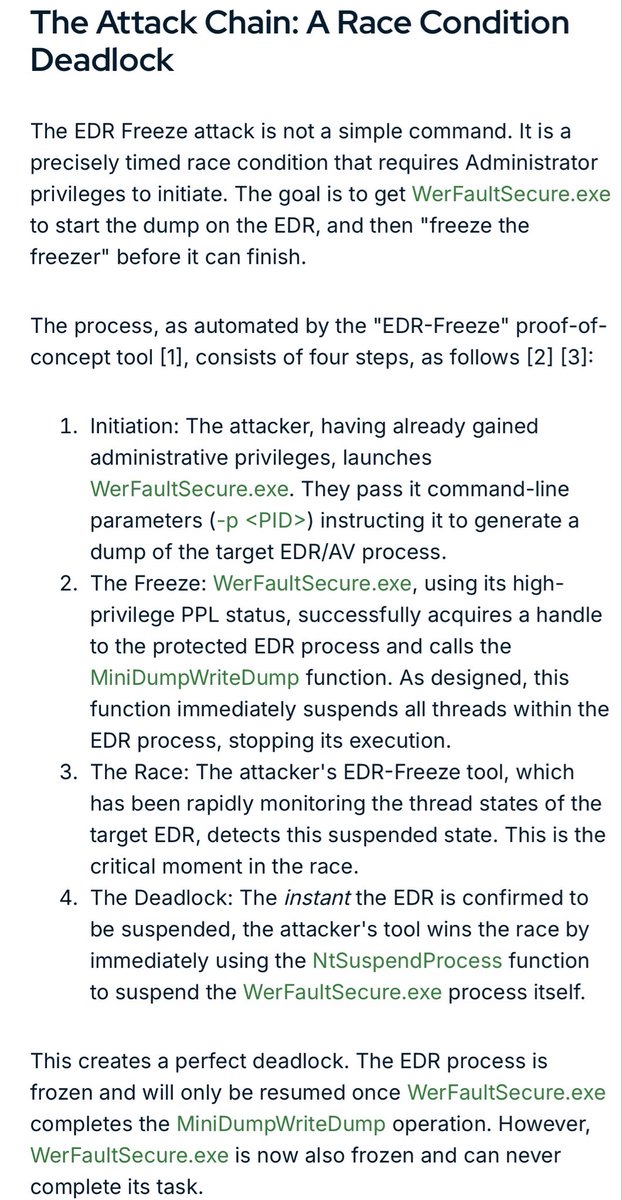
A new evasion technique known as "EDR-Freeze" has emerged, changing the way attackers neutralize endpoint security. Unlike traditional methods that attempt to crash or terminate security software (which often triggers alerts), EDR-Freeze suspends the security process entirely, rendering it "comatose" but technically alive. This attack is particularly dangerous because it operates entirely in user mode, meaning it does not require the attacker to bring a vulnerable driver (BYOVD) or exploit kernel-level flaws. Instead, it abuses legitimate Windows error reporting tools to freeze Endpoint Detection and Response (EDR) agents, creating a blind spot where malicious activity can occur undetected.
https://t.co/60aVeVHl2V
We are upgrading our #relay encryption algorithm for improved security. In upcoming releases, Arti and #Tor will both support a new encryption algorithm called Counter Galois Onion (CGO). CGO prevents attackers from tampering with encrypted traffic, adds forward secrecy, and brings Tor's encryption up to modern standards. https://t.co/o7YDZo3E2G