ENTRENAMIENTO EN HIPOXIA INTERMITENTE. La respuesta del VO₂máx al entrenamiento hipóxico depende del protocolo y del nivel de entrenamiento. Vivir alto y entrenar bajo beneficia especialmente a deportistas, mientras el ejercicio en hipoxia y la exposición pasiva resultan más eficaces en personas no entrenadas. (lee el artículo completo en BLOG JL Chicharro en https://t.co/ghlyA0rsYU) https://t.co/uEfjmhyJWF
Your muscles don't exercise in isolation. A new study reveals that sprint-interval exercise triggers coordinated signaling between muscle, fat tissue, liver, brain, pancreas, and immune cells through hundreds of proteins that reshape metabolism across your entire body.
Researchers tracked nearly 3,000 proteins in blood before, immediately after, and 3 hours following two types of exercise in young, healthy males. Sprint-interval exercise consisted of six 30-second all-out cycling bursts with 4-minute rests between sets. Moderate-intensity exercise was 90 minutes of continuous cycling.
The difference was striking. Sprint intervals altered 714 proteins immediately after exercise, more than 98% of which increased. Moderate-intensity exercise changed only 7 proteins at the same timepoint. The number increased to 19 after 3 hours, but remained dramatically lower than the sprint response.
Think of your bloodstream as a communication highway. After intense exercise, it floods with signals that travel to different organs. The study identified proteins originating from muscle, fat tissue, liver, brain, immune cells, pancreas, and other organs.
Skeletal muscle proved particularly sensitive to intensity. The researchers isolated human muscle cells and electrically stimulated them to mimic different exercise types. Simulated sprint exercise released 212 proteins into surrounding fluid. Simulated moderate exercise released only 9.
But muscle wasn't working alone. Sprint exercise increased proteins from the pituitary gland that regulate stress responses, factors from the brain involved in blood vessel relaxation, and immune proteins that modulate inflammation. The pattern suggested coordinated signaling across multiple organ systems.
The study also examined exercise metabolites, small molecules involved in energy production and cellular signaling. Sprint exercise immediately increased lactate, pyruvate, malate, and the obesity-suppressing compound N-lactoyl-phenylalanine (Lac-Phe). Moderate exercise showed a delayed response, with fatty acids rising primarily at the 3-hour mark.
To understand where these signals end up, researchers exposed human fat cells to blood plasma collected after each exercise type. Plasma from sprint exercise triggered extensive changes to fat cell gene activity, affecting 1,128 genes. Plasma from moderate exercise changed only 25 genes.
The remodeled fat cells showed activation of pathways controlling hormone responses, nutrient sensing, and fat breakdown. Several immune signaling receptors increased, suggesting exercise plasma primes fat tissue to respond to inflammatory signals differently.
The findings held up in real tissue. When researchers biopsied abdominal fat before and 3 hours after a maximal treadmill test, 418 genes overlapped with those changed by sprint plasma in isolated cells. This confirms circulating factors from intense exercise genuinely alter fat tissue biology.
Not all changes disappeared with training. After 8 weeks of regular exercise, the same intensity-dependent patterns persisted when participants repeated the acute tests. Growth hormone, von Willebrand factor, and POMC still increased more after sprints than moderate sessions.
The clinical relevance became clear when researchers cross-referenced exercise-responsive proteins with a database tracking 53,026 people for disease outcomes. They identified 143 proteins increased by exercise that associated with lower disease risk.
Of the 33 proteins specifically protective against type 2 diabetes, metabolic disorders, and obesity, 32 were elevated by sprint-interval exercise. Only 3 were elevated by moderate-intensity exercise. Proteins like ADGRG2, FGFBP1, and MXRA8 consistently showed strong protection across multiple metabolic conditions.
This isn't an argument against moderate exercise. The sustained energy demands of longer duration activity clearly stimulate different adaptive pathways, particularly in the liver. Proteins like IGFBP1 and follistatin increased exclusively after moderate exercise, likely reflecting sustained shifts in insulin and glucagon signaling.
The study reveals exercise intensity as a distinct variable that determines which protective signals reach your tissues, which organs respond, and potentially which disease risks decrease. The time-efficient nature of high-intensity exercise appears to work through fundamentally different signaling mechanisms than longer moderate sessions.
Key findings:
• Sprint-interval exercise altered 714 blood proteins immediately post-exercise vs. 7 for moderate-intensity exercise
• 25% of all detectable proteins changed after sprint exercise, with >98% increasing rather than decreasing
• Muscle cells released 212 proteins after simulated sprint exercise vs. 9 after simulated moderate exercise
• Sprint exercise plasma changed 1,128 genes in human fat cells vs. 25 genes for moderate exercise plasma
• Of 33 proteins protective against diabetes and obesity, 32 increased after sprint exercise vs. 3 after moderate exercise
• Intensity-dependent responses persisted after 8 weeks of training, suggesting they reflect relative intensity rather than training status
• Exercise metabolites showed distinct temporal patterns: lactate and Lac-Phe peaked immediately after sprints, while fatty acids increased later
• Moderate exercise uniquely increased liver-derived proteins (IGFBP1, follistatin) at the 3-hour timepoint
The mechanistic picture is incomplete. The study couldn't definitively prove which organs secrete which proteins, relying instead on tissue-specific gene expression databases and cell culture models. Blood volume shifts during exercise also complicate interpretation, though the findings held after correcting for plasma concentration changes.
The research focused on young, healthy, predominantly male participants. Whether the same intensity-dependent patterns occur in women, older adults, or people with existing metabolic disease remains unknown. The protective associations came from observational data that can't prove causation.
Still, the study offers a framework for understanding why brief, intense exercise produces adaptations comparable to or exceeding longer moderate sessions. The answer appears to lie in differential organ crosstalk triggered by metabolic stress signals that moderate exercise simply doesn't generate.
La suplementación con creatina se utiliza ampliamente en los deportes y es cada vez más popular entre las personas que hacen ejercicio. Aunque el papel fisiológico de la creatina ha sido ampliamente estudiado, la biología de la creatina en condiciones patológicas sigue siendo poco conocida.
Este artículo muestra que la suplementación exógena de creatina promueve la metástasis tumoral a través del mecanismo de activación plaquetaria en varios modelos de ratones y humanos.
Para su revisión:
👇👇👇
🔥 La “zona quemagrasas” existe. La “zona mágica para adelgazar”, no.
La oxidación de grasa alcanza su máximo generalmente al 50–65% del VO₂max y cae a intensidades superiores.
Pero maximizar grasa oxidada durante el entrenamiento ≠ maximizar pérdida de grasa corporal.
Dos conceptos que seguimos confundiendo.
¿Y si envejecer bien dependiera de la calidad de tus mitocondrias, no de su número?
Nueva revisión en Nature Metabolism @NatMetabolism sobre control de calidad mitocondrial (MQC) y longevidad:
🔧 La célula gestiona sus mitocondrias como una fábrica 🏭 inspecciona, repara y recicla lo defectuoso. Mitofagia + biogénesis = dos mitades del mismo ciclo.
⚖️ Envejecer no es perder mitocondrias, es acumular las malas: masa conservada pero disfuncional.
🩸 Contraintuitivo: el NAD+ en sangre total NO cae de forma universal con la edad.
🏃 El ejercicio aeróbico mejora los marcadores de MQC más que el de fuerza.
📄 https://t.co/jAlTNaxC9m
Your body only has a limited number of ways it can move.
Flexion & Extension. Abduction & Adduction. Internal & External Rotation. Pronation & Supination.
Thousands of exercises. Same fundamental movement patterns.
Understanding them can instantly improve how you learn anatomy and analyze exercise form.
Niveles altos de testosterona hacen que los hombres se comporten de forma menos fingida/falsa y que su generosidad no dependa de si alguien los está mirando, mientras que niveles más bajos favorecen una generosidad más dependiente de la mirada ajena, más estratégica o fingida.
لكل طبيب وطالب طب..
لا تستخدم ChatGPT
لا تستخدم Claude
لا تستخدم Gemini
أخطاؤهم كبيرة ، وهلوستهم كثيرة ..
هنا جبت لك 6 منصات ذكاء اصطناعي طبية تقدر تستخدمها وانت واثق 🩺
🚨 ¿Cuánto ejercicio necesitas REALMENTE para proteger tu corazón?
📊 Nuevo estudio en 17.088 personas con casi 8 años de seguimiento:
✅ 150 min/semana de ejercicio moderado-vigoroso (lo que recomiendan las guías) reduce el riesgo cardiovascular un 8-9%.
⚠️ Para reducir el riesgo un 20% necesitas ~340-370 min/semana.
🔥 Para reducirlo un 30% necesitas ~560-610 min/semana.
Imaginar mentalmente contracciones musculares aumentó la fuerza sin hacer ningún ejercicio físico. La aumentó en un 35% en el abductor del dedo meñique y en un 13,5% en los músculos flexores del codo.
¿Cuántas horas necesitas dormir para ralentizar el envejecimiento? 😴
🚨 Nature (500.000+ personas): dormir menos de 6 horas o más de 8 horas se asocia con envejecimiento biológico acelerado.
📉 El rango óptimo: entre 6,4 y 7,8 horas.
🔺 Menos de 6 h: +50% riesgo de mortalidad.
🔺 Más de 8 h: +40% riesgo de mortalidad.
La longevidad también depende de dormir las horas que necesitas.
Revisión sistemática y Metanalisis
No es necesario 10 mil pasos al día con 7 mil pasos diarios se logra disminuir:
✅47% riesgo de muerte por cualquier causa
✅ 25% riesgo cardiovascular
✅ 37% mortalidad por cancer
✅ 14% incidencia de Diabetes
✅ 38% riesgo de demencia
✅ 22% síntomas depresivos
✅ 28% riesgo de caídas
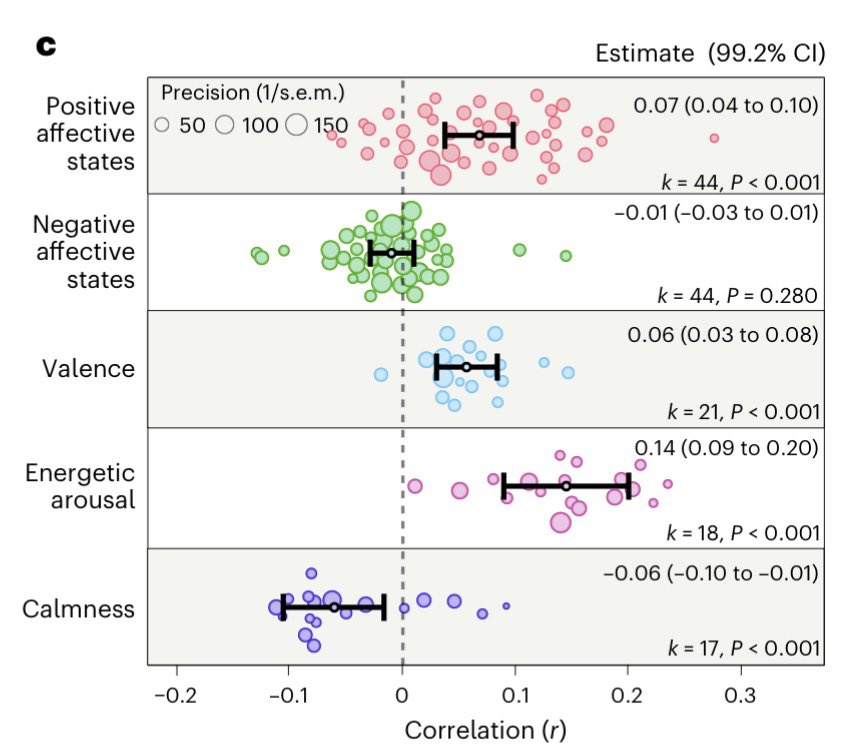
🚨 ¿Cuál es el impacto REAL del ejercicio en tu energía y tus emociones?
Un análisis de ~1.000.000 de horas encontró que pasar de estar sentado a realizar ejercicio se asocia con: ⚡️ +62% más energía 😊 +24% más emociones positivas 🧠 +16% más bienestar emocional
¿Quieres más energía? Entrena.
¿Quieres sentirte mejor? Entrena.
⌚️🚩Tu reloj puede estar engañándote con las calorías que gastas.
📊 Error real al medir las calorías que gastas:
Apple Watch Series: ❌ 14–25% de error
Polar Vantage V: ❌ 16–26% de error
Fitbit Sense: ❌ 13–30% de error
👉 Si te dice “has quemado 2.000 kcal”
➡️ La realidad puede ser 1.400–2.600 kcal
Eso es hasta ±600 kcal de error.
Conclusión:
Los relojes inteligentes no son preciosos para calcular el gasto calórico.
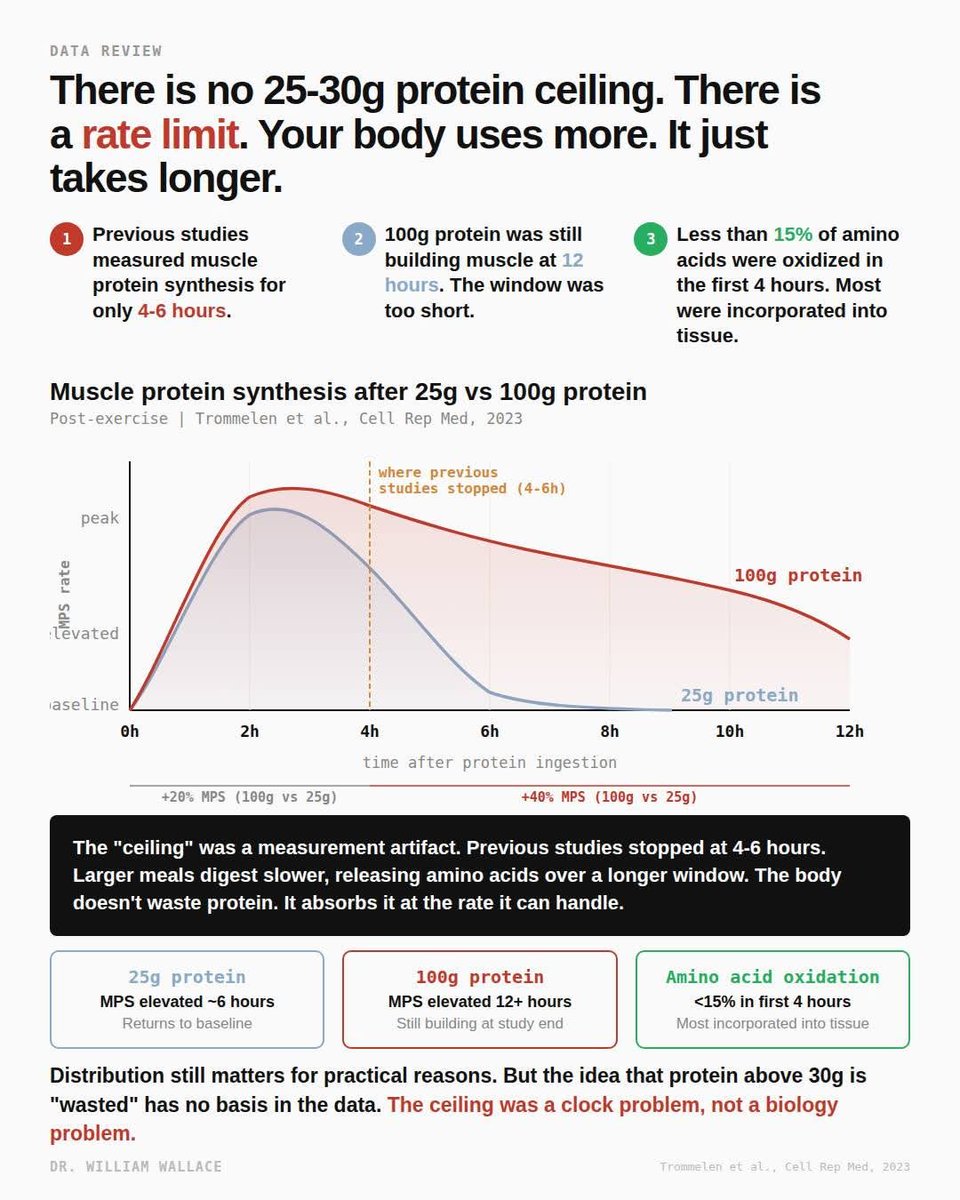
"Your body can only use 25-30g of protein per meal. Anything above that gets wasted."
This claim has been repeated in fitness nutrition for over a decade, and it was built on studies that measured the right thing over the wrong timescale.
Moore 2009 gave six young men 0, 5, 10, 20, or 40g of egg protein after leg-only resistance exercise and tracked muscle protein synthesis for four hours. MPS plateaued at 20g. Witard 2014 repeated a similar dose-response with whey protein after unilateral leg exercise in 48 resistance-trained men and found MPS rose 49% at 20g and 56% at 40g over four hours, with the authors concluding 20g was sufficient for maximal stimulation. Case closed, or so it seemed. The problem wasn't the dose. It was that a 4-hour window captures the peak response to 20g but only the opening chapter of what 40g is doing.
Think of digestion as a funnel with a fixed flow rate. Pour a cup of water through it and it drains in minutes. Pour a gallon and it doesn't overflow. The funnel just drains at the same rate over a longer period. Protein behaves the same way. A smaller dose gets absorbed and used quickly. A larger dose digests over a longer window because the stomach slows gastric emptying and the intestine releases amino acids gradually. Muscle tissue keeps incorporating them wave after wave. The "ceiling" in those early studies wasn't a biological saturation point. It was what you see when you stop watching before the larger dose finishes working.
Trommelen et al. (2023, Cell Reports Medicine) tested this directly. They randomized 36 recreationally active young men to 0g, 25g, or 100g of milk protein after a 60-minute whole-body resistance session and tracked muscle protein synthesis for twelve hours using a quadruple isotope tracer. In the first four hours, myofibrillar protein synthesis was only about 20% higher after 100g than after 25g. In the four-to-twelve-hour window, that gap widened to roughly 40%. That later window is where the bigger dose actually separates from the smaller one, and it's exactly where every prior dose-response study stopped measuring. The authors also reanalyzed the oxidation data from Moore and Witard and concluded that postprandial amino acid oxidation represents less than 15% of the increment in ingested protein. The paper states it plainly: "Protein ingestion has a negligible impact on whole-body protein breakdown rates or amino acid oxidation rates."
Caveats belong in the read. This was young recreationally active men following a single bout of resistance exercise. Not trained athletes, not women, not older adults, not a longitudinal hypertrophy trial. A 2024 Witard commentary in the International Journal of Sport Nutrition and Exercise Metabolism flagged that the finding may not translate to resistance-trained young women with different anabolic kinetics.
Practically: you don't need to portion exactly 25-30g of protein every three hours to avoid "wasting" it. Larger meals extend the anabolic window rather than capping it. Distribution across the day still matters for satiety, blood sugar, and hitting your daily target. But the rigid per-meal rule has weaker biology behind it than previously believed.
Sources:
https://t.co/AHrjZkIGRp
https://t.co/Cq27xvSl92
https://t.co/HPFcXBTlKV
https://t.co/SPjf72NSX9
https://t.co/q5hcTQ50FP
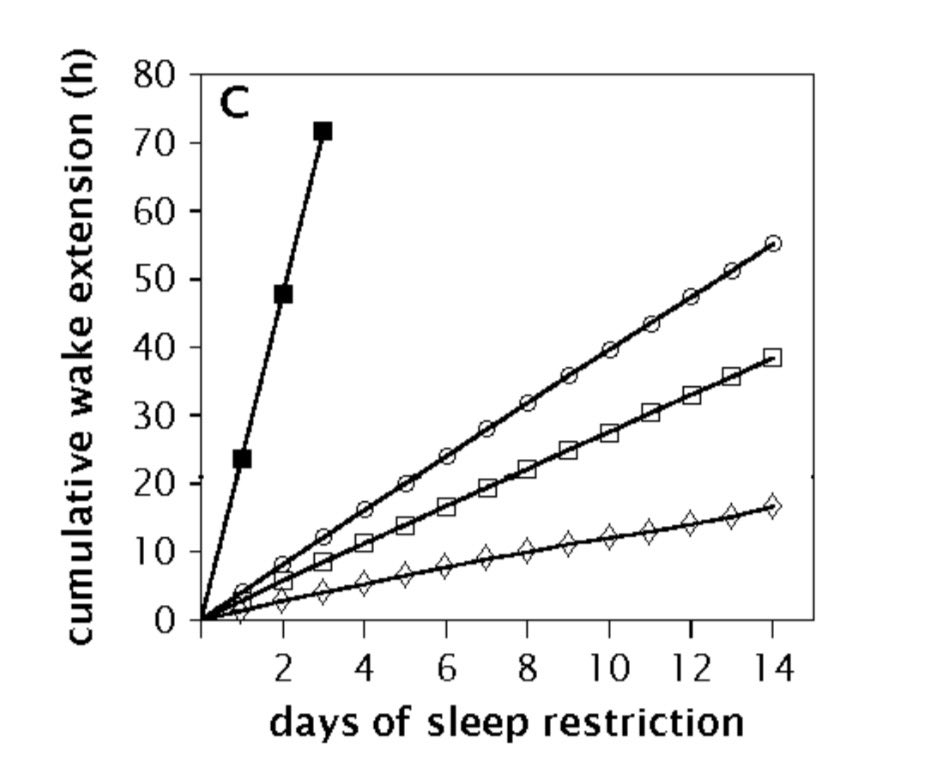
🚩🚩 DORMIR 6 HORAS AL DÍA NO ES SUFICIENTE
Tras 14 días durmiendo 6h/noche, tu rendimiento cognitivo cae igual que tras 24h sin dormir
📉 Lo peor:
– El deterioro es progresivo y acumulativo
– Es lineal (cada día rindes peor)
– Y no te das cuenta: la somnolencia subjetiva apenas sube.
💣 Dormir poco no te adapta… te deteriora.