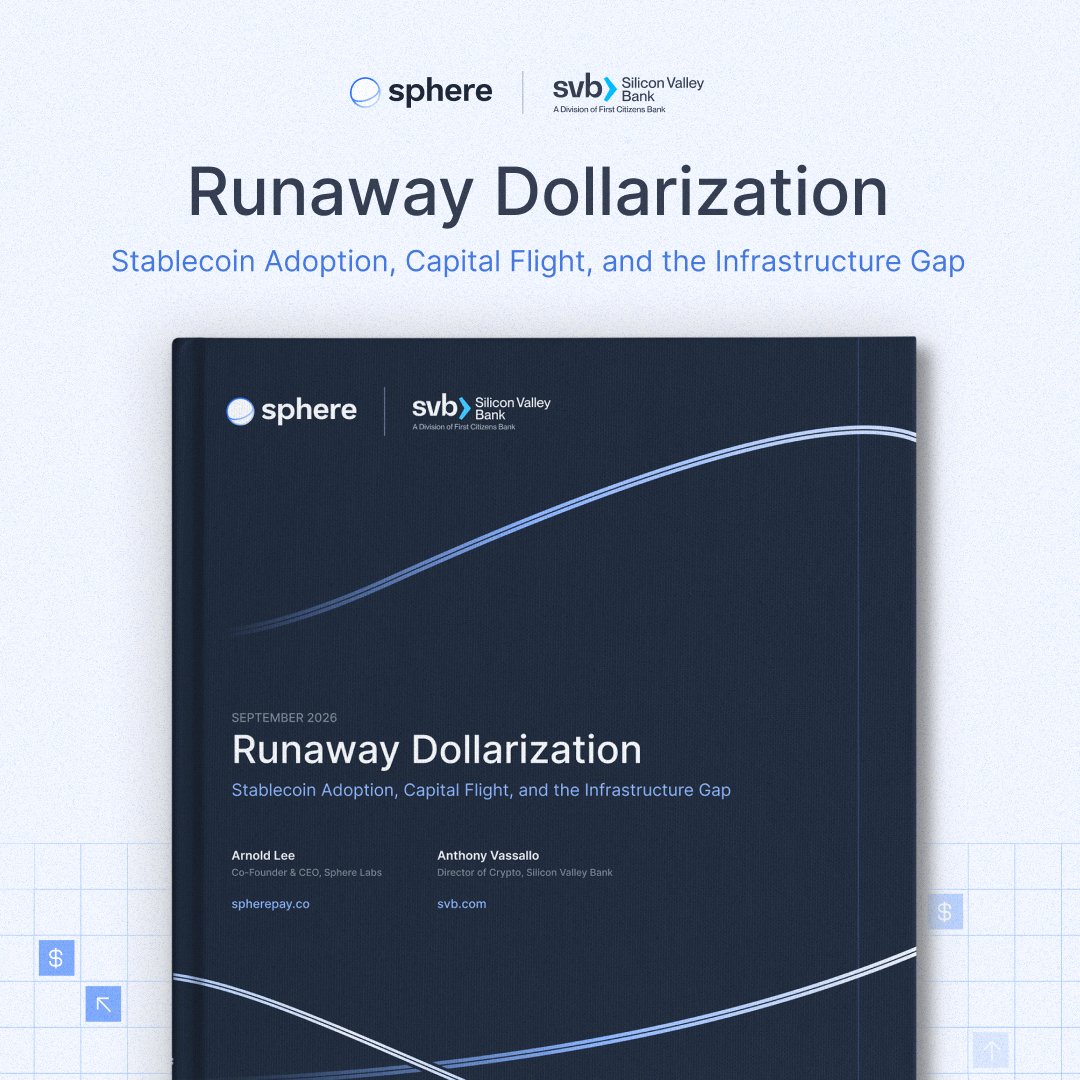
After a currency crisis, local stablecoin holdings rise about 75% within a year and stay there, a new @IMFNews working paper finds.
Our CEO @0xdirichlet & SVB’s @A_Vassallo discuss what the move from bank deposits to on-chain dollars means for oversight in their latest report: https://t.co/7NoZMA37JK
The future of sport is about more than what happens on the court.🎾
In partnership with @NYAtlantics_, we’re exploring what’s next at the intersection of padel and technology, and what it means to be part of a changing sports landscape.
The margin on moving dollars in and out of stablecoins is down to single-digit basis points and dropping. Every other currency is headed the same way.
You can't build a company on that, so where is the opportunity?
Our CEO @0xdirichlet on @stabledash
Among @Bitwise's 2026 crypto predictions (from @Matt_Hougan and @RasterlyRock), one in particular stood out: stablecoins will be blamed for destabilizing an emerging market currency.
"Blamed" is the key word. Dollarization and capital flight during periods of high inflation and currency instability aren't new. What's new is the vehicle. Bitwise's view is that the blame will be misplaced; the flight is symptomatic of a currency that has already lost confidence. Stablecoins are simply deemed the most rational destination for that money, not the reason it leaves. That's largely true, but stablecoins do change the speed and scale of the flight itself, and that's the part that deserves more attention.👇
Stablecoins' biggest strengths, instant and global access to dollars, are also what can amplify instability at scale. These dynamics are already unfolding, and they raise questions that existing capital flow frameworks were not designed to handle.
It isn't only an emerging market story. For many countries, it's a question of monetary sovereignty. In the US, it's what happens to bank funding and credit creation if deposits migrate to stablecoins at scale.
When the next currency crisis hits, stablecoins will be the most visable exit, which makes them the easiest target. We've already seen early versions of this, like Nigeria's 2024 crackdown on crypto exchanges amid pressure on the naira. The concerns driving those responses are valid, but measures taken mid-crisis tend to be blunt and often fall hardest on the households and businesses using stablecoins to preserve purchasing power.
Getting this right will take banks, policymakers, and industry working through it hand in hand. That's a large part of the motivation behind Runaway Dollarization, co-authored by @0xdirichlet (@sphere_labs) and @A_Vassallo (@SiliconVlyBank). It examines how stablecoin dollarization is unfolding, where the biggest pressure points are, and key considerations for a managed transition.
The goal is to start a conversation, and we want to hear what people think. If you're working on these questions, please reach out!!
In 1997, the Fed’s check-transport network used ~50 aircraft to fly 200 legs a night. After flights were grounded on 9/11, Fed float peaked at $28B, versus a pre-attack daily average of ~$766M. The Fed continued crediting banks while paper checks couldn’t reach the banks that needed to pay them.
The disruption helped spur Check 21, which gave qualifying printed reproductions legal equivalence to original checks. Banks could transmit images and print substitutes where paper was still required.
Banks adopting image processing could keep transacting with banks that still required paper. That compatibility helped the transition.
I think there’s a lesson here for tokenization: institutions move at different speeds. If we want tokenization to scale, we need to put as much thought into the transition as the end state. Give institutions a reason to move, and minimize the friction of doing business with those that haven’t.
Stablecoins are becoming the internet's dollar, and that shift is starting to reshape monetary sovereignty in high-inflation economies.
Our new report with Silicon Valley Bank looks at what is driving that shift, and how controls can keep pace as emerging market adoption scales.
This got me thinking about Tether’s original objections to MiCA. Ardoino argued that forcing issuers to hold bank deposits exposes the token to bank failures. The ESCB’s proposal highlights another side of the same problem: a run on the token can drain funding from the banks holding its reserves.
My takeaway so far is that removing the deposit floor makes sense, but liquidity is as (or more) important than the backing asset, I think. The proposed liquidity buckets help, but redemptions can arrive before T-bills mature. Someone still has to provide the dollars in the meantime.
For a systemic stablecoin, should we be designing reserve requirements and access to emergency liquidity together? Your point about promising redemption in a currency the local central bank can’t issue seems especially important here.
Padel: one of the fastest growing sports on the planet, and still somehow under the radar.
Contrarian bets are where the outsized returns are. Both on and off the court.
The @NYAtlantics_, presented by Sphere. 🎾
@blockiosaurus If you don't listen to it, the All In podcast has spoken about this quite a bit recently. Publish data to a blockchain to improve the publicly available data and let the free market make decisions efficiently
@blockiosaurus Glad you’re enjoying it! We provided what we believe are sane default implementations and we’re looking forward to what other implementations the community comes up with.
So far Star Frame is my favorite Anchor alternative. Everything is optional so you can reject the evil of macros if you want to follow the one true path of traits