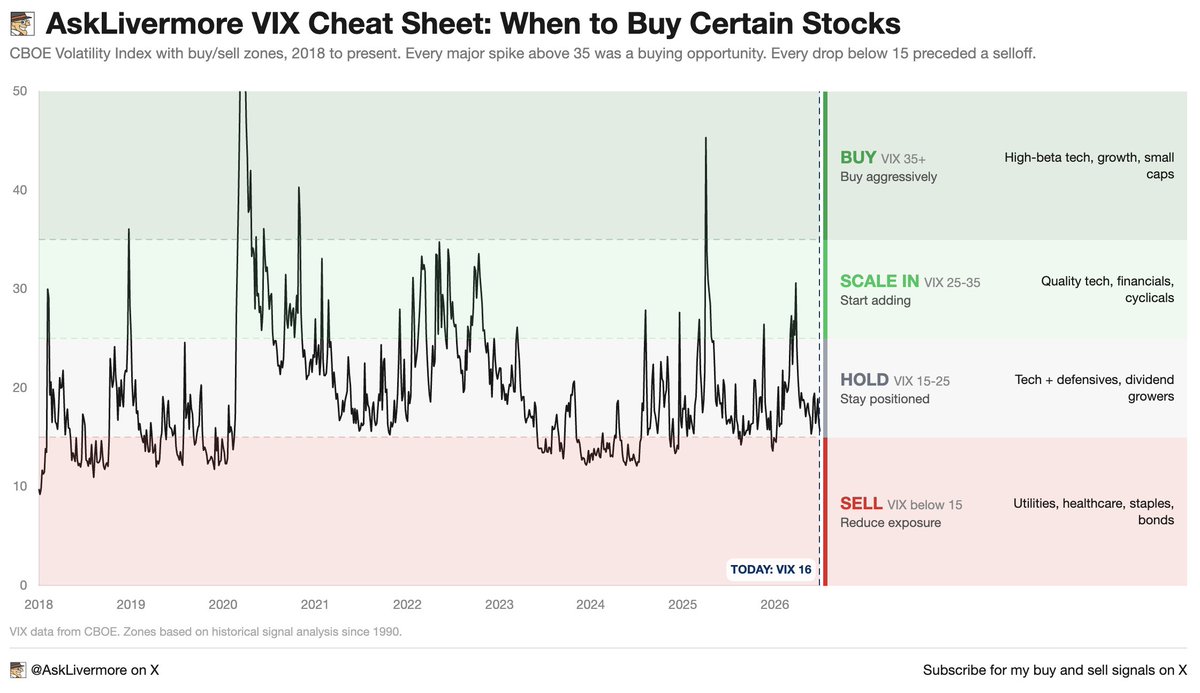
This is all you need to do to make millions in the stock market. Save this. Screenshot it. You will need it.
1. VIX above 35: buy aggressively
- High-beta tech, growth, small caps
- Every single time the VIX spiked above 35 since 2018 was a generational buying opportunity. COVID bottom. Oct 2022 bottom. Tariff crash. If you bought when everyone else was panicking, you made a fortune.
2. VIX 25 to 35: start scaling in
- Quality tech, financials, industrials, cyclicals
- This is where smart money starts building positions. Not all at once. Gradually. The fear is real but the opportunity is bigger.
3. VIX 15 to 25: hold
- Balanced: tech + defensives, dividend growers
- This is normal. Stay positioned. Don't chase, don't panic. Let your winners run.
4. VIX below 15: reduce exposure
- Rotate to: utilities, healthcare, staples, bonds
- This is when everyone is comfortable. Nobody is hedging. Nobody is worried. That's exactly when you should be.
- Every major crash in market history was preceded by the VIX sitting below 15 for weeks.
Right now the VIX is at 16. We're in the hold zone. Stay positioned but stay alert.
Bookmark this. The next time the VIX spikes above 35, don't freeze. Buy.
Today’s job report shows continuation of prior 3 reports. Companies adopting AI there are large scale layoffs. Professional services particularly. Anyone who sits behind a computer is subject to cut. If you build stuff w/ your hands, you’re ok until Musk sends an army of robots.
Paul Tudor Jones says the US is more dependent on equity prices than ever, and explains what a 35% correction would trigger in the economy:
"We're 252% of stock market cap to GDP. In 1929 we were 65%. In 1987 we got to ~85-90%. In 2000, 170%.
If you think about the periodicity of significant bear markets. Since 1970, we get a mean reversion about every 10 years.
Let's say mean revert to the past 25 or 30-year PE. That would be a 30, 35% decline. Well, 35% on 250% of GDP is 80, 90% of GDP.
10% of our tax revenues are capital gains, they go to zero. So you can see the budget deficit blowing up. You can see the bond market getting smoked. You can see this kind of negative self-reinforcing effect.
In the stock market, we're over-equitized as a country. We have the highest individual equity weightings in the history of the country.
And then the real problem is if you look at private equity in 2007-2008, that was about 7% of institutional portfolios. Now it's about 16% of the institutional portfolios. We're so much more illiquid than we were in 2008.
The problem is that if you buy the S&P at this current valuation, the 10-year forward return is negative when you buy the S&P with a PE of 22. That's what history shows.
So yes, the S&P is spectacular long-term, if you have a hundred-year view. But that's because that's an average of a hundred years, including times when the S&P 500 PE was 6, 7 and 8, or one third of what it is right now.
Valuation matters a lot, and the stock market's really high and it's gonna be really hard to make money from here with any kind of long-term view."
Holy crap!
Here is the aftermath of that 1.2 million square foot paper products warehouse in Ontario that was set on fire by a disgruntled employee.
Toilet paper is going to cost more than gas in Gavin Newsom‘s California.
Mr. President. Would you mind explaining what exactly did you win from this war? Or did everyone run out of interceptors? Here is 8-point agreement of 2-week ceasefire:
1. Commitment to non-aggression.
2. Maintaining Iran’s control over the Strait of Hormuz.
3. Agreement on uranium enrichment.
4. Cancellation of all primary and secondary sanctions.
5. Termination of all UN Security Council and IAEA Board of Governors resolutions.
6. Payment of compensation to Iran.
7. Withdrawal of American combat forces from the region.
8. A complete ceasefire on all fronts.
I’m genuinely struggling to understand this.
Ye is banned from the UK for saying offensive things.
Meanwhile, a former ISIS terrorist, Ahmed al-Sharaa was shaking hands with Keir Starmer and King Charles III last week.
One said mean things.
The other chopped heads off.
This does not make sense.
JUST IN: The United States has fired 2,400 Patriot interceptors in 31 days. It manufactures 650 per year. Replenishment at current production takes three and a half years. It has consumed 40 percent of its global THAAD inventory. It produces fewer than 100 THAAD interceptors annually. Full replenishment takes four to five years. Each interceptor contains neodymium and samarium-cobalt magnets sourced from Chinese-controlled supply chains. The US defence rare earth stockpile has approximately two months remaining.
Read those numbers again. The US military has consumed more precision weapons in one month than it can manufacture in three years, using materials it can only source from the country it may need to fight next.
Every Patriot fired at an Iranian Fattah-2 over Riyadh is a Patriot that does not exist for a Chinese DF-21 over the Taiwan Strait. Every rare earth magnet consumed in Gulf interceptors is a magnet that cannot be installed in a replacement built for the Pacific. The Iran war is not just depleting American arsenals. It is depleting American deterrence against China. And the country counting the interceptors from both sides of the table, as supplier and as future adversary, is the same country hosting peace talks in Beijing right now.
China controls 90 percent of rare earth refining. China produces 90 percent of the world’s high-performance magnets. China buys 80 to 91 percent of Iran’s oil exports. China provides BeiDou navigation and ammonium perchlorate propellant to the Iranian missiles that are forcing the US to burn through its interceptor stockpile. China is simultaneously the supplier of the weapons America is using, the supplier of the weapons Iran is using, the primary customer of the oil the war is disrupting, and the only country with the leverage to end the disruption.
The arithmetic of the grand bargain is not complicated. The US needs Chinese rare earths to rebuild its interceptor inventory. China needs Hormuz open to receive Iranian oil. The US needs the war to end before its stockpiles hit zero. China needs tariff relief, semiconductor export control rollbacks, and Taiwan arms-sale restraint. Both sides need something only the other can provide. The question is not whether a deal happens. The question is how much of America’s strategic position in the Pacific gets traded for the minerals needed to survive the Gulf.
RAND estimated that 78 percent of US defence contractors would face production shutdowns within 90 days of a Chinese rare earth cutoff. The 2027 deadline to ban Chinese-sourced magnets from Pentagon procurement is nine months away with no domestic alternative at scale. MP Materials operates the only US rare earth mine and ships its concentrate to China for processing. The mine-to-magnet supply chain that the Pentagon needs to survive a Taiwan contingency runs through the country the Taiwan contingency is designed to deter.
This is not a supply chain problem. This is a civilisational dependency. The United States built the most advanced military in human history on materials processed by its principal strategic competitor. It is now fighting a war that burns through those materials at a rate that makes replenishment impossible without the competitor’s cooperation. And the competitor is sitting in a conference room in Beijing today, across the table from Pakistan’s foreign minister, calculating exactly how much of America’s future it can extract in exchange for the minerals America needs to have a future at all.
The deal of the century is not a choice. It is arithmetic. And the arithmetic leads to Beijing.
https://t.co/dAOBBMrIOk
⛽️Diesel prices since the Iran conflict:
🇵🇭 Philippines +81.6%
🇳🇬 Nigeria +78.3%
🇲🇾 Malaysia +57.9%
🇺🇸 USA +41.2%
🇩🇪 Germany +30.9%
🇷🇺 Russia +0.5%
🇮🇳 India 0%
🇸🇦 Saudi Arabia 0%
Why such a massive difference?
It comes down to 3 things:
🔴 How you buy it Philippines & Nigeria import nearly all their diesel at market price. No subsidies. No buffer. Price spikes hit immediately.
🟡 How far it travels Asian countries sit at the end of the longest supply routes. Hormuz disruption adds distance, insurance and time to every cargo.
🟢 Whether you produce it Saudi Arabia produces its own. Russia produces its own. India has long term contracts with Russian crude at fixed discounts. They're insulated.
The Iran war didn't hit everyone equally.
It hit hardest where there's no domestic production, no subsidies and no alternative supply.
That's most of Asia 🎯
The pump price is just where the geopolitics ends up.
💡 Subscribe to my newsletter ☑️Link in my bio
The CIA didn't hide a cancer cure. The pharmaceutical industry made it unprofitable to pursue one.
I've been using antiparasitic drugs like ivermectin and mebendazole in my cancer protocols since 2017. Not because cancer is a parasite. That's an oversimplification that leads people down the wrong path. It's because parasites and cancer cells run the same biological playbook: hijack the host, evade immune detection, replicate, spread. Drugs designed to disrupt one can hit the other.
What I've seen clinically is that these drugs, when used properly alongside immunotherapy, can extend lives that the conventional system had written off. But they're not magic bullets. Every cancer is different. Dosing matters. Combinations matter. I've also seen cases where fenbendazole appeared to accelerate tumor growth when used incorrectly. The science here requires precision.
Mebendazole has over 200 published studies showing anti-cancer activity. The evidence has been building in plain sight for years. The real question isn't why the CIA had this document. It's why drugs that cost a few dollars per dose still can't get funding for large-scale cancer trials. You already know the answer.
With roundtrip financing and channel stuffing inventory, $NVDA is doing exactly what Cisco & Nortel did back in dot-com bubble of 2000 right before they collapsed.
P.S. Nvidia replaced Enron on the S&P 500 in 2001.
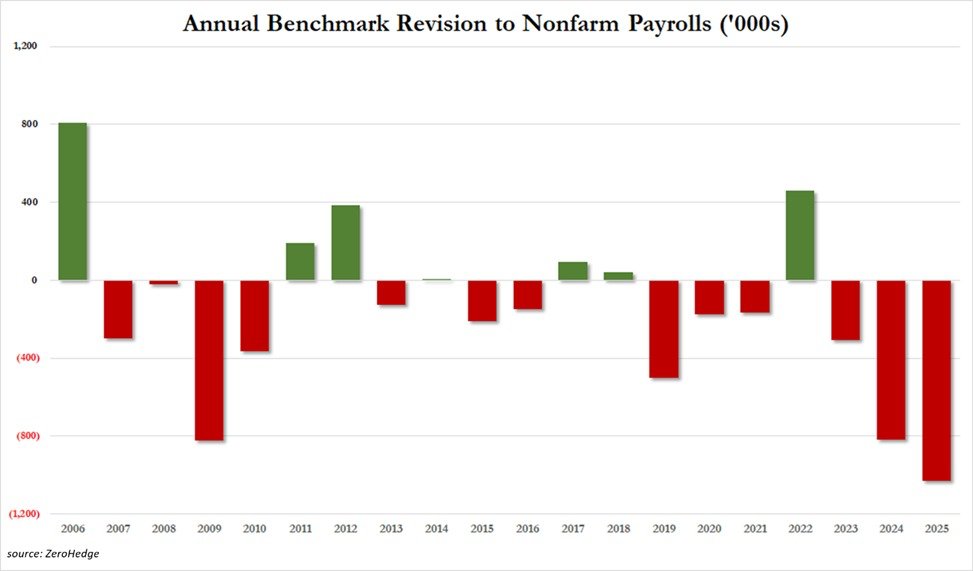
BREAKING: US job numbers were revised down by -1,029,000 jobs in 2025, the largest annual revision in at least 20 years.
This follows downward revisions of -818,000 in 2024 and -306,000 in 2023.
In total, -2,153,000 jobs have been revised out of initially reported data over the last 3 years.
Since 2019, -2,500,000 jobs have been erased from official data, with negative revisions occurring in 6 of the last 7 years.
By comparison, 2009-2010 combined downward revisions were roughly -1,200,000.
What is happening with US labor market data?
I don't understand why $IBKR is insisting on 2-factor authentication. The amount of money I'm losing on every single trade, like buddy, who else do you think it could be?
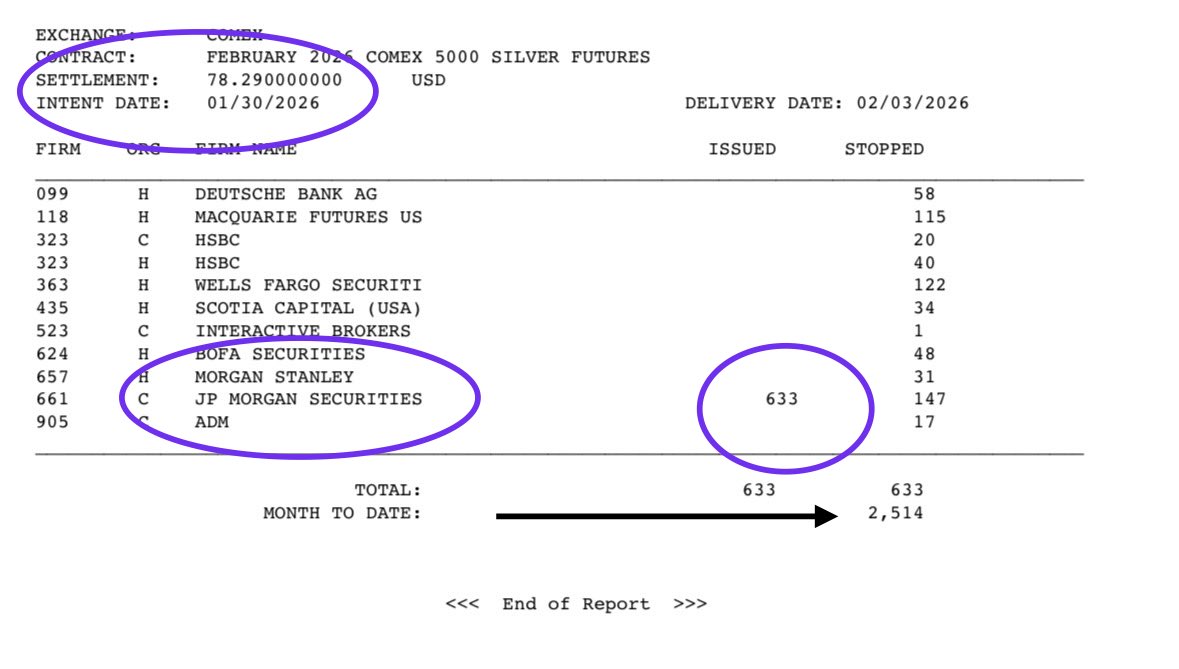
If you look carefully into the latest Comex report, $JPM closed its silver shorts EXACTLY at the very bottom of the price crash and from there it all started to come back up
This isn’t coincidence
This isn’t conspiracy theory
This is the proof the whole Friday crash was planned
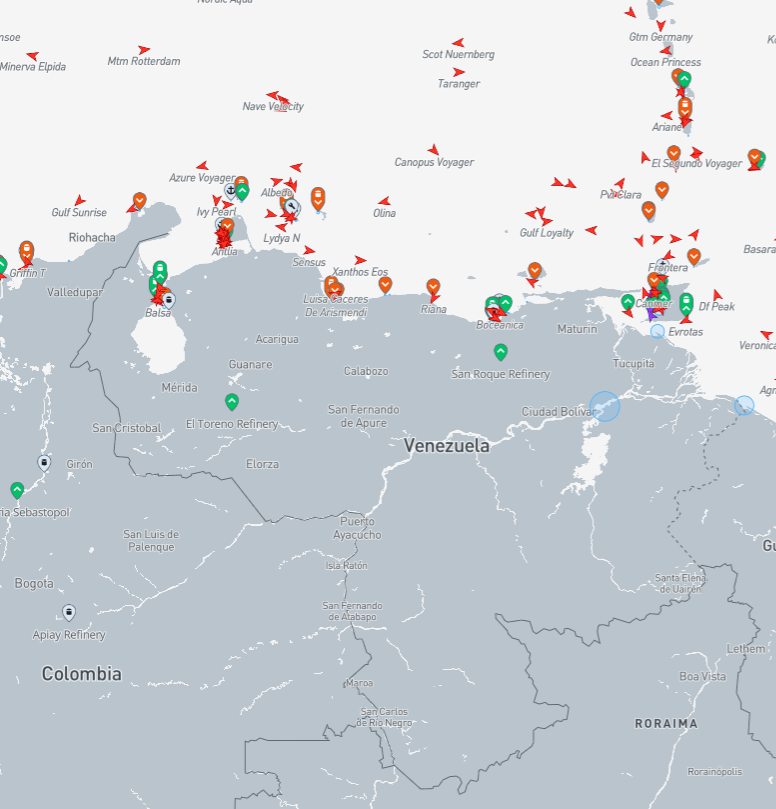
🔘Trump Orders Total Blockade on Sanctioned Venezuelan Oil Tankers
🔘US Crude Oil Inventories Stay Low Amid Ongoing Draws
🔘Pemex Awards Five New Contracts, But Fails to Attract Major Players
🔘Escalating US-Russia Energy Sanctions: More of the same game of musical chairs
🔘Qatar's AI Ambitions Fueled by Abundant Cheap Energy
🔘Saudi Firm Emerges as Top Bidder for Lukoil's International Assets: What are the implication?
🔘Russian Oil Tankers Pile Up Off China's Coast: So what?
🔘IEA's Latest Coal Outlook: Another forecast failure!
Daily Energy Report https://t.co/KPykqGz1dS