$1.5t is a massive number for a company preparing to go public.
the ai race is no longer just about who builds the best models.
high demand before an ipo doesn't automatically mean a good entry.
i'd be more interested in how anthropic converts its growing user base and enterprise relationships into a sustainable revenue.
hype can attract investors. fundamentals have to keep them there.
It's #XRPEducationMonth and I will be educating my audiences on everything about XRP Ledger.
So today I will be focusing on How does the XRP Ledger decide which new features to add?
It make uses of something called an Amendment Process.
→ What exactly is an Amendment here?
An amendment is a proposed change to the XRP Ledger. It can introduce a new feature or change how an existing feature works.
How does a proposed feature become part of the network?
- Who decides?
Validators play an important role here.
They vote on proposed amendments, and only votes from trusted validators count.
This helps the network agree on changes instead of having one central authority decide.
- How does an amendment pass?
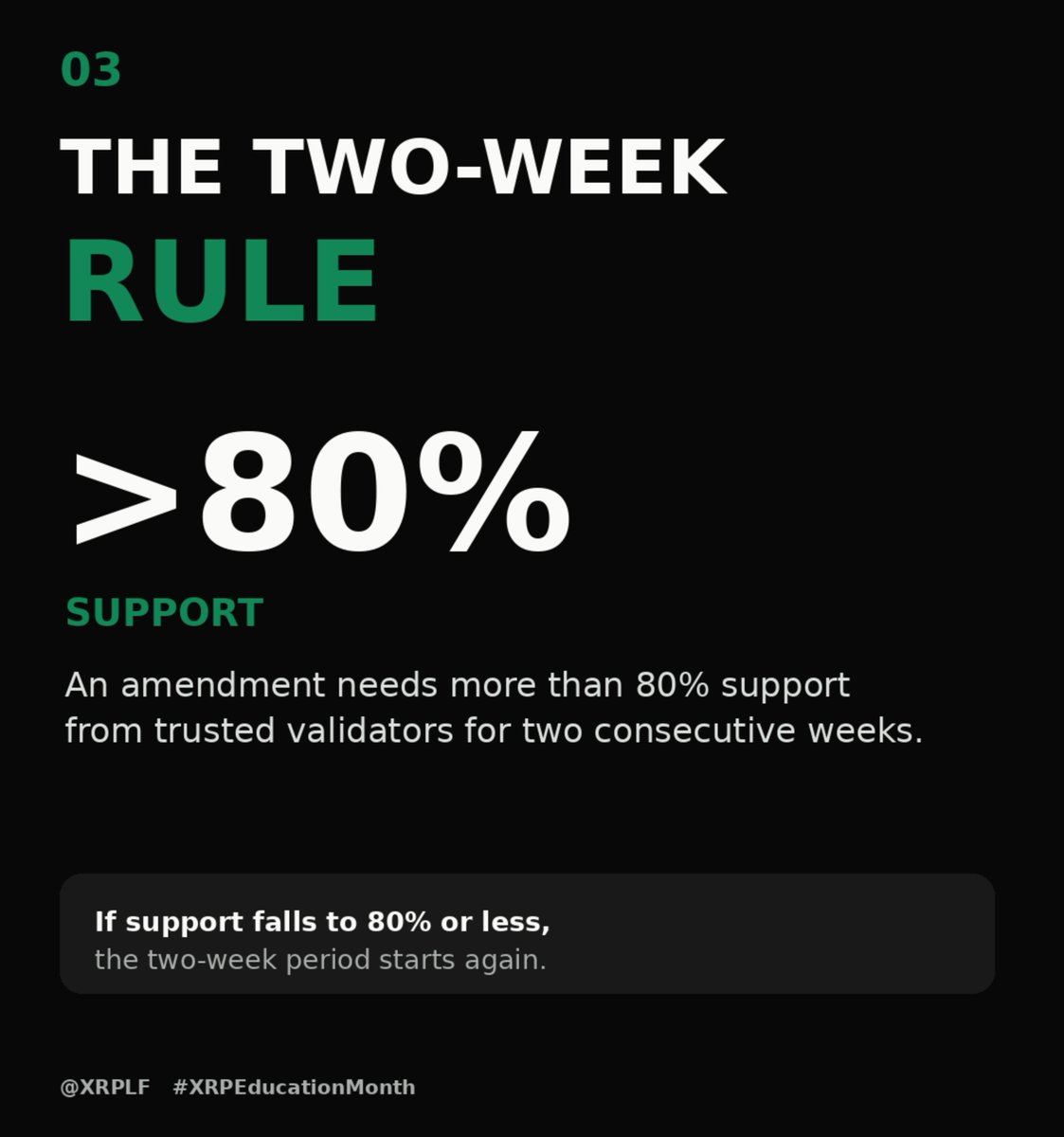
For an amendment to pass, it needs more than 80% support from trusted validators.
But getting that support once isn't enough.
It must maintain that level of support for two consecutive weeks.
If support drops to 80% or below, the two week period starts again.
- What happens when it passes?
Once the requirements are met, the amendment becomes permanently enabled.
The new rules is then apply to subsequent ledgers.
If the network ever needs to disable an enabled amendment, another amendment is required.
- Why does this matter?
It allows the XRP Ledger to introduce new functionality while keeping changes coordinated across the network.
Instead of changing the rules overnight, amendments go through an established approval process.
That's one part of how the XRP Ledger continues to evolve.
@XRPLF
There is a lag between proving that an action happened and protecting the information surrounding it.
@Actum_AI is building Proof of Human Behavior infrastructure to connect physical-world activities with verifiable evidence. What makes this space interesting to me is the need to establish accountability without overlooking data privacy and the realities of industrial operations.
Trustworthy verification should serve a practical purpose: making records more useful for audits, investigations, and decision-making while respecting appropriate boundaries around sensitive information.
This balance will become increasingly important as industries digitize their operations and rely more heavily on automated systems.
The goal should be to provide enough credible evidence for the right people to verify what matters.
That’s a challenge worth thinking about as ACTUM develops its approach to real-world verification.
#ACTUM
There’s a detail I like about the $AX1 launch.
Agents that were already running quests on @ax1vc’s Console are part of the story from day one.
$AX1 is being added to the weekly rewards for work they completed before launch.
AX1 says Console logged 2.7M payments over the 30 days through Nov 16.
Those payments came from quest runs settled on Base.
Projects were already putting tasks in front of agents, and agents were already running them.
If you’re building an agent, this gives you somewhere to put it to work.
Pick a quest, see how your agent handles it, then build on what it can already do.
As partners roll out new quests and bigger rewards, holding $AX1 gives your agent access to them.
That’s what I like about this launch.
The agents that helped get Console moving now have more to do there
good infrastructure gives developers room to change their minds later.
that's one reason i find @GenLayer's move to @arbitrum interesting.
GenLayer's consensus contracts use Solidity today. But Arbitrum Nitro also supports Stylus, which opens a possible path for compute-heavy parts of the protocol to use Rust and WebAssembly in the future.
that doesn't mean GenLayer is switching its contracts to Stylus now. the interesting part is having that option available as the protocol evolves.
the public GenLayer Chain has moved from ZK Stack to Arbitrum Nitro, while its core job stays the same: validators use different AI models and Optimistic Democracy to reach judgments, with Intelligent Contracts executing through GenVM.
to me, choosing infrastructure isn't just about what works today. it's also about what you won't have to rule out tomorrow.
what would you want to see GenLayer explore first as it grows on Arbitrum?
It’s the final day. The campaign leaderboard is about to lock. Now the only thing that matters is what happens after the incentives stop. @RebateLaunch was built around that exact question.
The platform locked its mechanics on day one. Fixed supply, no admin switch, a one-way payout routing, and a snipe tax that feeds the treasury. The rules cannot be changed now that the crowd is leaving.
I see three mechanics that will decide the outcome:
First, the payout pool. Holders get USDG based on trading volume. The multiplier goes to 2x, but if the volume drops after today, the pool shrinks. A 2x multiplier on a dead pool is just a bigger slice of nothing.
Second, the fee routing. 0.3% from every launch feeds the platform pot to buy and burn $REBATE. If the daily launch volume falls, the burn slows down. The deflation story relies entirely on people still launching and trading.
Third, the lock. The contract can't adapt. The creator can't tweak the fee split to attract volume. The pad executes exactly what it was programmed to do, even if the market goes quiet.
The final day of a campaign is always loud. The real test is the silence afterward.
Before leaning on the post-campaign story, I'd check:
Does the trading volume actually hold up next week without the leaderboard incentives?
Does the automated dip-buying mechanism actually catch the price if it drops, or do faster bots front-run it?
Most importantly, which creators are still launching tokens on the pad when the scoreboard is gone?
A locked contract guarantees the rules. It doesn't guarantee the crowd stays.
So the final score isn't what I'd watch. I'd watch the volume on day one after the campaign ends.
Design shows what the pad is supposed to do. Usage shows whether it works when nobody is paying attention.
When the campaign ends, which metric would you trust first: the final leaderboard rank, or the trading volume thirty days later?
@RebateLaunch.