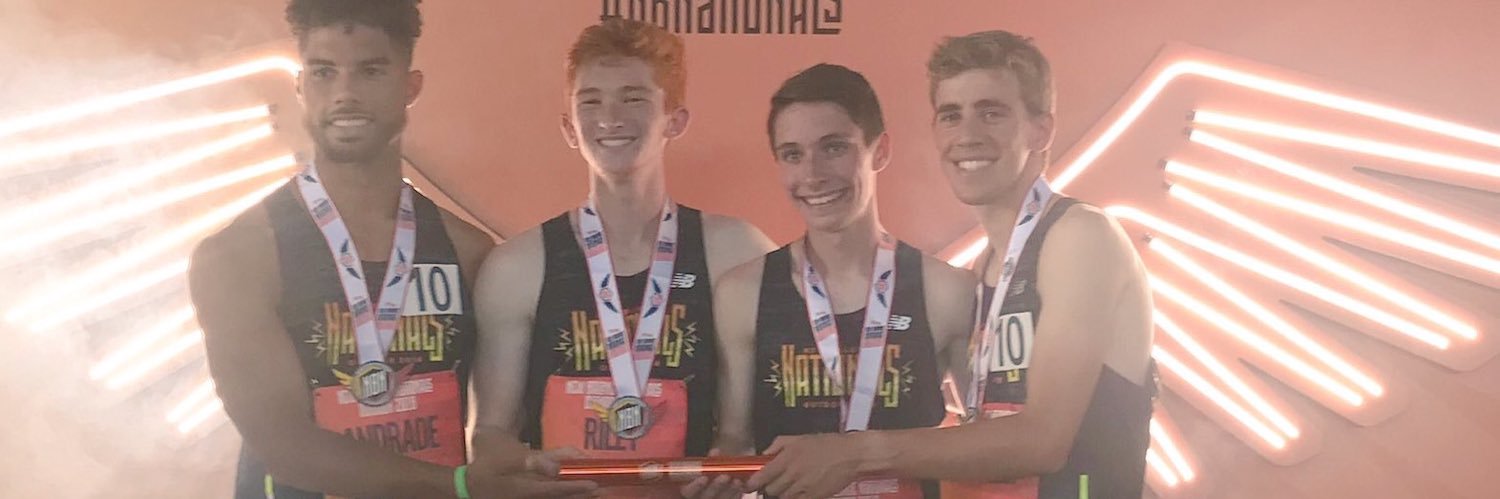
Proud to announce my commitment to Lynn University where I will continue my academic and athletic career running Mens Cross Country and Track and Field. Can’t thank my friends, family, coaches, and teammates enough for helping me reach this point.
WELCOME BACK DAVE WOTTLE 🤯
Colin Sahlman of @NAUTrackFieldXC hit 400m of the #NCAATF 800m final in DEAD LAST before overhauling the eight men in front of him, including indoor champ Tyrice Taylor, to claim the national title in 1:44.22.
Sahlman’s mark is a lifetime best and moves him up to NCAA #6 all-time.
THE CURSE IS BROKEN ⛓️💥
Simeon Birnbaum becomes the first man since German Fernandez in 2009 to win a NCAA 1500m/mile title after breaking the collegiate record.
Yared Nuguse won the 1500m at NCAAs in 2019 and broke the collegiate record in 2021, but Birnbaum is the first man in 17 years to successfully cap a record-breaking season with a national title.
Sean McVay nailed the job description.
Be an elevator.
Lift people to their highest potential.
That's it.
That's leadership.
Not a critic. Not a ceiling. An elevator. 🔥
And since we’re on this
1. One thing I struggle with in these conversations is how quickly we dismiss concerns about compensation in sports with “if you don’t like it, don’t do it.”
Most people who get into coaching, operations, recruiting, or athletics know they aren’t getting rich. That’s not the point.
2. The point is that low pay and unpaid positions inevitably determine who can afford to stay in the profession.
When compensation is extremely low, talent becomes secondary to financial flexibility. The people who can stay are often the people who have support systems, savings, family assistance, or the ability to absorb years of financial sacrifice.
3. That affects everyone, regardless of background. There are incredibly talented coaches, administrators, and staff members who leave sports every year because they simply can’t make the finances work.
And when good people leave, the profession loses valuable perspectives and talent.
4. There is also a women's component to this conversation.
Historically, coaching has been one of the primary ways female athletes stay connected to the game after their playing careers end. Unlike many men, who have traditionally had broader representation throughout the sports industry, the pipeline for women often starts with participation and then transitions into coaching, operations, administration, and leadership roles.
When those entry-level positions pay very little, many talented women are forced to pursue more financially stable careers instead. Not because they lack passion, but because they have to make practical decisions about their future.
Women are also more likely to face additional considerations around caregiving responsibilities, family planning, and long-term financial security. When compensation is low, those factors can make staying in sports significantly more difficult.
The result is a smaller pipeline of women entering and remaining in the profession, fewer women advancing into leadership positions, and less representation across the industry as a whole.
5. That’s why compensation matters beyond just fairness.
When entry-level positions pay very little, the industry unintentionally narrows the pool of people who can realistically pursue them. The result isn’t necessarily the most talented people getting opportunities, it’s often the people who can afford to wait the longest.
6. I don’t think this is a passion problem.
Sports is filled with passionate people. The question is whether we’re creating a system that allows the best and brightest to stay in it, regardless of their financial circumstances.
7. Two things can be true:
Sports requires sacrifice.
And the industry can do a better job making sure that sacrifice isn’t the price of admission 🤷🏽♀️
@WorldAthletics did publish the qualification system for the 2027 World Championships.
The one for @LA28 shouldn’t be very different…
It raises some concerns by athletes and coaches.
Here some thoughts about it:
One year ago, the NCAA blindsided college athletics with unprecedented roster limits.
Thousands of student-athletes lost opportunities as coaches were put in the terrible position of cutting and/or de-committing players. Then AFTER the damage was done, the NCAA introduced the “Designated Student Athlete” designation as a way to let some athletes stay without counting against roster limits.
But many programs had already made painful decisions because coaches were told the limits were coming and tried to give athletes as much notice as possible.
Now we are about to do this AGAIN.
The NCAA is expected to approve a 5th year of eligibility next month — after most programs have already recruited their 2027 classes based on the CURRENT rules and CURRENT roster limits.
In women’s soccer, we already operate under a restrictive 28-player cap. You cannot recruit for FOUR classes for years, then suddenly force programs to fit FIVE classes onto the same roster without student-athletes paying the price.
Because when seniors stay, someone else loses a spot.
More cuts. More decommitments. More athletes caught in the middle of ever-changing rules they had nothing to do with.
College recruiting happens YEARS in advance. Families and athletes make life-changing decisions based on the rules in place at the time.
If 5th years are approved, they should all be classified as DSAs so as to not count against roster limits. Otherwise the NCAA is about to repeat the exact same disaster all over again.
#StopChangingTheRules #HereWeGoAgain #DSAThe5thYears
Spurs culture is elite. So much of it traces itself directly back to Gregg Popovich. One of my favorite parts of researching and writing the Way of Excellence was digging into what makes the Spurs so special. https://t.co/QMMhSCRaNL
Universities had 17 years of warning. They responded by doing the opposite of what the math demanded.
In 2008, American birth rates fell off a cliff. The Great Recession made people stop having kids. Those never-born children would be turning 18 right now. The number of U.S. high school graduates peaked at roughly 3.9 million in 2025. By 2029, that number drops 15%. By 2041, it drops by nearly half a million students per year.
Every school in this tweet had access to the same Census data. They all saw the same curve.
Administrative positions at U.S. colleges grew 60% between 1993 and 2009, ten times the rate of tenured faculty growth. Non-instructional spending (student services, administration) grew 29% from 2010 to 2018. Instructional spending grew 17%. Average tuition at public four-year schools went from $3,500 in 2000 to $10,560 in 2023. Yale now has more administrators than undergraduate students. 5,460 administrators for fewer than 5,000 undergrads.
They built the cost structure of a growth company on top of a customer base that was mathematically guaranteed to shrink.
The split in this data tells you everything. Clemson, Syracuse, Duke, UNC, and Indiana are all cutting because the model broke. Alabama, Ole Miss, and the University of Florida are turning away more applicants than ever. Harvard gets five applications for every spot. The middle is where the cliff hits. Elite schools absorb demand. Everyone between elite and community college fights over a shrinking pool. The Fed published a study in December 2024 predicting 80 colleges will close in the next five years. Since 2016, over 100 already have. In 2024 alone, 28 shut down. One per week.
These program cuts and layoffs are a decade late. The birth rate data was sitting in Census spreadsheets the entire time. Everyone in higher education administration saw the enrollment cliff coming. They hired more administrators anyway.
We often think coaching is all about the workouts, game plans, and the technical stuff.
It's not. That stuff matters. But it misses the stuff that actually make a difference.
Here's 23 coaching principles I've collected over two decades of coaching everyone from high school kids to some of the world's best:
1. Coach from dependence to independence.
Coaching is about making your own job kind of obsolete. Works towards having our athlete be more self-sufficient, with a coaches role moving towards a kind of mentor and partnership.
2. Coaching comes from conversation.
And most of that is observing and listening. The athlete tells you everything you need to know…if you're paying attention.
3. Caring comes first.
If they know you don’t care, the perfect plan won’t matter. The old saying “They don’t care how much you know until they know how much you care,” is still true.
4. Standards without warmth makes them fragile.
Warmth without standards leaves them lost. You need both. In parenting research they call this authoritative instead of authoritarian.
5. The story they tell themselves runs the show.
Coach the story. Knowledge doesn’t change behavior. Story does. “It’s hard to outperform your self-concept.”
6. You can't want it more than they do.
The day you start trying to is the day you've lost the room. Your job is to set the conditions and pull the lever, not push the cart.
7. Effort is contagious.
So is dread. Pay attention to which one you're spreading. You are the thermostat not the thermometer. You're changing the room temp.
8. Challenged, not threatened.
We do our best when we're stretched, not when our worth is on the line. Hard things land different when failing doesn't mean you're worthless. Stretch the challenge. Keep the worth out of it.
9. People perform best when they feel valued as a person and not just an athlete, that they belong, and when they’re performing out of joy instead of fear. Joy is a performance enhancer.
10. Reward what you preach.
If you say process and only celebrate outcomes, the brain hears the second message.What is honored will be cultivated. Watch what you praise.
11. Action is the antidote to anxiety.
One purposeful step convinces the brain the situation is manageable. Don't wrestle the monster. Point at the work and start moving.
12. Confidence is quiet. Insecurity is loud.
Arrogance sits on insecurity. Confidence sits on experience. The brashest voice in any room is usually the one most afraid of being found out. Real confidence comes from earned experience. Do the work.
13. Ego kills sync.
It crowds out the signals that lead to connection.
Always stay in learning mode. Be curious. “Once you stop learning about your athletes, you've stopped coaching.” Brother Colm O’Connell
14. Skills come from struggle.
Don’t over coach or step in too early. Rescue them too soon and they don’t keep what they almost figured out. Productive failure beats premature help.
15. Plant seeds constantly. And water them.
Any coach, teacher, or parent will tell you of the kid who told them years later they finally get it. We can’t force understanding. Just keep cultivating the space for it to grow.
16. Define success yourself.
Don't import a definition that gets in the way of the person you're trying to help become. The borrowed definition almost always fails the person who's actually in front of you.
17. Lower the bar, raise the floor.
Too often we focus on those rare days when everything aligns. You can’t control when those show up. Focus on raising your floor, making the average days better.
18. If they can only succeed with you, you’ve failed.
The goal is to give people autonomy and agency. To teach them how to do the thing, and then ultimately let them go.
19. Teach, don’t just train.
Too often, we get stuck in prescriptive mode. Remember, you are fundamentally changing the person in front of you.
20. Coaching is pattern recognition.
We pick up patterns when we pay attention. Build a database deep enough that you can see what an athlete is showing you. Then trust it.
21. Be in love with an idea, just don't marry it.
Don't become the person who swears by a single diet for everyone. Every system eventually fails, and if you've tied your identity to it, you go down with the ship.
22. The car ride home is the practice.
After a hard race or a bad workout, the brain is wide open. What you say in those minutes lasts longer than anything you said in practice all season.
23. Get out of your own way.
Most of coaching is helping people stop self-sabotaging. Under-preparation is a coping strategy. The athlete who skips the work is protecting his ego.
Private equity is beginning to buy up sports teams and leagues in Connecticut. I was in the north end of Hartford today talking about my bill to keep profit vultures out of kids sports.
Steve Kerr had nothing left to prove. But at a crossroads in his career, facing down the pains of his past convinced him he had everything left to play for.
Wright Thompson shares the full story 👇 https://t.co/qaKZXJhGU6
The best thing colleges can do for student-athletes mental and physical health?
Hire good coaches who care about the overall person.
It's not hard. Coaches in the business know who does it well/who to avoid.
All the student welfare programs are meaningless without good leaders.
New: According to sources, former Celtics superstar Isaiah Thomas is back with the franchise after being hired as a pro and college scout.
https://t.co/YZRDT0q1Dq
🚨 Sir Alex Ferguson on what still decides football in 2026:
🗣️ Ferguson: “People spend more time than ever talking about systems, structures, build-up shapes, inverted full-backs, and all of these modern ideas. And yes, the game has changed, no doubt about that. But football has never stopped being simple at its core.
At the highest level, when pressure is at its peak, tactics don’t score goals and they don’t clear danger in your box. Players do. The ones with courage, the ones who don’t hide, the ones who take responsibility when the game is tight and everything feels heavy.
At Manchester United, we always understood that. You don’t build great teams by overcomplicating things—you build them by creating winners. Players who hate losing more than they enjoy winning. That’s what carries you through difficult moments in a season.
I’ve seen matches where we were not the better tactical side, but we won because the mentality was stronger. We refused to accept defeat. Someone always stepped up, whether it was a tackle, a run, a goal, or just leadership in the dressing room.
Modern football will keep evolving, but one thing will never change. When everything is analysed, studied, and planned… it still comes down to individuals stepping up when it matters most. That’s what separates good teams from champions.”