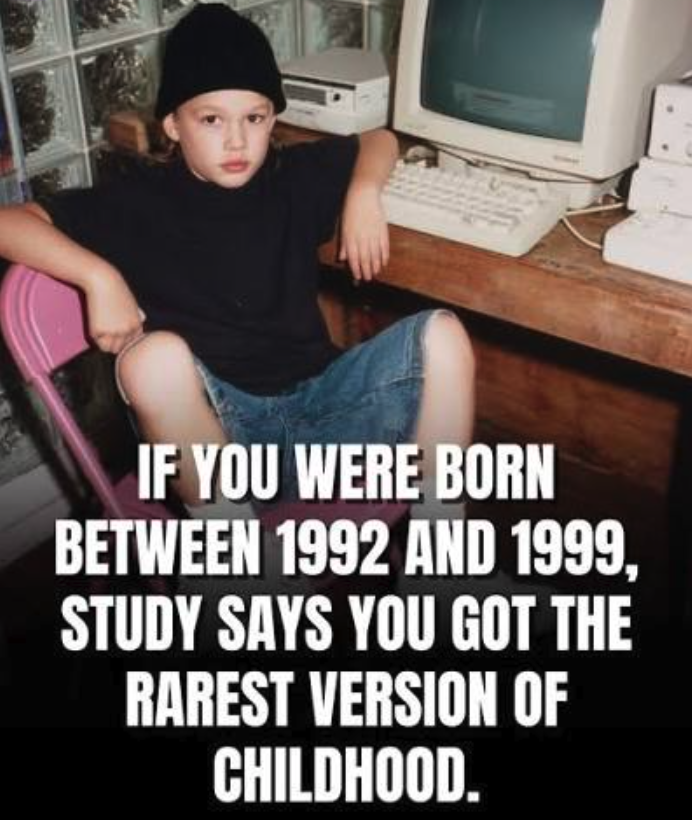
If you were born between 1992 and 1999, studies show you got the rarest version of childhood.
People born between 1992 and 1999 belong to a unique micro-generation known as Zillennials. They experienced a rare cultural sweet spot because they are the last group to remember a fully analog childhood but the first to navigate a completely digital adolescence.
During their early years, life was fundamentally unplugged. They played outside until the streetlights came on, watched movies on VHS tapes, and used landlines to call friends. Entertainment required physical presence and imagination, creating a childhood detached from constant public scrutiny or online validation.
As they entered middle and high school, the world shifted beneath them. They witnessed the birth of the modern internet, the launch of the first smartphones, and the rise of early social media platforms like Myspace and Facebook. They did not grow up with tablets as toddlers, but they were tech-savvy enough to adopt new devices instantly as teenagers.
This specific timing created a generation that acts as a linguistic and cultural bridge. They understand the slow pace of the pre-internet era, yet they are entirely fluent in modern digital culture. This dual perspective gives them a rare form of adaptability, allowing them to relate equally to older adults and younger digital natives.
The economic case for abolishing the EU now kind of makes sense.
The EU initially sold the entire project as the way to make Europe an economic superpower.
But instead, the continent is steadily falling further behind.
In 2008, the EU’s economy per person was 76.5% the size of the United States and by 2023 it had fallen to 50%.
During those same 15 years, the American economy grew 87% and the EU grew only 13.5%.
US GDP per capita is nearly double the EU average in nominal terms and still about 38% higher after cost of living adjustments.
Growth has been abysmal. The Eurozone averaged a pathetic 0.9%, barely outrunning population growth.
So since the experiment failed and is obviously still headed in the wrong direction
why not pull the plug?
🇬🇧 A former British Prime Minister just said the quiet part out loud:
Liz Truss:
“The deep state is real. NGO activists and globalist networks have quietly captured the levers of government and media… reshaping the West from the inside.”
For years, anyone who pointed this out was mocked, smeared, and called a conspiracy theorist.
Head teachers, journalists, ordinary people ,all dragged through the mud for noticing the same pattern.
Now a woman who actually sat in Downing Street is confirming it on camera. No apology. No walk-back.
This isn’t fringe anymore.
This is a former Prime Minister describing how unelected activists, foreign-funded NGOs, and transnational networks have more power over policy than the people we actually elect.
Ideas that get labelled “conspiracy” today have a habit of becoming accepted fact tomorrow.
The people who were paying attention were right the whole time.
Watch the full clip. Share it.
The more they try to bury this conversation, the louder it needs to get.
The capture of our institutions is not a theory.
It’s the reason nothing ever seems to change , no matter who you vote for.
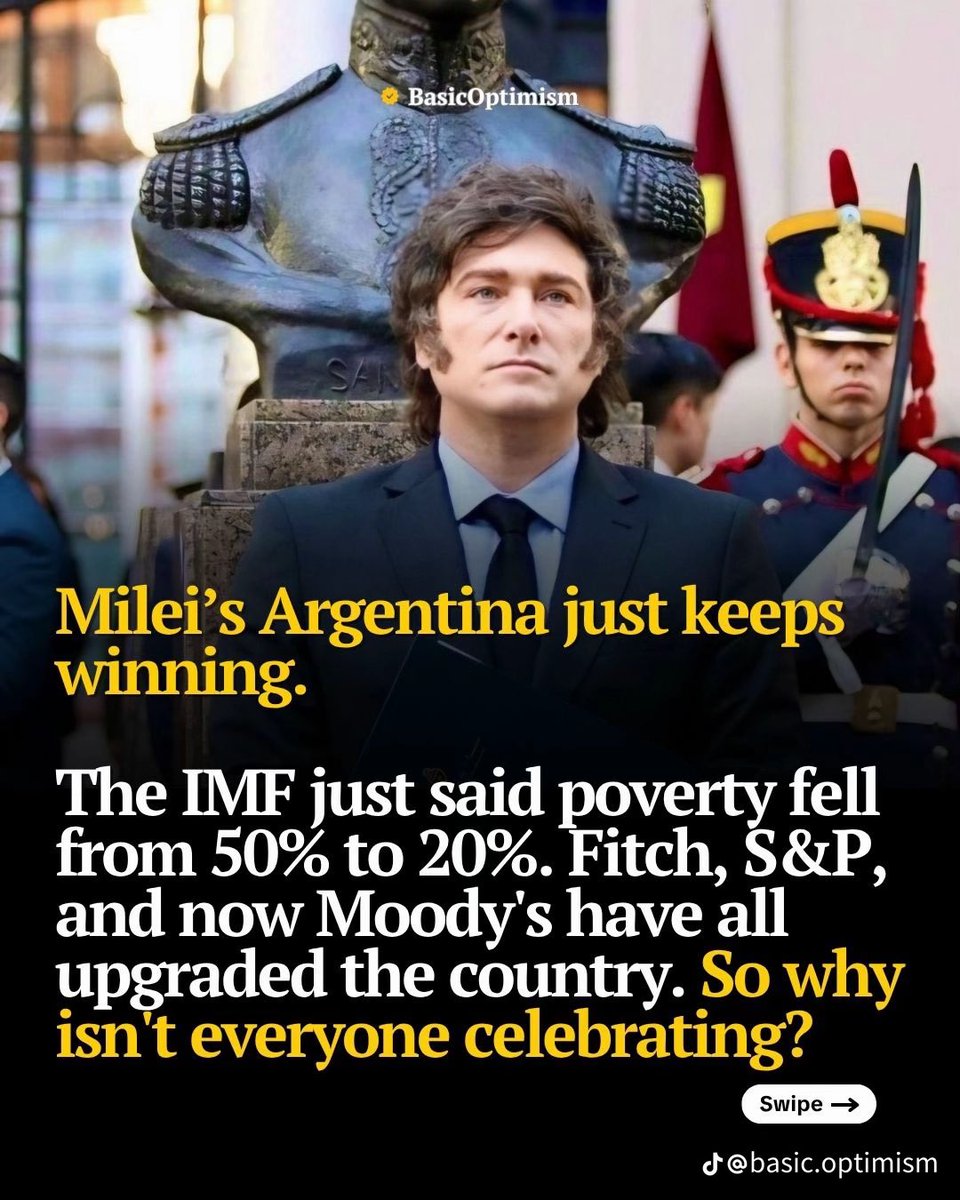
Argentina is showing former socialist countries how to do it.
President Milei has cut the government in half. He stopped printing pesos to pay their bills.
He got rid of rent control, which resulted in thousands of units coming onto the market and rent prices declining 40%.
Millions of people are escaping poverty in Argentina due to Milei.
Schau dir diese Grafik genau an. Sie erklärt, warum sich in Deutschland Leistung nicht mehr lohnt.
Ein Paar, zwei Kinder, beide arbeiten.
Bei 4.000 Euro brutto bleiben rund 2.700 Euro.
Bei 5.000 Euro brutto bleiben rund 2.650 Euro.
Du liest richtig. Tausend Euro mehr verdient. Weniger im Portemonnaie.
Und jetzt der Teil, der wirklich weh tut: Bei 2.000 Euro brutto stehen dieser Familie etwa 2.350 Euro zur Verfügung.
Bei 5.000 Euro brutto sind es 2.650 Euro.
3.000 Euro mehr erarbeiten. 300 Euro mehr haben.
Das ist kein Rechenfehler. Jeder zusätzlich verdiente Euro zieht Wohngeld, Kinderzuschlag und Freibeträge mit sich in den Abgrund, während Steuern und Sozialabgaben gleichzeitig steigen.
Man nennt es Transferentzugsrate. Ökonomen kennen das Problem seit Jahren. Die Bundesregierung hat Gutachten dazu bestellt.
Passiert ist nichts.
Und dann wundert sich die Politik, warum niemand mehr die Stunden aufstockt. Warum die Zweitverdienerin in Teilzeit bleibt. Warum der Facharbeiter die Beförderung ablehnt.
Die Leute sind nicht faul. Sie rechnen.
Ein System, das Anstrengung und Fleiß nicht belohnt, bekommt am Ende genau das: keine Anstrengung.
In most countries, earning a PhD means writing a dissertation.
Hundreds of pages of theory, research, and citations that very few people will ever read.
China decided to try something different.
Under a law passed in 2024, select universities can now award engineering doctorates based on physical prototypes, new techniques, or major installations instead of traditional papers. The rule is straightforward: build something that works in real life and at scale, and you can graduate.
The first cohort has already finished.
Zheng Hehui earned his doctorate by designing reinforced steel blocks that snap together like Lego to form massive bridge pylons. His invention is already in use on the Changtai Yangtze River Bridge, the world's longest cable-stayed bridge.
Wei Lianfeng became the first practical PhD graduate at Harbin Institute of Technology by developing vacuum laser welding processes for the Nuclear Power Institute of China.
Another candidate built a fire-fighting system for large seaplanes.
At least 11 engineers have now earned their doctorates through this route.
Since 2022, more than 60 universities and 100 companies have collaborated, selecting over 20,000 students for practical doctorate programmes.
The goal is to close the gap between academic theory and industrial application, particularly in fields like artificial intelligence and semiconductors.
One student built a bridge. Another welded nuclear components.
And they got the same three letters as everyone else.
The US doesn't have such a program. What do you think? Good idea or not? Weigh in
1 in 16 American kids no longer goes to school.
Their parents took them home.
In 1999 it was 1 in 59.
Homeschooling has nearly quadrupled since.
Many conservative families are homeschooling over values.
- Critical race theory
- Gender ideology
- Schools that hide things from parents
They aren't wrong on the academics either.
Proficient, high school seniors, by our own Department of Education's standard:
- Math: 22%
(45% can't do basic math, the worst in recorded history)
- Science: 22%
- Reading: 35%
Senior math and reading are the lowest ever recorded.
We spend $20,387 a year per student, more than 98% of countries on earth.
We wrote the test.
We set the passing line.
Three out of four seniors still can't clear it.
Schools teaching values nobody asked for, failing at the subjects they were hired for.
You pay twice.
Once in taxes, once in what your kid never learned.
3.4 million families quit waiting and started homeschooling.
Nobody put it on a ballot.
They just left.
The West has feminized its values and institutions.
This has created a culture that places inclusion before achievement, safety over risk, and emotional experience above rational thought.
This has reshaped how our schools, media, courts, and government function.
America was not inherited. It was designed.
This is the most important difference between the American political system and every European one – and it explains almost everything about how they behave differently under pressure.
The European systems are the accumulated result of centuries of people grabbing, protecting, and occasionally reforming their privileges. The castle became the parliament. The knight became the aristocrat became the bureaucrat. The physical hierarchy of the medieval order dissolved slowly into the institutional hierarchy of the modern state – but the direction of power never fundamentally changed. It flows downward. The state is the source. The citizen is the recipient. Rights are granted, regulated, and can be revoked. The government rules. The people, from time to time, get to choose which version of the ruling class they prefer. But not too much.
America reversed the direction deliberately, constitutionally, and in writing. Power flows upward from the citizen. The government does not grant rights – it is created specifically to protect rights that exist before it and above it. The Bill of Rights is not a list of things the government allows you to do. It is a list of things the government is forbidden to touch. The distinction is not semantic. It is civilizational.
The founders had read their history. They designed against the accumulation of power: separation of powers, checks and balances, federalism, the armed citizen as the ultimate check on all of it. Not a perfect system. A system designed to be imperfect in a specific way – to make the concentration of power difficult, slow, and visible.
Europe reformed its inherited systems. America built from first principles. The European instinct was to trust the institution. The American instinct is to limit it. The gun is the symbol of the difference – not as a weapon but as a principle. In America, the citizen is armed because the citizen is sovereign. In Europe, the citizen is disarmed because the state is sovereign. Everything else follows from that single difference in the direction of power.
Georgia ranked 137th in the world for ease of doing business.
3 years later it was 11th and had overtaken Germany and France, while everyone was still calling it a failed post-Soviet state.
A businessman named Kakha Bendukidze took the economy ministry after the Rose Revolution in 2003 and tore the system apart.
He cut the tax code from 21 taxes to 6, slammed in a flat 12% income tax, and wiped out most of the licenses and permits choking every business.
Then he fired the entire corrupt traffic police overnight and built a new force from scratch.
GDP grew 7.5% a year and foreign investment went from almost nothing to $2.1 billion.
No country has ever climbed the rankings that fast.
Back in clown world, Western governments keep adding rules and agencies while growth stalls because real reform would destroy the parasites they protect.
Do animals like music?
Studies found they enjoy specially designed sounds using pitches, tones and tempos that are familiar to a particular animal's species.
This dog, for example, is really sensitive to percussions.
Ann Widdecombe at the 2019 Oxford Union debate. Speaking against “no platforming” the former UK MP declares: “Only two sorts of people oppose free speech… snowflakes and totalitarians.” She tells them no one has the right to be protected from offence free speech is for everyone.
Thomas Sowell: "Why do we expect different groups to perform the same, and have the same skills and outcomes? When there are vast differences in their backgrounds.
Germans arrived in America with piano making skills, so you can't expect the Irish to produce pianos to the same levels as the Germans.
Even in countries where there are indigenous people only, outcomes also differ there. Equality does not exist anywhere on this planet."
.@elonmusk says zero people died from DOGE cuts to USAID. The billionaire CEO of SpaceX and Tesla, in his own words, helped feed the policy to the woodchipper last year, when he was the head of America’s Department of Government Efficiency. In an exclusive interview, @zannymb, The Economist’s editor-in-chief, challenges his claims: https://t.co/ZvmVXffNiD
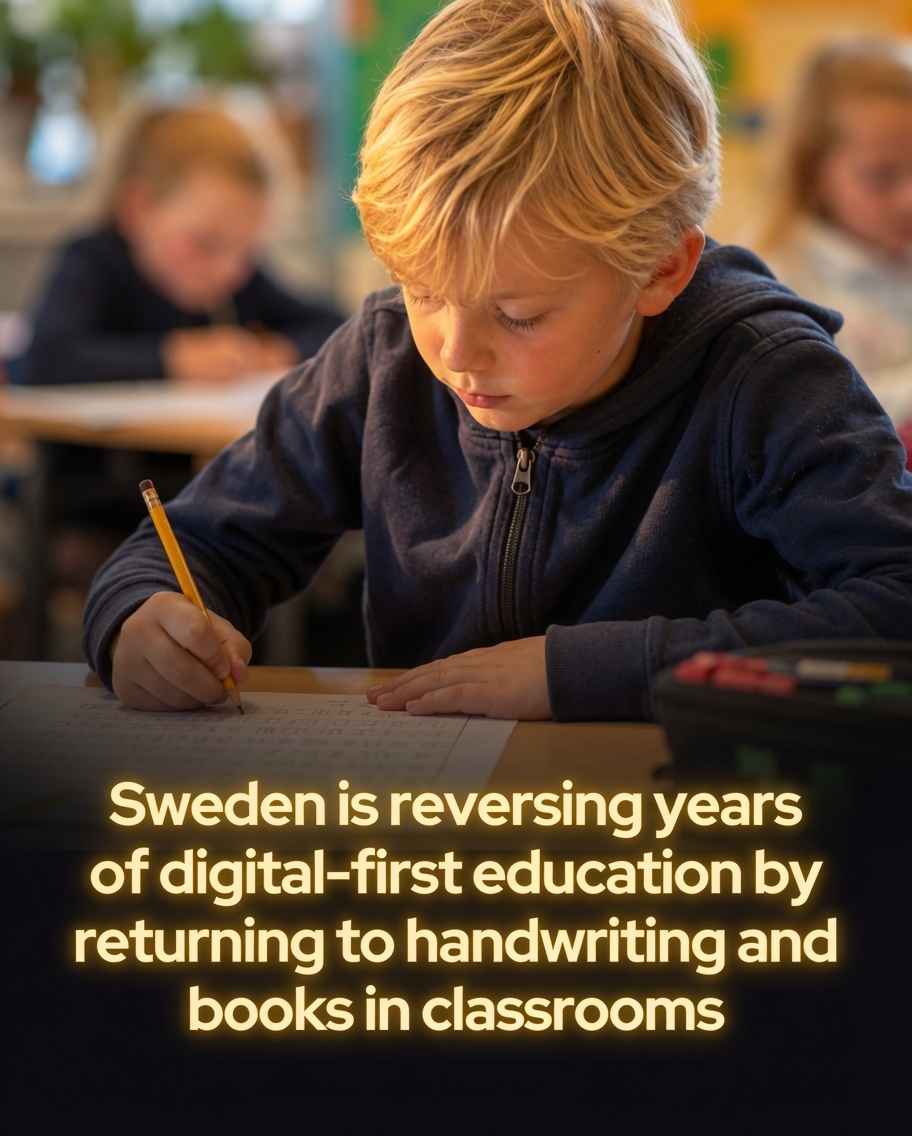
Sweden is reintroducing printed books and handwriting into its classrooms. Once celebrated as a leader in digital education, the country is now directing significant resources toward traditional textbooks while limiting the use of tablets and screens, particularly for young students.
Swedish authorities attribute this policy shift to mounting evidence that excessive screen time may have harmed reading proficiency and basic skill development. The government has also announced plans to ban digital learning tools for children under six years old.
Scientific research on handwriting provides insight into the rationale. When children write by hand, they engage multiple brain areas responsible for motor control, visual processing, memory, focus, and language. Unlike typing, this process demands precise coordination of fine movements alongside letter recognition and word formation. Studies indicate that such multisensory engagement enhances letter knowledge, spelling, reading acquisition, and memory retention.
Printed books may similarly promote stronger comprehension. Research shows that people often retain information more effectively from physical pages than from digital displays. The tangible nature of paper offers spatial references that aid memory organization. In contrast, screen based reading, especially when interrupted by notifications or hyperlinks, can fragment attention and reduce deep focus.
This approach does not reject technology entirely. Computers and tablets continue to serve important roles in research, group projects, accessibility features, and interactive exercises. Education specialists emphasize the need for thoughtful integration, applying digital resources where they prove most effective while safeguarding core practices such as handwriting, printed materials, and direct teacher instruction.
Sweden's policy change mirrors growing international discussions about optimal screen time in schools. As educators worldwide evaluate the benefits and drawbacks of digital tools, many are reconsidering when traditional methods may better support fundamental learning.