1/ 8×H100 lost to 4×H100 with one config change
I ran 12 experiments tuning vLLM for a 4B model at 400 concurrent users. Doubling GPUs: +61% throughput. One batching knob on half the hardware: better latency AND better cost-per-token.
A thread on what actually moves metrics 🧵
That means your unit economics are now a product decision made by whoever wrote the default config, often an engineer optimizing for demo quality, not margin. The teams doing this well route by task: high effort for the 5% of requests that need it, low for the rest.
The reasoning dial is a pricing decision, not a technical one. Anyone budgeting AI spend in 2026: the "reasoning effort" dial on modern models isn't a quality slider, it's a cost curve. Same model, same API, 2.4× price difference between low and high effort on Gemini 3.8 Flash.
Anthropic (Claude Fable 5.1 / Mythos 5.1, Sept 1), Google (Gemini 3.8 Flash, Sept 2), Meta (Muse Spark 1.3, Sept 2), and OpenAI (GPT-6 Astra, Sept 3–4) all released in one week. Notably, Google itself is telling developers to stay on 3.7 Flash for efficiency-first workloads.
Four frontier labs shipped new models in 48 hours last week. Google is openly recommending its older model for a large class of workloads. We've crossed from "which model is best" into "which model is right for this specific job at this specific cost".
Most teams' evaluation processes haven't caught up. If your model selection process still ends at "we use the newest one," you're leaving both money and reliability on the table.
@AnthropicAI open-sourced Claude Commerce Agents, for building AI shopping assistants. However, not every retailer is ready. Every retailer is asking which lab (@OpenAI or @AnthropicAI) do we go with?
Walked through each path from building AI Agents at production scale driving $
"MLA is theoretically interesting but slow in practice" is half right. The slowness is an implementation choice.
Full derivation, both kernels, numbers out to 131K:
https://t.co/MP4j73OMmN
Part 3 next week: a decision tree for picking attention.
My MLA had a smaller KV cache than my MHA and decoded 8× slower.
32K ctx, batch 16: MLA 5,000 tok/s vs MHA 42,000.
Two days later I found the matrix identity that makes it 13× faster with identical outputs. 🧵
https://t.co/MP4j73OMmN
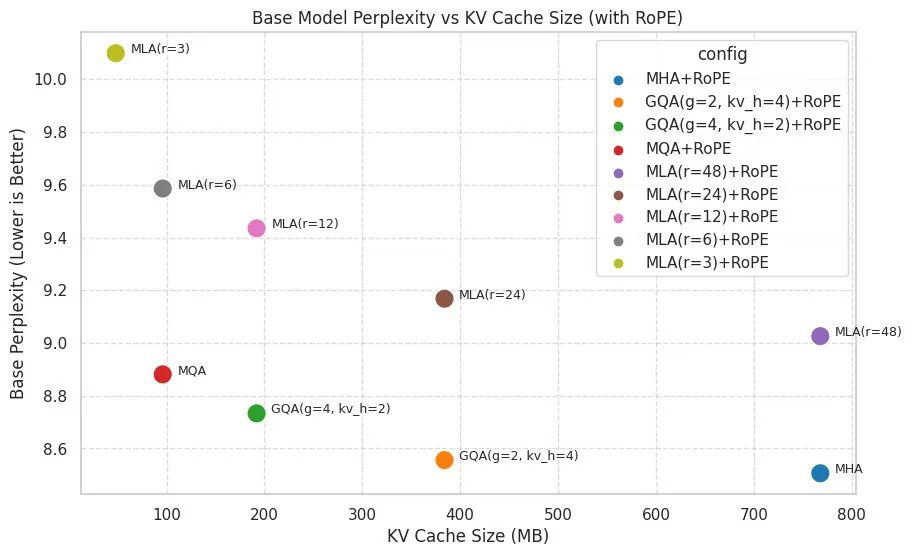
The honest part: absorbed MLA at 131K is still ~27% behind GQA(kv=8) at the same 8 GB cache.
This moves MLA from unshippable to competitive. It doesn't make it win.
And it breaks if you put RoPE on K — decoupled RoPE is the fix.
All nine trained checkpoints are now public on Hugging Face, with the raw CSVs of 210 H100 benchmark cells. Rerun it on your data; if your Pareto frontier disagrees with mine, I want to see it.
The question: how much KV cache do you actually buy per % of validation loss? Nine 30M-param language models, identical training, different attention.
Findings and full writeup -> https://t.co/AKTlp0i53G
📌 At production dimensions (H=32, d_head=128, batch 16, 131k ctx): MHA's KV cache hits 32 GB on an 80 GB card. MQA does 14× MHA's throughput on 1/32 of the cache. The cache wall is not theoretical.
9/Final: 4×H100, CUDA graphs, seqs=64 → p95 TTFT 1,716ms, p95 ITL 6.7ms, 0% errors at 400 users. Beat the matched reference on all three axes.
Full writeup + harness/configs: [https://t.co/LRORUmvnuV] [https://t.co/HabkeiOrsY]
thank you @VizuaraAI@modal
1/ 8×H100 lost to 4×H100 with one config change
I ran 12 experiments tuning vLLM for a 4B model at 400 concurrent users. Doubling GPUs: +61% throughput. One batching knob on half the hardware: better latency AND better cost-per-token.
A thread on what actually moves metrics 🧵
8/Measurement honesty: my cold-baseline A/B said max_num_seqs was worth +137%. Properly warmed runs: +30–50%.
CUDA graph warmup contaminates naive A/Bs. No warmup protocol = your deltas are upper bounds.