@andersonbcdefg I heard a rumor that this class was the first time the physics department was ever investigated by the athletic department for giving out too many A’s to athletes
New paper where we microscopically observe spin polarons in a triangular Fermi-Hubbard system! Kinetic frustration in triangular lattices leads to the formation of polarons that can exist in the absence of superexchange and are robust at high temperatures.
https://t.co/KpU4sWRIL9
Congratulations to Lysander Christakis who received his PhD written under the direction of Professor Waseem Bakr. Principal examiners in attendance were Professors Waseem Bakr, David Huse, and Jeffrey Thompson. #PrincetonPHYFPO
Today, Stanford graduate workers have announced our intent to unionize! Follow along and join us in solidarity as we fight to make Stanford a fair and safe workplace by giving graduate workers a real voice in our wellbeing. Stanford works because WE do! #StanfordGWU#SGWU
Huge results from the @Holland_ConnorM and the Cheuk Lab with the first demonstration of on demand entanglement between individually prepared molecules https://t.co/1ljZjWlkGz
https://t.co/v6Kjr9gjVo Our paper on the observation of the Hanbury Brown-Twiss effect with a molecular quantum gas microscope is now out in Nature Physics! @PrincetonPhys@NaturePhysics@princetonideas
Check out our new paper from the Bakr lab! We use ultracold molecules in an optical lattice to simulate an interacting spin model, and then probe the growth of correlations between the spins in time with microscopic resolution https://t.co/BjCBY5y7pT
Huge results from the Bakr Lab molecule experiment! I remember talking to an excited @LEChristakis over four years ago, when there was basically no experimental setup, about the potential to do a measurement like this one with molecules in a quantum gas microscope. Congrats :)
@QuantumHazzard However, one could definitely think about some interesting SLM + AOM setups that might be capable of expanding our current system further..
@QuantumHazzard@QuantumHazzard Your analysis is on the nose! The main challenges we see with only using SLMs for our application are lack of reconfigurability within an experimental cycle and difficulty controlling site intensities to <= 0.5 percent using holographic methods.
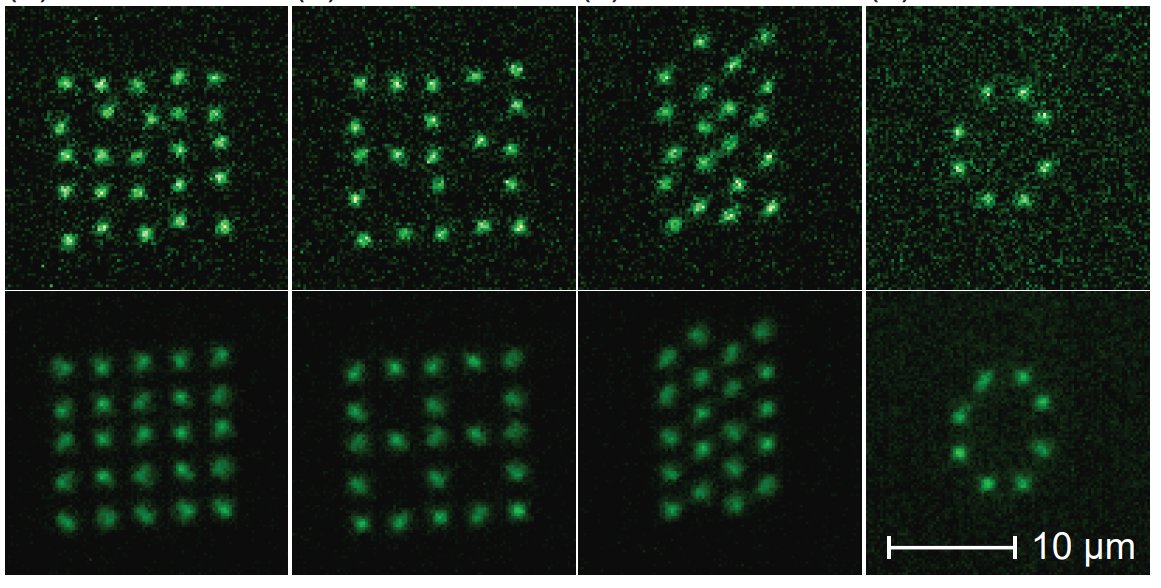
Further, we initialize near zero initial entropy states using a new bilayer spin-charge readout scheme. By preparing a 2x2 Hubbard plaquette, we demonstrate all components of a programmable fermion quantum simulator. Theory collaboration with @QuantumHazzard and team as well!
Latest work from the Bakr Lab https://t.co/sbNPl1Wa59! We scale our Fermi-Hubbard optical tweezer platform to 2-dimensions, where we realize a variety of programmable lattice geometries using a stroboscopic technique.
Bummed that Fermi-Hubbard model experiments aren't flexible enough? Or cold enough?
Waseem Bakr's group (@bspar) has a solution: programmable Hubbard models w atoms in tweezers. Programmable geometry & record-low entropy.
Happy to play a small role. https://t.co/GsG2SRHz2a
The MLB website without any references to baseball players is accidentally an extremely compelling display of what companies have without their workers.
Nothing. They can’t make anything, they can’t do anything, there is nothing interesting about them. They have nothing
I'm excited to share the latest preprint from the Bakr lab, where we observe the Hanbury Brown and Twiss effect with ultracold molecules for the first time:
https://t.co/5jkN0S53BJ
Check out our latest work (and my first “first author” paper!) on realizing a bottom-up Fermi-Hubbard lattice using an optical tweezer array! https://t.co/0qxCyoCnYT