In one week, GitLab Transcend goes live from London on June 10 and streams globally.
Get hands-on with agentic AI, hear from technology leaders at @AnthropicAI, @MercedesBenz, @googlecloud, @awscloud, Cube, and Compare the Market on the future of software development, and dive into new research from @Stanford's SWEPR scientists on engineering productivity in the AI era.
Save your spot. https://t.co/rV8tbcnbie
Uber reportedly now caps coding agents at $1,500/month per employee per tool - seems sensible to me, but it's also an interesting hint at the value Uber thinks these tools are providing
https://t.co/6YT0lCzPml
We don't charge for tokens, we draw down credits based on LLM requests.
You can get inference embedded within GitLab, we provide access to all the popular models hosted from the AI labs, and hosted on Bedrock/Vertex, or you can bring your own self-hosted models, or you can choose to connect models that you're already paying for elsewhere, and NOT pay for embedded inference.
Additionally, some features we have pinned to fixed costs, like our code review agent which costs just $0.25/merge request, because with all of the code and context in the repo, we've optimized it to be very good and cost effective so that customers can turn it on for every MR.
No one else provides this level of flexibility, which is obviously advantageous for customers, but also gives us a better cost basis than traditional AI vendors.
As for your last question, we believe in responsible growth, which optimizes for long term gross profit dollars.
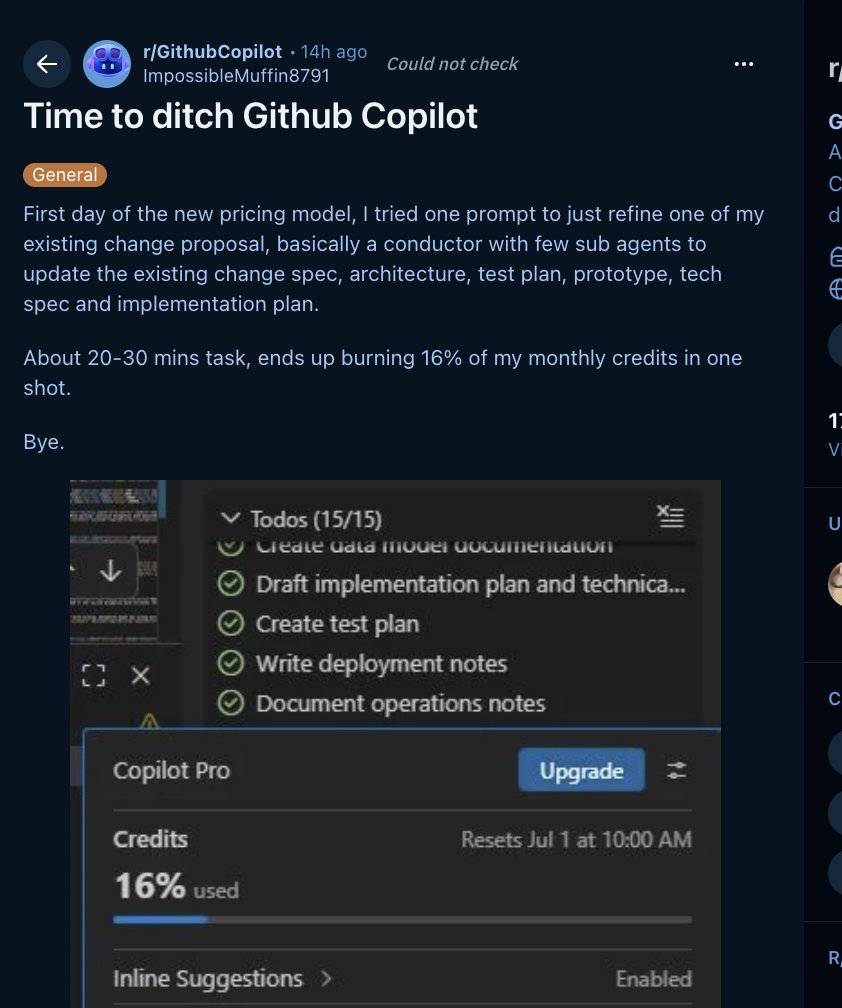
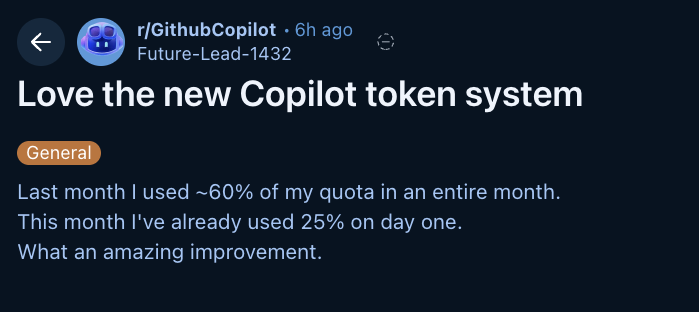
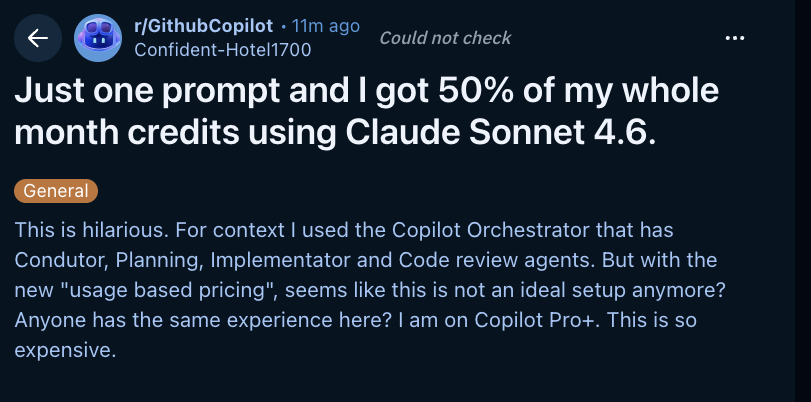
Copilot customers, if you run out of credits on GitHub, consider checking out GitLab and Duo Agent Platform. It is free to sign up and every premium seat includes $12/month and every ultimate seat includes $24/month in promotional credits so you can experiment with a more powerful cloud neutral, model neutral agent platform for DevSecOps with zero cost. Learn more and get started here: https://t.co/dO6nONgXX5
Jensen Huang just said the biggest prediction about AI was dead wrong.
It’s not replacing software engineers.
It’s making companies hire more of them.
Huang: “If you can hire a software engineer and you could generate 9 trillion dollars worth of productive work, why wouldn’t you want to hire more software engineers?”
Nine trillion dollars.
That’s the number that collapses the entire narrative.
Three years of headlines screaming that AI would erase the people who built it.
Huang: “People talk about AI reducing jobs, complete nonsense.”
And he’s right.
Huang: “The number of engineers, software engineers is actually increasing.”
Not plateauing.
Not declining slower than expected.
Increasing.
When one person can move nine trillion dollars worth of output, you don’t cut headcount.
You hire every engineer you can find.
Huang: “If that line was flat, then obviously people will hire fewer software engineers. But because the output is so incredible, people want to hire more software engineers.”
Cheaper never shrinks a field.
It floods it.
He’s right about all of it.
And it is the smallest part of what he said.
The number of engineers was never the real question.
The real one is what the engineer is for.
The ceiling on what one person could build was always the tool in their hand.
That ceiling is gone.
And when building costs nothing, only one thing stays rare.
Knowing what is worth building.
Leverage does not make you valuable.
It makes you visible.
It takes whatever is already inside you and multiplies it.
Vision turns into force.
Hollowness turns into scale.
For all of history, work was the great blur.
The lazy and the brilliant both showed up. Both looked busy. Both put in the hours.
That blur was the closest thing we ever had to equal.
And it is burning off.
When the doing is free, all that remains to measure is the mind that chose what to do.
The machine was never coming for your job.
It was coming for the place you were hiding.
Huang: “This is going to show up in our economy somehow soon.”
It shows up in people first.
We spent three years afraid the machines would learn to think.
The real fear runs the other way.
They will give us everything we ask for.
And leave us alone with the size of what we wanted.
Anthropic models have been the Duo default since inception and we’re happy to share Opus 4.8 is now available, same day release. https://t.co/NG7D1L5fko
Watching the AI ROI conversation get real this week. The honest answer to “what did we get for the spend” isn’t available in most platforms yet.
We’ve been building our agent platform knowing it was just a matter of time with three meaningful answers, that keep getting better over time:
We’re using fixed pricing on the use cases where ROI is proven. Example: basic code review at $0.25 instead of $15+. Customers know the unit cost before they consume a credit.
We ship our usage dashboards with detailed telemetry and auditing on every agent action tied to budget controls down to the individual user. Finance gets the same visibility engineering has had on cloud spend for a decade.
We’re providing an AI impact dashboard that correlates consumption with engineering cycle outcomes. Actual movement in the work.
The first wave of AI buying was faith-based. The second wave will be evidence-based, and the vendors who can show the link between spend and shipped software will be the ones to bet on.
@JaredSleeper Thanks @JaredSleeper - entirely consistent with what I hear customers say every day, and what we shared a few quarters ago from our own customer survey.
GitLab Secrets Manager is now in Public Beta. Store credentials in the same platform that runs your code, govern access through your existing group and project structure, and scope each secret to the job that needs it.
Supply chain security is on everyone’s mind, as attackers use LLMs to accelerate their own nefarious activities.
Dependency scanning just got better in GitLab 19.0, helping you stay up to date and secure.
Software supply chain visibility gets stronger in 19.0. Dependency scanning with SBOM produces an auditable inventory of third-party components in your build, and security analyzer profiles turn on SAST, Secret Detection, and Dependency Scanning across projects through policies.inventories every direct and transitive dependency in your project and tells you which vulnerable packages your application actually usesReachability analysis prioritizes the packages code actually calls.
Air-gapped environments have been the last to realize AI productivity gains. The most capable models land in cloud-first deployments first.
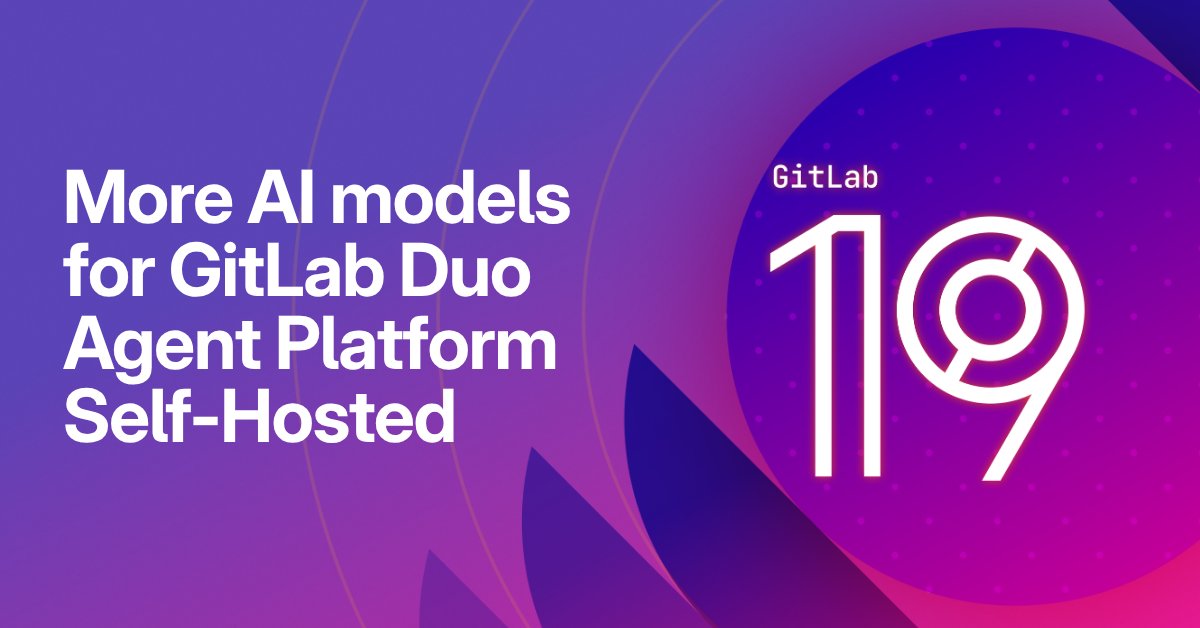
GitLab 19.0 adds four new open source models, Mistral Devstral 2 123B, GLM-5.1, Kimi-K2.6, and MiniMax-M2.7, for GitLab Duo Agent Platform self-hosted, delivering capable agentic workflows, with no data leaving your environment.
Learn more. https://t.co/fFlASeIfn5
One million developer hours saved per year! Read how one of the world’s largest, multinational banks uses GitLab + Duo to go faster. Thank you Barclays! https://t.co/9lzRv8gYOR
From the same survey:
“We’re at the death of code review. I used to do very deep code reviews where I’d take the time to understand the architecture. I have no motivation in spending that time to review a giant PR where it’s clear that even the original author didn’t bother to do that.”
A lead engineer at a small company said that. He’s not wrong, and he won’t be the last to say it.
Human code review of every line doesn’t scale when AI is producing the code. The math doesn’t work. The reviewer is the bottleneck, the reviewer is human, and humans tire quickly keeping up with machines.
That’s why we fixed Duo Agent code reviews at $0.25 per review, so teams can afford to run it on every MR, before the human ever sees it. Automation is the only path that keeps quality from collapsing under volume.
@Pragmatic_Eng surveyed 900+ engineers on AI tools. The patterns in the data are hard to miss.
Codebase quality is decreasing. Maintenance burden is concentrating on the fewer engineers who still understand the systems. "Drive-by" contributors generate code without owning what they ship. Complexity is exploding.
One staff engineer put it bluntly: AI agents generate too much repetitive code, developers lose understanding of the codebase, and bad architecture becomes invisible.
Generating code is the easy part. Everything that happens after: review, integration, deployment, maintenance, security, that is where the real cost and risk lives. And that's where GitLab's repo-side Duo Agent Platform shines.
The whole industry is learning the same lesson: coding faster isn't shipping faster. It might be the opposite.
https://t.co/IaAJS862Z1
Every org has AI-written code in their repo, and most can't tell you which agent wrote it.
GitLab logs every agent action, runs every MR through your approval rules, and scans every diff before merge.
See how teams are keeping agent code in check at https://t.co/AwlsmsLvLE.
@Pragmatic_Eng surveyed 900+ engineers on AI tools. The patterns in the data are hard to miss.
Codebase quality is decreasing. Maintenance burden is concentrating on the fewer engineers who still understand the systems. "Drive-by" contributors generate code without owning what they ship. Complexity is exploding.
One staff engineer put it bluntly: AI agents generate too much repetitive code, developers lose understanding of the codebase, and bad architecture becomes invisible.
Generating code is the easy part. Everything that happens after: review, integration, deployment, maintenance, security, that is where the real cost and risk lives. And that's where GitLab's repo-side Duo Agent Platform shines.
The whole industry is learning the same lesson: coding faster isn't shipping faster. It might be the opposite.
https://t.co/IaAJS862Z1
10/ The full Act 2 roadmap drops at GitLab Transcend on June 10. Architectural bets, product roadmap, business model evolution — all of it.
If you want to see the full picture of what we're building, you won't want to miss out.
https://t.co/om4raW6V6m
1/ Yesterday I published a letter to our customers and investors about GitLab Act 2.
The agentic era is the largest opportunity in our history. We're making the structural and strategic decisions to meet it.
A thread on what changes, what doesn't, and what we're betting on. 👇
https://t.co/y6IOeD7CcH
9/ How we'll operate going forward:
Three operating principles, built on a culture of excellence:
Speed with Quality. Move faster than we have, with the discipline that lets others rely on the work.
Ownership Mindset. The people closest to the work make the decisions and own the result.
Customer Outcomes. Measure ourselves by what changes for the customer, not by activity on our side.