$PGE.V $PGEZF @Stillwater_CM prime opportunity here for equity partnership with U.S Gov’t. They are in advanced talks with both the U.S. Department of Energy and U.S. Department of Defense. If you want to secure a domestic supply of platinum, palladium or rhodium, it is coming out of Stillwater, MT. Period. Partnership opportunity with $SBSW as well, who operates the Stillwater East mine in same district (right next door)
The Trump Administration Now Owns:
1. 10% equity stake in Intel, $INTC
2. 15% equity stake in MP Materials, $MP
3. 10% equity stake in Lithium Americas, $LAC
4. 10% equity stake in Trilogy Metals, $TMC
5. A “golden share” in US Steel Corporation
6. Floated idea of equity stake in defense contractors
Financial markets have entered a new era: government equity stakes.
What's the next acquisition for President Trump?
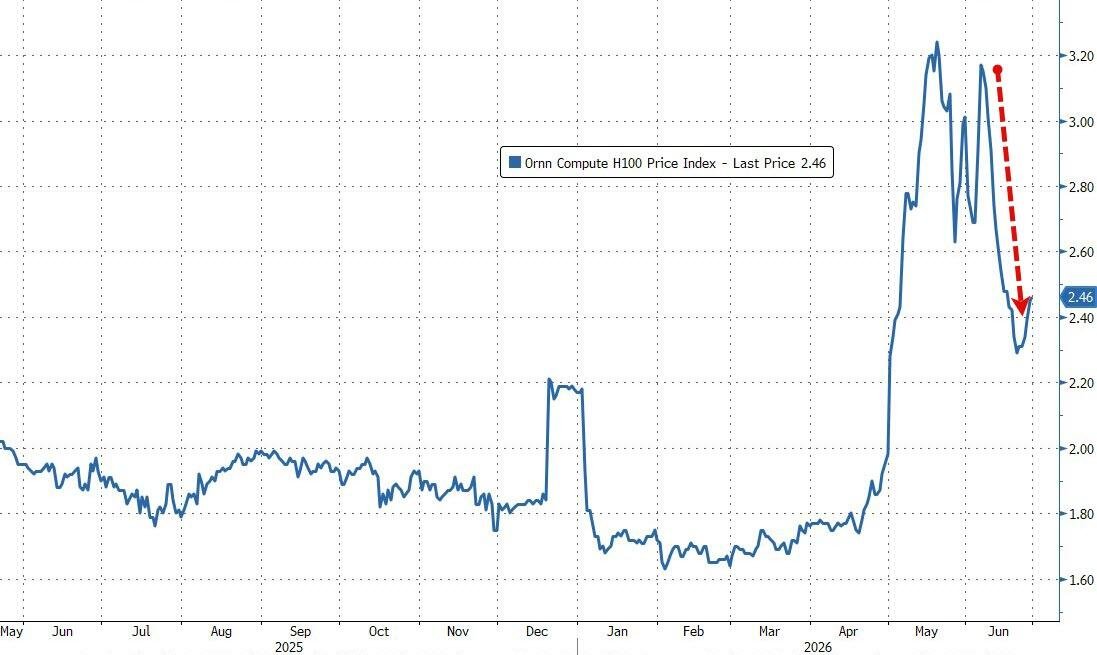
AI compute prices are completely collapsing. This is going to impact AI data center gross margins at the worst possible time.
Keep in mind, even at peak pricing all of these AI providers were extremely unprofitable.
The decline in private credit funding has forced them to switch from heavily subsidized subscription pricing to token based billing.
A desperate move, because corporations are now realizing LLMs are anywhere from 10-20x more expensive than they had been told.
Like subprime loans in 2008, the teaser rate just expired.
The rush for SpaceX, Anthropic and OpenAI to IPO is clearly because they see a double headwind of declining demand + declining gross margins.
Price discovery and return to normal is the hallmark of every bubble.
Did the AI bubble just pop?
After 15 yrs on Wall Street I retired at 38. Got bored after 2 yrs and at the request of clients started the VRA in 2003, which as it turned out was one of the first, online (only) investment newsletters.
In my second Letter (2003) I recommended gold @ $350 and silver @ $5. We’ve never removed our buy rating on either. We’ve also, for 23 years, recommended to our subs that they should save in gold over fiat. This recommendation alone has helped 100’s (likely 1000’s) to become multi-millionaires.
Beginning 2 weeks ago we made the call that rates would soon rollover, as disinflation becomes the primary theme into the 2030’s.
We’ve since been adding aggressively to our gold/silver/miner recs.
We’re still early in this bull market of bull markets. We see gold topping $15k and silver $300 by 2030. Investors will make absolute fortunes from here in gold miners with >3 million/oz in the ground.
This is the best buying opportunity of the last 3-4 years. 🚀
After reflection, this new narrative by Palantir is probably much more consequential than people may assume.
Palantir is basically being the canary in the coal mine announcing the death of two major assumptions propping up the US economy right now:
1) that AI labs will be able to extract significant economic rent - as opposed to AI models being mere commodities
2) that other countries can accept structural dependency on US technology and services without pushing back on sovereignty concerns
Why are Palantir specifically starting to be vocal about this?
First off, major middle-powers, even US “allies”, are one by one showing them the door. In June, France announced that the DGSI - its domestic intelligence agency, which had relied on Palantir since the 2015 Paris attacks - would replace it with French firm ChapsVision, with Prime Minister Lecornu explaining (https://t.co/SLhEGprBZC) that France “cannot accept new strategic dependencies in the digital sphere” and shouldn't depend on the goodwill of companies “capable of turning off the tap.”
Germany moved even earlier: its domestic intelligence service, the BfV, also selected ChapsVision over Palantir (https://t.co/pDZVj4SYUY), and the German military has said it will no longer use Palantir at all. Then, just this week, Spain instructed state-controlled companies - including strategic firms like Telefónica, Indra and Navantia - to avoid signing any new contracts with Palantir (https://t.co/0ik4UAFrT7).
Even in the UK, Washington's most loyal vassal, the NHS's £330 million data contract with Palantir is under review following parliamentary pressure (https://t.co/uJl6g4BMsW), and London Mayor Sadiq Khan blocked a proposed £50 million Palantir contract with the Metropolitan Police.
Palantir making a lot of noise around them caring about sovereignty makes a lot of sense: it's damage control since they keep being told they're a sovereignty risk.
I doubt it will work - because it's true: they are a sovereignty risk - but the fact that they feel the need to be vocal around this tells you where the wind is blowing: they're not shaping the narrative, they're reacting to one they're losing.
What they're saying against closed-source AI (basically a broadside attack on OpenAI and Anthropic), is again highly self-serving. Palantir's sudden love of open-weight AI models conveniently coincides with them launching 2 days before a partnership with Nvidia to sell exactly that: open models models (NVIDIA's Nemotron) in sovereign environments.
So it's essentially a product launch.
It doesn't make what they're saying wrong: it is factual that the value proposition of closed-source AI labs looks increasingly unsustainable. I mean: you're paying 10X the price of Chinese open-source AI models for something that's not really better (or just marginally) and on top of that you have zero control over your data, or the models themselves.
When Palantir says that "the architecture that maximally preserves sovereignty is one that enables institutions to own their tribal knowledge, and to compound it as alpha," they're right. I'd add that this also means you shouldn't trust Palantir either with that "tribal knowledge"... they obviously left this part out 😉
When you take a step back, these two things have major implications on many other US companies.
SpaceX - which just went public at the largest IPO valuation in history - is one clear example as I describe in my latest article on the new space race with China (https://t.co/JK3ELAyEVO).
If countries like France concluded with Palantir that they couldn't depend on a company “capable of turning off the tap” when it’s merely analyzing their data, what should they conclude about a company that aims to literally control their entire connectivity - at one man's whim, from space?
What percentage of SpaceX's crazy market cap is based on the assumption that foreign governments will not do to Starlink what they're currently doing to Palantir?
And SpaceX - or Palantir - aren't alone: a significant proportion of the top US tech giants, who rose in a world where no one questioned American technological hegemony, now face an environment that's much less conducive to the kind of lock-in their business models - and valuations - depend on.
When you pair this with the fact that it increasingly looks like the US made a wrong bet with closed-source AI - an extremely expensive wrong bet - the picture that emerges is of a country that bet its economic future on two things - proprietary AI and captive allies - and is losing both at the same time.
And to compound the problem, it doesn't help that the official narrative of the US government - via the voice of Jacob Helberg, the Under-Secretary of State (https://t.co/Z1rotPl9Ee) - is to be vocally opposed to "AI Sovereignty": essentially telling everyone "you know what, your worst fears are real, our tech companies are really out to undermine your sovereignty."
Read Helberg's post (the one I linked) and put yourself in the shoes of - say - a European or Asian leader and ask yourself how you'd react to being told that building your own AI capabilities is "marching in perfect formation into the past," that your pursuit of sovereignty is really just "synchronized mediocrity," and that your only path to the future runs through American technology.
If it was me in a position of power, I'd read this as a massive wakeup call: when another country's official position is that your sovereignty is a problem, history says you're about to need it.
So yes, it looks like - unexpectedly - Palantir, of all companies, is being quite the canary in the big tech mine. Yes they obviously do this for self-serving and cynical purpose, and yes they're of course also very much part of the problem and not the solution. But it doesn't make them wrong: sometimes it takes a vulture to tell you something is dying.
BREAKING: OpenAI has proposed giving the Trump Administration a 5% stake in the company to "clear political obstacles," per FT.
Details include:
1. Sam Altman has argued that giving the public a financial stake in the company is the best way to share the upside of AI
2. OpenAI is reportedly in "early talks" for a public ownership deal as political pressure rises
3. The proposed arrangement would involve other US AI companies handing over a similar stake
4. Sam Altman is reportedly in active talks with the Trump Administration about the situation
The Trump Administration may soon have equity in US AI giants.
Your 30s are for raising a family while growing in your career and settling into a home as you save for retirement and find time and funds to travel and stay involved in your hobbies and be there for your friends' special moments and cooking your own meals while keeping a regular fitness routine and a clean house and still getting enough sleep to function.
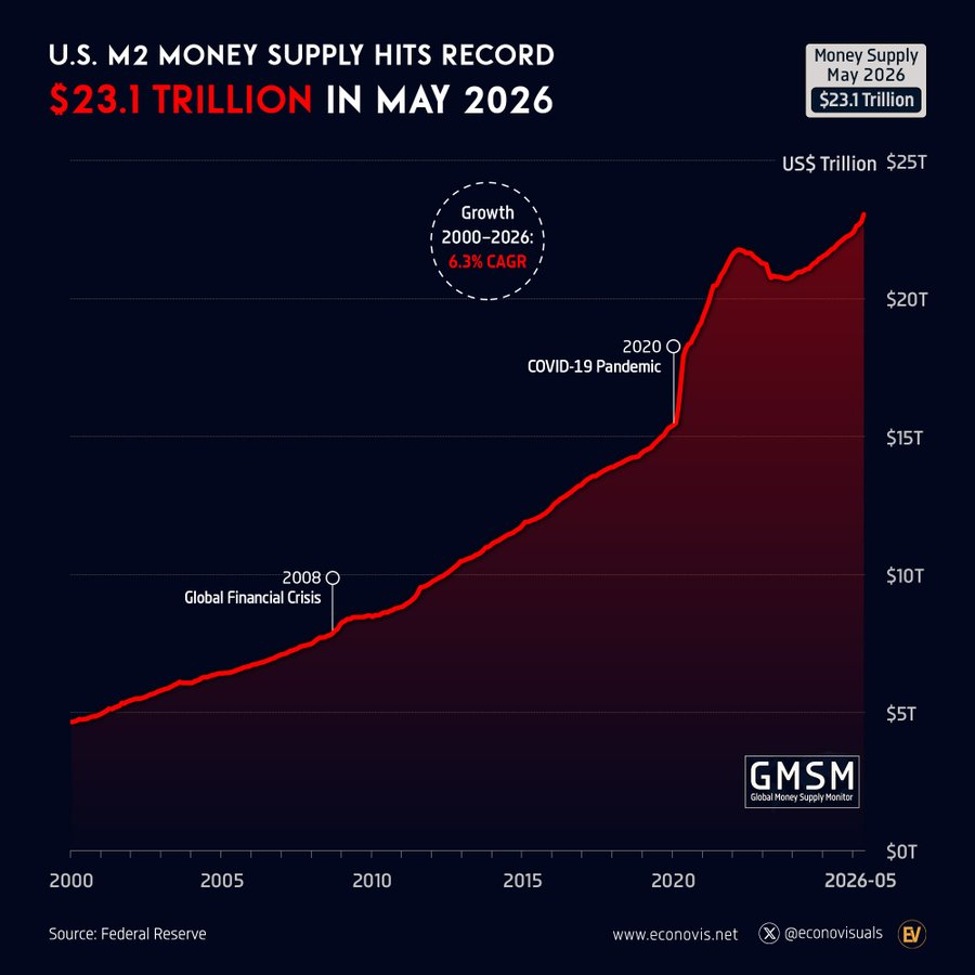
BREAKING: US M2 money supply surged +$247.8 billion in May, to a record $23.1 trillion.
This marks the largest monthly increase since May 2021.
Year-to-date, M2 has soared +$698.6 billion, the largest January to May increase in 5 years.
Money supply now stands $1.3 trillion above the March 2022 peak.
Since 2000, money in circulation has grown at an average annual rate of +6.3%.
US money creation is accelerating.
Dave Ramsey explains that the key to happiness is getting some buddies together, buying 10% of an OTC-listed community bank, forcing your way into the board, and taking over the company