@Xinbato_oz Your neighbor....he needs his ass clocked the fuck out with straight hook to his temple! As well as......introducing yourself to his wife in a manner that her holes would belong to you as you'd now leave "Deposits" in her to where the term creampies would be a understatement 😈
@hellsw40@ZyraGabriela Mmmm. This is usually the time I ask myself "Is there really someone else who is very attracted to the same array of people as I am?" Not this time! I'm just that much more horny because of it 😈😋!
The historic Associated Press photograph captures a confrontation in downtown Mobile, Alabama, on September 24, 1977, when a large group of Black counter-demonstrators disrupted a Ku Klux Klan march...
While the Civil Rights Act of 1964 and Voting Rights Act of 1965 legally dismantled segregation and expanded voter protections, social resistance remained strong in some communities.
By the mid-to-late 1970s, federal data and civil rights monitoring groups documented hundreds of hate-related incidents annually nationwide.
Membership in organized white supremacist groups had declined from their peak in the 1920s, when groups like the Ku Klux Klan claimed several million members, but the organization still maintained thousands of active participants and sympathizers across regional chapters. Meanwhile, African American voter registration in the South rose dramatically, from roughly 23% in 1960 to nearly 60% by 1980, marking major political progress despite ongoing hostility and intimidation attempts.
Law enforcement and civil rights organizations increasingly tracked extremist activity during this era. The Federal Bureau of Investigation expanded domestic monitoring of hate groups, while advocacy groups pushed for stronger civil rights enforcement.
Studies from the late 1970s showed that communities with higher voter registration and civic participation among minority populations were statistically more likely to experience short-term spikes in protest activity, but also demonstrated faster long-term gains in representation and economic opportunity.
#archaeohistories
@hellsw40@ZyraGabriela Wow! What a great detailed pervy choice of words that could never be confused as a fabrication. As a fellow pervy minded person myself.....I've had to immediately start stroking my black pipe though I'm in the view of others in public😈
Oct 17, 1931: Al Capone, the most famous gangster in America, was convicted of tax evasion.
For years Capone ran Chicago's bootlegging, gambling, and prostitution rackets during Prohibition and lived like a celebrity. Everyone knew about the murders, including the St. Valentine's Day Massacre in 1929. Nobody could prove he was behind any of them. Witnesses were too scared to talk.
The government went after his money instead. In 1927 the Supreme Court ruled that even illegal income had to be reported and taxed. Capone had never filed a tax return. He owned nothing in his own name and did business in cash.
While Eliot Ness and his Untouchables raided breweries and got the headlines, a team of IRS agents quietly built the real case. One of them found an old ledger from a gambling house with payments marked to "Al." They tracked down the bookkeeper who wrote it and got him to testify.
Capone's men tried to bribe and threaten the jurors. The judge found out and, on the first day of the trial, swapped the entire jury with one from another courtroom.
Capone was convicted and sentenced to 11 years in federal prison. He was eventually sent to Alcatraz. By the time he got out in 1939, he was suffering from syphilis that had attacked his brain. He died in Florida in 1947, at 48.
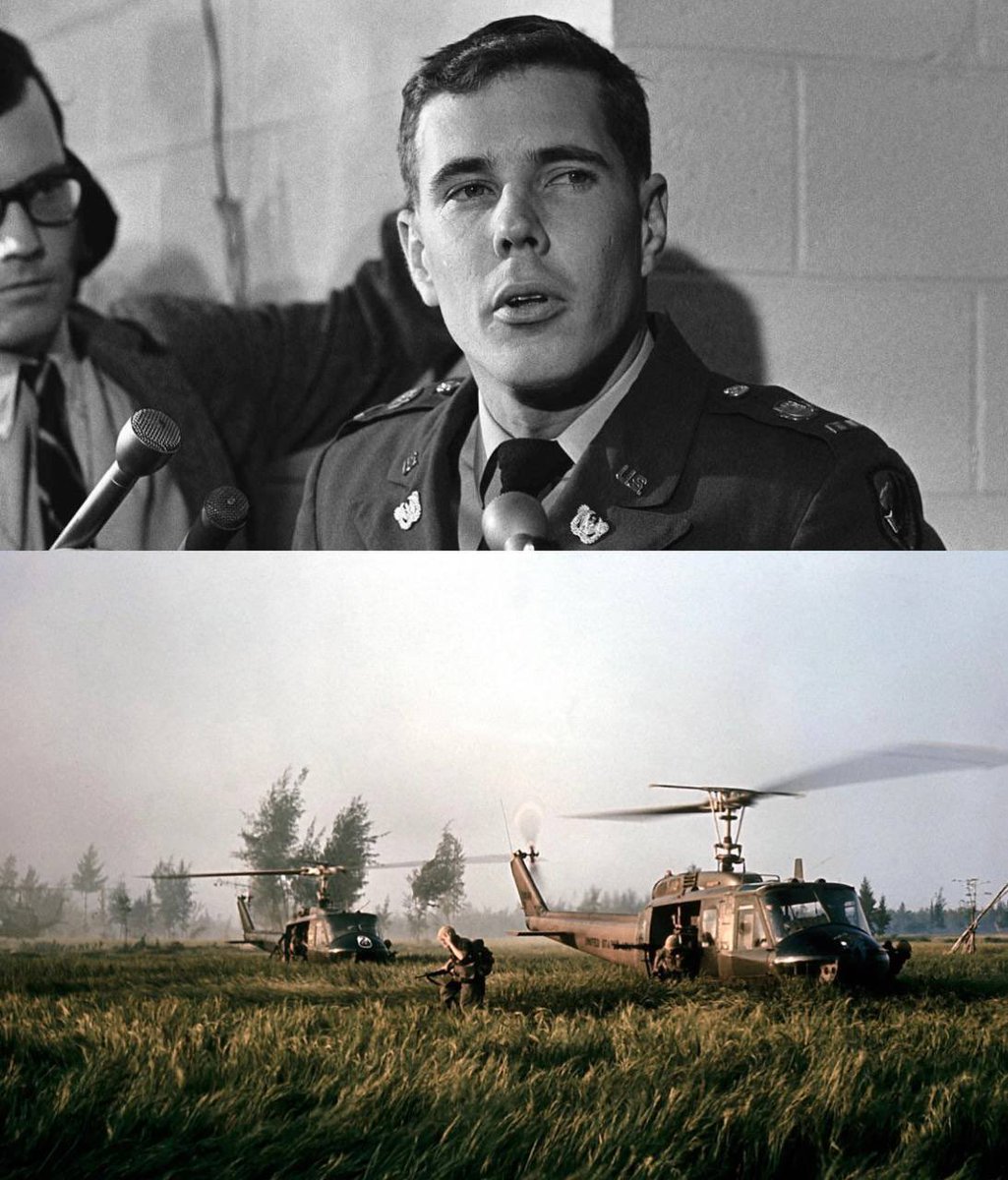
In 1968, helicopter pilot Hugh Thompson saw American soldiers m*ssacring Vietnamese Civilians from the air. He landed his helicopter between the soldiers and survivors and ordered his crew to shoot the Americans if they tried to k*ll them.
On the morning of 16 March 1968, Warrant Officer Hugh Thompson and his two-man crew, crew chief Glenn Andreotta and gunner Lawrence Colburn, were flying their observation helicopter over the village of Sơn Mỹ in Quảng Ngãi Province, South Vietnam.
They had been told it was a Viet Cong stronghold. It wasn't. The village was full of unarmed rice-farming families.
As Thompson made pass after pass over the area, he radioed:
"It looks to me like there's an awful lot of unnecessary killing going on down there.Something ain't right about this. There's bodies everywhere. There's a ditch full of bodies."
Between 347 and 504 unarmed men, women, and children were being systematically sh*t by American troops under Lieutenant William Calley.
Thompson landed his helicopter between the advancing American soldiers and a group of Vietnamese civilians hiding in a bunker.
He told his crew to train their machine guns on the American troops and open fire if they tried to harm the civilians.
He then personally coaxed eleven people out of the bunker and arranged for them to be evacuated by two Huey gunships flying as his escort.
Andreotta then spotted movement in an irrigation ditch filled with approximately 100 bodies. They landed again.
Andreotta waded through the dead to pull out a young boy still alive, covered in blood. Thompson flew him to hospital.
The aftermath was nearly as ugly as the m*ssacre itself.
Thompson was initially given a Distinguished Flying Cross, but the citation fabricated the events entirely, praising him for rescuing a child "caught in intense crossfire" and making no mention that the fire was from American troops.
Thompson threw the medal away.
When he testified before Congress in 1970, Congressman Mendel Rivers declared that Thompson was the only soldier at My Lai who deserved punishment, for turning his weapons on fellow Americans and attempted to have him court-martialled.
Thompson received d*ath threats and woke to find mutilated animals on his porch.
He went by a nickname for years to avoid being recognised.
It took thirty years and a nine-year letter-writing campaign by a university professor before Thompson finally received the Soldier's Medal for heroism in 1998, the Army's highest award for bravery not involving direct enemy contact.
Crew member Andreotta received it posthumously; he had been ki*led in combat three weeks after My Lai.
The only reason the Army finally acted was because Vietnam was preparing to give Thompson its own medal, and the US Army didn't want to be upstaged.
Thompson d*ed of cancer in 2006. He is buried in Louisiana with full military honours, including a helicopter flyover.
For years, Vermont State Police unknowingly drove around with a hidden pig printed on the side of their patrol cars.
The decals were produced through Vermont Correctional Industries, where prison inmates helped manufacture items for the state.
At some point, someone secretly altered the police emblem.
Hidden inside the black-and-white spots of the cow on Vermont’s state seal was the unmistakable silhouette of a pig, a deliberate insult aimed at police.
Nobody noticed.
Around 60 altered decals were produced, with as many as 30 police cruisers eventually displaying them.
Then, in 2012, a trooper inspecting his vehicle looked closely at the cow and finally spotted it.
Some officers were furious.
A state police spokeswoman said the prank disrespected officers, particularly those who had died in the line of duty.
Public Safety Commissioner Keith Flynn saw the funny side.
“We can see the humor,” he admitted.
The state spent $780 replacing the altered decals.
After years of driving around with a hidden pig on their cruisers, police finally removed the joke.
We, The Black Delegation, feel the need to remind all parties involve and observing, Stephen A. Smith does not represent the Black Community, and if we’re being honest, many in The Black Delegation have been trying to trade him to the White Delegation, but they keep rejecting the trade.