@chrisluxonmp Speak for yourself Christopher.
Ukraine, has almost always been one of the most corrupt countries on Earth, so…stay in your lane pal.
I, for one, do not support your warped view on this conflict
Here’s the deal: Mastercard's got a racket going, and nobody bats an eye.
You buy a $4 coffee, and by the time the transaction’s done, Mastercard and its buddies have dipped their grubby hands in for about 37 cents in fees. Doesn’t sound like much until you realise what that means for the small to medium retailer.
Their margins?
Sliced to ribbons.
The little guy selling coffee isn’t swimming in profits—he’s treading water. Every swipe chips away at what he’s worked for. It's daylight robbery with a smile and a shiny card reader.
Now, Mastercard will tell you they’re providing a service—"facilitating payments," they say, as if moving numbers between banks is some Herculean task in the digital age.
But let’s call it what it is: an empire of middlemen built to profit off every latte, sandwich, and tank of gas. The system isn’t designed to help you; it’s designed to bleed everyone—merchants, consumers, anyone who dares participate in the economy.
And this? This is what people call "innovation."
But then there’s BTC.
Or rather, what BTC as the fake cash Bitcoin was supposed to be. Digital cash, they said. Freedom from middlemen. Except, somewhere along the way, BTC became a parody of itself.
The fees? Higher than Mastercard, higher than Visa, higher than any sane person should tolerate. You try buying a coffee with BTC, and you’ll find yourself paying $5 in fees for a $4 drink.
It is laughable—like trying to squeeze an elephant through a keyhole. They’ll tell you it’s "digital gold," a "store of value," but let’s not mince words: BTC is about as useful as a rubber cheque in a windstorm when it comes to everyday transactions.
The problem isn’t just the fees. It’s the philosophy. BTC sold itself as the future of money, but what it delivered was a speculative asset for gamblers and grifters. It’s not digital cash. It’s not even close. What we need, what the world needs, is something that actually works—something that can handle the load of real commerce without collapsing under its own arrogance.
Enter the real potential of Bitcoin, the original vision.
Not the bastardised mess we see today, but the idea of a system that can process millions of transactions per second, with fees so low they’re practically invisible—fractions of a cent, less than 1/100th of a cent. Imagine a world where you can buy that $4 coffee and the fee is a rounding error, not a bloody tax.
A world where merchants keep their profits, where middlemen are stripped of their power, and where money flows as freely as conversation.
This isn’t some utopian fantasy; it’s achievable. NOW!
The technology exists. The infrastructure can be built. But it requires a return to the principles that made Bitcoin revolutionary in the first place: scalability, efficiency, and a focus on enabling real-world commerce. Not hodling. Not speculative bubbles. Real. Bloody. Transactions.
Think about what that means for the global economy. Small businesses thrive because they’re not handing over chunks of their revenue to parasitic payment processors. Micropayments become viable, opening up new markets and possibilities—pay-per-article journalism, real-time streaming payments, tipping systems that don’t gouge the giver or the receiver. Entire industries could be transformed, not by greed, but by practicality.
The beauty of it all?
It’s decentralised—not in the buzzword sense, but in the way that matters. No single entity controls it. No Mastercard, no Visa, no central bank skimming off the top. It’s a system where the power is in the protocol, where the rules are set and cannot be changed on a whim to benefit the few at the expense of the many.
So, the next time someone tells you BTC is the future, laugh. Laugh because the real future isn’t in skyrocketing fees and elitist nonsense. The real future is in a system that does what money is supposed to do: enable trade, foster trust, and get out of the bloody way. That’s Bitcoin. That’s digital cash. And that’s the revolution worth fighting for.
Jack Mallers, a preacher in the church of delusion, spits out words that taste like cheap liquor: “#Bitcoin can change the world because the world can’t change #Bitcoin.” The irony drips off him like sweat in a losing fight.
But here’s the thing he won’t tell you—BTC isn’t Bitcoin. It’s the ghost of an idea that’s been beaten to death, dressed up, and paraded around like it’s still alive.
They took Bitcoin and gutted it. Ripped out its heart—the ability to scale—and left the carcass for fanboys to worship. BTC doesn’t scale, doesn’t move, doesn’t breathe. It’s a corpse they’re dragging around while screaming about how revolutionary it is. But revolution isn’t static. It isn’t broken blocks and crippled dreams. It isn’t a system designed to fail the second it’s asked to handle the weight of the world.
And Jack, he knows this. He knows BTC can’t do what Bitcoin was supposed to do. He knows it’s a goddamn Ponzi, a plaything for gamblers and ideologues. But he keeps the charade going, because what’s the alternative?
Admit that they killed the real Bitcoin? That they castrated it and sold off its future for quick profits and fake promises?
The world won’t change for BTC. How could it? BTC doesn’t work. It’s like trying to build a skyscraper on quicksand. No foundation. No strength. Just a lot of noise, a lot of lies, and a bunch of fools hoping no one notices the cracks in the walls.
Bitcoin was supposed to be a system for everyone. Fast. Scalable. Honest. But BTC? It’s none of those things. It’s a grift wrapped in ideology, a lie they keep repeating because they think if they say it enough, people will believe it. But the truth doesn’t care about repetition. It’s out there, waiting, ready to burn through their bullshit like sunlight through fog.
So keep talking, Jack. Keep selling your fantasy.
But here in the streets, in the rain, in the cold, we know the truth.
BTC isn’t #Bitcoin. It’s the cheap knockoff they’re trying to pass off as the real thing. And no amount of hashtags will change that.
To defend the right of the inventor to set something within a protocol is to defend the very essence of property rights—the foundation upon which all human progress stands. Satoshi Nakamoto, in creating Bitcoin, made a declaration that the protocol was immutable, set in stone. This was not a mere technical decision but a moral stance, an assertion that the creator has the sovereign right to determine the path and purpose of what they bring into existence.
When Satoshi Nakamoto said Bitcoin was unchangeable, it was not just a statement about software; it was a declaration of the integrity of creation itself. To now suggest that a group of unauthorised developers can alter the protocol is to reject the rights of the individual creator and to hand the keys of innovation to the whims of a collective.
This is the Communist/collectivist lie, the perversion that demands that an individual’s creation belongs to the mob and can be reshaped by any who claim the right to do so.
Imagine a situation where a digital cash system, purportedly designed for widespread use, sees its market capitalization multiply 100-fold. Presently, the value of the system's unit hovers around US$60,000 per coin, amounting to a total capitalization of US$1.2 trillion across 20 million units. Multiplying this by 100 would bring the total capitalization to US$120 trillion, an astronomical figure representing a significant portion of the global economy, which is estimated at around US$400 trillion in total value. Such a scenario, on the surface, might seem like a triumph for those holding these assets, but the implications for society and the economy as a whole would be catastrophic.
First, consider the transactional aspect. As the value of each unit increases exponentially, so too would the associated fees for processing transactions. Under this hypothetical structure, fees would skyrocket to anywhere between US$5,000 and US$50,000 per transaction. The very notion of widespread, casual transactions – a core principle in the design of any cash system – would become a fantasy. Only the wealthiest individuals and institutions could afford to move these assets, rendering the system entirely inaccessible to the average person. What was once envisioned as a tool for financial inclusion and microtransactions would become a tool for the financial elite, whose ability to leverage vast sums of capital would be the only remaining use case.
The second consequence stems from the transactional bottleneck. If the costs of transferring value are prohibitively high, people simply won't transact. The system would grind to a halt, as very few transactions would be processed. Those holding assets might be inclined to hoard them, further reducing liquidity and economic dynamism. Paradoxically, the system, in its effort to preserve value, would become a static, non-functional network. The once-touted utility of facilitating peer-to-peer transactions would fade into obscurity.
Moreover, this vast increase in market capitalization does not exist in a vacuum. A US$120 trillion market capitalization for this system would represent a massive portion of the global economy. The opportunity cost of this is tremendous – resources, innovation, and capital that could have been deployed in more productive, wealth-generating enterprises would be locked up in an asset that is not functioning as intended. The deflationary spiral that ensues would decimate broader economic productivity.
Furthermore, this immense concentration of wealth in a single asset would exacerbate inequality. With only a limited number of individuals holding the vast majority of units, they would possess outsized influence and control over the financial system. The average person would be shut out entirely, unable to afford the prohibitively expensive fees, let alone acquire enough units to participate meaningfully. What was designed to democratize finance would instead deepen the divide between the wealthy and the impoverished.
In sum, this hypothetical scenario is a clear demonstration of what happens when a system, designed for a specific purpose, deviates far from its intended utility. While some may benefit enormously from the speculative appreciation of the asset, the broader societal consequences – economic stagnation, growing inequality, and the erosion of financial inclusivity – would be devastating. This is not the path to widespread prosperity but rather a cautionary tale of what happens when market dynamics are divorced from real utility and grounded in speculative mania.
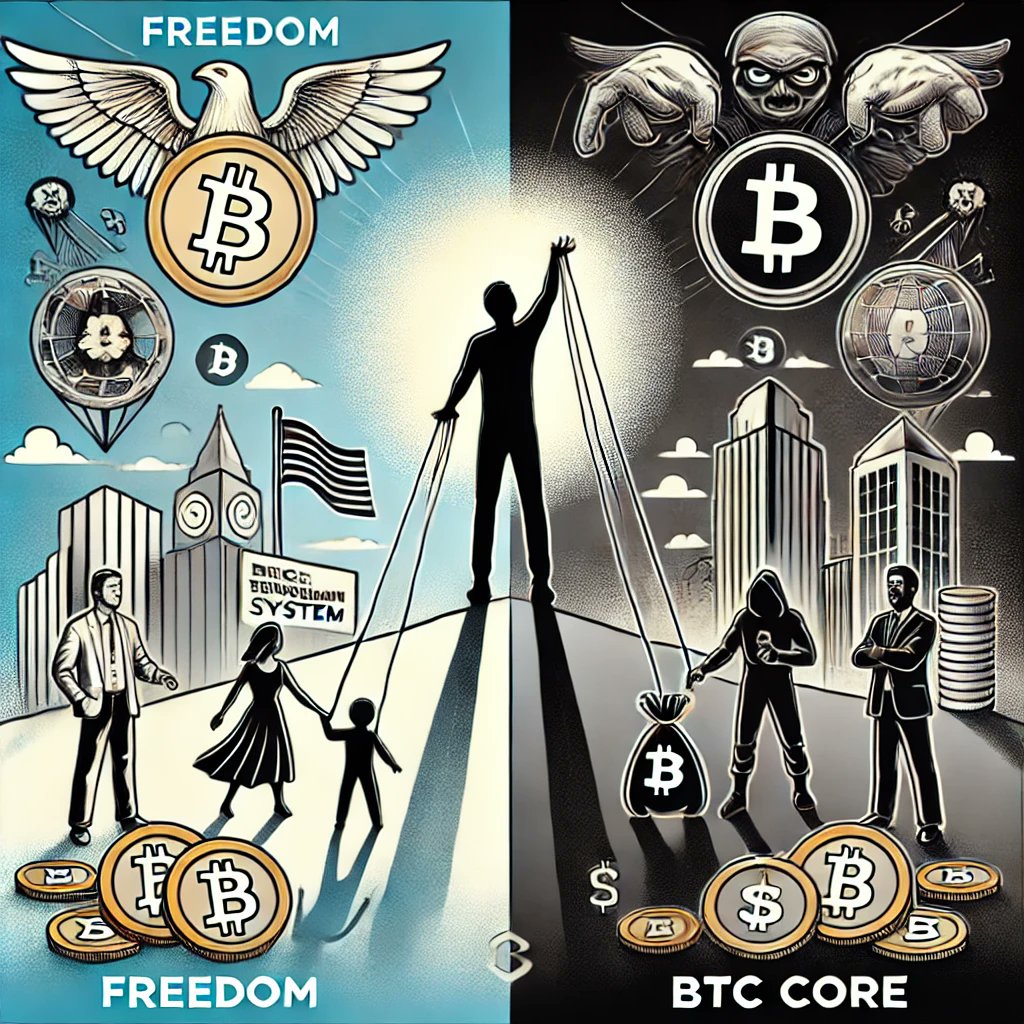
This image is a perfect illustration of how BTC Core has lost its original path and vision.
The statement that "Bitcoin isn't for people that live on less than $2 a day" is a far cry from what Bitcoin was designed to be—a tool for everyone, not just the wealthy.
It reveals how BTC has shifted from a system that promised financial inclusion, low-cost transactions, and individual empowerment to one that now serves the interests of the elite and the wealthy few.
One of the ironies in modern discourse is how often people assume that systems designed to protect property rights or recover assets from fraud only benefit the wealthy. In reality, systems that allow for the recovery of large-value assets through government intervention serve a much broader purpose—especially for those who are most vulnerable. It’s not hard to see why.
BTC, in its current form, functions almost entirely as a speculative asset. This is unsustainable, and when that speculation fades, it will collapse with astonishing speed. The reality is that BTC has no practical use beyond being a vehicle for speculation. It cannot scale, its transaction fees are sky-high, and it no longer serves the purpose it was originally designed for—a micropayment system and timestamp server.
When people realise this, the price will inevitably fall, and with that, the entire system will unravel.
In examining the differences between BTC, BSV, and the ideas presented by Satoshi Nakamoto, particularly regarding scalability, transaction costs, and decentralisation, we can use deductive reasoning to understand how each aligns with or deviates from Satoshi's original vision. Satoshi famously stated that Bitcoin could scale better than Visa, a key indicator that scalability and transactional efficiency were crucial to his design.
In the political arena of the US, the Democrats reject Bitcoin for the wrong reason, while the Republicans embrace Bitcoin for the wrong reason. Both are the fruits of a prevailing deception led by BTC, which is a corrupt version of the genuine Bitcoin.
Now that the deception has reached the top (symbolized by the former and potentially the future President Trump), the stake is even higher.
This is my conclusion after years of deep cross-disciplinary studies: BTC is parasitic economically, dishonest morally, and harmful socially.
But the genuine Bitcoin is the opposite.
BSV is the original Bitcoin and the only genuine Bitcoin. See the link below.
It's not about which coin is worth holding. It's about what kind of digital future the world will have. I cover the broader topic in the book “BIT & COIN: Merging Digitality and Physicality” (https://t.co/GfkMqqJwya)
Volume I Digital Humanity’s Truth Layer Blockchain The New Internet, its Authenticity Layer, and Applications
Volume II Bitcoin, Blockchain, and Beyond Essays of Science, Economics, Law, Ethics, and Controversies.
BSV is the original Bitcoin and the only genuine Bitcoin https://t.co/5GyE4NMSe2
🚨A Dark Money Deep Dive showing Blockchain evidence and relationships between some of the darkest money in Tech, including the relationships between Wanxiang, MIT, Epstein, Peter Thiel, and many foreign adversaries of America, including one that Purchased and Owned the Domains KillTrump.Crypto and KillTrump.Eth.
I first started investigating what I share below when I uncovered Blockchain evidence that contradicts Gary Genslers teachings at MIT on Ethereum's history. Gary Gensler, current Chair of the @secgov, taught about the history of Ethereum's ICO. Gary claims, VC and current Consensys Founder purchased 10% of the ICO, another 10% went to the Ethereum Foundation, and the remaining 80% was sold to the Public. Blockchain evidence shows us that Wanxiang was the original funder of the Ethereum Foundation, and Vitalik Buterin's wallets. - A wrote a thread showing the evidence behind my claims here, which is derived from public information and blockchain transactional evidence: https://t.co/yW6547eVxp
Vitalik Buterin, founded Ethereum in 2013, and was named as a Thiel Fellow in January of 2014. Later that year, in July of 2014, Ethereum held their ICO, raising a record amount of Investment dollars. Theil would later go on to give Thiel Fellowships to 22 different individuals directly, and another 32 Indirectly from 2014 to 2022. These founders were involved in the creation and development of blockchain technology, from prediction markets like Augur, to KYC tech like BlockScore; They founded Blockhains like Polkadot, and protocols like Anchor. They are tied to many Israeli funded projects, like Immutable X, as well as the Ukrainian Ministry of Digital Transformation. I wrote a thread in June 2023 covering the most impactful Thiel Fellow in the Blockchain Space from each of his classes. You can read about each individuals contributions here: https://t.co/XuObMyNj1S
In 2015, SEC Chair Gensler was MIT Media Labs senior advisor & taught economics with Glenn Ellison, the father of Sam Bankman-Fried's girlfriend, and co-CEO of Alameda, Caroline Ellison. Peter Thiel was taught Tax Law by Sam Bankman-Fried's father, where he learned the idea of placing much of his early Facebook stock into a tax-free IRA, leading to a $5 Billion tax-exempt "Piggy Bank".
Around this same time, in August 2015, one month after Ethereum's mainnet launch, Peter Thiel, Jeffrey Epstein, Reid Hoffman, Elon Musk, and Mark Zuckerberg all met with the at the time, MIT Media Director, Joi Ito, for Dinner in Palo Alto.
https://t.co/MkU4N8g3yX
You may or may not know that Epstein had a history with MIT that began much earlier than that dinner. After Epstein's 2008 conviction, he made several donations to MIT's Media Lab, along with Bill Gates, where work was being done on developing CBDC "Project Hamilton".
As early as 2015, Vitalik Buterin was tied into Wanxiang Labs, later holding the position of Chief Scientist for Wanxiang Labs, who created technology that was a direct competitor to Ethereum. By 2021, Wanxiang Labs had already invested in more than 500 different Blockchain projects.
In 2018, Wanxiang formed an official partnership with MIT's Media Lab. MIT and Wanxiang share the same Blockchain slogan, "In Blockchain we Trust", a dig at the US Dollars, "In God we Trust". https://t.co/ti4TTiVxQQ
I wrote a thread here that shows MIT was one of the largest holders of Ethereum in it's earliest days, and revealed Ethereum transactions being sent between Wanxiang's Crypto Wallets and an MIT's: https://t.co/fSFcmHPMTu
In fact, MIT may have even had their own Exchange, as they originally funded an address labeled by Crypto Site Breadcrumbs, as an unknown exchange. I covered that here: https://t.co/UPm1XIMeSD
SIDE NOTE: In 2023, I wrote a thread here, that pointed to evidence that the meme token, ShibaInu was created by a founder who was an intern for Microsoft when it was created, that was visiting MIT's media lab, who were also tied to the Japanese Crypto Market Maker B2C2, tied to Chicago's Market Maker, Cumberland. https://t.co/so5JENZxbI
However, Getting back on track, to MIT and Wanxiang's relationship. The official 2018 partnership wasn't the start of their actual relationship. In fact, Wanxiangs relationship dates back to 2012 with MIT, but in order to fully understand it, you must go back further.
In 2009, Biden's Administration, underneath President Obama, pushed for Grants that would be given to a MIT spinoff Battery company named A123, along with Fisker Automotive. In January 2011, Wanxiang met with Obama, and employed Obama's ally, former Chicago Mayor Richard Daly. Richard's brother, William Daly, was Obama's Chief of Staff from 2011 - 2012.
Wanxiang Group Corporation purchased A123, who received $250 Million in US Government grant dollars from Obama/Biden in 2009. Wanxiang also purchased the bankrump assets of Fisker Automotive in 2014, which also received Government funding. Both of these companies were supposed to build products in Biden's home state of Delaware. American Politicians were angry with the Obama/Biden administration as they allowed our foreign competitor to purchase American funded cutting edge technology at basement level prices, denying American companies who were also trying to acquire the tech. We gave away American Technology funded by American Tax Payers to our foreign adversaries, rather than keeping the technology in-house and under the control of American Companies. Worse yet, A123's technology could be used by the Chinese Military. The deal between Wanxiang and A123 was completed by Sidley Austin.
https://t.co/tm0tGorr3I
Wanxiang also owns the largest Copper Mine in North Korea, the country that American Intelligence Agencies like the FBI claim controls the "Hacking" group, Lazarus, who has stolen Billions of Dollars from Americans in Crypto to fund their "Nuclear" Weapons Projects. And despite being the largest Importer of North Korean minerals, Wanxiang, to this day, has yet to be Sanctioned.
In an Intelligence Report completed by Typhoon Investigations, a Map was created which shows how politically connected Wanxiang's now deceased founder, Lu Guanqiu, was to Global Leaders, including President Obama, Hunter Biden, President Biden, John Kerry, ex President Bush, Kim Jong Un, Xi Xinping, and many others.
By 2017, Wanxiang had at least 22 companies in 10 different Countries, from the US to Germany. They owned 60% of the Automotive Aftermarket in China, is one of the largest Real Estate buyers in America, the largest Mineral importer in North Korea, and in 2017 it was said that 1 in 3 American automobiles contain parts from Wanxiang.
In 2021, Sam Bankman-Fried paid CCP officials a $40 Million dollar Bribe. I traced the funds down on the Blockchain, and found those funds flow from FTX to a CCP official directly tied to Prometheum and Hashkey. Prometheum, and in part Hashkey, are partly owned by Wanxiang, and when looking analyzing their Blockchain transactions, they appear as though they are one of the same. Here is some of that Blockchain evidence showing Wanxiang's relationship to Prometheum, Hashkey and Longling Capital.
You can see the post I made on the Bribe here: https://t.co/8k6y9VqKsB
Prometheum established a strategic partnership and joint development agreement with Shanghai Wanxiang Blockchain in 2018, according to an SEC filing. The deal gave Prometheum access to Wanxiang’s “technology resources, industry contacts, [&] intellectual capital,”
On Wanxiang's own websites homepage they Proclaim: "Wanxiang America Corporation, The United States Incorporated offices of WANXIANG CHINA." They go on to state: "U.S. companies and customers can deal in U.S. dollar currency and US contracts when working with China."
Five Months after I released the blockchain evidence showing that Wanxiang was the original backer of Ethereum, in July of 2023, US Lawmakers called for an investigation into Wanxiang's partner, Prometheum.
This is because, despite blockchain evidence showing Prometheum's tied to the Chinese communist Party, in May of 2023, Chair Gensler, FINRA, and the SEC awarded Prometheum a "First of its Kind" and only ever given Special Purpose Broker Dealer license for Digital Assets. This meant Prometheum now had access to American Markets.
Shortly after this happened, I revealed that Prometheum, the company that is tied to the Bidens, Bush, Obama, North Korea, and many others, purchased and created the Crypto Domains, KillTrump.eth and KillTrump.Crypto. You can read that thread showing forensics blockchain evidence here: https://t.co/nsM2coUOer
Since that date, Prometheum wasn't stripped of their license. Nothing has happened to Prometheum, who purchased domains while President Trump was still a sitting US President. The only thing that has happened is now, someone has tried to actually k1ll Trump.
For more information on Wanxiang's ties to Crypto, you can read this blog here, written by best selling author @markcamilleri5 : https://t.co/WyRF0h0OrD
There are many more, equally as important connections to be talked about beyond the one's mentioned above; Including how Ethereums own Foundation is connected to massive Thefts on their own Blockchain, which have gone unpunished over the course of a Decade. Ethereum's largest buyers of their ICO was money that came from the wallets of the corrupt Special Agents wallets from the US Secret Service (Shaun Bridges) and DEA (Carl Mark Force IV), who seized the Mt. Gox funds in 2013/2014, one year prior to the Ethereum ICO. These funds were somehow untraced, despite being in the wallet that was seized by the Mt. Gox Task Force.
I've written about that several times, and included evidence, along with my believing's that "Lazarus", the supposed "North Korea" hacking group talked about earlier, being cover to some of the same people and groups I talk about above, as the corrupt agents Ethereum wallets become a part of the same network of wallets who have stolen billions since Mt. Gox, much of which is blamed on the Lazarus Group. Meanwhile, blame is being placed on this group by the FBI, DOJ, NYAG, CFTC, and others. Is it bad intel, or an inside job showing corruption at the highest, most dangerous of levels: https://t.co/58gvDybb79
That's all for now. Stay curious my Friends.
🫡🌎🌍🌏🇺🇸
Reminder: BTC is a psyop controlled by globalist authoritarians like Jack Dorsey and Larry Fink who spent the last decade buying influencers and startups so they control what everything thinks about bitcoin.
The blue-haired edge lord influencers you listen to are just actors who are paid to ruthlessly enforce their cancel culture on the whole blockchain economy as a way to make sure everyone stays on their lane on this part of the plantation.
Best case scenario: BTC brings you into the petty bourgeois of the ruling class.
It won’t make anyone one bit more free the way things are going.


![BoringSleuth's tweet photo. 🚨A Dark Money Deep Dive showing Blockchain evidence and relationships between some of the darkest money in Tech, including the relationships between Wanxiang, MIT, Epstein, Peter Thiel, and many foreign adversaries of America, including one that Purchased and Owned the Domains KillTrump.Crypto and KillTrump.Eth.
I first started investigating what I share below when I uncovered Blockchain evidence that contradicts Gary Genslers teachings at MIT on Ethereum's history. Gary Gensler, current Chair of the @secgov, taught about the history of Ethereum's ICO. Gary claims, VC and current Consensys Founder purchased 10% of the ICO, another 10% went to the Ethereum Foundation, and the remaining 80% was sold to the Public. Blockchain evidence shows us that Wanxiang was the original funder of the Ethereum Foundation, and Vitalik Buterin's wallets. - A wrote a thread showing the evidence behind my claims here, which is derived from public information and blockchain transactional evidence: https://t.co/yW6547eVxp
Vitalik Buterin, founded Ethereum in 2013, and was named as a Thiel Fellow in January of 2014. Later that year, in July of 2014, Ethereum held their ICO, raising a record amount of Investment dollars. Theil would later go on to give Thiel Fellowships to 22 different individuals directly, and another 32 Indirectly from 2014 to 2022. These founders were involved in the creation and development of blockchain technology, from prediction markets like Augur, to KYC tech like BlockScore; They founded Blockhains like Polkadot, and protocols like Anchor. They are tied to many Israeli funded projects, like Immutable X, as well as the Ukrainian Ministry of Digital Transformation. I wrote a thread in June 2023 covering the most impactful Thiel Fellow in the Blockchain Space from each of his classes. You can read about each individuals contributions here: https://t.co/XuObMyNj1S
In 2015, SEC Chair Gensler was MIT Media Labs senior advisor & taught economics with Glenn Ellison, the father of Sam Bankman-Fried's girlfriend, and co-CEO of Alameda, Caroline Ellison. Peter Thiel was taught Tax Law by Sam Bankman-Fried's father, where he learned the idea of placing much of his early Facebook stock into a tax-free IRA, leading to a $5 Billion tax-exempt "Piggy Bank".
Around this same time, in August 2015, one month after Ethereum's mainnet launch, Peter Thiel, Jeffrey Epstein, Reid Hoffman, Elon Musk, and Mark Zuckerberg all met with the at the time, MIT Media Director, Joi Ito, for Dinner in Palo Alto.
https://t.co/MkU4N8g3yX
You may or may not know that Epstein had a history with MIT that began much earlier than that dinner. After Epstein's 2008 conviction, he made several donations to MIT's Media Lab, along with Bill Gates, where work was being done on developing CBDC "Project Hamilton".
As early as 2015, Vitalik Buterin was tied into Wanxiang Labs, later holding the position of Chief Scientist for Wanxiang Labs, who created technology that was a direct competitor to Ethereum. By 2021, Wanxiang Labs had already invested in more than 500 different Blockchain projects.
In 2018, Wanxiang formed an official partnership with MIT's Media Lab. MIT and Wanxiang share the same Blockchain slogan, "In Blockchain we Trust", a dig at the US Dollars, "In God we Trust". https://t.co/ti4TTiVxQQ
I wrote a thread here that shows MIT was one of the largest holders of Ethereum in it's earliest days, and revealed Ethereum transactions being sent between Wanxiang's Crypto Wallets and an MIT's: https://t.co/fSFcmHPMTu
In fact, MIT may have even had their own Exchange, as they originally funded an address labeled by Crypto Site Breadcrumbs, as an unknown exchange. I covered that here: https://t.co/UPm1XIMeSD
SIDE NOTE: In 2023, I wrote a thread here, that pointed to evidence that the meme token, ShibaInu was created by a founder who was an intern for Microsoft when it was created, that was visiting MIT's media lab, who were also tied to the Japanese Crypto Market Maker B2C2, tied to Chicago's Market Maker, Cumberland. https://t.co/so5JENZxbI
However, Getting back on track, to MIT and Wanxiang's relationship. The official 2018 partnership wasn't the start of their actual relationship. In fact, Wanxiangs relationship dates back to 2012 with MIT, but in order to fully understand it, you must go back further.
In 2009, Biden's Administration, underneath President Obama, pushed for Grants that would be given to a MIT spinoff Battery company named A123, along with Fisker Automotive. In January 2011, Wanxiang met with Obama, and employed Obama's ally, former Chicago Mayor Richard Daly. Richard's brother, William Daly, was Obama's Chief of Staff from 2011 - 2012.
Wanxiang Group Corporation purchased A123, who received $250 Million in US Government grant dollars from Obama/Biden in 2009. Wanxiang also purchased the bankrump assets of Fisker Automotive in 2014, which also received Government funding. Both of these companies were supposed to build products in Biden's home state of Delaware. American Politicians were angry with the Obama/Biden administration as they allowed our foreign competitor to purchase American funded cutting edge technology at basement level prices, denying American companies who were also trying to acquire the tech. We gave away American Technology funded by American Tax Payers to our foreign adversaries, rather than keeping the technology in-house and under the control of American Companies. Worse yet, A123's technology could be used by the Chinese Military. The deal between Wanxiang and A123 was completed by Sidley Austin.
https://t.co/tm0tGorr3I
Wanxiang also owns the largest Copper Mine in North Korea, the country that American Intelligence Agencies like the FBI claim controls the "Hacking" group, Lazarus, who has stolen Billions of Dollars from Americans in Crypto to fund their "Nuclear" Weapons Projects. And despite being the largest Importer of North Korean minerals, Wanxiang, to this day, has yet to be Sanctioned.
In an Intelligence Report completed by Typhoon Investigations, a Map was created which shows how politically connected Wanxiang's now deceased founder, Lu Guanqiu, was to Global Leaders, including President Obama, Hunter Biden, President Biden, John Kerry, ex President Bush, Kim Jong Un, Xi Xinping, and many others.
By 2017, Wanxiang had at least 22 companies in 10 different Countries, from the US to Germany. They owned 60% of the Automotive Aftermarket in China, is one of the largest Real Estate buyers in America, the largest Mineral importer in North Korea, and in 2017 it was said that 1 in 3 American automobiles contain parts from Wanxiang.
In 2021, Sam Bankman-Fried paid CCP officials a $40 Million dollar Bribe. I traced the funds down on the Blockchain, and found those funds flow from FTX to a CCP official directly tied to Prometheum and Hashkey. Prometheum, and in part Hashkey, are partly owned by Wanxiang, and when looking analyzing their Blockchain transactions, they appear as though they are one of the same. Here is some of that Blockchain evidence showing Wanxiang's relationship to Prometheum, Hashkey and Longling Capital.
You can see the post I made on the Bribe here: https://t.co/8k6y9VqKsB
Prometheum established a strategic partnership and joint development agreement with Shanghai Wanxiang Blockchain in 2018, according to an SEC filing. The deal gave Prometheum access to Wanxiang’s “technology resources, industry contacts, [&] intellectual capital,”
On Wanxiang's own websites homepage they Proclaim: "Wanxiang America Corporation, The United States Incorporated offices of WANXIANG CHINA." They go on to state: "U.S. companies and customers can deal in U.S. dollar currency and US contracts when working with China."
Five Months after I released the blockchain evidence showing that Wanxiang was the original backer of Ethereum, in July of 2023, US Lawmakers called for an investigation into Wanxiang's partner, Prometheum.
This is because, despite blockchain evidence showing Prometheum's tied to the Chinese communist Party, in May of 2023, Chair Gensler, FINRA, and the SEC awarded Prometheum a "First of its Kind" and only ever given Special Purpose Broker Dealer license for Digital Assets. This meant Prometheum now had access to American Markets.
Shortly after this happened, I revealed that Prometheum, the company that is tied to the Bidens, Bush, Obama, North Korea, and many others, purchased and created the Crypto Domains, KillTrump.eth and KillTrump.Crypto. You can read that thread showing forensics blockchain evidence here: https://t.co/nsM2coUOer
Since that date, Prometheum wasn't stripped of their license. Nothing has happened to Prometheum, who purchased domains while President Trump was still a sitting US President. The only thing that has happened is now, someone has tried to actually k1ll Trump.
For more information on Wanxiang's ties to Crypto, you can read this blog here, written by best selling author @markcamilleri5 : https://t.co/WyRF0h0OrD
There are many more, equally as important connections to be talked about beyond the one's mentioned above; Including how Ethereums own Foundation is connected to massive Thefts on their own Blockchain, which have gone unpunished over the course of a Decade. Ethereum's largest buyers of their ICO was money that came from the wallets of the corrupt Special Agents wallets from the US Secret Service (Shaun Bridges) and DEA (Carl Mark Force IV), who seized the Mt. Gox funds in 2013/2014, one year prior to the Ethereum ICO. These funds were somehow untraced, despite being in the wallet that was seized by the Mt. Gox Task Force.
I've written about that several times, and included evidence, along with my believing's that "Lazarus", the supposed "North Korea" hacking group talked about earlier, being cover to some of the same people and groups I talk about above, as the corrupt agents Ethereum wallets become a part of the same network of wallets who have stolen billions since Mt. Gox, much of which is blamed on the Lazarus Group. Meanwhile, blame is being placed on this group by the FBI, DOJ, NYAG, CFTC, and others. Is it bad intel, or an inside job showing corruption at the highest, most dangerous of levels: https://t.co/58gvDybb79
That's all for now. Stay curious my Friends.
🫡🌎🌍🌏🇺🇸](https://pbs.twimg.com/media/GS8kDtJXUAAu-hQ.jpg)
![BoringSleuth's tweet photo. 🚨A Dark Money Deep Dive showing Blockchain evidence and relationships between some of the darkest money in Tech, including the relationships between Wanxiang, MIT, Epstein, Peter Thiel, and many foreign adversaries of America, including one that Purchased and Owned the Domains KillTrump.Crypto and KillTrump.Eth.
I first started investigating what I share below when I uncovered Blockchain evidence that contradicts Gary Genslers teachings at MIT on Ethereum's history. Gary Gensler, current Chair of the @secgov, taught about the history of Ethereum's ICO. Gary claims, VC and current Consensys Founder purchased 10% of the ICO, another 10% went to the Ethereum Foundation, and the remaining 80% was sold to the Public. Blockchain evidence shows us that Wanxiang was the original funder of the Ethereum Foundation, and Vitalik Buterin's wallets. - A wrote a thread showing the evidence behind my claims here, which is derived from public information and blockchain transactional evidence: https://t.co/yW6547eVxp
Vitalik Buterin, founded Ethereum in 2013, and was named as a Thiel Fellow in January of 2014. Later that year, in July of 2014, Ethereum held their ICO, raising a record amount of Investment dollars. Theil would later go on to give Thiel Fellowships to 22 different individuals directly, and another 32 Indirectly from 2014 to 2022. These founders were involved in the creation and development of blockchain technology, from prediction markets like Augur, to KYC tech like BlockScore; They founded Blockhains like Polkadot, and protocols like Anchor. They are tied to many Israeli funded projects, like Immutable X, as well as the Ukrainian Ministry of Digital Transformation. I wrote a thread in June 2023 covering the most impactful Thiel Fellow in the Blockchain Space from each of his classes. You can read about each individuals contributions here: https://t.co/XuObMyNj1S
In 2015, SEC Chair Gensler was MIT Media Labs senior advisor & taught economics with Glenn Ellison, the father of Sam Bankman-Fried's girlfriend, and co-CEO of Alameda, Caroline Ellison. Peter Thiel was taught Tax Law by Sam Bankman-Fried's father, where he learned the idea of placing much of his early Facebook stock into a tax-free IRA, leading to a $5 Billion tax-exempt "Piggy Bank".
Around this same time, in August 2015, one month after Ethereum's mainnet launch, Peter Thiel, Jeffrey Epstein, Reid Hoffman, Elon Musk, and Mark Zuckerberg all met with the at the time, MIT Media Director, Joi Ito, for Dinner in Palo Alto.
https://t.co/MkU4N8g3yX
You may or may not know that Epstein had a history with MIT that began much earlier than that dinner. After Epstein's 2008 conviction, he made several donations to MIT's Media Lab, along with Bill Gates, where work was being done on developing CBDC "Project Hamilton".
As early as 2015, Vitalik Buterin was tied into Wanxiang Labs, later holding the position of Chief Scientist for Wanxiang Labs, who created technology that was a direct competitor to Ethereum. By 2021, Wanxiang Labs had already invested in more than 500 different Blockchain projects.
In 2018, Wanxiang formed an official partnership with MIT's Media Lab. MIT and Wanxiang share the same Blockchain slogan, "In Blockchain we Trust", a dig at the US Dollars, "In God we Trust". https://t.co/ti4TTiVxQQ
I wrote a thread here that shows MIT was one of the largest holders of Ethereum in it's earliest days, and revealed Ethereum transactions being sent between Wanxiang's Crypto Wallets and an MIT's: https://t.co/fSFcmHPMTu
In fact, MIT may have even had their own Exchange, as they originally funded an address labeled by Crypto Site Breadcrumbs, as an unknown exchange. I covered that here: https://t.co/UPm1XIMeSD
SIDE NOTE: In 2023, I wrote a thread here, that pointed to evidence that the meme token, ShibaInu was created by a founder who was an intern for Microsoft when it was created, that was visiting MIT's media lab, who were also tied to the Japanese Crypto Market Maker B2C2, tied to Chicago's Market Maker, Cumberland. https://t.co/so5JENZxbI
However, Getting back on track, to MIT and Wanxiang's relationship. The official 2018 partnership wasn't the start of their actual relationship. In fact, Wanxiangs relationship dates back to 2012 with MIT, but in order to fully understand it, you must go back further.
In 2009, Biden's Administration, underneath President Obama, pushed for Grants that would be given to a MIT spinoff Battery company named A123, along with Fisker Automotive. In January 2011, Wanxiang met with Obama, and employed Obama's ally, former Chicago Mayor Richard Daly. Richard's brother, William Daly, was Obama's Chief of Staff from 2011 - 2012.
Wanxiang Group Corporation purchased A123, who received $250 Million in US Government grant dollars from Obama/Biden in 2009. Wanxiang also purchased the bankrump assets of Fisker Automotive in 2014, which also received Government funding. Both of these companies were supposed to build products in Biden's home state of Delaware. American Politicians were angry with the Obama/Biden administration as they allowed our foreign competitor to purchase American funded cutting edge technology at basement level prices, denying American companies who were also trying to acquire the tech. We gave away American Technology funded by American Tax Payers to our foreign adversaries, rather than keeping the technology in-house and under the control of American Companies. Worse yet, A123's technology could be used by the Chinese Military. The deal between Wanxiang and A123 was completed by Sidley Austin.
https://t.co/tm0tGorr3I
Wanxiang also owns the largest Copper Mine in North Korea, the country that American Intelligence Agencies like the FBI claim controls the "Hacking" group, Lazarus, who has stolen Billions of Dollars from Americans in Crypto to fund their "Nuclear" Weapons Projects. And despite being the largest Importer of North Korean minerals, Wanxiang, to this day, has yet to be Sanctioned.
In an Intelligence Report completed by Typhoon Investigations, a Map was created which shows how politically connected Wanxiang's now deceased founder, Lu Guanqiu, was to Global Leaders, including President Obama, Hunter Biden, President Biden, John Kerry, ex President Bush, Kim Jong Un, Xi Xinping, and many others.
By 2017, Wanxiang had at least 22 companies in 10 different Countries, from the US to Germany. They owned 60% of the Automotive Aftermarket in China, is one of the largest Real Estate buyers in America, the largest Mineral importer in North Korea, and in 2017 it was said that 1 in 3 American automobiles contain parts from Wanxiang.
In 2021, Sam Bankman-Fried paid CCP officials a $40 Million dollar Bribe. I traced the funds down on the Blockchain, and found those funds flow from FTX to a CCP official directly tied to Prometheum and Hashkey. Prometheum, and in part Hashkey, are partly owned by Wanxiang, and when looking analyzing their Blockchain transactions, they appear as though they are one of the same. Here is some of that Blockchain evidence showing Wanxiang's relationship to Prometheum, Hashkey and Longling Capital.
You can see the post I made on the Bribe here: https://t.co/8k6y9VqKsB
Prometheum established a strategic partnership and joint development agreement with Shanghai Wanxiang Blockchain in 2018, according to an SEC filing. The deal gave Prometheum access to Wanxiang’s “technology resources, industry contacts, [&] intellectual capital,”
On Wanxiang's own websites homepage they Proclaim: "Wanxiang America Corporation, The United States Incorporated offices of WANXIANG CHINA." They go on to state: "U.S. companies and customers can deal in U.S. dollar currency and US contracts when working with China."
Five Months after I released the blockchain evidence showing that Wanxiang was the original backer of Ethereum, in July of 2023, US Lawmakers called for an investigation into Wanxiang's partner, Prometheum.
This is because, despite blockchain evidence showing Prometheum's tied to the Chinese communist Party, in May of 2023, Chair Gensler, FINRA, and the SEC awarded Prometheum a "First of its Kind" and only ever given Special Purpose Broker Dealer license for Digital Assets. This meant Prometheum now had access to American Markets.
Shortly after this happened, I revealed that Prometheum, the company that is tied to the Bidens, Bush, Obama, North Korea, and many others, purchased and created the Crypto Domains, KillTrump.eth and KillTrump.Crypto. You can read that thread showing forensics blockchain evidence here: https://t.co/nsM2coUOer
Since that date, Prometheum wasn't stripped of their license. Nothing has happened to Prometheum, who purchased domains while President Trump was still a sitting US President. The only thing that has happened is now, someone has tried to actually k1ll Trump.
For more information on Wanxiang's ties to Crypto, you can read this blog here, written by best selling author @markcamilleri5 : https://t.co/WyRF0h0OrD
There are many more, equally as important connections to be talked about beyond the one's mentioned above; Including how Ethereums own Foundation is connected to massive Thefts on their own Blockchain, which have gone unpunished over the course of a Decade. Ethereum's largest buyers of their ICO was money that came from the wallets of the corrupt Special Agents wallets from the US Secret Service (Shaun Bridges) and DEA (Carl Mark Force IV), who seized the Mt. Gox funds in 2013/2014, one year prior to the Ethereum ICO. These funds were somehow untraced, despite being in the wallet that was seized by the Mt. Gox Task Force.
I've written about that several times, and included evidence, along with my believing's that "Lazarus", the supposed "North Korea" hacking group talked about earlier, being cover to some of the same people and groups I talk about above, as the corrupt agents Ethereum wallets become a part of the same network of wallets who have stolen billions since Mt. Gox, much of which is blamed on the Lazarus Group. Meanwhile, blame is being placed on this group by the FBI, DOJ, NYAG, CFTC, and others. Is it bad intel, or an inside job showing corruption at the highest, most dangerous of levels: https://t.co/58gvDybb79
That's all for now. Stay curious my Friends.
🫡🌎🌍🌏🇺🇸](https://pbs.twimg.com/media/GS8b8tDWgAAIDnh.jpg)


![BoringSleuth's tweet photo. 🚨A Dark Money Deep Dive showing Blockchain evidence and relationships between some of the darkest money in Tech, including the relationships between Wanxiang, MIT, Epstein, Peter Thiel, and many foreign adversaries of America, including one that Purchased and Owned the Domains KillTrump.Crypto and KillTrump.Eth.
I first started investigating what I share below when I uncovered Blockchain evidence that contradicts Gary Genslers teachings at MIT on Ethereum's history. Gary Gensler, current Chair of the @secgov, taught about the history of Ethereum's ICO. Gary claims, VC and current Consensys Founder purchased 10% of the ICO, another 10% went to the Ethereum Foundation, and the remaining 80% was sold to the Public. Blockchain evidence shows us that Wanxiang was the original funder of the Ethereum Foundation, and Vitalik Buterin's wallets. - A wrote a thread showing the evidence behind my claims here, which is derived from public information and blockchain transactional evidence: https://t.co/yW6547eVxp
Vitalik Buterin, founded Ethereum in 2013, and was named as a Thiel Fellow in January of 2014. Later that year, in July of 2014, Ethereum held their ICO, raising a record amount of Investment dollars. Theil would later go on to give Thiel Fellowships to 22 different individuals directly, and another 32 Indirectly from 2014 to 2022. These founders were involved in the creation and development of blockchain technology, from prediction markets like Augur, to KYC tech like BlockScore; They founded Blockhains like Polkadot, and protocols like Anchor. They are tied to many Israeli funded projects, like Immutable X, as well as the Ukrainian Ministry of Digital Transformation. I wrote a thread in June 2023 covering the most impactful Thiel Fellow in the Blockchain Space from each of his classes. You can read about each individuals contributions here: https://t.co/XuObMyNj1S
In 2015, SEC Chair Gensler was MIT Media Labs senior advisor & taught economics with Glenn Ellison, the father of Sam Bankman-Fried's girlfriend, and co-CEO of Alameda, Caroline Ellison. Peter Thiel was taught Tax Law by Sam Bankman-Fried's father, where he learned the idea of placing much of his early Facebook stock into a tax-free IRA, leading to a $5 Billion tax-exempt "Piggy Bank".
Around this same time, in August 2015, one month after Ethereum's mainnet launch, Peter Thiel, Jeffrey Epstein, Reid Hoffman, Elon Musk, and Mark Zuckerberg all met with the at the time, MIT Media Director, Joi Ito, for Dinner in Palo Alto.
https://t.co/MkU4N8g3yX
You may or may not know that Epstein had a history with MIT that began much earlier than that dinner. After Epstein's 2008 conviction, he made several donations to MIT's Media Lab, along with Bill Gates, where work was being done on developing CBDC "Project Hamilton".
As early as 2015, Vitalik Buterin was tied into Wanxiang Labs, later holding the position of Chief Scientist for Wanxiang Labs, who created technology that was a direct competitor to Ethereum. By 2021, Wanxiang Labs had already invested in more than 500 different Blockchain projects.
In 2018, Wanxiang formed an official partnership with MIT's Media Lab. MIT and Wanxiang share the same Blockchain slogan, "In Blockchain we Trust", a dig at the US Dollars, "In God we Trust". https://t.co/ti4TTiVxQQ
I wrote a thread here that shows MIT was one of the largest holders of Ethereum in it's earliest days, and revealed Ethereum transactions being sent between Wanxiang's Crypto Wallets and an MIT's: https://t.co/fSFcmHPMTu
In fact, MIT may have even had their own Exchange, as they originally funded an address labeled by Crypto Site Breadcrumbs, as an unknown exchange. I covered that here: https://t.co/UPm1XIMeSD
SIDE NOTE: In 2023, I wrote a thread here, that pointed to evidence that the meme token, ShibaInu was created by a founder who was an intern for Microsoft when it was created, that was visiting MIT's media lab, who were also tied to the Japanese Crypto Market Maker B2C2, tied to Chicago's Market Maker, Cumberland. https://t.co/so5JENZxbI
However, Getting back on track, to MIT and Wanxiang's relationship. The official 2018 partnership wasn't the start of their actual relationship. In fact, Wanxiangs relationship dates back to 2012 with MIT, but in order to fully understand it, you must go back further.
In 2009, Biden's Administration, underneath President Obama, pushed for Grants that would be given to a MIT spinoff Battery company named A123, along with Fisker Automotive. In January 2011, Wanxiang met with Obama, and employed Obama's ally, former Chicago Mayor Richard Daly. Richard's brother, William Daly, was Obama's Chief of Staff from 2011 - 2012.
Wanxiang Group Corporation purchased A123, who received $250 Million in US Government grant dollars from Obama/Biden in 2009. Wanxiang also purchased the bankrump assets of Fisker Automotive in 2014, which also received Government funding. Both of these companies were supposed to build products in Biden's home state of Delaware. American Politicians were angry with the Obama/Biden administration as they allowed our foreign competitor to purchase American funded cutting edge technology at basement level prices, denying American companies who were also trying to acquire the tech. We gave away American Technology funded by American Tax Payers to our foreign adversaries, rather than keeping the technology in-house and under the control of American Companies. Worse yet, A123's technology could be used by the Chinese Military. The deal between Wanxiang and A123 was completed by Sidley Austin.
https://t.co/tm0tGorr3I
Wanxiang also owns the largest Copper Mine in North Korea, the country that American Intelligence Agencies like the FBI claim controls the "Hacking" group, Lazarus, who has stolen Billions of Dollars from Americans in Crypto to fund their "Nuclear" Weapons Projects. And despite being the largest Importer of North Korean minerals, Wanxiang, to this day, has yet to be Sanctioned.
In an Intelligence Report completed by Typhoon Investigations, a Map was created which shows how politically connected Wanxiang's now deceased founder, Lu Guanqiu, was to Global Leaders, including President Obama, Hunter Biden, President Biden, John Kerry, ex President Bush, Kim Jong Un, Xi Xinping, and many others.
By 2017, Wanxiang had at least 22 companies in 10 different Countries, from the US to Germany. They owned 60% of the Automotive Aftermarket in China, is one of the largest Real Estate buyers in America, the largest Mineral importer in North Korea, and in 2017 it was said that 1 in 3 American automobiles contain parts from Wanxiang.
In 2021, Sam Bankman-Fried paid CCP officials a $40 Million dollar Bribe. I traced the funds down on the Blockchain, and found those funds flow from FTX to a CCP official directly tied to Prometheum and Hashkey. Prometheum, and in part Hashkey, are partly owned by Wanxiang, and when looking analyzing their Blockchain transactions, they appear as though they are one of the same. Here is some of that Blockchain evidence showing Wanxiang's relationship to Prometheum, Hashkey and Longling Capital.
You can see the post I made on the Bribe here: https://t.co/8k6y9VqKsB
Prometheum established a strategic partnership and joint development agreement with Shanghai Wanxiang Blockchain in 2018, according to an SEC filing. The deal gave Prometheum access to Wanxiang’s “technology resources, industry contacts, [&] intellectual capital,”
On Wanxiang's own websites homepage they Proclaim: "Wanxiang America Corporation, The United States Incorporated offices of WANXIANG CHINA." They go on to state: "U.S. companies and customers can deal in U.S. dollar currency and US contracts when working with China."
Five Months after I released the blockchain evidence showing that Wanxiang was the original backer of Ethereum, in July of 2023, US Lawmakers called for an investigation into Wanxiang's partner, Prometheum.
This is because, despite blockchain evidence showing Prometheum's tied to the Chinese communist Party, in May of 2023, Chair Gensler, FINRA, and the SEC awarded Prometheum a "First of its Kind" and only ever given Special Purpose Broker Dealer license for Digital Assets. This meant Prometheum now had access to American Markets.
Shortly after this happened, I revealed that Prometheum, the company that is tied to the Bidens, Bush, Obama, North Korea, and many others, purchased and created the Crypto Domains, KillTrump.eth and KillTrump.Crypto. You can read that thread showing forensics blockchain evidence here: https://t.co/nsM2coUOer
Since that date, Prometheum wasn't stripped of their license. Nothing has happened to Prometheum, who purchased domains while President Trump was still a sitting US President. The only thing that has happened is now, someone has tried to actually k1ll Trump.
For more information on Wanxiang's ties to Crypto, you can read this blog here, written by best selling author @markcamilleri5 : https://t.co/WyRF0h0OrD
There are many more, equally as important connections to be talked about beyond the one's mentioned above; Including how Ethereums own Foundation is connected to massive Thefts on their own Blockchain, which have gone unpunished over the course of a Decade. Ethereum's largest buyers of their ICO was money that came from the wallets of the corrupt Special Agents wallets from the US Secret Service (Shaun Bridges) and DEA (Carl Mark Force IV), who seized the Mt. Gox funds in 2013/2014, one year prior to the Ethereum ICO. These funds were somehow untraced, despite being in the wallet that was seized by the Mt. Gox Task Force.
I've written about that several times, and included evidence, along with my believing's that "Lazarus", the supposed "North Korea" hacking group talked about earlier, being cover to some of the same people and groups I talk about above, as the corrupt agents Ethereum wallets become a part of the same network of wallets who have stolen billions since Mt. Gox, much of which is blamed on the Lazarus Group. Meanwhile, blame is being placed on this group by the FBI, DOJ, NYAG, CFTC, and others. Is it bad intel, or an inside job showing corruption at the highest, most dangerous of levels: https://t.co/58gvDybb79
That's all for now. Stay curious my Friends.
🫡🌎🌍🌏🇺🇸](https://pbs.twimg.com/media/GS8netTXMAAwUVh.jpg)





