The last time humans wiped out a continent's ruminants the planet went into a 1,300-year freeze, and the paper that found it is the strongest defence a cow has ever been handed.
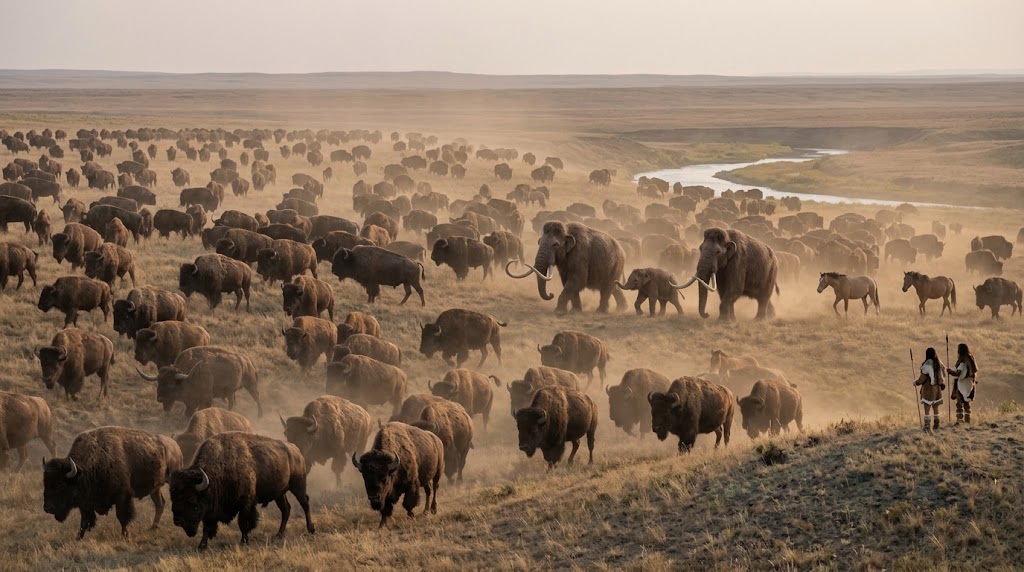
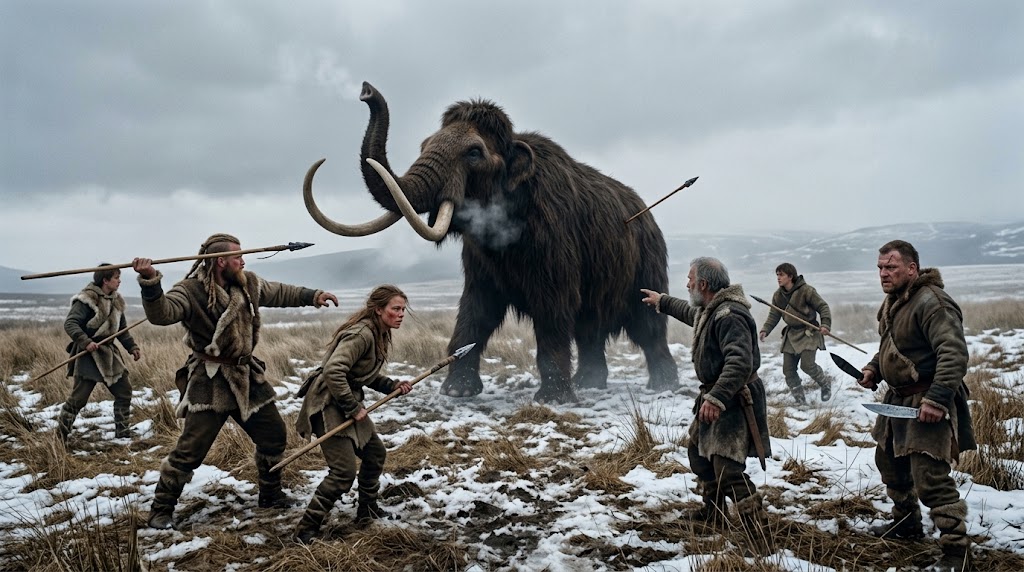
Around 13,400 years ago people walked into the Americas over the land bridge and found a continent thicker with big herbivores than Africa is today. Mammoths, mastodons, giant ground sloths, camels, horses, a bison the size of a van. Within a thousand years 114 species of them were gone.
At almost the same moment the ice cores show something that had never happened before or since. Atmospheric methane fell off a cliff, from about 700 parts per billion to 500, two to four times faster than at any other point in the record. Then the world, which had been warming its way out of the ice age, plunged back into cold. The Younger Dryas. Four to eight degrees colder across North America and northern Europe, for 13 centuries.
In 2010 a team at the University of New Mexico did the sum nobody had thought to do. They took every extinct herbivore, its body mass, its gut, how much it ate, and worked out what those animals had been breathing out. Just under 10 million tonnes of methane a year, gone in a millennium. Enough, they wrote, to account for a big share of the drop, and for it to have played a part in the freeze.
Their own words were that this may have been the earliest catastrophic event attributed to human activity. Humans killed the ruminants and the climate changed.
The direction it changed in is the bit that matters.
Those animals were not pumping fossil carbon into the sky. They were eating grass that had pulled carbon out of it, breathing some back as methane, and the air was clearing it every decade or so and handing it back to the grass. A steady herd, a steady loop, a warm world that had a herd in it. Remove the herd and the methane in the loop drains away, and the ice comes back for a thousand years.
Fifty million years of ruminants on earth. One recorded case of taking them off a continent.
It got colder. People starved. The Clovis culture nearly vanished with the mammoths.
The modern proposal is the same experiment, with better paperwork.
Mass Rapes
A young Israeli woman, in the midst of being abducted by Hamas Muslim terrorists, has a large blood stain on her pants, suggesting she was raped
Squeeze two and a half million years of human history into a single day, and farming turns up in the last few minutes.
00:00: The human line is eating meat, cracking marrow and following the herds.
06:00: Still eating meat.
12:00: Still eating meat.
18:00: Still eating meat.
23:52: The first farmers plant grain. Within a few thousand years they are 16cm shorter and their teeth are rotting.
23:59:55: Industrial seed oil arrives on the supermarket shelf.
23:59:58: A government committee tells you to eat less meat.
23:59:59: A documentary tells you your ancestors were plant-powered.
That leaves 23 hours and 52 minutes of the human story fuelled by the animal, and 8 minutes of grain, most of which the bones regret.
The diet you are told is extreme is the one your species ran on all day.
Fibre is the only thing on the nutrition label recommended on the grounds that your body cannot use it.
There is no fibre deficiency. No disease. No name. Nobody in history has been carried into a hospital short of bran.
Breast milk contains none. Every human who ever lived was built on zero for the first year.
A lion eats none. A wolf eats none. A cat fed it gets sick. Every carnivore on earth is at zero and has never needed a laxative.
The Inuit ran on seal, fish and whale at zero fibre and their doctors wrote home about the absence of bowel complaints.
You cannot absorb it. That is the definition. It goes in, it reaches the colon, and bacteria eat it there because you could not.
The bacteria turn some of it into butyrate, and butyrate is the entire scientific case for fibre. It feeds the cells of the colon wall.
Butyrate is named after butter. Butter is 3 to 4% butyrate. It has been in the fridge the whole time.
So the argument is that you should eat cardboard, so that germs in your colon can make a small amount of a substance you could have spread on toast.
Everything else fibre is credited with, the fullness, the regularity, the cholesterol, the cancer, is either unproven, reversed on removal, or achieved faster with a steak.
They took the part of the plant no animal can eat and made it a food group.
Sawdust has fibre in it. Nobody has yet recommended a daily serving, but the century is young.
@KingBobIIV@SteveDa15434515 This is happening to you because they want you crushed and broken for your honesty.
To a corrupt system, the greatest threat is exposure.
Would £1 from 99k get you a few nights good sleep in a safe place with no phone signal?
If it does it's worth it.
4 of them Raped every Orifice she had!
A 16 year old girl stopped to ask for directions at 555 pizza shop ( should be 666)
A Gang of at least 4 Afghan Asylum Seekers dragged her upstairs, Threw her onto a dirty mattress, pinned her down and then took turns going through her.
Throughout the trial, prosecutor Simon Taylor told grim details of how "every single orifice had been penetrated by the group of men, while others watched, laughed and joined in themselves".
When they finished they simply kicked her out into the street.
The Pizza shop owner has been here long enough to get a 🇬🇧 passport, return to Afghanistan for a holiday and bring a wife back.
The shop has reopened now with a new owner who has the same surname as the last owner….
Three things….
Don’t give Asylum seekers passports, it’s what they want, it’s all they want!
Deport foreign criminals
Stop buying with cash anywhere you suspect Asylum Seekers may be illegally working
For butter to clog your arteries, it would have to grow a second double bond. Two-thirds of it is saturated fat, which has none to offer.
For butter to clog your arteries, it would have to carry linoleic acid. It brings about 2%.
For butter to clog your arteries, it would have to oxidise the particle carrying your cholesterol. That reaction needs polyunsaturated fat, the kind butter barely contains.
For butter to clog your arteries, it would have to bring sugar to glycate that particle. It brings none worth weighing.
For butter to clog your arteries, it would have to be what the pathologists find in the plaque. They find omega-6 from seed oil.
For butter to clog your arteries, it would have to be new. People churned it for thousands of years before heart disease became the leading cause of death.
For butter to clog your arteries, Americans would have had to eat more of it as heart disease climbed. They were eating less of it every decade.
Every rung needs butter to stop being butter.
Which is exactly what they built margarine to do.
Things you can legally buy in Britain today:
- Cigarettes.
- A litre of vodka at 9am.
- An energy drink with 13 teaspoons of sugar, at 16.
- Paracetamol enough to end a liver, across two shops.
- A scratchcard.
- A vape shaped like a highlighter.
- A loaf that stays soft for three weeks.
- A bottle of hexane-washed oil with a heart on the label.
- A month of weight-loss injections from a website that asked your height.
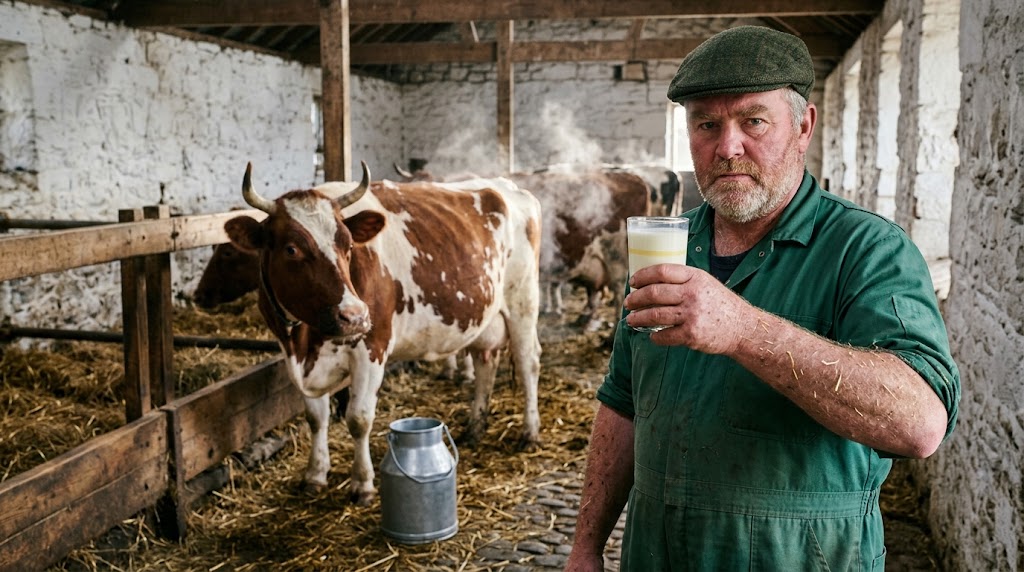
Things a Scottish dairy farmer cannot sell you:
- A glass of milk from his own cow.
Banned since 1983, on the grounds of safety.
@SamLovesEngland@RupertLowe10 No, it's brilliant - the intimidation is meant to stop any campaigning - and this lad is showing that it won't work.
That's the democratic process - or used to be
University debate, "Were humans built to eat meat?", same two chairs, same clock.
Vegan: "Anatomically we're closer to the gorilla than the lion. Flat molars, long gut. A gentle plant-eater with delusions."
Paleoanthropologist: "Then explain the acid."
Vegan: "Which acid?"
Paleoanthropologist: "Your stomach runs at a pH of about 1.5. A lion's sits nearer 3.6. Yours is stronger than the animal you've just been contrasted with, by a factor of about a hundred."
Vegan: "Stomach acid digests food."
Paleoanthropologist: "A cow's rumen sits at about 6.5. That's a compost heap with a pulse. Yours strips the zinc off a coin. Why would a gentle plant-eater carry that?"
Vegan: "Protection."
Paleoanthropologist: "From what? Lettuce doesn't fight back."
Vegan: "Bacteria."
Paleoanthropologist: "Which bacteria live in a leaf at a level that needs a pH of 1.5? Name the salad."
Vegan: "..."
Paleoanthropologist: "The animals that run acid as low as ours are the scavengers. Vultures. Things that arrive at a carcass on the second day and need to kill what's already living in it. We're not built like the lion. We're built like the bird that waits for the lion to finish."
Vegan: "Flattering."
Paleoanthropologist: "It's a picture of a species with a rock, a sharp flake and no claws. You don't get the fresh kill. You get the femur nobody could open, forty hours late, and you'd better have the acid for it."
Vegan: "Acid that strong is dangerous. Look how many people are on tablets for it."
Paleoanthropologist: "The only animal on earth that pays to switch its stomach off. You've spent sixty years pouring cereal onto a carcass digester and now you're medicating the digester for doing its job."
Vegan: "So your argument is that we're vultures."
Paleoanthropologist: "My argument is a number. Yours is a feeling about gorillas. The gorilla eats for most of the day and its gut is a fermentation tank. Yours is done in a few hours and runs on acid. One of you is designed for leaves."
Moderator: "Thirty seconds."
Paleoanthropologist: "She can keep them. I'm still waiting on the salad."
A cast iron pan's non-stick coating is baked-on animal fat, and the pan that replaced it was made for decades with a chemical DuPont paid $671 million to settle lawsuits over.
Cast iron:
- One material, poured in a foundry
- Its non-stick layer is fat, baked hard onto the metal
- Gets slicker every time you fry in it
- Goes in the oven, on the coals, over a fire
- Puts iron into whatever you cook
- A 1930s Griswold still fetches more than a new pan
- Outlives the person who bought it
Non-stick:
- A skin of PTFE over thin aluminium
- Starts breaking down at around 260°C
- The fumes give people polymer fume fever
- The same fumes kill pet birds in the next room
- Made with PFOA until the industry phased it out
- PFOA was found in the blood of nearly every American tested
- Sold on the understanding you'll buy another in a few years
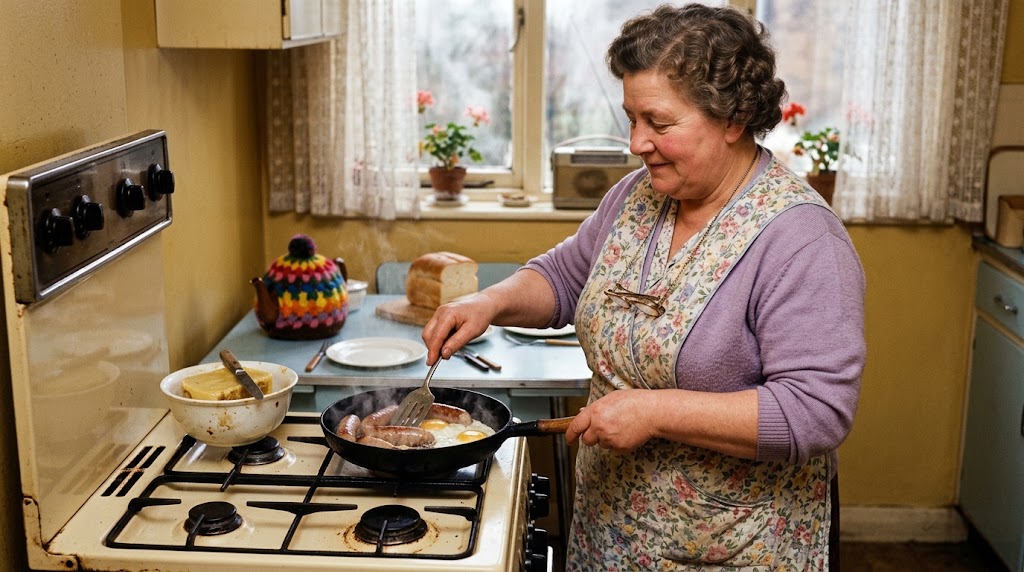
Your grandmother's non-stick came off the Sunday joint. Yours came with a class action.
The Highland Scot drove his beef south to England and kept the porridge.
Everyone knows the Scots were raised hard on oats: salt, a spurtle, a cold kitchen, and a nation of hill men built on a bowl of grey.
Samuel Johnson knew it too. His 1755 dictionary defined oats as a grain which in England is generally given to horses, but in Scotland supports the people. He meant it as a sneer, and it was the most accurate entry in the book.
The Highland economy ran on black cattle. Small, shaggy, hardy beasts that swam the narrow sounds between the islands and the mainland on the way to market, in a droving trade with records going back to 1359.
By 1723 somewhere between 25,000 and 30,000 head a year were changing hands at the tryst in Crieff. When the trade moved to Falkirk, the fields there could hold 150,000 cattle, sheep and horses on a market day, with 2,000 drovers sleeping in the open. Some of the cattle were shod like horses to survive the road. Rob Roy MacGregor started out as a respectable drover before he went into the cattle business from the other direction. Most of that beef kept walking: fattened in Norfolk, sold at Smithfield, salted into the daily ration of every soldier and sailor King George had fighting the French.
And the drover walking beside it lived on oatmeal, onions and whisky. When things were thin he opened a vein in one of the beasts, mixed the blood into his oatmeal and called it black pudding.
The cow paid the rent. The oats were what was left.
Then the landlords worked out that sheep paid even better than cattle and needed fewer people, and the Clearances did the rest. The families who stayed were pushed onto the coast and onto the potato, and when the blight arrived in 1846 the Highlands had a famine of their own.
Porridge was what a cattle nation ate after the cattle had been sold to pay somebody else.
Today it comes in a box with a heart on the front, sold as the secret of the hardy Scot. The hardy Scot would have swapped you the whole box for one of the cows.
@tractorgirly Exactly, inflatables are the safest craft on earth.
except in high winds and rough seas
Even if you punctured every cell, enough air remains trapped to guarantee it'll float.
@lamornabuck@ABridgen No, everyone should NOT have soy milk
We evolved to consume animal, fat, blood, meat, milk, butter, cheese, yoghurt, etc.
Mongols conquered vast territories without soy milk.
Plant food was for serfs and slaves.
Lords and slave masters ate the meat.
We ate sugar for 200 years before anything went wrong with it.
1700: 4lb a head a year.
1800: 18lb.
1900: 90lb, and the working man took it in his tea 6 times a day.
Obesity in 1900: about 3%. Diabetes rare enough that a doctor could name his cases.
1911: the first tin of cottonseed oil sold as food goes on the shelf. Mazola corn oil, the same year.
1960s: soybean oil in everything with a wrapper.
2000: the seed oils are a fifth of the calories in America.
Then the sugar started counting. Every gram of it doing damage it had not managed in two centuries of trying.
1999: sugar consumption peaks and starts to fall.
2020: it is down about 15% from that peak. Obesity is up from 30% to 42% over the same years.
Sugar went down. The waistline went up. The oil never moved off the shelf.
Sugar is guilty. It is guilty of exactly what it did, which was making a body already wrecked by the oil worse. It was never the one who kicked the door in.
They arrested the accomplice, put a tax on it, and left the ringleader in the fryer with a heart-healthy sticker on.