#Bitcoin for the learning impaired: Transactions, UI/UX, and Key Management Problems for 8 Billion people
"Not your keys, not your coins" is a necessary mantra for the full transition to bitcoin as a user, but there is a large gap between initial adoption of bitcoin by the average person and proper key and seed phrase management. This is something I have watched repeatedly with new users as they transition to setting up and managing their own wallets and keys, but there is a huge opportunity for education and/or products that simplify this process.
Ardent Bitcoiners tend to have a higher than average sensitivity to security and understanding of the dubious nature of wallet keys, seed phrases, passphrases, etc. We have all read the horror stories, many of us (myself included) have been the idiot to lose a seed phrase, corrupt encrypted backups, or fall victim to custodial bankruptcies and fraud. In many cases these are inconsequential losses, but in other cases these represent life changing amounts of wealth even if it wasn't thought to be a big deal at the time of the loss.
It is easy to forget that the transition for Bitcoiners from this 'careless' state to the highly aware and redundantly secure user was a learning process that required continuous education and hours (hundreds or thousands of hours) of education. "Responsibility Go Up" (RGU) becomes more important than "Number Go Up" (NGU). Without the former, the latter really is an empty phrase, the two concepts are inextricably linked though this labor of love is often downplayed in the general narratives and memes around Bitcoin. It isn't as attractive to new users to sign up for a never ending education about finance and data security, though many of us have a deeply seated passion for these topics, most did not develop that passion until they started down the Bitcoin rabbit hole.
Coming from an information security, banking/finance, intelligence, IT, etc. background really accelerates this learning curve, but I have still witnessed the hubris of individuals with these backgrounds become their downfall. Many do not take the losses well, lack personal accountability, or use the sour grapes fallacy to justify their losses. "This is why Bitcoin won't work for most people" echoes in their explanations.
How do we bridge this gap in understanding without custodial solutions and key management and seed phrase backup services that require trusted 3rd parties? This is the direction most businesses in the industry go with the problem and it is a double edged sword where we give up centralized banks for newer rebranded centralized custodians for this highly sensitive data. The average user cannot afford many of the solutions that exist or cannot understand the backup methods and redundancies already built into many bitcoin wallet devices, so they throw their Bitcoin savings into a custodial exchange and go back to living their day to day lives.
Most people have little time, focus, or energy for the education and burdensome RGU while trying to stay afloat in a turbulent and depressing world that grinds their labor under the fiat Ponzi. I still have friends and family that I have setup wallets for or made every effort to Uncle Jim that simply do not use the technology because of a perception of difficulty or the cost of time. This is something that many Bitcoiners forget while we are in the echo chamber of those who understand the responsibility of managing their own wealth. For the rest of society the added burden often outweighs the perceived benefits of using Bitcoin, dismissively they assume that it is too good to be true and therefore not worth the time and energy needed to engage with it.
Custodians bridge this gap for most of these users by making the exposure to Bitcoin IOUs seem easier than owning real Bitcoin, but the reputation of Bitcoin from this perspective is still seen as a scary and uncertain gamble by no-coiners. They rightly associate Bitcoin/crypto exchanges with casinos or Ponzi schemes in the wake of FTX, the lore of Mt Gox, and the cascading failures of 2022, or scams of 2017-2018. Worse yet, many affected by failures in this cycle that are getting their balances back will walk away thinking they were protected by government or regulations, making them downplay the seriousness of self-custody if they stay in this market. Many will cash out with a bad taste in their mouth and others will simply move to a new custodian.
Is a Bitcoin IOU better than holding US dollars in a bank? Paper returns on investment would say yes, but most of us cringe at the thought of these paper Bitcoin IOUs being used by the masses. We see the inevitable ethics failures and problems with trusting 3rd parties to manage this ultra-scarce asset in a for profit business model. The alluring promises of yield or simple thoughtless data storage is a veiled threat toward users sold as a service, but we need to find more effective means of sharing this understanding with the broader Bitcoin message.
"Not your keys, Not your coins" needs to evolve into a more encompassing and digestible educational message. We need software and hardware wallet products that have redundancy baked into the setup of the device beyond the single 12-24 word seed phrase and keys common to most setups without introducing a centralized or 3rd party management feature. Too many laypersons want or need a "tech support" or "password reset" feature to bail them out for a lack of awareness. We can educate many of these people, but we must accept that many of these people will not be able to learn this due to impairment, many lack the intelligence or ability to understand the core concepts or manage the risks when the rest of their lives allow them numerous safety nets. What do we do for those that are incapable of learning to use something this complex? We must step outside our perception of intelligence and look at the reality of learning impairment in the general population. The subset of bitcoiners today is not an accurate representation of this learning impaired group and this technology does not fit their needs yet.
Many individuals can be educated slowly over enough time to use wallets and non-custodial Bitcoin, but maybe half of society as a whole cannot use the technology as it is today. They need easier to use interfaces, backups that do not require them to store and remember the locations of an object, a seed phrase, a pin number, or a passphrase. Biometrics and genetic information is a feared solution by many that could be a promising way to solve this issue, but I have yet to see a product with these features built in that could be used by individuals with moderate to severe learning impairments. How do we make Bitcoin less technocratic?
There will always be a stratification of Bitcoin users due to this difficulty curve and equity in Bitcoin is often a dirty word, but there is a huge opportunity and need for this level of service or product for less savvy users. For many people with these impairments the generation and recording of a seed phrase, sending a transaction, or verifying an address can represent an impossible task. Self-custody and storing sensitive data in a secure manner over long periods of time may not be possible for them. Are we setting these individuals up for failure and how can we accommodate this reality?
Do these people never get to hold real bitcoin? Do they get shunted to layer 2 and 3 custodial services while the savvy get total financial freedom? There is no requirement built into the game of Bitcoin that will resolve this problem for every potential user, but the incentives do align with our goals of mass adoption to solve this for as many potential users as possible. No shit coin, no exchange, and no service within Bitcoin has truly solved this problem preventing mass adoption by the learning or visually impaired. We have set the groundwork for many competent people to adopt Bitcoin and any ignorance is indeed their own problem, but a solution for the other half of learning or visually impaired individuals will bridge the gap to billions of users while providing a safer and more usable experience to the ignorant. I repeatedly hear that we should not make it easier or no accommodation is needed and that people can all learn to use Bitcoin and it is simply not true as it is today.
The incentives align here, even if the purists among us are resistant to making it easier to be aloof about Bitcoin key and seed phrase management as a component of financial sovereignty. The inaccessibility of the technology will limit 4 billion or more people on earth from being able to truly adopt Bitcoin and become equals in the future of money. There are other issues with the costs of devices, the costs of services, and the access to technology for visually impaired users that need to be solved, but this one is a glaring hole in the marketplace.
Biometric and genetic data could be a possible way forward in solving key, seed phrase, and passphrase management issues, there are ways to split keys and have a 3rd party assist with recovery that would not allow them to move user funds, but at the end of the day these all have very real costs that are insurmountable for many of the learning impaired potential users of Bitcoin. User interfaces and experience models need to include more visually intuitive layouts and verification for addresses that accommodate those that cannot read strings of alphanumeric text. I don't want to pretend to have solutions, I want to open a dialogue about these issues. Maybe somebody is already working on these problems, maybe there are solutions I am not seeing, but I do know they are not well known or common enough to be available to laypersons and the world of no-coiners.
What do you think? How can we bring Bitcoin to all 8 billion people on earth? We have done a great job laying the future of the industry out and now there are some problems to solve with the mass adoption model as it stands. Can we bring Bitcoin to the learning and technologically impaired without stratifying society into multiple classes of users and different classes of Bitcoin?
@AltcoinDaily He is wrong in assuming bitcoin has a large energy "requirement". It can run on 2 computers or nodes and does not require mining at scale. It provides a economic incentive to consume more power and by doing so increases security. That economic incentive cannot drive bitcoin to 0
Good morning.
The 20 millionth Bitcoin was mined yesterday. This means that 95% of all Bitcoin that will ever exist is now in circulation, and it will take 114 years to mine the remaining 5%. No other asset on earth works like this.
Have a great day.
Colleagues stuck in #dubai sent me this video of a missile intercepted over @MediaOneHotel near the #DubaiMarina
Pray for the middle east and all of the innocent people caught in this conflict
Made it out of #Dubaiairport just in time last night. Colleagues that got stuck reported explosions overhead the @MediaOneHotel from intercepted missiles.
Stay safe out there, its a mad world.
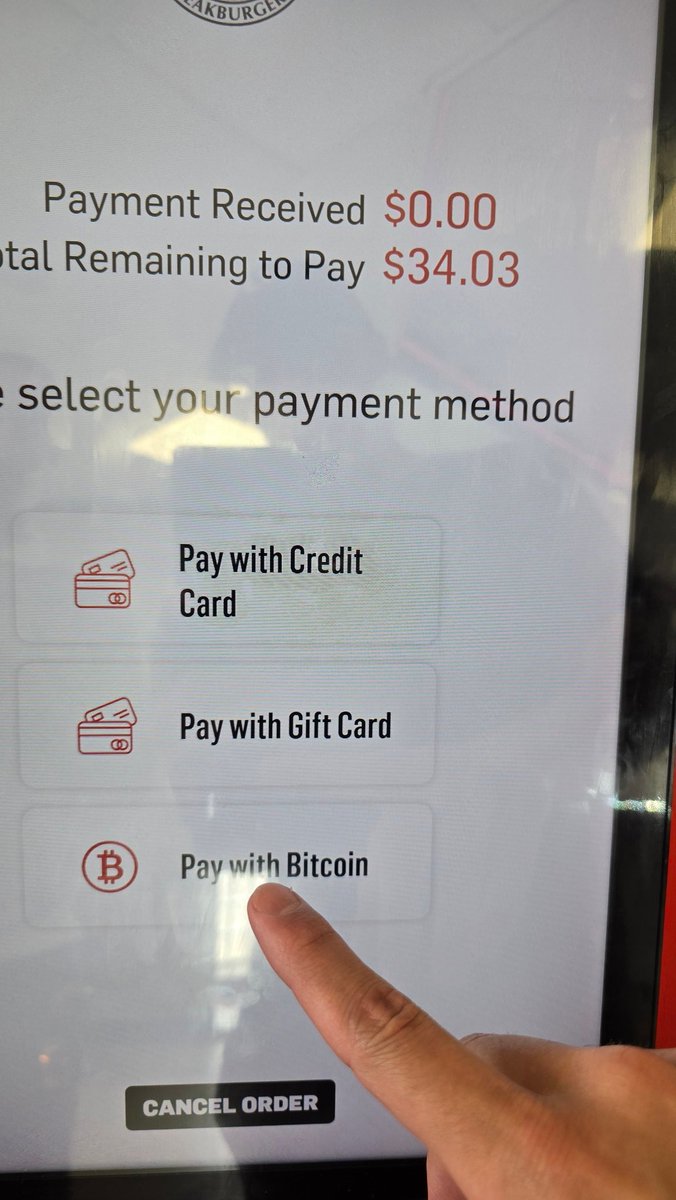
STEAK 'N SHAKE COO SAID, "BITCOIN IS FASTER THAN CREDIT CARDS. WE ARE SAVING 50% IN PROCESSING FEES."
"WE ARE SEEING A SPIKE IN GROWTH AFTER ACCEPTING BITCOIN" 🚀
Nine months ago today, Steak n Shake launched its burger-to-Bitcoin transformation when we started accepting bitcoin payments. Our same-store sales have risen dramatically ever since.
Bitcoin payments for Steak n Shake burgers go into our Strategic Bitcoin Reserve, which then funds Bitcoin bonus pay for our employees.
We have combined a decentralized, cash-producing operating business with the transformative power of Bitcoin.
Thank you Bitcoiners!
Capitalism started in 1602 in the Netherlands with the world’s first stock exchange.
Capitalism just died in the Netherlands in 2026 with the first unrealized gains tax.
Neofeudalism is here.
We are all serfs now.
Steak n Shake is removing all microwaves from its restaurants. We expect every unit to be microwave-free by April 15. Quality restaurants don't need microwaves. It is part of our journey to improve food quality and use traditional methods of cooking only. Eat Real Food. 🇺🇸
Not a huge fan of @Ledger wallets for all of the reasons, and this #Bitcoin edition Flex wallet I got for testing sat on the shelf for awhile and had a battery failure before I could set it up...👀