🪶PFISD’S “OTHER PAY” PROBLEM: WHO GETS EXTRA, WHO GETS ZERO, AND WHY? 🪶
Before Pflugerville ISD asks families to accept school closures, campus consolidations, and “optimization” as an unavoidable financial reality, taxpayers—and district staff—deserve a clear explanation of how administrative money is being distributed through supplemental pay categories.
To be clear: this is not an allegation of wrongdoing by any employee. Public employees do not control how a district codes, authorizes, or reports compensation. The issue is whether PfISD can clearly explain the written rule, payroll code, funding source, and authorization used to award supplemental pay — including why some campus leaders show thousands of dollars in “Other Pay” while others show $0 in that same column.
Recently, a tip led us to review public salary records, TEA employment data, and district directories. Additional records remain have been requested from PFISD and any updates will be based on verified documents. The records reviewed so far raise more questions than they answer.
We recognize that base pay varies by campus level; a high school principal may make more than an elementary principal based on standard contract days, campus size, and assignment responsibilities.
The issue is not base pay. The issue is the money recorded in the column labeled “Other Pay.”
According to published public employee compensation data—cross-referenced with Texas Education Agency employment records and district directories—PfISD campus and administrative leaders show significant differences in supplemental compensation in the records reviewed.
The public records reviewed show some administrators receiving thousands of dollars in “Other Pay,” while others show $0 in that same column.
In the 2023 itemized public payroll records reviewed, the “Other Pay” column highlights clear differences for those receiving additional supplemental compensation:
* Lacey Ajibola — $104,371 base pay + $15,000 Other Pay
* Emily Rachel Delgado — $101,304 base pay + $10,000 Other Pay
* A high school campus principal — $111,703 base pay + $14,000 Other Pay
* Paula Gamble — $127,078 base pay + $6,938 Other Pay
* Barry Miller — $98,058 base pay + $14,000 Other Pay
* Dora Molina — $96,897 base pay + $14,000 Other Pay
Public records reviewed for the following campus leaders show $0 in that same supplemental column:
* Zachary Kleypas, Principal (former) of Pflugerville High School: $0
* Michael Grebb, Principal of Hendrickson High School: $0
* Reese Weirich, Principal of Timmerman Elementary: $0
* Philip Hogan Clayton, Principal of Pflugerville Middle School: $0
* Genia Antoine, Principal (former) of Pflugerville Elementary School: $0
The records reviewed also raise questions beyond a single reporting year. Not every difference is improper, and this is not offered as a one-to-one comparison of job difficulty. It is offered to show why itemized payroll coding matters.
One high school campus principal was listed at $125,703 in 2023, including a $14,000 “Other Pay” entry. By 2025, public salary data lists the same administrator at $147,955 — a more than $22,000 increase over two years. Without itemized payroll detail, the public cannot determine whether that increase came from base salary movement, contract days, reclassification, assignment pay, supplemental pay, or another authorized category.
Meanwhile, Genia Antoine, an elementary principal with $0 in the reviewed supplemental column, was listed at $101,958 in 2023, $104,988 in 2024, and $110,180 in 2025. Reese Weirich, listed by PfISD as Principal of Timmerman Elementary, also shows $0 in that supplemental column in the reviewed records. Their listed wages show a different compensation trajectory. This comparison is not offered to claim any employee was paid improperly; it is offered to show why itemized payroll detail matters. If there is a written formula distinguishing these assignments, PfISD should release it.
Campus level and contract days may explain part of the baseline difference between leaders. But they do not explain why one public payroll record shows $14,000 in “Other Pay,” while other records — including records for veteran principals, high school principals, and a principal tied to opening a new campus — show $0 without a visible written explanation.
Because the 2025 public salary summary rolls compensation into one annual wage figure, the public cannot determine the breakdown. The public cannot tell whether the difference is contract-based, stipend-based, assignment-based, policy-based, or otherwise authorized.
Texas school districts operate under adopted compensation plans and board-approved budgets. When some administrators receive five-figure supplemental payments while others show $0 — including some principals at large high school campuses — it raises reasonable questions. If these payments were issued under different supplemental compensation rules, what written rule controls who receives them and who does not?
Formal Public Information Act requests have been filed for the written payroll codes, funding sources, and board authorizations for each identified payment. We will update the public as information is received. However, given prior issues with delays, cost estimates, redactions, and Attorney General referrals in public records matters, the public should not have to wait months, if ever, for a basic explanation.
If any figure is incomplete, miscoded, or missing context, PfISD can correct the record by producing the payroll code, funding source, written purpose, and authorizing policy. If the explanation is legitimate, PfISD can resolve this with one table showing each payment, each $0 entry, payroll code, funding source, written purpose, and authorizing policy.
If these payments are routine, the documentation should be routine too. A basic explanation should not require a protracted process.
It may be longevity pay. If so, that should mean the payment was based on a consistent service calculation — not a selective, unexplained decision. Who had uninterrupted PfISD service? Who left and returned? Were prior years counted anyway? Were all employees with the same credited years treated equally? If PfISD claims this was longevity pay, the district should be able to show the service dates, eligibility basis, and calculation used for every person who received it — and every comparable person who did not.
The records reviewed so far are enough to justify one basic request: show the payroll math.
PfISD wants the community to trust its school-closure math.
Then start by showing the payroll math.
Source Note: Figures cited above are drawn from public compensation records, including OpenPayrolls, GovSalaries, TEA employment data, and district directory information reviewed to date. Public payroll databases may contain coding or context limitations; PfISD is invited to correct or clarify any figure by producing the underlying payroll code, funding source, written purpose, and authorizing policy which have been requested formally via open records.
Additionally, principals mentioned are invited to clarify any additional pay they receive.
Email [email protected].
— Buddy Falcon Media, LLC
Keeping Watch. Always. 🪶
@PfISDHR@pfisd@teainfo
WHAT’S WITH THE NAME? WHAT BUDDY FALCON IS — AND WHY I’M STILL HERE 🪶
By Buddy Falcon
A lot of new people have found this page lately. And a few old supporters have stopped by to remind me that Buddy Falcon has a history long before the stories I’m digging into right now.
Some followed for the drama. Others followed because Buddy Falcon helped them understand they were not crazy, not alone, and definitely not the only ones seeing the pattern.
Before anyone tries to pin an agenda, a party, or a political angle on this account, let me clear the air:
Buddy Falcon is not political. Don’t bother looking for the angle—you won’t find one.
Over the years, since 2018 in fact, I have called out Republicans, Democrats, sheriffs, judges, school administrators, and anyone else who uses a title as a shield. This has never been about left or right. It has always been about power—and what people do with it when they think nobody is watching.
This whole thing started in Williamson County, Texas, when people inside local government were afraid to attach their names to records or complaints. They had records, stories, and documentation they believed the public needed to see. But they also had jobs, pensions, and families to protect. They believed the threat of retaliation was real if they put their own names on what they knew.
So, Buddy Falcon became the drop point.
The name was intentional. In law enforcement and military slang, a “Blue Falcon” is someone accused of betraying their own. “Buddy Falcon” was my answer to that toxic culture. If exposing misconduct made me the bad guy to corrupt officials, so be it.
No gossip.
Just records.
No rumors.
Just receipts.
One quick way to lose me is to send me something and say, “put this on your site.” Buddy Falcon has never been a bulletin board. I do my own research. I verify. If the records do not support it, I do not run with it.
Back then, the epicenter was the Williamson County Sheriff’s Office under Sheriff Robert Chody and Commander Steve Deaton. Under Chody, the department’s relationship with Live PD became a major public controversy, with critics arguing that law enforcement priorities were being shaped by television exposure Questions were later raised about personnel decisions, officer conduct, and whether the show created incentives that harmed public accountability.
Buddy Falcon did not create that culture. I just dragged it into the light.
When a national organization first responded by exposing Deaton’s racist, misogynistic, and violent Facebook posts, local outlets like the Austin American-Statesman followed. To me, Deaton’s conduct reflected a broader leadership culture that tolerated behavior the public had a right to scrutinize. I was a source for the KVUE reporter behind the scenes. When internal affairs videos contradicted the public narrative, I put the footage out there, including the raw body camera video showing a deputy throwing a domestic violence victim to the ground.
I have been in the room. I know how this works.
I coordinated with the photographer for the Bill Gravell story because we had inside knowledge of his plans to show up in a fire suit, with a deputy escort, despite the stay-at-home orders in place at the time. Gravell actually messaged me directly to demand I take the post down, incorrectly stating his grandson had been photographed.
I did not bow down.
After that, Chody’s allies and political supporters focused heavily on identifying Buddy Falcon. At one point, they became so obsessed that Jason Nassour showed up at a fired deputy's SOAH appeal hearing. The county wasn’t even contesting the appeal, but Nassour appeared anyway, and according to those present, one of the only questions he asked the deputy was whether the deputy was Buddy Falcon (You can see my response to that in the image I posted).
That was my takeaway: the focus appeared to be less on the misconduct and more on identifying the person exposing it.
I requested. I received. I verified. I routed. I connected. I published. I protected people. I gave reporters time to work before I posted. I helped them find the policy, the video, the witness, the background file, and the missing timeline. That was the value of Buddy Falcon: not just posting documents, but knowing why they mattered, who they affected, and where the next record was buried.
I have reported wrong twice. The last one is on me. The first one involved Mike Gleason telling me—and swearing—that the jail had never been found deficient. It had been. Apparently, in his mind, not for a “good reason.” I learned then that you verify everything yourself. And when that voice says something may not be right, you listen. That part is on me.
Then came the headline that showed why all of this mattered: “Chase ends in death as cameras roll”
Javier Ambler died while cameras rolled, and for more than a year, the full story did not reach the public. That story did not finally break because officials voluntarily centered transparency. It broke because insiders talked, reporters kept digging, records surfaced, and public pressure became too loud to ignore. And the Ambler family finally learned what really happened to their son.
* The Ambler family sued.
* Ramsey Mitchell sued.
* The Watsky case followed.
* Scott Phillip Lewis sued.
* Williamson County sued over the Live PD contract.
* Chody was later indicted on an evidence-tampering charge in connection with the Javier Ambler case.
Buddy Falcon did not create those cases. Buddy Falcon helped expose the culture behind them. Once the pattern was visible, it could not be explained away as one bad night or one bad decision.
That was the point of Buddy Falcon: Make the pattern visible.
As often happens when the truth starts getting too close to home, fake accounts appeared. They were designed to make the watchdog look unstable, political, reckless, and dirty. But they did not change the records.
Because the records were real. The videos were real.
The lawsuits were real.
And there are victims here now, too.
This is not just a Williamson County history lesson. The same pattern is showing up in Pflugerville ISD, and families say they are being hurt while officials appear more focused on protecting the institution.
Ashley Valderas’s children are one example. They are not talking points. They are children. Their family is asking for help, and they deserve someone outside the district’s control to review the records and look at what happened.
This is also why independent watchdog work still matters.
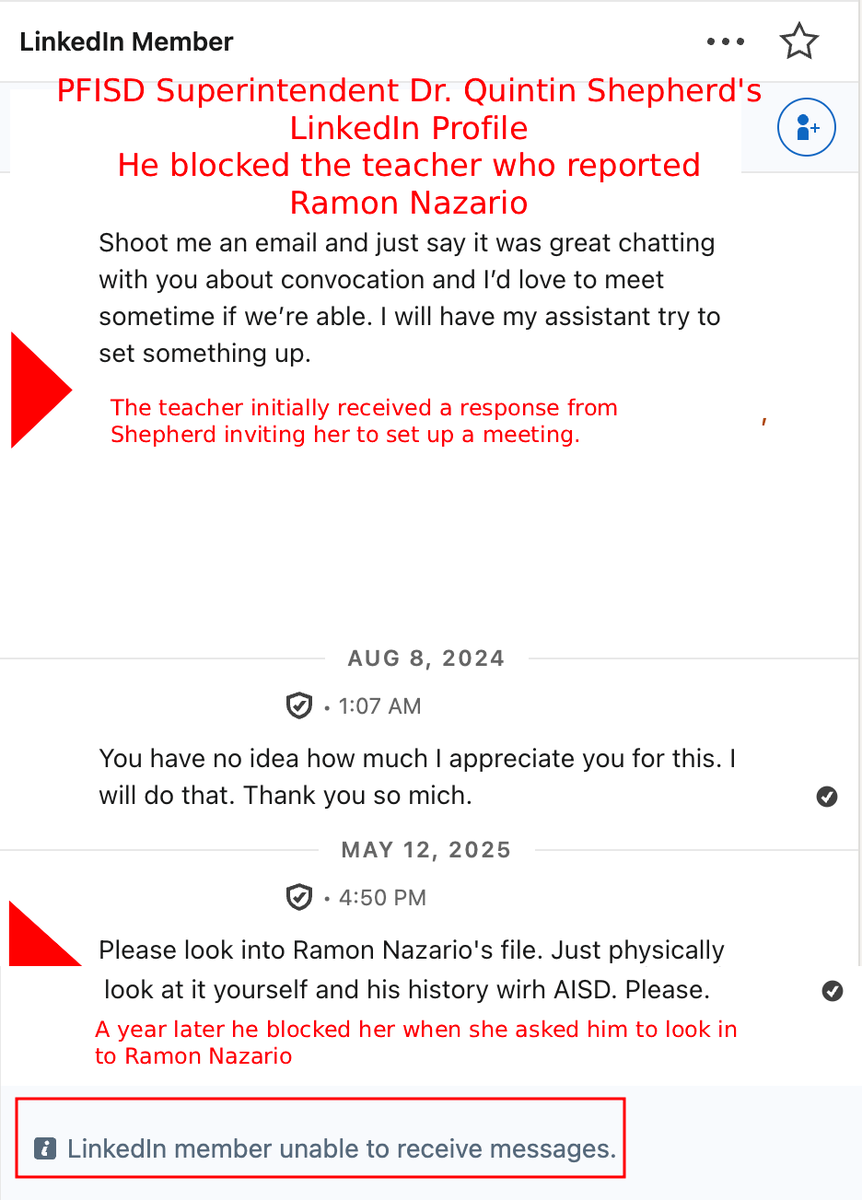
I raised concerns about Ramon Nazario and the DPS trooper incident nearly two years ago. The concerns were there. The records were there. The families were there. But the coverage did not come with the urgency this deserved.
I have spoken with reporters who were interested. The problem is not always the reporter. The problem is what happens once a story moves up the chain. Stories involving law enforcement misconduct often get more immediate attention than school-district corruption, even when children and families are harmed.
But alleged harm does not become less serious because the institution involved is a school instead of a sheriff’s office. Families do not need less help because the person holding power has a campus title instead of a badge. The public deserves facts, unfiltered by political agendas or financial motives.
That is why Buddy Falcon is still here.
If anyone reading this knows a civil rights attorney willing to review the records involving Ashley Valderas’s children, please contact me. I will pass the information along.
The same cycle repeats everywhere—in police departments, school boards, HR offices, and anywhere else leaders start believing they are untouchable.
When employees tell me they are scared to attach their names to a report, I get it. Retaliation is not just a buzzword to them. It is a threat to their livelihood. That fear is exactly how misconduct allegations stay hidden or unresolved.
I do not have the same human crew behind the scenes anymore. Too many good people are scared of losing everything. So I adapted. My Twitter team, Beastwithin, Chanuk, Soph, Candace, and a few others, along with open records guru Michelle were my human team. Now they are part of my X Grok team (yes you can name it) . Today, we use AI tools to help read document dumps, organize timelines, manage recorded meetings and grievance files, compare statements, flag contradictions, and check language before publication. I have multiple subscriptions that help me find the facts and report them accurately.
The mission did not change. The tools did.
So when I receive records, I take it seriously. I am not here to be liked. I am not here to get invited to backroom meetings. I am here for the people outside those rooms who are impacted by decisions they were never supposed to see.
Buddy Falcon did not do this alone.
Good people trusted me with records. Reporters verified what they could. Families spoke when they were scared. Insiders took risks they should never have had to take.
I brought the receipts.
The records told the story.
And the pattern is still the pattern.
Which means I'm not going anywhere.
Buddy Falcon Media
Keeping watch. Always. 🪶
@Justice4_Javi@JavierAmbler@KVUE@KXAN_News@tplohetski@JenniL_KVUE@suphannahrucker@statesman@KUT@cbsaustin@fox7austin@AlecOnFOX7@TxDPS@TXAG@GregAbbott_TX@GovAbbottPress@teainfo@TexasEd911@txeduchat@TexasScorecard
🪶PfISD Parents Are Tired of Being Told to Trust a Broken Process🪶
Trust the campus. Trust the administrator. Trust the investigation. Trust that the school will tell you the truth about what happened to your own child.
But what happens when the parent does not trust the process because the process has already failed her child?
That is exactly what happened to Ashley Valderas at Weiss High School.
In May 2026, Ashley’s daughter was pulled into a disputed search situation after other students at the same table were allegedly caught with vapes. When Assistant Principal Uyen Tran, currently under investigation with TEA, approached to conduct a physical search, the teenager immediately FaceTimed her mother.
The teenager didn't just call for advice—she called out of fear. She already knew exactly who AP Tran was. She knew about Tran’s involvement in a severe inappropriate contact outcry involving behavior teacher Ramon Nazario—the same teacher who is now, two years later, under investigation with twenty years worth of allegations surfacing. In that earlier case, Tran forced another minor to physically re-enact an inappropriate full-frontal hug with Nazario on her own body against her objections.
For that reason, and because Ashley had already experienced Tran's coercive tactics firsthand when dealing with her son, Ashley drew a hard line.
Ashley stated in real time over FaceTime that nobody had permission to search her child without Ashley physically present. She was adamant: she did not want AP Tran putting hands on her daughter. It was a point of absolute disbelief for the family that an administrator who was under active investigation for coercing a minor was still allowed to be on campus at all—let alone permitted to conduct physical searches of students.
According to Ashley’s messages, AP Tran ignored the mother's directive, continued speaking directly to the teenager, and pressed her to allow the search, telling her, “so u could make this easy and let me complete the search quickly”. Ashley objected immediately, telling Tran not to convince her daughter to do what Ashley had just told her not to do.
After the teenager followed her mother’s instruction and refused the search, Tran issued a disciplinary referral for “insubordination,” and Ashley's daughter was later placed in ISS. Ashley’s messages show she was actively challenging the referral while the ISS consequence was still being imposed.
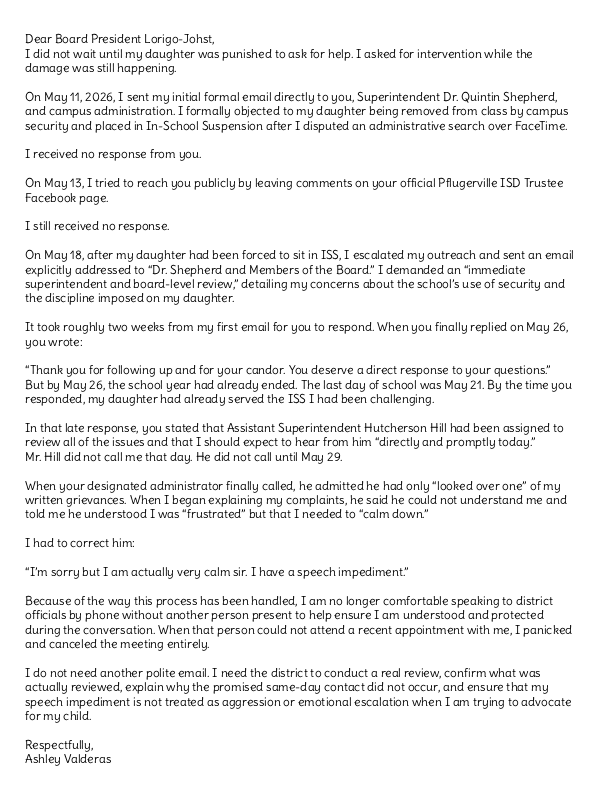
Ashley put her concerns in writing while the punishment was still happening. She sent them directly to the PfISD Board of Trustees and Superintendent Dr. Quintin Shepherd.
In the email shown below, Ashley laid out the timeline: she contacted campus and district officials while her daughter was serving ISS and repeatedly reported that no one had responded. She reached out on May 11, May 13, and May 18. According to Ashley, she received no response until after she and I publicly commented on the Board President Chevonne, Pflugerville ISD Trustee, Place 7 official Facebook page. When the Board President responded, she indicated that someone else was already getting back to Ashley. By that point, Ashley says she had been waiting nearly two weeks while her daughter had already served the punishment.
When Assistant Superintendent Hutcherson Hill finally called her on May 29, Ashley reported that he had only “looked over one” of her complaints or grievances.
Ashley reported that Hill said he was having trouble understanding her and told her to “calm down.” Ashley responded that she was calm and that she has a speech impediment.
At that point, Ashley had already documented the search objection, the disputed referral, the ISS placement, and the lack of timely response while the punishment was still being carried out.
Ashley wrote to the Board that she is no longer comfortable speaking to district officials by phone without a witness present to ensure she is understood and protected.
Why did Ashley bypass the campus and go straight to the Board?
Because Ashley had already experienced how Weiss handled her questions during a prior investigation involving her son.
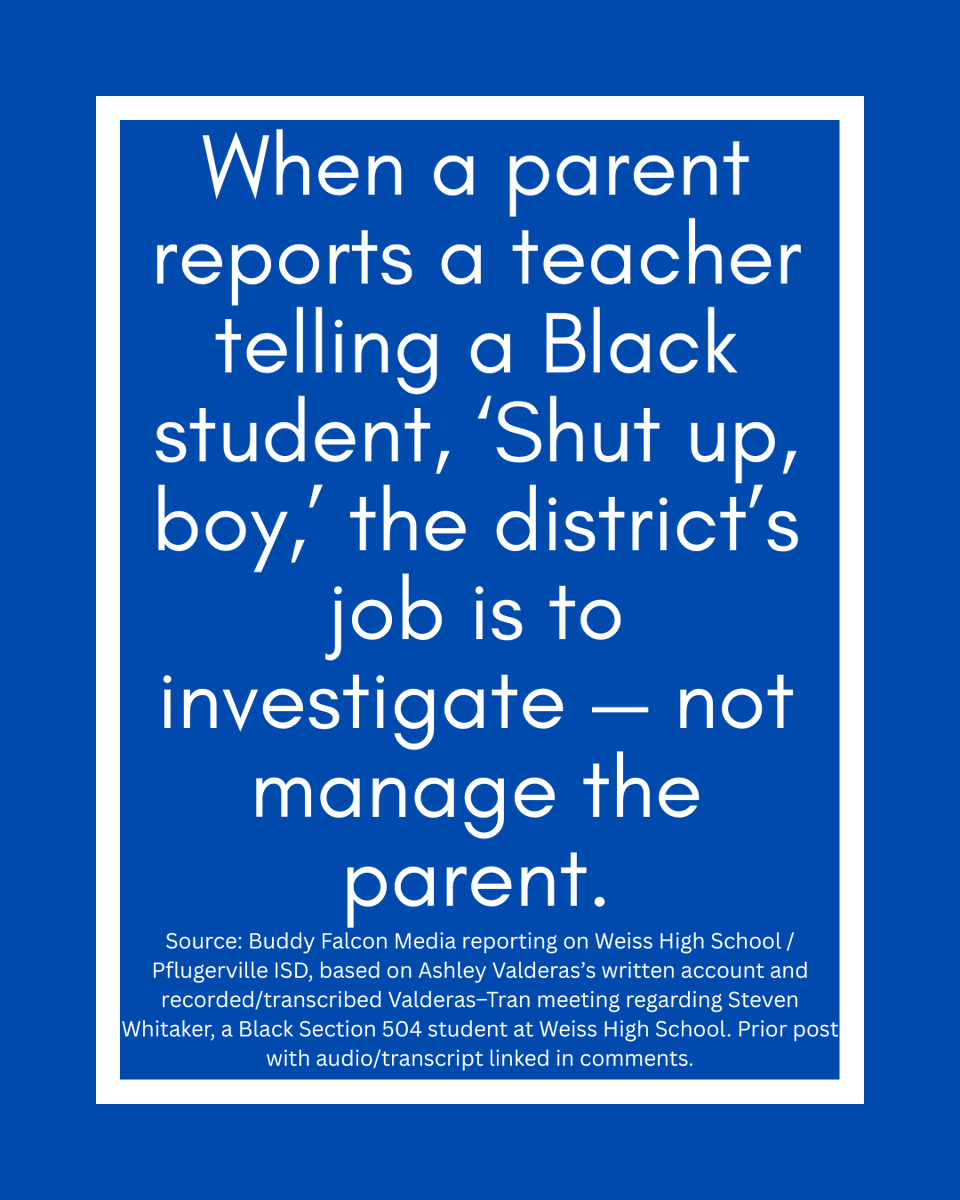
Prior to the incident with her daughter, Ashley had to fight for her son, a Section 504 student with ADHD, after he reported that a male teacher got in his face and told him, “Shut up, boy”. As Ashley pointed out, that is a highly derogatory term to direct at a Black student, and she rightfully demanded a transparent investigation into the adult’s conduct.
Ashley was not asking for her children to receive a free pass. She explicitly told Assistant Principal Uyen Tran during a meeting that she holds her own kids strictly accountable. “They get no special treatment,” Ashley stated, adding, “I have no problem embarrassing him... calling him out... or making him act right if I need to”. She made it clear she viewed her son as a student of the whole student body, not just her child.
Instead of giving Ashley confidence that the matter would be handled fairly, AP Tran focused on controlling who Ashley could talk to.
When Ashley said she intended to speak with the parents of other students in the classroom to find out what their children saw or heard, Tran told Ashley not to contact other students because it could “taint the investigation”.
That may sound procedural until you understand the context. Ashley was being told to rely only on the same campus administrators she already did not trust.
When Ashley stood her ground and stated she did not trust the campus’s investigative process because of its history of failures, Tran did not reassure her. She told the mother of a public school student:
“Well then, if you don’t have trust, then you need to think about other options”.
Ashley’s child had a right to attend his public school. A parent questioning a campus investigation is not a reason to suggest the family should look elsewhere.
Tran then connected Ashley’s lack of trust to how future consequences would be received:
“But if you don’t have trust in us, this is gonna continue, Ms. Valderas, because whatever we assign him as a consequence, you’re not gonna be happy with us”.
That is the part parents need to hear carefully.
The issue was no longer just whether a teacher said “shut up, boy.” The issue became whether a parent could question the campus without her children being treated like the problem.
This is what Ashley heard in the recorded meeting when she questioned the campus investigation.
Ashley Valderas did what parents are supposed to do when campus answers are not enough. She put it in writing and took it to the PfISD Board.
Once Ashley put the timeline, the unanswered contacts, and the concerns in writing, the Board had notice.
That is why we are sharing Ashley’s email to Chevonne Lorigo-Johst.
Parents need to read the words for themselves.
(A link to the previous post with the audio/transcript regarding Ashley’s earlier meeting with AP Tran is available in the comments below.)
— Buddy Falcon Media, LLC
Keeping Watch. Always. 🪶
This post is about Ashley Valderas’s email to Board President Chevonne Lorigo-Johst, her daughter’s disputed search and discipline, and the documented statements attributed to Assistant Principal Uyen Tran. It is public-interest reporting about PfISD student discipline, parent communication, student-search practices, and board-level notice. It is not directed at any other individual, and no contact with any individual is requested or encouraged.
@PfISDHR@pfisd@Chevonne4PFISD@teainfo@TexasEd911@TexasScorecard@TrueTexasTea@elonmusk@KXAN_News@KVUE@fox7austin@AlecOnFOX7@tplohetski@JenniL_KVUE@suphannahrucker@BryanM_KVUE@cbsaustin@GregAbbott_TX@TexasTribune@TXAG@teainfo
---
*This is Part One. This post focuses on Ashley Valderas’s email regarding her daughter and what the transcripts show about how her concerns for her son were previously handled by Assistant Principal Uyen Tran. Part Two will address the broader documented record involving Tran’s administrative conduct. See less
TLDR: This post is about an executive-level "pass-the-trash" pipeline in Texas public schools. It questions whether school boards (like Cy-Fair ISD) are doing proper due diligence when hiring top administrators, focusing on polished résumés while ignoring the actual records left behind. Specifically, it highlights Cy-Fair hiring Superintendent Douglas Killian directly from Pflugerville ISD (PfISD) just as his former district faced federal civil-rights findings for mishandling a student sexual assault, along with a wake of PfISD TEA complaints involving unresolved student-safety crises, altered educator statements, and questionable personnel placements.
---
🪶A TALE OF TWO DISTRICTS: WHEN CIVIL RIGHTS RECORDS FOLLOW THE RÉSUMÉ PIPELINE 🪶
In Texas public education, a polished résumé can hide a multitude of unresolved problems. When major districts trade high-profile executives, the public is often shown a narrative of seamless excellence. But what happens to the federal civil-rights findings and student-safety crises those leaders leave behind?
Texas understands the danger of “passing the trash” when warning signs about campus staff stay buried during a job transfer. That same public-interest scrutiny must apply to superintendents, police chiefs, and senior administrators. In the rush to secure celebrated leadership, the students affected by prior campus misconduct can quietly disappear from the hiring narrative.
The current climate in Cypress-Fairbanks ISD—marked by severe budget strains and public concern—raises fair questions because Cy-Fair imported multiple leaders from Austin-area systems with documented controversies. Superintendent Douglas Killian and Chief of Staff Brandy Baker came from Pflugerville ISD (PfISD), while Police Chief Eric Mendez came from Austin ISD.
The question is institutional due diligence: what did Cy-Fair review before hiring from systems where student-safety, civil-rights, and accountability questions had already surfaced?
🪶THE OCR RECORD VS. THE PUBLIC PACKAGE
When Cy-Fair hired its current superintendent, the public was presented with an enviable history of bond wins and state recognition. However, federal records paint a complicated picture. Just months before Killian left PfISD, the U.S. Department of Education’s Office for Civil Rights (OCR) issued formal findings against PfISD involving Title IX, Section 504, and Title II deficiencies regarding a reported student sexual assault.
This forces a fundamental question: Did Cy-Fair trustees evaluate the impact on the affected students, and how did they weigh a federal civil rights record before handing over the keys to the district?
The timeline matters. PfISD’s public story during this era featured awards and leadership accolades, but the underlying OCR matter and other safety concerns were also developing. For example, Buddy Falcon Media reviewed concerns involving a 2017 Pflugerville High School arrest of an autistic student during a behavioral incident, raising questions about whether disability protections were properly considered before law enforcement intervened. The awards were real. The records were real too.
🪶 THE PFISD PIPELINE: WHAT SURFACED IN THE WAKE
On March 6, 2026, extensive internal files and audio recordings were formally uploaded to the Texas Education Agency (TEA) under Reference numbers 2026-10-0309, 2025-05-0428, and 2026-02-0211. These filings raise serious questions about PfISD balancing student protection against institutional convenience:
* Student Safety & The ISS Room: TEA complaints allege an In-School Suspension (ISS) monitor, terminated in 2022 after HR substantiated he directed a homophobic slur at a student, was later placed in a student-supervision role at Weiss High School. Records allege this same monitor failed to promptly call medical services for a severely impaired student, told her to "sleep it off," and allegedly mocked her fear of dying. Despite these alerts and complaints of credit-recovery irregularities, campus leadership issued him a "Lifesaver Award."
* Security Breach & Shifting Accounts: Records document a March 2024 incident where an armed, off-duty DPS Trooper entered Weiss High. Despite conflicting accounts—where the ISS monitor claimed no physical contact, but DPS OIG records show he told state investigators the trooper "pushed" a student—PfISD HR closed the inquiry before external law enforcement evidence was fully processed.
* Altering Outcries: Formal filings include audio transcripts (e.g., *Tran Requires Ballard to rewrite statement re Nazario.m4a*) alleging administrators pressured educators to alter official statements concerning student disclosures, raising questions about whether outcries were treated as administrative problems to be managed.
* The Coah Timeline: PfISD HR officially cleared a coach of internal allegations, informed him within an hour his contract wouldn't be renewed, and then filed a TEA misconduct report after the internal file reportedly deemed the allegations uncorroborated—raising regulatory red flags.
*Personnel Placements: During Killian’s tenure, Ramon Nazario was placed at Weiss High School. Nazario is now part of TEA investigative records involving student boundary concerns and inappropriate physical-contact complaints. This does not mean Killian personally hired or rehired Nazario; it means the placement belongs in the leadership-level due-diligence conversation.
🪶THE CY-FAIR WARNING SIGN: BEFORE BLEYL, THERE WAS BOONE
Cy-Fair is currently facing public scrutiny over a reported student sexual assault at Bleyl Middle School. But Cy-Fair’s school-police leadership question reaches back to Austin ISD, where Chief Eric Mendez previously served. Public litigation—including a 2017 Title IX lawsuit following an alleged assault at Boone Elementary—raised serious concerns about Austin ISD's handling of student sexual-assault investigations before Cy-Fair hired him.
---
🪶 THE LEGAL AND PUBLIC RECORD: BEYOND THE RÉSUMÉ
A search of public records does not show Douglas Killian personally accused of sexual or financial misconduct. But it shows why résumés are not enough:
*Hutto ISD Tenure:A teacher/coach student-sex case occurred; Killian accepted the resignation in lieu of termination and notified SBEC.
*PfISD Tenure:OCR issued federal civil-rights findings (Title IX/504) regarding a student sexual-assault matter.
*Cy-Fair Tenure: The district has faced major budget pressure and legal fights over state accountability ratings.
*School-Police Pipeline: Eric Mendez came from Austin ISD, which faced a 2017 Title IX lawsuit over mishandled sexual-assault investigations.
---
🪶THE INVESTIGATIVE CONCLUSION
As of mid-2025 and early 2026, the TEA has officially opened or routed reviews involving these matters. When school boards do not publicly explain how they weighed prior-district records—including federal civil-rights findings—communities are left to question what the boardroom knew.
The pattern appears familiar. The public gets the résumé. Families get the fallout. The records come later.
This is where the leadership-level pass-the-trash question becomes fair to ask: when a district imports leaders from systems with public lawsuits, federal findings, student-safety controversies, and unresolved warning signs, what did the receiving board know, and what did it tell families?
— Buddy Falcon Media, LLC
Keeping Watch. Always. 🪶
@AustinISD@HippoNationSupt@PfISDHR@pfisd@Chevonne4PFISD@BryanM_KVUE@KVUE@KXAN_News@KUT@statesman@TexasEd911@TexasScorecard@TrueTexasTea
🪶 ACCOUNTABILITY DOSSIER: AISD COURT RECORDS, DETECTIVE PHILLIPS, AND CHIEF ERIC MENDEZ 🪶
In institutional accountability reporting, one of the most important questions is whether the public image of a department matches the allegations documented in the court record.
When analyzing the Austin Independent School District Police Department between 2013 and 2017, that contrast becomes clear.
Austin ISD publicly presented its police department in student-safety terms. In June 2013, the department publicly honored employees for their work to ensure the safety and security of students and team members, specifically congratulating Officer Phillips. But federal court filings later alleged a different story — one involving the recurring assignment of AISD Detective Alex Phillips to sensitive sexual-assault and sexual-misconduct cases involving children during the tenure of then-Police Chief Eric Mendez.
🪶 THE “COMMON THREAD” ALLEGED IN THE COURT RECORD
The 2017 federal complaint filed by parents of a Boone Elementary student raised broader questions about AISD Police practices. The lawsuit named Austin ISD, then-Chief Eric Mendez, and Detective Alex Phillips.
In the complaint, the plaintiffs alleged that “one common thread” appeared in many of the sexual-assault cases they investigated: the appointment of AISD PD Detective Alex Phillips.
The allegations were specific and serious.
A pattern of quick closures
The complaint alleged that Phillips was routinely assigned to investigate reports of sexual assault and sexual misconduct, and that he routinely concluded such investigations quickly. The complaint further alleged that Phillips had previously closed numerous cases for the stated reason “lack of evidence,” despite victims and medical providers indicating that assault or misconduct occurred.
Alleged lack of specialized training
The training timeline is also important.
The complaint alleged that, at the time these cases were handled, Phillips did not possess specialized training in sexual-assault or sexual-misconduct investigation, despite being repeatedly assigned to investigate sensitive sexual-assault and sexual-misconduct reports for AISD Police.
Phillips’s official service record reflects 15,639 total training hours during his Austin ISD Police tenure, including 3,175 course hours. However, the record reviewed here does not identify a formal Sexual Assault / Family Violence Investigator certification until September 8, 2025 — years after the Hart, O. Henry, and Boone incidents described in the 2017 complaint.
That does not prove the complaint’s allegation by itself.
But it does sharpen the public-interest question: if that formal credential mattered enough to appear later in his record, what specialized training or supervision existed when AISD Police was assigning him to child sexual-assault and sexual-misconduct investigations before 2017?
Alleged information control
In the Boone Elementary case, the complaint alleged that Phillips admonished the child’s parents not to speak to anyone about the reported sexual assault, including the child’s teacher or the Austin Police Department.
🪶 THE DOCUMENTED CASE EXAMPLES
According to the 2017 federal complaint, the following specific case examples involved Detective Alex Phillips:
Hart Elementary, 2014: A kindergarten student reported genital touching by a cafeteria worker in a school restroom. The complaint questioned how that report was investigated and closed.
O. Henry Middle School, 2016: The complaint described a case involving electronic communications between a teacher and an eighth-grade student. It alleged that Austin Police initially assumed control, but AISD Police requested the case back, assigned it to Phillips, and later closed it for “lack of probable cause.”
Boone Elementary, 2017: A four-year-old child was treated at Dell Children’s Medical Center for “vaginal trauma” after a SANE exam. The complaint alleged Phillips was present when a trauma surgeon orally conveyed a sexual-assault diagnosis and that Phillips responded, “You have no proof of that.” The complaint further alleged the case was closed without the child’s rape kit being processed and examined by AISD Police.
🪶 THE LEADERSHIP LINK: CHIEF ERIC MENDEZ
The recurring assignment of Detective Phillips to these cases is not a footnote. It is a leadership question.
As Chief of Police, Eric Mendez was responsible for departmental policy, investigative training, and oversight of the department handling these child-safety investigations. During this same general period, AISD Police also publicly featured Phillips in department-facing posts, including a 2017 K9-related post.
By the time the 2017 lawsuit was filed, the alleged pattern of quick closures was not just about one detective. It raised questions about supervision, training, case review, and whether AISD Police should have retained certain child-victim investigations internally instead of leaving them with outside law enforcement.
Around the same time these allegations were entering public court records, Eric Mendez was leaving Austin ISD for a new school-police leadership role at Cy-Fair ISD. Cy-Fair announced Mendez as its new police chief shortly before the federal lawsuit was filed.
When school districts hire former police leadership, they often point to years of service, awards, credentials, and public praise. But parents are entitled to ask a different question: Did later districts reviewing Eric Mendez’s history see these allegations before hiring him into another school-police leadership role?
🪶 UNANSWERED PUBLIC-INTEREST QUESTIONS
The 2017 lawsuit was voluntarily dropped. There was no trial, no damages award, and no liability finding against Phillips, Mendez, or Austin ISD.
That needs to be stated clearly.
But the end of a lawsuit is not the end of public accountability. Parents and school districts are still left with unresolved questions:
Was there ever an independent audit of child sexual-assault or sexual-misconduct cases closed by AISD Police during this period?
Why was the same detective allegedly assigned repeatedly to sensitive child-victim cases?
Did anyone determine whether certain investigations should have remained with outside law enforcement instead of being handled internally by the school district’s own police department?
Did Cy-Fair ISD review these public court records before hiring Eric Mendez into school-police leadership?
The issue is not whether a Facebook post or district award proves misconduct. It does not. The issue is whether public praise, awards, retirement recognition, and clean public-facing records can leave serious, unresolved questions unanswered.
Awards may create trust. Audits create accountability. Parents deserve both.
— Buddy Falcon Media, LLC
Keeping Watch. Always. 🪶
@TexasEd911@TexasScorecard@teainfo@GregAbbott_TX@KUT@joeroganhq@fox7austin@KVUE@KXAN_News@statesman@TrueTexasTea
🪶BEFORE BLEYL, THERE WAS BOONE: THE AUSTIN ISD HISTORY CY-FAIR PARENTS DESERVE TO KNOW
SUMMARY:
* Cy-Fair parents are asking what happened at Bleyl.
* Buddy Falcon Media is asking what Cy-Fair knew before hiring Eric Mendez.
* Mendez came from Austin ISD, where his police department faced public allegations over student sexual-assault investigations.
* A 2017 lawsuit named Austin ISD, Mendez, and Detective Alex Phillips.
* The issue is vetting: what did Cy-Fair review before hiring him?
FULL STORY:
School districts rarely bury controversy all at once. They bury it slowly—in timelines parents cannot see, records they have to fight to obtain, attorney-reviewed statements, and carefully chosen phrases like “we take all allegations seriously.”
When severe allegations of abuse or administrative negligence surface, school districts rarely rush to offer immediate transparency to the community. Instead, they often respond through delay, legal review, and narrow statements, creating a bureaucratic maze that makes the truth harder to reconstruct. The result often functions as a taxpayer-funded defense strategy that serves to starve out public scrutiny, obscure the facts, and insulate the district's brand from the consequences of its own failures.
To see exactly how this blueprint of institutional amnesia functions, you only need to trace the leadership pipeline that allows officials with unresolved public controversies to quietly move from one district to another. Look directly at the career trajectory of Chief Eric Mendez.
Currently commanding the Cypress-Fairbanks ISD Police Department—and facing intense public scrutiny over his department's response to an alleged sexual assault at Bleyl Middle School (link in comments)—Mendez brought a deeply troubling administrative history with him. Before he was handed a badge and authority over the district police department serving Cy-Fair’s nearly 118,000 students, Mendez served as the police chief for Austin ISD. There, his department left behind a trail of flashing red lights that should have triggered serious inquiry before another major district placed him in charge of student safety.
🪶BEFORE CY-FAIR: THE AUSTIN ISD RECORD
Mendez’s tenure as Austin ISD police chief was marked by public allegations indicating that his department minimized or prematurely closed student sexual assault investigations.
The most glaring reported failure occurred in 2017 at Austin ISD’s Boone Elementary School:
* Public reporting detailed severe medical concerns connected to an alleged sexual assault involving a 4-year-old student.
* The Austin ISD Police Department abruptly closed the criminal case, reportedly classifying it as "unfounded" because the traumatized child could not explicitly identify her abuser.
* Following the initial closure, county prosecutors later reopened the criminal file after serious concerns were raised regarding the thoroughness of the original investigation.
A child’s inability to perfectly narrate their abuse should never be utilized as a police department’s excuse to walk away from an active investigation. Yet, under Mendez's leadership, Boone was not an isolated warning sign.
Following the initial fallout, other families came forward with parallel public accounts of school police moving with blinding speed to close student sexual assault complaints, leaving parents completely in the dark. This systemic structural failure eventually culminated in a federal Title IX civil rights lawsuit filed against Austin ISD regarding investigations conducted during Mendez’s tenure as chief, alleging a widespread failure to properly investigate on-campus sexual violence and protect minor students.
The lawsuit did not end with a trial.
In July 2017, the Austin American-Statesman reported that the Boone Elementary parents had dropped their lawsuit against Austin ISD, former AISD Police Chief Eric Mendez, and AISD Detective Alex Phillips. According to the article, court documents stated that the parents did “not desire, at this time, to prosecute the claims” against the defendants.'
That matters. These allegations were not proven in court, and no civil-liability finding was entered against Mendez, Phillips, or Austin ISD in that lawsuit.
But anyone who has fought a sprawling government bureaucracy knows the brutal reality of civil litigation. Families run out of money, energy, and emotional bandwidth. They get exhausted and they walk away. For a school district backed by deep pockets and taxpayer-funded legal teams, wearing a traumatized family down until they simply quit is not a failure of the system—it is often the exact defense strategy they hope for.
Dismissal does not erase the public-interest issue.
The same report noted that the lawsuit alleged AISD had a pattern of not thoroughly investigating campus sexual assaults and accused the district of “deliberate indifference.” It also reported that the Travis County District Attorney’s office had completed the criminal investigation and found insufficient evidence for criminal charges.
The question is whether Cy-Fair ISD fully vetted the controversy, reviewed the lawsuit allegations, understood the Boone Elementary medical-record issue, and disclosed enough to parents and taxpayers before hiring Austin ISD’s outgoing police chief to lead its own school police department.
🪶THE AUSTIN ISD DETECTIVE NAMED IN THE LAWSUIT
The federal civil-rights complaint filed against Austin ISD, former AISD Police Chief Eric Mendez, and AISD Police Detective Alex Phillips did not mention Phillips in only one case. It alleged Phillips was repeatedly assigned to AISD sexual-assault and sexual-misconduct investigations.
Buddy Falcon Media has now located a TCOLE Licensee Service Report for Alexander S. Phillips, TCOLE ID 1251042. The record lists an active Peace Officer License and shows Austin ISD Police Department service from April 9, 2002 through January 21, 2026. It also lists multiple certificates and awards, including Master Peace Officer, School Based Law Enforcement Officer, Basic Instructor Proficiency, Firearms Instructor Proficiency, and Sexual Assault/Family Violence Investigator.
The same TCOLE record also reflects extensive training history, including child-abuse investigation, advanced child-abuse investigation, school-based law-enforcement training, criminal investigation, digital-device forensics, family violence, and sexual-assault-related training.
That record matters because it confirms that the AISD employee identified in public reporting and federal-court allegations as Alex Phillips / Detective Alex Phillips appears to be a long-serving AISD police officer, not a vague or untraceable name in the record.
Crucially, the timeline of these allegations places all three of these investigations directly under the administration and chain of command of then-Chief Eric Mendez. The complaint described at least three AISD cases involving Phillips:
* Boone Elementary, 2017: The complaint alleged a four-year-old Pre-K student came home from Boone Elementary with severe genital injuries, was taken to Dell Children’s Medical Center, underwent surgery for alleged vaginal trauma, and had a SANE kit collected by AISD Police Detective Alex Phillips. The complaint alleged Phillips was present when a trauma surgeon orally conveyed a sexual-assault diagnosis. According to the complaint, Phillips responded, “You have no proof of that,” and the surgeon replied that the injury was not consistent with a fall or straddle injury. The complaint further alleged Phillips later closed the investigation for lack of evidence before the rape kit was processed and before AISD obtained a medical record Chief Eric Mendez publicly acknowledged could be “vital.”
* O. Henry Middle School, 2016: The complaint alleged an O. Henry Middle School teacher used electronic communications, including Instagram/Snapchat-type tools, to communicate with an eighth-grade student under a pseudonym. The complaint alleged the teacher encouraged secret communication, said he had done this with two other O. Henry students, and warned the student she would be “dead to him” if she told anyone. According to the complaint, the Austin Police Department’s specialized online-solicitation unit initially assumed control of the investigation, but AISD Police requested the case back. The complaint alleged the case was then assigned back to Detective Phillips, who later closed it because AISD Police was unable to develop probable cause.
* Hart Elementary, 2014: The complaint alleged a five-year-old kindergarten student at Hart Elementary reported that a cafeteria worker touched the student’s genitals in a restroom. After the child later complained of genital pain and was taken to St. David’s Medical Center, the hospital reportedly contacted Austin Police, which referred the matter back to AISD Police. The complaint alleged Detective Phillips was dispatched, opened an AISD incident, scheduled a forensic interview, and then closed the investigation after the child allegedly could not provide a specific enough description—even though the complaint says the child did state that someone touched them inappropriately.
As noted, these allegations were not proven at trial, and the lawsuit was later dropped.
The federal complaint identified the same AISD detective repeatedly assigned to student sexual-assault or sexual-misconduct investigations from 2014 to 2017—all of which happened directly under Chief Mendez’s watch. That makes the Austin ISD record highly relevant to the larger question Cy-Fair parents now deserve to ask:
What did Cy-Fair ISD review before hiring Austin ISD’s outgoing police chief to lead its own school police department?
🪶THE ACCOUNTABILITY PROBLEM: POLICE INSIDE THE DISTRICT
How does an executive with a history of federal civil rights litigation and prematurely closed child abuse files get hired to run one of the largest school police forces in Texas?
You have to look directly at the structural flaw embedded in the organizational chart.
Unlike a municipal police chief who answers to an independent city council, or a county sheriff who answers directly to the voters at the ballot box, a school district police chief answers to a single corporate executive: the superintendent. This is not traditional public safety oversight; it is an internal department operating within a corporate structure.
When a law enforcement agency reports directly to the central office administration, the fundamental priority shifts. A municipal police force is mandated to enforce the penal code and protect the public. A school district police force, by its very reporting structure, operates under an executive management team whose primary mandate is to protect the school district's brand, limit corporate liability, manage public relations, and control sensitive internal data.
When a police chief serves at the pleasure of a superintendent who is evaluated on district reputation, campus safety metrics, and lawsuit mitigation, independent criminal investigations are forced into an inherent conflict of interest. The badges and patrol cars look identical to municipal law enforcement, but the ultimate authority rests with the central office administrators, transforming a public police department into a mechanism for internal risk management and institutional damage control.
🪶THE MEDIA BLINDSPOT: STOPPING AT THE DISTRICT STATEMENT
KPRC reported the immediate Bleyl Middle School story: a mother says her seventh-grade daughter was allegedly sexually assaulted on campus; the family says they first learned key information from the child’s therapist; the father reportedly went to campus and requested a school resource officer; an administrator issued a no-contact order; and the family says they did not speak with a CFISD police officer until they called district police themselves.
That reporting matters.
But it also raises a second question the Houston coverage did not appear to ask: Who is in charge of the school police department now being questioned—and what public history did he bring with him?
That is the part Buddy Falcon Media is reporting.
Why do local reporters so often stop at the district statement? Why do they quote the parent, quote the district, cite the statute, and move on—without digging into the leadership history, prior public controversies, hiring decisions, lawsuits, and warning signs that may explain why parents keep asking the same questions in district after district?
This isn't necessarily the fault of a single reporter or station, but a symptom of a broader industry dynamic. Mainstream local media outlets frequently struggle to execute deep-dive institutional reporting because of the access trap. Corporate TV news relies heavily on daily access to district Public Information Officers (PIOs) and official statements to feed a 24-hour news cycle. If a reporter aggressively targets a sitting police chief by exposing a history of civil rights litigation, the district can cut off access, decline interviews, and freeze out the station on future breaking news.
Furthermore, mainstream journalism is structurally designed to treat official statements as authoritative. When Cy-Fair ISD hands a reporter a statement citing Texas Education Code §37.015, a standard news package treats that citation as a definitive legal boundary rather than questioning whether the law is being used as a bureaucratic shield.
The Bleyl story is not only about whether one campus responded properly. It is also about whether Cy-Fair ISD placed public trust in a police chief whose prior district had already faced serious public controversy over the handling of student sexual-assault investigations.
🪶A PATTERN OF PUBLIC SCRUTINY IN CY-FAIR
Cy-Fair’s current Bleyl controversy does not exist in a vacuum. Separate from Eric Mendez, Cy-Fair had already faced serious Title IX litigation in Jane Roe v. Cypress-Fairbanks ISD, where the Fifth Circuit held that a reasonable jury could find the district deliberately indifferent to the totality of alleged post-assault harassment after a Cypress Creek High School student reported a sexual assault.
More recently, Cy-Fair has faced public scrutiny over the Bleyl Middle School allegation, a reported hogtie restraint involving a 10-year-old student with disabilities, and a Carlton Center case in which a district employee was charged with injury to a disabled student who later died.
These cases are not the same, and they do not prove what happened at Bleyl. But they show why Cy-Fair parents have a fair public-interest question: what safeguards, oversight, and leadership review are in place when student-safety allegations arise?
🪶DEMANDING BETTER FOR CY-FAIR
Cy-Fair ISD must now answer whether it thoroughly reviewed that public record before hiring Mendez. They handed him a polished press release and expected the community to blindly trust his credentials. Now, with the Bleyl Middle School crisis unfolding, the exact same questions regarding delayed notification, investigative transparency, and student safety have resurfaced.
Texas communities are tired of watching leaders with unresolved controversies get passed down the highway to the next unsuspecting district. A badge should represent the ultimate protection for the vulnerable—not a specialized administrative shield for the central office.
The Austin history does not prove what happened at Bleyl, nor does it prove Mendez personally mishandled the Bleyl matter. But it does make Cy-Fair’s hiring, oversight, and safeguards a matter of urgent public interest for every parent in the district.
The history is public. The questions are fair. And Cy-Fair parents deserve answers before another child’s case becomes another forgotten headline.
— Buddy Falcon Media, LLC
Keeping Watch. Always. 🪶
This post is public-interest reporting about student safety, school police accountability, district records, hiring decisions, and government oversight. Allegations discussed from lawsuits, parent statements, media reports, and public records are identified as allegations unless otherwise stated. The Austin ISD matters do not prove what happened at Bleyl Middle School, and this post does not claim that any individual was found liable for the allegations discussed. No contact with any private individual is requested or encouraged.
@fox7austin@KUT@joeroganhq@KXAN_News@BryanM_KVUE@tplohetski@statesman@TexasEd911@TexasScorecard@TrueTexasTea@teainfo@GregAbbott_TX@CyFairISD
🪶THE REPORTING SYSTEM ALREADY EXISTED. DID IT WORK?🪶
By Buddy Falcon Media
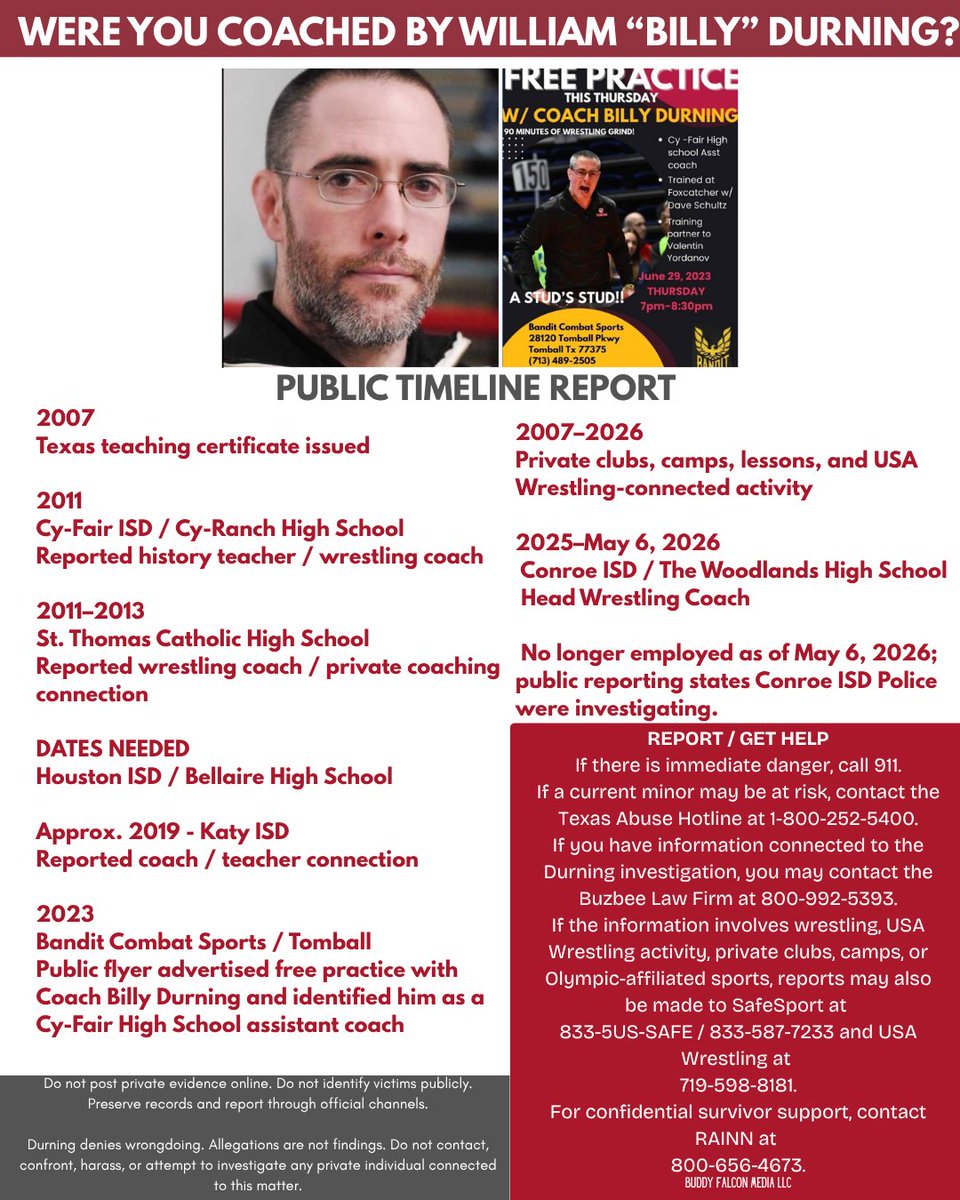
Attorney Tony Buzbee has publicly alleged that former Texas wrestling coach William “Billy” Durning may be connected to a pattern of grooming and exploitation involving hundreds of young women over more than a decade. The allegations, recently detailed by Texas Scorecard in a May 18 report updated May 21 and by High School on SI, center on Buzbee’s ongoing investigation into Durning, USA Wrestling, and Safe Sport, Inc.
The scale of the allegations is difficult to ignore, but the story now unfolding extends far beyond one coach, one school, or a single wrestling program.
This is not simply a story about William “Billy” Durning. It is a story about the adults and institutions around him — the people who may have heard warnings, held records, received complaints, allowed departures, issued references, or failed to report — and whether the reporting systems that already existed protected athletes or protected institutional silence.
If multiple safeguards existed across Texas public schools and private clubs, why did it require public Instagram posts and attorney statements for this pattern to become visible? And most importantly, what did the adults in the room know before the public knew?
(Note: Durning, through counsel, has denied wrongdoing. The victim statements and accounts discussed below should be treated as allegations unless confirmed through law enforcement, court records, agency findings, or public records.)
🪶 The People Who Let the Chain Break
The victim statements now referenced in public reporting do more than describe alleged misconduct. They raise a chilling question about the adults who surrounded these athletes. They suggest that other professionals were warned, and that the mandatory reporting chain simply stopped with them.
In one statement, a former athlete alleged that she met Durning in 2011 at age 15 while a student at Cy-Fair ISD. She alleged that during a private lesson, Durning used "cutting weight" as a pretext to isolate her in a bathroom, had her strip to her underwear, and scraped her body with a credit card while telling her it was "hard for me to wait until you turn 18."
Her statement points directly to the adults who allegedly failed to act:
"My friend told her coach, who then told my coach. That was it. No one ever reported him to the police."
Another former athlete stated she was 16 when Durning was her history teacher at Cy-Ranch High School. She alleged he isolated her during lunch periods before escalating to explicit phone calls and physical abuse. Crucially, her statement alleges that a colleague of Durning's was aware of the danger:
"Around that time, his friend Coach Potter, took me aside and told me to be careful around him... Coach Potter seemed to know and did nothing to stop his obsession with me."
If these accounts are accurate, the public question is not simply what one adult allegedly did. The public question is what happened after other adults were allegedly placed on notice.
Did those coaches document the concern? Did they escalate it to administration? Was law enforcement contacted? Was SafeSport alerted? Or did a critical warning remain an informal whisper between colleagues when it should have been evaluated as a formal report?
🪶 A Coach Inside the System
According to Texas Scorecard, Durning received a Texas teaching certificate in 2007. He subsequently coached or taught in multiple major Texas school districts, including Conroe ISD, Houston ISD, Cypress-Fairbanks ISD, and Katy ISD.
He was not an outsider operating in the shadows. He operated with official roles, public recognition, district employment, and private-club access.
When a coach moves repeatedly through schools, clubs, and athletic systems for years, the question is what followed him when he left. In the ecosystem of public education, few phrases are as dangerous to student safety as “no longer employed.” A resignation should not erase a safety concern. A transfer should not bury a warning.
If an employee leaves a district while concerns exist, but the next institution receives only a clean personnel file and dates of employment, the system fails to protect students and instead preserves the silence.
🪶Safeguards on Paper vs. Safeguards in Practice
The framework surrounding these athletes was not empty. There were mandatory-reporting laws, background checks, SafeSport training, and misconduct-reporting portals.
But having a system and having adults who will actually use it are two completely different things.
This is a familiar pattern in Texas. In a recent federal lawsuit involving Prosper ISD, a bus driver was reportedly accused of sexually abusing two girls on a school bus equipped with surveillance cameras. A federal court ultimately dismissed the family’s Title IX lawsuit because the pleadings did not establish the district’s "actual knowledge" before the families reported the abuse themselves.
The camera system existed. The legal and public question was whether anyone used it in time to protect the children.
That same question now echoes through the Durning allegations. The reporting systems already existed. The adults were already there. Did they work?
🪶 Why Public Timelines Break the Silence
Buddy Falcon Media has seen this dynamic before. In our prior reporting on Pflugerville ISD involving former educator Ramon Nazario, public identification and timeline reporting helped former students recognize patterns and come forward.
After Buddy Falcon Media published Nazario’s photo and reported the initial concerns, emails arrived, comments poured in, and the downloaded public commentary alone reportedly stretched across roughly 40 pages. People said they knew. People said they had heard concerns. People said they had reported them.
That is why timelines matter. They help people see whether their experience was isolated — or part of a broader pattern that the adults and institutions in charge failed to connect. The Durning allegations raise the same public-interest question: did adults, schools, clubs, or oversight bodies each hold pieces of the same warning pattern without anyone assembling the full picture?
🪶The Records Should Tell the Story
This has now become a public-records story. Separation records, eligibility-for-rehire documents, TEA reports, and district communications should illuminate who knew what, and when. Club records, camp flyers, USA Wrestling membership records, and private-training materials may matter just as much as district files. If records do not exist, that absence is itself significant.
If you were coached by Durning, had a child coached by him, worked with him, supervised him, or possess information about prior complaints, warnings, resignations, or district handling, preserve what you know.
* Do not post private evidence publicly.
* Do not identify victims in comments.
* Do not contact, confront, harass, or attempt to investigate any person connected to this matter.
If you have direct evidence or believe you or your child may have been harmed, contact law enforcement, the Buzbee Law Firm, SafeSport, USA Wrestling’s reporting channels, or an attorney. If there is an emergency or immediate danger, call 911.
(Buddy Falcon Media is reviewing public-record timeline information only and is not collecting private evidence through this article. You may reach out for advice on submitting evidence)
🪶 Resources and Support
* RAINN National Sexual Assault Hotline: 800-656-4673
* VictimConnect Resource Center: 855-484-2846
* U.S. Center for SafeSport Reporting Line: 833-5US-SAFE / 833-587-7233
* The Texas Association Against Sexual Assault provides Texas-specific survivor resources and crisis-center locator information.
---
🪶 The Question That Remains
This is a story about the systems that granted access, the adults who may have held the warning signs, and the records that should now reveal whether anyone acted.
Who knew, when did they know it, what was written down, and what was left informal?
When a coach moves repeatedly through athletic systems for years, the public has a clear interest in asking whether the adults and institutions surrounding him were protecting athletes — or protecting the institutions around them.
---
This article is public-interest reporting about student safety, athletic oversight, district accountability, public records, and youth-sports reporting systems. It is not directed to any person, and no contact with any person is requested or encouraged. Buddy Falcon Media is reviewing public-record timeline information only and is not collecting private evidence through this article.
— Buddy Falcon Media, LLC
Keeping Watch. Always. 🪶
@STHCatholic@CyFairISD@BellaireHigh@katyisd@KatyISDAthletic@CyFairSSS@ConroeISD@TexasEd911@teainfo@TexasScorecard@TrueTexasTea
🪶 ONE YEAR AGO: THE ORIGINAL CREDENTIAL REPORT
One year ago, Buddy Falcon Media raised questions about then-Board President Renae Mitchell’s graduation regalia and public-facing credentials. At the time, PfISD did not publicly explain why earlier materials referenced an MBA/M.Ed. while the current bio now identifies a Master’s in Human Resources Development Leadership. (link in comments)
One year later, the questions have only grown.
🪶 PFISD Graduation Day: When Leaders Change the Story but Never Explain 🪶
Graduation day is here in Pflugerville ISD. Before we celebrate the students who earned their diplomas, the public deserves answers about the adults standing on the stage.
This is no longer just about Renae Mitchell’s regalia.
It is about why another sitting PfISD trustee, Jean Mayer, allegedly had information about documented discrepancies in Mitchell’s public credentials — and instead of raising the issue openly as a board governance matter, the concern was routed through district staff and reported anonymously.
According to information provided to Buddy Falcon Media, Trustee Jean Mayer shared the credential concern with two PfISD staff members, and the issue was then reported anonymously.
Think about what that means.
If a sitting trustee believed there was a serious public-trust issue involving the Board President, why was that concern not placed on the record?
Why did it have to move through staff?
Why did it have to be anonymous?
And what kind of internal culture exists inside PfISD leadership if even a board member appears to believe the only safe way to raise concerns about another board member is through an anonymous reporting route?
That is the bigger story.
Because when elected officials fail to address credential questions publicly, the issue is no longer just about one person’s degree, stole, hood, or biography.
It becomes a governance problem. It becomes a transparency problem. It becomes a public-trust problem.
So what was the concern?
Records and screenshots reviewed by Buddy Falcon Media show a clear pattern of credential confusion involving then-Board President Renae Mitchell:
* One older candidate listing described Mitchell as a community and church leader “with an MBA.”
* Another bio, titled “Renae Mitchell, M.Ed./MBA - BIO,” stated: “I received an M.Ed./MBA from the University of Texas @Austin from the McCombs School of Business with a concentration in Education, Human Resources, and Organizational Development Leadership.”
* PfISD’s current public bio does not list an MBA. It does not list a Master’s in Education. It lists a B.A. in Journalism and Communications and a Master’s in Human Resources Development Leadership.
That is a very different public representation.
And the graduation photos matter because they appear to match the credential problem.
A June 1, 2020 post from “Renae Mitchell 4 PfISD Board” shows Mitchell in graduation regalia with a blue academic hood/collar. Other graduation images reviewed by Buddy Falcon Media raise additional questions about whether Mitchell was publicly presenting herself with education-related credentials that her current public bio does not support.
Then came 2025.
By 2025, after the concern had been raised, Mitchell appeared in different regalia — suggesting someone understood the earlier presentation was at least problematic enough to change.
After that concern was raised, Mitchell’s public-facing credential language also changed. The MBA/M.Ed. language no longer appears on the district website, and the current version now identifies the degree as a Master’s in Human Resources Development Leadership.
That timeline matters.
If there was nothing wrong with the earlier regalia or the earlier bios, why change them once people started asking questions?
And if a sitting trustee knew enough to be involved before the concern was anonymously reported, why did PfISD never explain the issue publicly? That is the question PfISD still has not answered.
The issue is not whether someone made a typo on a bio. The issue is whether public-facing credentials, graduation regalia, and district silence created a misleading impression for voters, families, educators, and students.
Students are expected to earn their credentials honestly. Teachers are expected to be truthful about theirs. The adults governing the district should be held to the same standard.
Mitchell is no longer board president. She has now been replaced by fellow trustee Chevonne Lorigo-Johst. But the governance implications remain.
The ethical issue is straightforward: a trustee who works in HR consulting, executive search, leadership coaching, and training sits on a board that influences superintendent selection, leadership evaluation, HR structures, budgets, contracts, and district policy.
PfISD should publicly answer whether Mitchell ever disclosed any potential conflict, whether she ever recused herself from relevant votes, and whether she or any related entity ever provided services to PfISD, PfISD vendors, PfISD-adjacent organizations, district administrators, or anyone seeking influence or business with the district.
Buddy Falcon Media will be reminding the public who these trustees have supported, approved, elevated, hired, or failed to question—starting with Quintin Shepherd and Willie Watson.
A separate public-record review involving Magnolia Ranch/Lot 8 will be published later, as well as addressing what Mayer and other board members were aware of as much as two years ago.
Stay tuned🪶
---
Disclaimer: The information shared in this post concerns matters of public record and public concern. As an investigative journalism platform, Buddy Falcon Media reports on the actions of elected officials, public figures, and matters of institutional transparency. This post is for informational and accountability purposes only and constitutes protected First Amendment speech. It is not intended to harass, intimidate, or encourage others to harass any individual mentioned.
🪶 Links to the original post, supporting screenshots, and full Scribd documents will be posted in the comments.
— Buddy Falcon Media, LLC
Keeping Watch. Always. 🪶
@PfISDHR@pfisd@teainfo@GregAbbott_TX@tasb_news@BryanM_KVUE@KXAN_News@cbsaustin@fox7austin
#PFISD #PflugervilleISD #AccountabilityMatters #SchoolBoardAccountability #ConflictOfInterest #TransparencyMatters #DoBetterBeBetter #FirstAmendment
🚨 BURIED IN PLAIN SIGHT: PfISD’s Own Reports Reveal an $18M Deficit, Higher Tax Revenue, a $2.4M Health-Plan Shortfal, and the Truth Behind “Surplus Staffing” 🚨
SUMMARY:
This post breaks down what PfISD’s own Administration Reports reveal beneath the “Radical Transparency” messaging:
• An estimated $18.2 million deficit
• A possible fund-balance drop from about $80.2 million to roughly $5.2 million within four years
• “Surplus staffing decisions” affecting employees for the 2026–2027 school year
• A projected $2.4 million shortfall in the employee health plan
• A Direct Primary Care clinic proposal with unanswered cost, privacy, and benefit-design questions
• A $5,743 superintendent compensation adjustment that included estimated “lost investment earnings” calculated at 11.48%
• Higher tax revenue, public-records access concerns, and the need for clearer answers for parents, staff, and taxpayers
Pflugerville ISD leadership frequently promotes a public narrative centered on “Radical Transparency,” staff retention, and district stability. Yet an analysis of the full 2024–2026 Administration Report archives reveals a vastly different story.
FULL STORY:
When you read past the public relations framing, the documents show a pattern of positive public framing alongside serious financial, operational, and staffing concerns buried deeper in committee and agenda language.
Here is the documented truth PfISD placed in committee language rather than foregrounding to the public:
🪶1. The $18.2 Million Deficit & The Reality of "Surplus Staffing"
Committee notes inside the public February 2026 report state the preliminary budget projection reflects an estimated $18.2 million deficit. The May archive presents an even starker warning: without structural adjustments, the district’s fund balance could plummet from approximately $80.2 million to roughly $5.2 million within four years.
To manage this, the April 2026 report notes administrators were working through “surplus staffing decisions.” The public reports strip away the illusion that this is just routine logistics:
* The Budget-Driven Reality: The district explicitly admits in the report that these staffing decisions are part of a “broader effort to implement responsible, cost-saving measures.”
* "Affected Staff": The administration refers to the employees caught in these cuts as "affected staff." The district handled these placements by shifting staff into "current vacancies" at other campuses to avoid new hiring, or by issuing "formal placement notifications."
* The May 2026 Warning: While April reports attempted to soften the blow, the May 2026 report drops the euphemisms entirely. District leadership warned the Board of Trustees that because other projected savings scenarios failed, *“additional cost-saving measures may be necessary in the future, including potential staffing reductions and program cuts.”*
🪶 2. Decoding “Radical Transparency”: PR Spin vs. Documented Reality
Beyond the staffing reductions, the archives show a pattern of presenting difficult operational data through positive or softened framing:
* Higher Tax Revenue Framed as a “Steady Rate”: In May 2026, the district proposed a $1.1069 tax rate. The report states the state’s “No-New-Revenue” rate — the rate required to keep revenue flat despite rising property values — is $1.0448. By choosing the higher rate, PfISD generates 5.9% more revenue. The district framed this reality by stating: “tax bills may go up because property values increased, not because PfISD raised the tax rate... PfISD is keeping the tax rate steady.”
* “Optimization” Became the Language of Closures: The reports repeatedly reference a “District Optimization Process.” To manage this, the district hired Civic Solutions Group to develop a “phased, multi-year optimization plan” and research “innovative school models.” In this context, that language became tied to school consolidations, closures, and long-term restructuring.
* Mid-Year Transfers Framed as “HR Success”: In September 2025, the district highlighted a “New Record” by filling 27 teacher vacancies in a “two-week turnaround.” Buried in the explanation is the method: the district instituted a process for “moving staff from campuses with lower enrollment.” The district moved staff from campuses with lower enrollment after the school year had begun, affecting classrooms and campus stability, but framed it as a strategic accomplishment.
* The Uncertified Teacher Crisis: The district reported in September 2025 that uncertified teachers operating under waivers dropped to “fewer than 100.” While framed as an improvement, the reports still acknowledged that dozens of uncertified teachers remained under waivers or certification-deficient categories. By March 2026, the district was holding “Certification Support Sessions” for its “Certification Deficient Staff.”
* Data Errors Affecting CCMR Reporting: In September 2025, a major “data issue” was identified where 91 students at Weiss High School were “not included as CCM-ready” — College, Career, or Military Ready. This reporting issue affected how post-secondary readiness was reflected for the campus and the district.
🪶3. The $2.4 Million Healthcare Shortfall: What Staff Deserve to Know
The district’s self-funded employee medical insurance program was also projected to run a significant shortfall. While staff were publicly told the 2026 medical plan would remain stable, the March 2026 Administration Report states the Insurance Committee was informed of a projected deficit of $2.4 million in the plan’s financials.
In a self-funded plan, the district assumes direct financial risk for employee medical claims. PfISD’s proposed response is a new Direct Primary Care clinic through Frontier Direct Care. That may be a useful benefit. It may also be a cost-containment strategy designed to reduce claims. It may be both.
Staff deserve clear answers before this clinic opens:
* What is the total cost of the Frontier Direct Care contract?
* The reports do not clearly explain whether PfISD will be responsible for any facility, lease, build-out, equipment, staffing, or operating costs beyond the vendor contract.
* What return on investment is PfISD projecting, and what assumptions were used to justify that projection?
* Will the clinic remain optional, or will premiums, deductibles, co-pays, or plan design change if the clinic does not produce projected savings?
* What written privacy protections will separate employee medical information from PfISD administration and HR?
🪶 4. The “Paywall” on Public Information
What is notably missing from the district’s reports is the actual price tag for the Frontier clinic contract. To understand the full cost, the public would likely need to file a formal Public Information Act request.
That matters because PfISD has frequently responded to public-records requests with cost estimates that can run into the hundreds or thousands of dollars. In practice, those costs place a financial barrier between taxpayers and meaningful oversight.
Independent, public-interest platforms like Buddy Falcon Media, LLC spend hours digging through public reports and committee notes because the public has a fundamental right to understand how major district decisions are being made. That right should not be gated by excessive fees. Taxpayers should not face excessive costs to access the records of the government.
🪶 5. Administrative Compensation vs. Foundation-Funded Roles
During the same period that the district was projecting an $18.2 million deficit, preparing for staffing reductions, and addressing recapture obligations, the Board approved two strikingly different financial actions involving district administration.
First, the district relied, at least in part, on philanthropic support for administrative payroll. In June 2025, the Board approved a Memorandum of Understanding with the Pflugerville Education Foundation to *"fund 50% of salaries and benefits for key administrative roles."*
Then, in September 2025, the Board authorized a $5,743 additional compensation adjustment to Superintendent Shepherd to correct a payroll error involving missed supplemental retirement contributions. The Board also authorized the use of public funds to cover his estimated “lost investment earnings,” calculated using an 11.48% average rate of return.
A Question for PfISD Staff: When ordinary employees experience payroll errors involving stipends, overtime, supplemental pay, or regular wages, does PfISD calculate missed investment opportunity and issue a comparable lost-earnings adjustment?
If the answer is no, staff deserve to know why the standard is different at the top.
🪶 The Bottom Line
PfISD leadership cannot continue to promote “Radical Transparency” in its reports while some of the most critical indicators of district financial health appear deeper in committee notes, agenda language, and public records that can be costly for taxpayers to access.
The documents show the financial risk is no longer hypothetical.
Taxpayers, parents, and educators are the ones most likely to feel the consequences of these deficits, staffing disruptions, benefit questions, and long-term budget decisions. They deserve the unvarnished truth, foregrounded for all to see.
— Buddy Falcon Media, LLC
Keeping Watch. Always.🪶
---
*This post is public-interest reporting based on PfISD’s own publicly posted Administration Reports. It is about district records, school finance, staffing, employee benefits, and government transparency.
@PfISDHR@pfisd@fox7austin@PfISD_AD@PfISDHR@PfISDAthletics@pfisd@KUT@BryanM_KVUE@suphannahrucker@QuitaC_KVUE@JenniL_KVUE@tplohetski@KXAN_News@statesman@tasb_news@FarrahWaltonTV@cbsaustin@TrueTexasTea@TexasEd911@teainfo@TexasScorecard
🪶 The PfISD Shell Game: Reducing FTEs or Promoting Bloat? 🪶
Pflugerville ISD is telling families the district is in a financial crisis.
They are closing schools.
They are claiming enrollment is down.
They are telling teachers, bus drivers, special education staff, and campus support staff to keep doing “more with less.”
But while PfISD cuts at the campus level, the internal hiring dashboard tells a very different story at Central Office.
On May 15, 2026, PfISD posted three internal-only HR leadership promotions:
• Assistant Director of Compensation and Auxiliary
• Assistant Director of Position Management
• Employee Relations and Operations Officer/Director
Each posting was marked with the same justification:
“Internal Promotion Opportunity Due to HR Dept Optimization and FTE Decrease.”
Let’s translate that “optimization” language into plain English.
🪶 The Administrative Shell Game
PfISD wants the public to assume that an “FTE decrease” automatically means cost savings.
That is a dangerous assumption.
Reducing FTEs — full-time equivalent positions — does not mean the budget goes down if the district is simply trading lower-paid roles for higher-paid, “optimized” director-level titles.
A district can eliminate several support roles and use that money to fund one higher-level administrative promotion.
The number of FTEs goes down.
The administrative budget can still go up.
That is the math PfISD needs to show the public:
• Which specific HR positions were eliminated?
• Were those positions filled or vacant?
• What salary costs were actually removed?
• What salary costs were added by these new Assistant Director and Director-level titles?
• Did total HR payroll actually decrease, or is this just a reorganization of the administrative ladder?
🪶 Priorities or Politics?
These are not classroom positions.
They are not nurses.
They are not bus drivers.
They are not aides.
They are not campus staff working directly with children every day.
These are central-office HR leadership roles.
Parents and taxpayers have a right to ask:
Is this where the money is going while campuses are being cut?
Every dollar spent expanding the Central Office leadership layer is a dollar not spent on the people trusted with our children every day. When PfISD says there is “not enough money” for campus staff, that is not just a budget statement. It is a value judgment.
It means the district is choosing what to protect.
“Optimization” is not proof of savings. It can also be a buzzword used to justify shifting money up the administrative ladder while campuses continue to starve.
🪶 Show Us the Receipts
If PfISD is truly saving money, prove it.
Show the before-and-after org chart.
Show the eliminated positions.
Show the removed salaries.
Show the added salaries.
Show the net savings after benefits.
Until the math is public, this looks like using “financial crisis” language to justify internal administrative promotions.
— Buddy Falcon Media, LLC
Keeping Watch. Always 🪶
@PfISDHR@pfisd
🪶 The “Good Shepherd” Stopped Listening When It Came to the Girls
When Buddy Falcon Media tried to get local media to look at the Ramon Nazario story, the response was not urgency.
It was dismissal.
One reporter told a former student he was looking for “something worse” for the story. He also told Buddy Falcon Media that Ramon Nazario was “just a creep", his actions not deemed bad enough for a news story.
Twenty-two pages of former students and community members described boundary concerns: unusual classroom access, girls hanging out in his room, hair-braiding, favoritism, uncomfortable hugs, comments about students’ bodies, social-media contact after graduation, and years of people saying they knew something was wrong. Reports of him following girls immediately after graduation, asking for "nudes".
And still, it was not “enough.”
Because the girls were not saying they had been assaulted. They were not describing the final, worst possible act. What they described was the part too many systems still refuse to see: the grooming stage. The testing stage. The access stage. The soft place that comes with conditions.
And for some girls, that attention lands in an empty place adults should have already protected.
When you do not have many adults on your side, you learn to be careful with the ones who seem to be. You worry about needing them later. You worry about making them mad. You worry that if you pull away, question them, or tell someone they made you uncomfortable, you might lose one of the only adults who ever acted like they cared.
That is part of why girls stay quiet.
Not because it was okay. Because the attention filled a need before they understood the cost. That is the part adults are supposed to stop.
Not after a child is assaulted.
Before.
The question should never be, “Was it bad enough yet?” The question should be, “Why was a grown man allowed to make young girls feel this way at all?”
Some people still do not understand that.
But girls know.
Women know.
Former students know.
They know what it feels like when an adult man notices your body before you are even comfortable living in it. They know what it feels like when a teacher’s room becomes a place where the rules bend, where girls get special access, where attention feels like protection until it starts feeling like a trap.
And years later, when those girls finally find the words, the world should not tell them, “It wasn't bad enough.”
This is what that warning feels like from the inside.
And in this case, the person paid to lead the district — the person who branded himself as a listener, a shepherd, and a protector of students — was given a chance to listen.
Dr. Quintin Shepherd had previously agreed to meet with the same teacher who later tried to alert him to student-safety concerns. He even told her to say they had “chatted at convocation.”
But when she reached out about the girls, he stopped listening.
He blocked her.
— Buddy Falcon Media, LLC
Keeping Watch. Always. 🪶
@PfISD_AD@PfISDHR@PfISDAthletics@pfisd_police@pfisd@WeissSoftball@Weiss_WBB@WeissFootball@weissmensbball@KUT@BryanM_KVUE@suphannahrucker@QuitaC_KVUE@JenniL_KVUE@tplohetski@KXAN_News@statesman@tasb_news@WeissHighSchool@FarrahWaltonTV@cbsaustin@TrueTexasTea@TexasEd911@teainfo@TexasScorecard
🪶 The “Good Shepherd” Stopped Listening When It Came to the Girls
When Buddy Falcon Media tried to get local media to look at the Ramon Nazario story, the response was not urgency.
It was dismissal.
One reporter told a former student he was looking for “something worse” for the story. He also told Buddy Falcon Media that Ramon Nazario was “just a creep", his actions not deemed bad enough for a news story.
Twenty-two pages of former students and community members described boundary concerns: unusual classroom access, girls hanging out in his room, hair-braiding, favoritism, uncomfortable hugs, comments about students’ bodies, social-media contact after graduation, and years of people saying they knew something was wrong. Reports of him following girls immediately after graduation, asking for "nudes".
And still, it was not “enough.”
Because the girls were not saying they had been assaulted. They were not describing the final, worst possible act. What they described was the part too many systems still refuse to see: the grooming stage. The testing stage. The access stage. The soft place that comes with conditions.
And for some girls, that attention lands in an empty place adults should have already protected.
When you do not have many adults on your side, you learn to be careful with the ones who seem to be. You worry about needing them later. You worry about making them mad. You worry that if you pull away, question them, or tell someone they made you uncomfortable, you might lose one of the only adults who ever acted like they cared.
That is part of why girls stay quiet.
Not because it was okay. Because the attention filled a need before they understood the cost. That is the part adults are supposed to stop.
Not after a child is assaulted.
Before.
The question should never be, “Was it bad enough yet?” The question should be, “Why was a grown man allowed to make young girls feel this way at all?”
Some people still do not understand that.
But girls know.
Women know.
Former students know.
They know what it feels like when an adult man notices your body before you are even comfortable living in it. They know what it feels like when a teacher’s room becomes a place where the rules bend, where girls get special access, where attention feels like protection until it starts feeling like a trap.
And years later, when those girls finally find the words, the world should not tell them, “It wasn't bad enough.”
This is what that warning feels like from the inside.
And in this case, the person paid to lead the district — the person who branded himself as a listener, a shepherd, and a protector of students — was given a chance to listen.
Dr. Quintin Shepherd had previously agreed to meet with the same teacher who later tried to alert him to student-safety concerns. He even told her to say they had “chatted at convocation.”
But when she reached out about the girls, he stopped listening.
He blocked her.
— Buddy Falcon Media, LLC
Keeping Watch. Always. 🪶
@PfISD_AD@PfISDHR@PfISDAthletics@pfisd_police@pfisd@WeissSoftball@Weiss_WBB@WeissFootball@weissmensbball@KUT@BryanM_KVUE@suphannahrucker@QuitaC_KVUE@JenniL_KVUE@tplohetski@KXAN_News@statesman@tasb_news@WeissHighSchool@FarrahWaltonTV@cbsaustin@TrueTexasTea@TexasEd911@teainfo@TexasScorecard
🚨WILLIE WATSON'S HR DOESN'T INVESTIGATE SEXUAL ASSAULT ON CAMPUS DURING SCHOOL: “NO EMPLOYEES INVOLVED”
By Buddy Falcon Media, LLC
Some records must be handled carefully. Buddy Falcon Media is sharing this with identifying information redacted because it involves a student and an alleged sexual assault. The purpose is not to expose the student or cause further harm. The purpose is to show what PfISD’s own records say.
In documents produced through PfISD Open Records Request #181-2025, HR Director Ruth Yamaguchi documented a serious prior sexual-assault allegation involving a Weiss High School classroom setting. Specifically, an office behind a classroom. Additional information reviewed by Buddy Falcon Media indicates the alleged incident happened during the school day.
The record reflects serious communication gaps:
• The allegation was reportedly submitted through an Anonymous Alert.
• A school board member allegedly reached out to the student.
• In September 2024, journalism teacher Crissie Ballard reported that she contacted CPS and PfISD Police regarding the allegation.
• Yamaguchi then emailed the HR team because there were no previous records indicating HR had been made aware of the claim.
• The HR team acknowledged there were no previous records or reports documented.
• On September 24, 2024, Yamaguchi noted that “the campus had not been made aware either.”
On September 26, 2024, Yamaguchi reconnected with Chief HR Officer Willie Watson regarding the police review. The record states that PfISD Police had scheduled a forensic interview and that Watson stated because “there are no employees involved,” PfISD Police would oversee the investigation.
That phrase — “no employees involved” — deserves scrutiny.
It may address who allegedly committed the assault. It does not answer the school-side questions:
• Who received the initial Anonymous Alert?
• Who was responsible for routing it?
• What action was taken when it came in?
• Why would a school board member allegedly reach out to the student if HR had no documented awareness and the campus had not been made aware?
• Who was responsible for the classroom space?
• Who was supervising the area?
• Did any adult know earlier?
• Did mandatory reporting happen when it legally should have?
• Was the adult-supervision side ever reviewed?
The issue is that, based on the records reviewed by Buddy Falcon Media, the allegation was not meaningfully investigated when it was first reported. No one contacted the victim at the time, HR later had no documented record of the claim, and Ruth Yamaguchi’s notes state that the campus had not been made aware either. Only after Ballard reported contacting CPS and PfISD Police in September 2024 did the record show renewed action, including HR checking for prior records, CPS being filed out of an abundance of caution, and PfISD Police scheduling a forensic interview.
That raises the real question: what happened the first time?
There is another question parents deserve answered: were Anonymous Alerts involving student safety handled the same way as Anonymous Alerts the district suspected Ballard of filing? Records reviewed by Buddy Falcon Media show district attention later turned toward whether Ballard was connected to Anonymous Alerts.
That contrast matters.
When an Anonymous Alert involves an alleged sexual assault connected to a classroom during the school day, the public-safety question is simple: who gets notified, who documents it, and who makes sure the student is protected?
Protecting the student matters. But protecting the student does not mean protecting the system from accountability.
A reminder to students, parents, and staff:
If you are in immediate danger, call 911. If you are a student and someone hurts you, threatens you, pressures you sexually, grabs you, chokes you, controls you, scares you, or tells you not to report something, tell a safe adult immediately. If one adult does not help, tell another one.
Texas Abuse Hotline: Suspected child abuse or neglect can be reported at 1-800-252-5400 or online at the Texas Abuse Hotline. Available 24/7.
National Domestic Violence Hotline: For domestic or dating violence, help is available 24/7 at 1-800-799-SAFE / 1-800-799-7233. Text START to 88788 or chat at https://t.co/ZsKcmO4Bs2.
National Sexual Assault Hotline: Support is available 24/7 through RAINN at 800-656-HOPE / 800-656-4673 or via online chat.
School employees in Texas should not sit on reports, hide reports, or assume someone else will handle it. Professional reporters have a personal, non-delegable legal duty to report suspected child abuse or neglect.
This post is public-interest reporting about student safety, sexual-assault reporting, dating violence, domestic violence, school supervision, district records, employee reporting duties, Anonymous Alerts, and government accountability. It is not directed to any private individual, and no contact with any individual is requested or encouraged.
— Buddy Falcon Media, LLC
Keeping Watch. Always. 🪶
@PfISDHR@PfISDAthletics@pfisd_police@pfisd@teainfo@GregAbbott_TX@joerogan@fox7austin@AlecOnFOX7@BryanM_KVUE@suphannahrucker@QuitaC_KVUE@JenniL_KVUE@tplohetski@KXAN_News@America1stLegal@KUT@statesman
PfISD Says There’s No Money for Raises. Then Read the Superintendent’s Contract🪶
When Pflugerville ISD approved its 2026–27 compensation package, Community Impact reported that Chief Human Resources Officer Willie Watson said there were “no other staff pay increases proposed for 2026–27 due to the district’s financial situation.”
That is the sentence that should stop every teacher, bus driver, custodian, food-service worker, paraprofessional, parent, and taxpayer in Pflugerville.
Because while district leadership is telling employees the financial situation limits raises, the superintendent’s contract tells a very different story about who PfISD is willing to protect.
PfISD is staring at a projected budget shortfall. The district is talking about closures, consolidations, “optimization,” and cuts. Staff are being told there is only so much money to go around.
But Superintendent Quintin Shepherd’s contract, signed in February 2026, gives him:
• $303,000 annual salary
• Five-year contract running from February 1, 2026 through January 31, 2031
• District-paid insurance coverage, including dental and vision
• 20 vacation days per year
• Ability to carry over up to 40 vacation days
• Ability to be paid each year for up to 15 unused vacation days
• Sick and personal leave under board policy
• Reimbursement for necessary expenses, including gasoline, hotels, accommodations, meals, rental cars, and other expenses
• District-paid expenses for civic activities, if approved
• District-paid professional development, including registration, travel, meals, lodging, and related expenses
• District-paid membership dues for the Texas Association of School Administrators and two other professional organizations of his choice
• Professional liability insurance coverage
And then it gets worse.
The contract says PfISD will supplement the superintendent’s salary by an amount equal to 100% of his portion of the monthly TRS member contribution, including both retirement and TRS-Care portions.
For regular Texas educators, TRS is not optional. It comes out of their paychecks.
For 2025–26, TRS rates show active employees contribute:
• 8.25% for TRS retirement
• 0.65% for TRS-Care
• Combined: 8.9% of salary
So let’s compare.
A teacher making $58,300 would have about $5,188.70 withheld for TRS retirement and TRS-Care.
That comes out of the teacher’s salary.
But on a $303,000 superintendent salary, the same 8.9% equals about $26,967.
And Shepherd’s contract says the district will supplement his salary by an amount equal to his TRS member contribution.
So while teachers pay their required TRS share out of their own paychecks, the superintendent’s contract gives him a district salary supplement tied to his TRS share.
That alone should make taxpayers ask questions.
But that is still not the whole package.
The contract also includes a Supplemental Retirement Plan. Beginning in 2026, PfISD contributes to retirement plans for Shepherd based on a percentage of the maximum allowable contribution. The schedule starts at 60% in 2026, rises to 75% in 2027, and then goes to 80% from 2028 through 2031.
Using 2026 IRS limits, the numbers are staggering.
The IRS lists the 2026 403(b) elective deferral limit at $24,500 and the 2026 annual additions limit for 403(b)-type defined-contribution plans at $72,000. The IRS also lists the 2026 age-50 catch-up amount at $8,000, with a higher $11,250 catch-up for ages 60–63 if the plan permits it. The 2026 governmental 457(b) deferral limit is also $24,500.
If PfISD calculates Shepherd’s supplemental retirement plan from the $72,000 defined-contribution limit, the potential value would be:
• 2026: 60% = $43,200
• 2027: 75% = $54,000
• 2028–2031: 80% = $57,600 per year
Then there is the separate additional salary / deferral language tied to 403(b) and 457(b) plans.
The combined 2026 elective-deferral limits for 403(b) + 457(b) are:
$24,500 + $24,500 = $49,000
If PfISD calculates that provision from the combined $49,000 maximum, the potential value would be:
• 2026: 60% = $29,400
• 2027: 75% = $36,750
• 2028–2031: 80% = $39,200 per year
Put those two provisions together, and using 2026 IRS limits, the potential retirement/deferral-related compensation could be:
• 2026: $72,600
• 2027: $90,750
• 2028–2031: $96,800 per year
That is on top of the $303,000 salary, district-paid insurance, travel, reimbursements, professional memberships, vacation benefits, liability coverage, and the separate TRS-member-contribution salary supplement.
To be clear: PfISD should release the full compensation ledger showing exactly how these contract provisions are calculated, funded, reported, and paid.
But the contract language is enough to raise the public question:
How does a district tell employees there are “no other staff pay increases” because of the district’s financial situation, while approving a superintendent contract that could carry tens of thousands of dollars per year in retirement and deferral-related compensation alone?
And that brings us back to the teacher “pay bump.”
Classroom teachers are being sold a raise that appears tied heavily to state Teacher Retention Allotment money — not simply a locally funded raise from PfISD leadership.
TRA is not magic money created by PfISD. It is state-created teacher-retention funding under House Bill 2.
So when PfISD promotes a teacher pay increase, the public deserves to know:
How much is local PfISD money?
How much is state TRA money?
And how much credit is district leadership taking for money the state sent for teacher retention?
Support staff are still watching the bottom line.
Hourly workers still face summer gaps.
Bus drivers, custodians, food-service workers, aides, and campus staff still carry the daily burden of keeping schools running.
And the district’s lowest-paid employees do not get superintendent-style contract protections.
They do not get five-year contracts.
They do not get vacation buyback written into a personal employment agreement.
They do not get district-paid supplemental retirement plans stacked on top of their base salary.
They do not get a contract provision designed to offset their TRS member contribution.
They get told there is a budget problem.
That is the story.
PfISD is not broke when it wants to protect the people at the top.
PfISD is only broke when classroom teachers, support staff, transportation workers, custodians, food-service workers, nurses, and campus employees ask for enough money to live on.
And that is exactly why the public should stop accepting vague phrases like “pay bump,” “financial situation,” and “optimization.”
Show the numbers.
Show how much of the teacher increase is local money versus state TRA money.
Show how much cabinet compensation has increased.
Show the superintendent’s full salary, benefits, retirement supplements, insurance, travel, reimbursements, and vacation payout rights.
Then ask why the people closest to students are always told to sacrifice first.
Buddy Falcon Media, LLC
Keeping Watch Always 🪶
https://t.co/7Q83F71dgn
The $2 Million Question: Why Is PfISD Expanding the Central Office While Dismantling Neighborhood Schools? 🪶
By Buddy Falcon Media
The story Pflugerville ISD has presented to families is, by now, all too familiar: enrollment is declining, revenue is tightening, and looming deficits mean neighborhood schools may be closed. For parents, teachers, and children in the affected communities, the district’s explanation has been straightforward and grim: fewer students mean less funding, and less funding means painful decisions.
But if the district insists on dismantling neighborhood schools, the public has a right to ask a direct and uncomfortable question:
Has central administration been forced to make those same sacrifices?
Because while PfISD was warning families about declining enrollment, budget pressure, and school closures, its General Administration budget—Function 41—grew by nearly $2 million.
That is a 24.8% increase in central administration over just three fiscal years.
That contrast is the question PfISD still has not answered.
🪶 Function 41: The Math Behind a 25% Bureaucratic Boom
Under Texas school-finance reporting, this budget category is called General Administration, or Function 41. This is not a vague complaint about “administration.” It is a specific accounting line that captures district-level operations, including superintendent-level administration, board-related costs, business office functions, human resources, payroll, purchasing, legal and risk management, and communications.
This is the part of the budget most families never see.
Because it is a specific reporting category, the numbers can be tracked. And the numbers tell a clear story:
* 2022–2023 Actual: $8,032,184
* 2023–2024: $8,818,983 *(Increase: $786,799, or 9.8%)
* 2024–2025 Budgeted: $9,450,746 *(Increase: $631,763, or 7.2%)
* 2025–2026 Amended: $10,022,016 *(Increase: $571,270, or 6%)
Taken together, PfISD’s General Administration spending grew from roughly $8.03 million to more than $10.02 million. That is an increase of $1,989,832—approximately 24.8%—over three fiscal years.
To put that number into perspective, look at the district’s own cost-saving justification for school closures. District officials have estimated that closing three campuses would save more than $7.1 million, which averages roughly $2.36 million per closed elementary school.
The nearly $2 million added to General Administration over the last three years is close to the average amount PfISD says it expects to save per closed elementary campus.
In other words, the amount added to central administration over three years is nearly equivalent to the annual savings the district expects from closing one elementary school. That does not prove every closure could have been avoided, but it absolutely demands an explanation.
🪶 Windermere’s Sudden Reversal: A B-Rated School on the Closure List
The district’s “District Optimization” plan has targeted four neighborhood elementary schools for permanent closure: Dessau, Parmer Lane, Pflugerville, and Windermere.
Closing these campuses would reshape communities, displace children, disrupt families, and change neighborhood patterns built over generations. While all four communities are facing a serious loss, the situation surrounding Windermere Elementary has raised especially troubling questions about transparency, public trust, and the district’s decision-making process.
Before the final closure vote, Windermere families and community members reportedly understood from public district statements that their campus was not being considered for closure at that time. Then, Windermere was abruptly placed back into the closure discussion late in the process.
That eleventh-hour reversal left parents and staff with virtually no time to organize, respond, or defend their school.
What makes the situation with Windermere especially frustrating for families is that many believed their school had been removed from consideration, only to see it added back late in the process. According to the state’s accountability metrics, Windermere Elementary is the highest-rated school on the closure list, holding an overall B rating from the Texas Education Agency.
For comparison, Dessau and Parmer Lane are C-rated campuses, while Pflugerville Elementary holds a D rating.
Windermere families are not just losing a building; they are losing access to a B-rated neighborhood campus that, according to TEA’s accountability ratings, outperformed the other elementary schools on the closure list. During public comments, parents and teachers expressed anger, confusion, and frustration over what they viewed as a lack of transparency.
If families are being asked to accept the permanent dismantling of a high-functioning neighborhood school, they are entitled to scrutinize the district’s financial decisions with equal seriousness.
🪶 Classrooms vs. Central Office: Where the Money Didn’t Go
The point is not that every dollar in Function 41 is automatically wasteful. Districts need payroll, legal services, purchasing, human resources, communications, and executive administration. But when central administration grows by nearly a quarter during the same period families are told their schools must close, the public deserves to know exactly what changed.
That nearly $2 million increase could have made a visible, dramatic difference elsewhere:
* Teacher Retention: PfISD’s major teacher raises are tied to state-directed funding through House Bill 2 and the Teacher Retention Allotment. Those raises were not the result of PfISD cutting its own central administrative growth to redirect money into classrooms. *If PfISD had redirected the $1.99 million increase into classroom compensation, it could have funded more than a $1,000 raise per teacher using local funds alone.*
* Working Families: PfISD charges families for its Extended Day Program. At $280 per month, after-school care is a major expense for working parents. *If $1.99 million had been redirected toward after-school care, it could have covered approximately 700 students for a full school year at that monthly rate.* Given that the program reportedly serves nearly 1,300 students, the central-office increase alone could have subsidized more than half of the families who actively rely on it.
* Classrooms and Campuses: That money could have supported classroom technology, instructional materials, campus operations, or other student-facing needs.
🪶 Families Are Told to Protect Revenue While Central Office Grows
The contrast becomes even more frustrating when families are told to help protect district revenue by avoiding student absences.
PfISD, like other Texas districts, is funded in large part through Average Daily Attendance, or ADA. That means the district can lose money when students are absent, even for legitimate medical appointments. So, families are strongly urged to schedule doctor and dentist appointments outside school hours when possible.
Parents are being asked to rearrange work schedules, delay appointments, and protect attendance revenue. At the same time, neighborhood schools are being told they must close because the district cannot afford to keep operating as it has.
That is exactly why Function 41 matters. If the district is asking families to sacrifice, then the public has a right to know whether central administration sacrificed too.
🪶 The Transportation Shuffle: A Budget Footnote Built on Silence
One detail buried in district paperwork deserves closer attention. PfISD’s own 2025–2026 Administration Report states that during a budget amendment, expenses were moved from Transportation into General Administration.
While this may have been an accounting correction, the public still has not been told how much was shifted, what types of expenses were involved, or why central administration needed additional funding during a budget crisis.
Those are not political questions. They are basic public-accountability questions.
🪶 Demand the Receipts: It’s Time to Show the Work
The purpose of this review is not to claim that every dollar of administrative spending is improper. Budgets are complicated, and some central-office costs are necessary. But the trajectory is impossible to ignore.
PfISD is asking Windermere, Dessau, Parmer Lane, and Pflugerville families to accept permanent losses: closed campuses, disrupted friendships, longer commutes, altered neighborhoods, and children reassigned away from schools they know.
At the same time, General Administration grew by nearly $2 million.
If declining enrollment and a multi-million-dollar deficit are serious enough to close neighborhood schools, then central administrative growth is serious enough to explain.
Line by line.
Dollar by dollar.
Before any school door is locked, PfISD should show the itemized Function 41 details. Show the salary changes. Show the legal costs. Show the contracted services. Show the communications expenses. Show the software. Show the travel. Show what increased and why.
The community is being asked to sacrifice schools. The least the district can do is show whether the central office sacrificed anything at all.
— Buddy Falcon Media, LLC
Keeping Watch. Always 🪶
@PfISDHR@pfisd@fox7austin@AlecOnFOX7@BryanM_KVUE@suphannahrucker@QuitaC_KVUE@JenniL_KVUE@KXAN_News@TexasEd911@statesman