The fallacy of this is that more creates more. More hours, more hiring, more something.
And it is true in a sense. If you put in more work, more work will happen. But I think for most startups, the leverage is really in how differently you approach the problem, how well you cultivate your team, and the strategy.
Any large company can outspend you on hours. They have thousands or tens of thousands more people, spending more hours. If hours worked were the metric, every large company and government organization would always win and do the best work. More hours, better output.
This thinking is often representative of younger founders, where the startup becomes their identity and life. They have a hard time doing anything else, and cannot understand that your work is not the person that is you. But activities outside of work can grow you as a person too and make you do better work.
I’ve never worked this way. As a designer, I always saw the need to take a step back, to take a break. At times, I might work 12 hours or 16 hours, or whatever amount was needed, but it wasn’t the norm. You just can't grind design, you need inspiration. But taking that step away from the work, would give me more perspective, inspiration and I could approach the problem differently or I could just see the solution.
Grinding is never good for any creative problem, and startups or creating new products are often mostly about creative problem solving. Grinding works ok for email jobs, or where you just executing on very clear playbook.
With Linear, we’ve never worked this way. We work reasonable hours, 5 days a week. All of us founders have families. Many of our employees have families. I personally stop every evening, spend time with the family, cook dinner for the family, eat dinner together, and focus on things outside of work. Sometimes I work in the late evenings or weekends, but to me the pride is that I don’t need to. Company should be succesful without it.
My goal is to build a company that is sustainable in the long term, and doesn’t require heroics or personal sacrifices every single day.
There are times when our team is heroic. Launches, incidents, some other work that just needs to be done. They will work late into the night because they know it is the right thing. But we don’t require that every day or every week, and the more this happens, the more I think it is a failure of our company and leadership. The team and the leaders should always keep a reserve to use when something is needed.
Our thinking was also that quality, which we value, doesn’t emerge from working more or stressing people more. It emerges when you create the conditions for it to emerge. Often it is the appreciation, space, time, and how the person feels. A person who is rested will do better work.
I wouldn’t attribute much of our success to working a lot. The success came from having clear thinking, ideas, and focus to do the right things.
I sometimes wish we could move the culture more toward a Zen master.
Real mastery is not exerting the most effort. It is achieving the outcome with the least necessary effort.
HTML is the new markdown.
I've stopped writing markdown files for almost everything and switched to using Claude Code to generate HTML for me. This is why.
1/7 Software engineering is changing fast. Not everywhere at once. Some orgs are already there. Others are years behind. Some engineers will come out ahead. Others won't.
The ones who do well are practicing these things right now:
I spent the weekend actually reading the Claude Code docs.
It's a rabbit hole.
CLAUDE.md files. MCP configs. Skills. Subagents. Hooks. Plugins. Agent Teams.
You could spend more time configuring Claude Code than building software.
All of it is productivity theatre.
The only thing that actually matters: think first, then give it focused, relevant context.
The software factory runs on specs.
Factories don’t run on memory. They run on blueprints.
For decades, software development pretended it was different.
- Code was the source of truth.
- Documentation was optional.
- Specs were often outdated the moment they were written.
AI is flipping that model. When models can write large portions of the code, the leverage moves upstream.
From typing code to defining what should be built.
That’s why something interesting is happening in modern dev workflows.
Markdown files are becoming infrastructure:
- Product specs
- Architecture docs
- Agents.md files
- SOPs
The .md file becomes the blueprint. AI reads the blueprint and produces code.
The better the spec, the better the system.
This is why the most effective teams are moving toward spec-driven development.
You're going to screw up your kids
Not in a traumatic way (hopefully), but in little ways you won't even realize until they're 25 and mentioning it casually.
"Yeah, Dad was always on his phone at dinner" or "Dad never really asked about my day."
Here's the thing most dads get wrong:
They think parenting is about AVOIDING mistakes.
It's not.
It's about preventing the BIG damage while accepting the small stuff comes with the territory.
THE BIG DAMAGE YOU CAN PREVENT:
• Feeling unloved
• Feeling unsafe with emotions
• Feeling like a constant disappointment
• Feeling unheard or dismissed
These aren't small quirks. These are the wounds that shape your kids' entire adult lives.
Their marriages. Their self-worth. Their ability to trust.
This is the damage that matters.
HOW TO PREVENT IT:
• Tell them you love them. Daily. Even when they're driving you insane.
• Don't explode unpredictably. If you do, apologize like a man.
• Praise effort over outcomes. Always.
• Put your phone down when they're talking.
• Never make them feel like their emotions are "too much."
None of this is complicated. But it requires something most dads don't have: energy and presence.
You can't be patient when you're exhausted.
You can't be present when you're mentally checked out.
You can't show up emotionally when your body is running on fumes.
This is why your health isn't selfish. It's the foundation for everything.
THE SMALL STUFF YOU CAN'T PREVENT:
→ Missing some of their events
→ Your weird household rules
→ Being stricter than other parents
→ Working long hours sometimes
They'll survive this. They might even joke about it someday.
But here's the difference:
A kid whose dad missed events but was LOCKED IN when present? Fine.
A kid whose dad attended everything but scrolled through his phone? Not fine.
Your kids won't remember every game you attended.
They'll remember if you were actually THERE when you showed up.
They won't remember every dinner.
They'll remember if you cared about their lives or just lectured them.
They won't remember every gift.
They'll remember if they felt SAFE coming to you when they messed up.
Presence isn't about quantity. It's about quality.
And quality requires a version of you that's rested, healthy, and mentally sharp.
THE REAL LITMUS TEST:
Before you react to something, ask:
"Will this help them or hurt them 20 years from now?"
Enforcing bedtime because they need sleep? Helps.
Screaming that they're "being ridiculous" because you're tired? Hurts.
Making them apologize for hitting their sibling? Helps.
Telling them "you're always causing problems"? Hurts.
You won't get it right every time. I don't.
But if your kids grow up knowing they were loved, heard, and safe with you?
You did the job.
And that job starts with being healthy enough to show up for it.
My reviews of agent-generated code are shifting from telling the agent to change things to be how I would have done it into deciding whether the way it's being done is actually wrong or just different and fine.
Focusing more on principles than style/implementation.
“Football is a sport, not a laboratory experiment. If the stewards of the game continue to prioritize technical perfection over the spirit of the law, they risk alienating the very people who make the game what it is: the fans. It is time to bring the “Beautiful Game” back to its roots.”
This “urgent call for reform” email to IFAB will strike a chord with many fans. Broadcaster Dave Johnson voices the views of supporters' "growing frustration - and frankly, disillusionment” – with the current application of VAR in offside decisions. “While the pursuit of accuracy is noble, the current “microscopic” approach has reached a breaking point that threatens the entertainment value and emotional integrity of the sport”.
“Football is a game of flow and spontaneous joy. Currently, that joy is being strangled by lengthy delays that often exceed three or four minutes, only to result in goals being overturned by the width of a shirt seam or a “toenail”.
“The recent controversy involving Fulham and Manchester United, where a goal was disallowed because a player’s elbow was deemed offside, serves as a perfect indictment of the current system. When the “clear and obvious” error mandate is ignored in favour of sub-pixelgeometry, the game moves away from fairness and into the realm of pedantry”.
Johnson outlines “key areas of concern”. 1. Spirit of the Law: “The offside rule was designed to prevent goal-hanging, not to penalise an attacker for having a larger shoe size than a defender”. 2. Fan experience: “Supporters in stadiums are left in a vacuum of silence, unable to celebrate goals, waiting for a verdict that often feels disconnected from the physical reality of the play”. 3. Margin of Error: “Current frame rates and the manual placement of lines do not account for the biological reality of movement, making “millimeter-perfect” decisions scientifically questionable”.
He seeks “fundamental changes to how offside is officiated”. 1. "the serious consideration of Arsène Wenger’s proposal. By requiring a clear gap of “daylight” between the attacker and defender, the advantage is returned to the attacking side, encouraging goals and reducing microscopic disputes”.
2. “Margin of Error” buffer: “Implementing a 5-10cm “tolerance zone” where the on-field decision stands unless the infraction is undeniable”. 3 Time limit on reviews: “If a decision cannot be reached within 60 seconds, the original on-field call should be upheld. This ensures that only “clear and obvious” errors are corrected”.
Johnson concludes his email by looking forward to “seeing these issues addressed in upcoming technical sub-committee meetings”. Good luck.
Code is becoming a commodity. Engineering judgment is the new scarcity.
Most developers use AI to type faster. The best engineers use AI to think deeper.
AI is not a junior developer. It is an infinite stochastic reasoning engine with zero understanding of "why." It offers Velocity (speed). You provide Vector (direction).
Velocity without Vector is just crashing faster.
Here is the framework for high-leverage Human-AI Engineering:
1./ The Divergence/Convergence Protocol
AI is a divergence engine (generating options). Humans are convergence engines (selecting the truth).
The Trap => Accepting the first output as the "answer."
Action => Force AI to act as a Devil’s Advocate. Prompt: "Generate 3 distinct architectural approaches for this, then roast each one for scalability and cost."
2./ Constraint Engineering > Prompt Engineering
AI excels at the "How" but hallucinates the "Who."
The Trap => Vague inputs leading to generic, bloated code.
Action => Write the press release or the one-paragraph problem statement before you open the IDE. If you can't articulate the constraints, you aren't ready to prompt.
3./ The Blueprint Rule
Code is cheap and ephemeral. System boundaries are expensive and permanent.
The Trap => Letting AI dictate the architecture via implementation details.
Action => You own the interfaces, data models, and failure modes. AI owns the implementation of the black boxes you define. Draw the boxes yourself, let AI fill them.
4./ Syntax vs. Semantics
AI sees patterns (Syntax). You see reality (Semantics).
The Trap => Assuming "it runs" means "it works."
Action => Treat AI code like a PR from a brilliant sociopath. It’s likely syntactically perfect and logically dangerous. Audit for security and business logic, not just compilation errors.
5./ The Empathy Gap
Algorithms optimize metrics. Humans optimize outcomes.
The Trap => Over-optimizing for efficiency while destroying the user experience.
Action => Reinvest the time AI saves you into the things that don't scale: talking to users, mentoring your team, and second-order thinking.
AI will commoditize the act of building. It will put a premium on knowing what to build.
Stop writing code. Start orchestrating logic.
Thoughts?
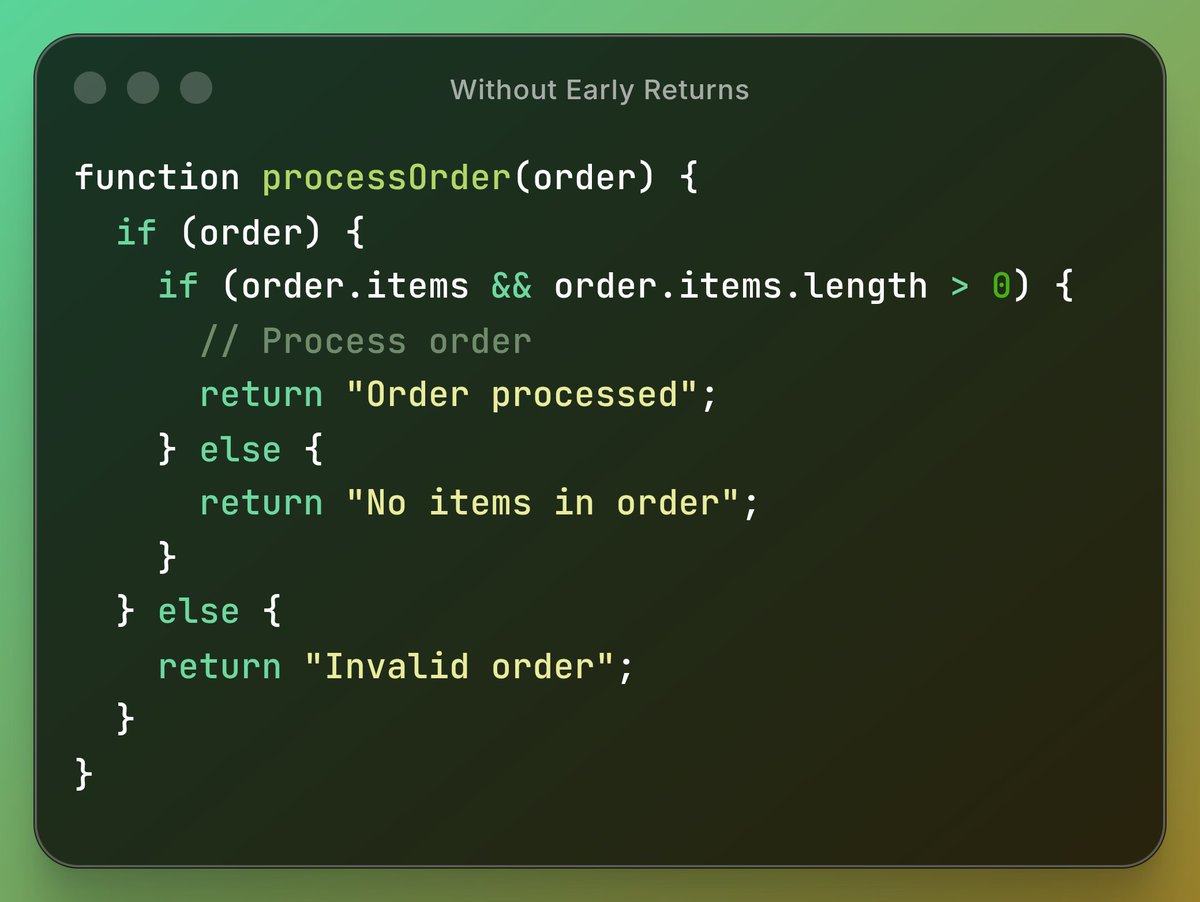
Honestly, every dev should always take advantage of "early returns".
It's a simple pattern with some important benefits:
- it prevent the function from doing unnecessary work (early exit)
- you can return results early as soon as the conditions are met
- the function becomes more readable
- when you handle errors and null cases at the start of the function, it reduces any cognitive load
"My name's Raymond. I'm 73. I work the parking lot at St. Joseph's Hospital. Minimum wage, orange vest, a whistle I barely use. Most people don't even look at me. I'm just the old man waving cars into spaces.
But I see everything.
Like the black sedan that circled the lot every morning at 6 a.m. for three weeks. Young man driving, grandmother in the passenger seat. Chemotherapy, I figured. He'd drop her at the entrance, then spend 20 minutes hunting for parking, missing her appointments.
One morning, I stopped him. "What time tomorrow?"
"6:15," he said, confused.
"Space A-7 will be empty. I'll save it."
He blinked. "You... you can do that?"
"I can now," I said.
Next morning, I stood in A-7, holding my ground as cars circled angrily. When his sedan pulled up, I moved. He rolled down his window, speechless. "Why?"
"Because she needs you in there with her," I said. "Not out here stressing."
He cried. Right there in the parking lot.
Word spread quietly. A father with a sick baby asked if I could help. A woman visiting her dying husband. I started arriving at 5 a.m., notebook in hand, tracking who needed what. Saved spots became sacred. People stopped honking. They waited. Because they knew someone else was fighting something bigger than traffic.
But here's what changed everything, A businessman in a Mercedes screamed at me one morning. "I'm not sick! I need that spot for a meeting!"
"Then walk," I said calmly. "That space is for someone whose hands are shaking too hard to grip a steering wheel."
He sped off, furious. But a woman behind him got out of her car and hugged me. "My son has leukemia," she sobbed. "Thank you for seeing us."
The hospital tried to stop me. "Liability issues," they said. But then families started writing letters. Dozens. "Raymond made the worst days bearable." "He gave us one less thing to break over."
Last month, they made it official. "Reserved Parking for Families in Crisis." Ten spots, marked with blue signs. And they asked me to manage it.
But the best part? A man I'd helped two years ago, his mother survived, came back. He's a carpenter. Built a small wooden box, mounted it by the reserved spaces. Inside? Prayer cards, tissues, breath mints, and a note,
"Take what you need. You're not alone. -Raymond & Friends"
People leave things now. Granola bars. Phone chargers. Yesterday, someone left a hand-knitted blanket.
I'm 73. I direct traffic in a hospital parking lot. But I've learned this: Healing doesn't just happen in operating rooms. Sometimes it starts in a parking space. When someone says, "I see your crisis. Let me carry this one small piece."
So pay attention. At the grocery checkout, the coffee line, wherever you are. Someone's drowning in the little things while fighting the big ones.
Hold a door. Save a spot. Carry the weight no one else sees.
It's not glamorous. But it's everything."
Let this story reach more hearts....
Credit: Mary Nelson
50 things I learned in the last 2 years
1. Be very specific when returning data from the database. Don’t blindly select all fields. Only return what’s needed.
2. Many people get way further ahead in life than you with fewer skills simply because they have the courage to try.
3. Communication is important in remote teams. Share progress, thoughts, questions, feedback, and memes. Over communicate.
4. Pick mature tools. Don't fall for the hype.
5. Low self-esteem and overthinking kill more dreams than anything.
6. Your family are the only ones who truly care about you.
7. AI is good and useful, but nowhere near the hype people create around it. 99.9% of the people hyping it are content creators that only create demos.
8. It's your responsibility to draw eyes to your work.
9. Quitting is not shameful. Knowing when to quit things is a superpower.
10. Don't wait to get laid off to prepare. Start interviewing, build some apps, and create a few pieces of content.
11. Social media is fake.
12. Nobody is going to save or push you. If you want to do something, you have to push yourself.
13. Go all in on your strengths rather than trying to fix your flaws.
14. Money brings happiness. Better healthcare. Better food. Better opportunities. Better future for your family.
15. Self-hosting apps is not that scary.
16. Good sleep is the most important thing for a healthy and productive life.
17. Hustle culture is bad. You can push your body to the limits when you're young, but you'll get the bill when you get older.
18. You only have a handful of friends.
19. Not all battles need to be won.
20. Being likeable can take you further than being smart.
21. If you get placed on PIP, start interviewing ASAP.
22. It's easier to make more money than to save money.
23. Children bring a whole new meaning to life.
24. Listen to your gut feeling.
25. Call your parents.
26. Don't let AI do the thinking for you.
27. When you get tired, rest. Don't quit.
28. Don’t compare yourself to others. It’s poison for your soul.
29. Try to write more.
30. Developers are obsessed with over-optimizing for imaginary scenarios.
31. Coding from books and tutorials is one thing, coding in real life is another.
31. Ship fast, but not at the expense of security.
33. Everything passes.
34. Don't get too cocky when you're on top, and don't be too demoralized when everything goes against you.
35. Donate to open-source.
36. Become friends with people who are already where you want to be. Or, at least, closer than you.
37. Employment is fine. There are some really cool jobs. Not everyone is made to be an entrepreneur.
38. Waking up early is the only productivity "trick" that works.
39. Companies don't care about you. They’ll throw you out without thinking twice when you’re no longer useful to them.
40. Multitasking doesn't exist.
41. JavaScript gets a lot of hate, but you can bet on it.
42. Donations don't work. Monetize your knowledge & work.
43. Sitting is the new smoking. Use proper ergonomic equipment. Stand up more often. Exercise. Eat healthier.
44. People love to give advice. Discard advice from people who are not "in the arena". It's easy to give advice from the sidelines.
45. It's more important than ever to be a competent developer.
46. Building your own side projects and releasing them to the public will teach you more than any job or course.
47. You only have "now". Not yesterday, not tomorrow.
48. Just start.
49. Only collaborate with companies that pay upfront.
50. AI is not smarter than you. Just faster.