Maybe very little folks noticed that DS4 supports both generating the refusal vector (or whatever behavior vector you can extract with prompt pairs) and then applying it with different strengths to the model activations at runtime.
How have the fundamentals of building large, distributed software systems changed the last decade? A conversation with Martin Kleppmann (author of Designing Data-Intensive Applications) - given that the second, updated edition of the book was just released.
Timestamps:
00:00 Early career
05:46 Building Rapportive
10:47 Working at LinkedIn
14:09 Writing Designing Data-Intensive Applications
23:00 Reliability, scalability, and repeatability
26:24 DDIA: the second edition
30:50 Tradeoffs of using cloud services
39:02 How the cloud changed scaling
42:53 The trouble with distributed systems
49:02 Ethics for software engineers
52:45 Formal verification
1:00:12 Academia vs. industry
1:03:50 Local-first software
1:09:50 Computer science education
1:18:32 Martin’s current research and advice
Brought to you by:
• @statsig – The unified platform for flags, analytics, experiments, and more. https://t.co/ZCSOIcWv31
• @SonarSource – The makers of SonarQube, the industry standard for code verification and automated code review. Check out Sonar's new architecture management capabilities that ensure both humans and AI agents respect your system’s blueprint. https://t.co/3Rycx5lfXE
• @WorkOS – Ship enterprise features – SSO, directory sync, RBAC, audit logs – in days, not months. https://t.co/Xxf2A82ixc
Three things worth considering, as discussed with Martin, in this episode:
1. Multi-region and multi-cloud are risk/cost trade-offs, not best practices.
Martin does not believe that there is a “best practice” in deciding whether to go multi-region or multi-cloud. This decision is a tradeoff between risk and costs. It’s a business decision to be made. Designing Data-Intensive Applications gives engineers the vocabulary to articulate the tradeoffs, not to dictate answers.
2. Replication for fault tolerance is more relevant for most engineers these days than sharding.
Though the book has a full chapter on sharding, Martin said that the cloud has reduced the need for manual sharding for the majority of teams. This is also because machines are increasingly bigger, and more workloads fit on a single machine. Sharding across machines is increasingly a specialist concern; replication for fault tolerance, however, is still relevant at every scale.
3. Knowing system internals as a superpower for application developers.
Martin maintains that Designing Data-Intensive Applications is not a book for people who build databases or even infrastructure, but it’s helpful for application developers to develop an intuition for making good design decisions and debugging performance issues we will eventually encounter.
In the next months I'll provide you with a Hacker News replacement that I'll run myself and I'll guarantee personally: no benefit for whatsoever individual, a team of 10/20 persons since the start, from different time zones, clear rules, total transparency, and a "karma" system. I really want to fix HN and provide something that is not bound to a specific company.
HN shadowbanning is always cool. 6 upvotes in 17 minutes but no way it can reach the home page, while 4 votes in 25 minutes is there. Note that I don't ping any friend when I post, so all the votes I receive are spontaneous. Yet... Moderation system and broken algorithms are part of HN decline.
And... the controller behavior was completely emulated and the Unix now boots. I want to dedicate this login screen to all the folks that claimed when it was already clearly nonsensical (at least since the first GPT3 version) that LLMs emitted "plausible language".
Hi friends, this summer I published my latest sci-fi short story with Urania-Mondadori. I attempted to translate it in English, for the potential English speaking readers here, and I believe the result is truthful to the original. This is the ePub file.
https://t.co/ucdPFIV5ao
Yo, @marcelotryle just released Starlette 0.47 while @pyconit with support for ASGI pathsend.
What does this mean? It means if you use Granian to serve your app, you're now 3.6x faster on static files, for free 🚀
Looking forward for a new FastAPI release @tiangolo 👀
The IEEE republished a lightly edited version of my recent essay, "In Praise of 'Normal' Engineers". 🙌 https://t.co/zvLUXAOEwn
The greatest engineering orgs in the world are not the most pedigreed, but the ones where normal engineers can move the business forward every day.
it's been 5 years but i still think about the debugging interview i had @stripe. interviewer opened github, showed me an issue for a bug in Preact, and i had to debug and fix. it was fun and still probably one of my favorite interviews that i've done.
While still quite experimental, the first release of RLoop – an #asyncio event loop for #python built with #rust – is now available 🎉
Looking forward to feedback from the ones willing to test it :)
https://t.co/uiTO24YGs1
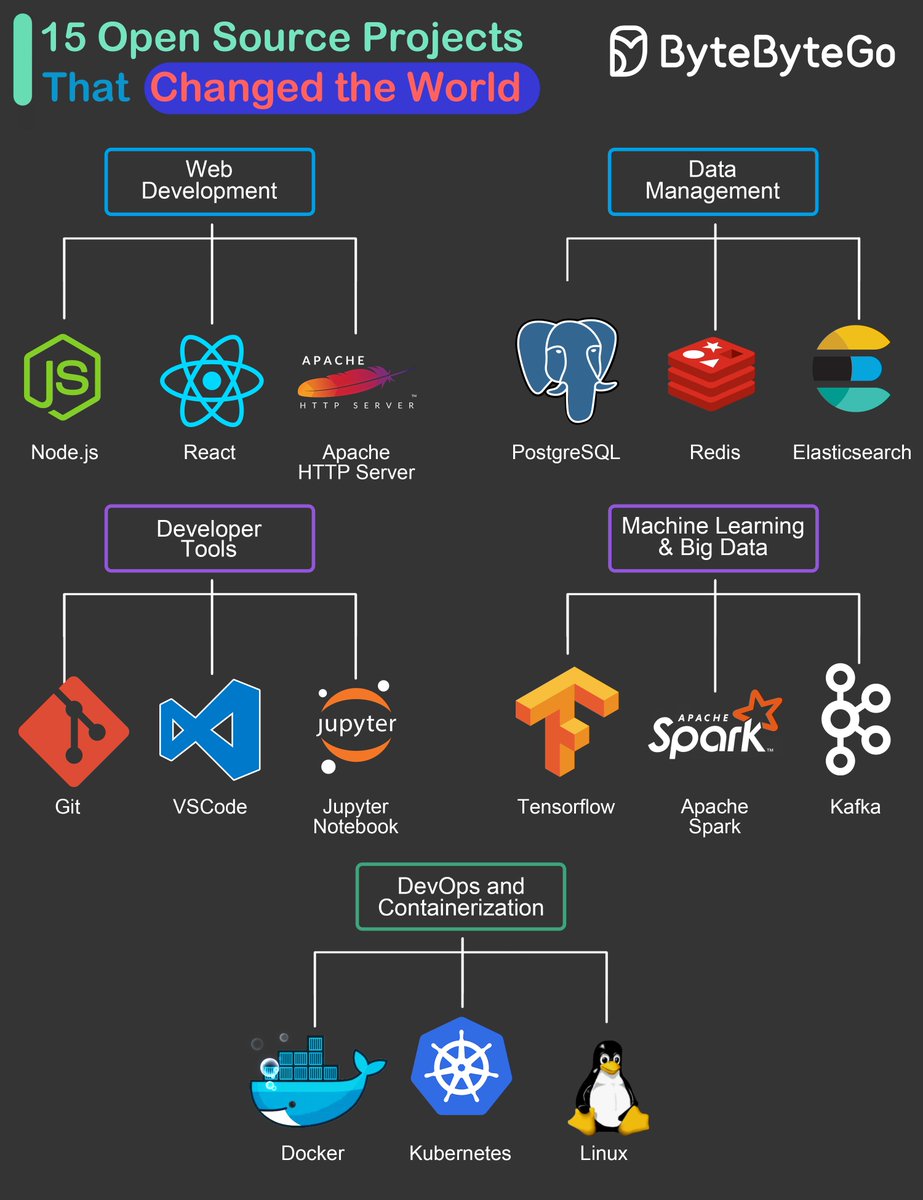
15 Open-Source Projects That Changed the World
To come up with the list, we tried to look at the overall impact these projects have created on the industry and related technologies. Also, we’ve focused on projects that have led to a big change in the day-to-day lives of many software developers across the world.
Web Development
- Node.js: The cross-platform server-side Javascript runtime that brought JS to server-side development
- React: The library that became the foundation of many web development frameworks.
- Apache HTTP Server: The highly versatile web server loved by enterprises and startups alike. Served as inspiration for many other web servers over the years.
Data Management
- PostgreSQL: An open-source relational database management system that provided a high-quality alternative to costly systems
- Redis: The super versatile data store that can be used a cache, message broker and even general-purpose storage
- Elasticsearch: A scale solution to search, analyze and visualize large volumes of data
Developer Tools
- Git: Free and open-source version control tool that allows developer collaboration across the globe.
- VSCode: One of the most popular source code editors in the world
- Jupyter Notebook: The web application that lets developers share live code, equations, visualizations and narrative text.
Machine Learning & Big Data
- Tensorflow: The leading choice to leverage machine learning techniques
- Apache Spark: Standard tool for big data processing and analytics platforms
- Kafka: Standard platform for building real-time data pipelines and applications.
DevOps & Containerization
- Docker: The open source solution that allows developers to package and deploy applications in a consistent and portable way.
- Kubernetes: The heart of Cloud-Native architecture and a platform to manage multiple containers
- Linux: The OS that democratized the world of software development.
Over to you: Do you agree with the list? What did we miss?
–
Subscribe to our weekly newsletter to get a Free System Design PDF (158 pages): https://t.co/eVEdOFSYPY
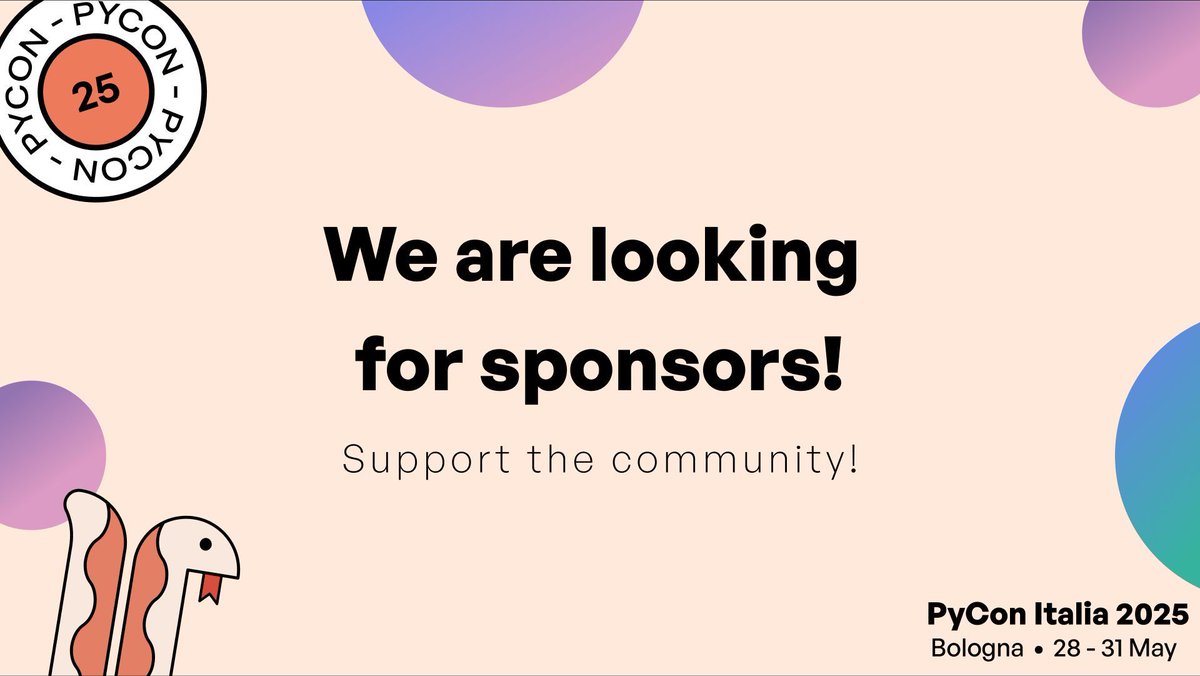
We are looking for sponsors!
Reaching out to your company about sponsoring PyCon Italia is a great way to support the community and help keep the conference accessible to everyone! 🙌
Get the brochure: https://t.co/rtIxvGPAmQ
#PyConIT2025