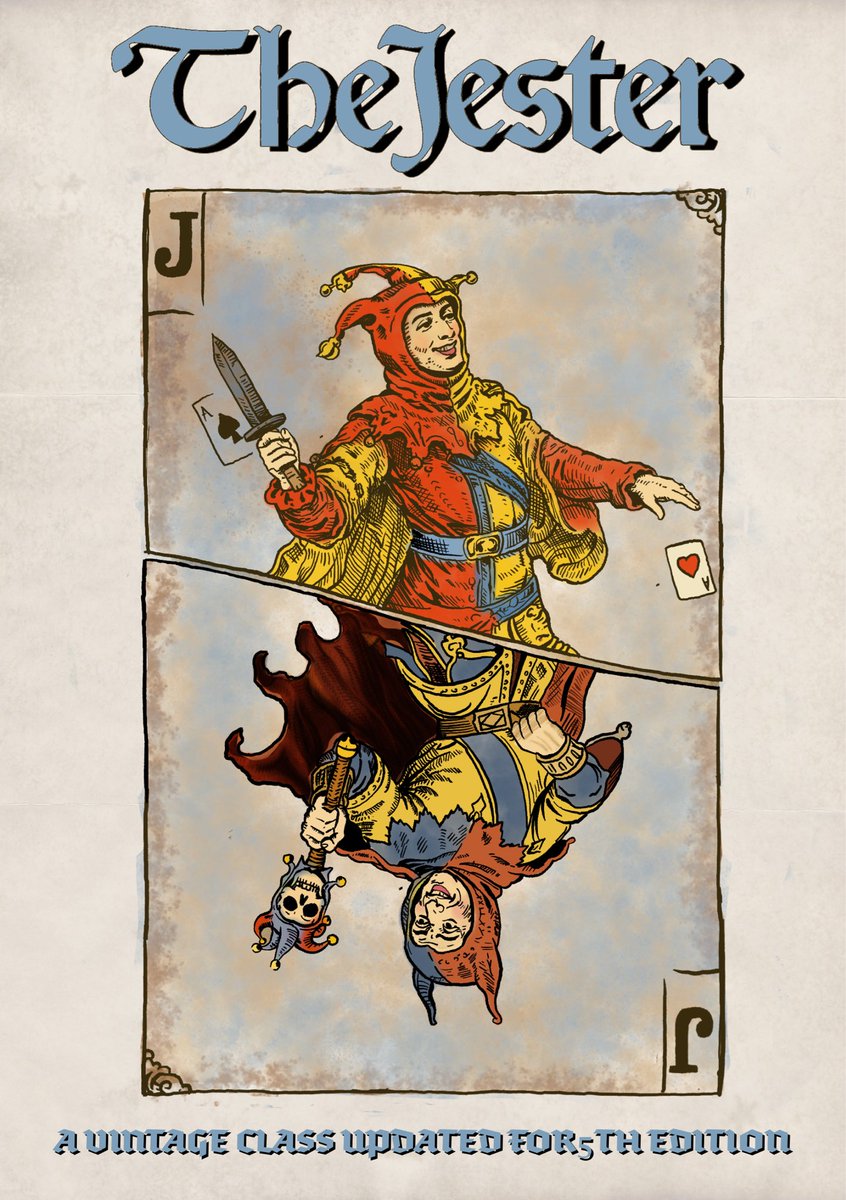
The 5e Jester is out.
Non-magical. Reaction-driven. Built around misdirection and punishing bad decisions.
• 2 classes,
• 2 subclasses
• 2 magic items
• 6 Jester Troupes
• Jester Troupe Generator
PWYW!
https://t.co/i42FIeTxN4
If you’re gonna get out of that dungeon alive, you gotta keep your wits sharp and your pencil sharper! The Strongheart pencil sharpener from TSR and Larami, 1983.
The subterranean lake water rippled as the drow rogue began dashing toward the raised exit on the other side. Suddenly a massive cave shark leapt from the deep, grasping him in its jaws and submerging into the depths. At that same moment, an Erinyes maiden descended from the inky heights and demanded that they venture no further, for they were in the domain of Primus. Luckily Shagrim and a lone barbarian, Tallbeard, had discovered the door to the other end of the watery chamber and beckoned the hostage group their way. The handsome tiefling wooed the comely shedevil, convincing her he needed the others alive for scientific experiments. As the romantic antics worked their charm, Bond escaped the death grip of the shark and he and the others moved toward the exit. Azzagh, a chieftain of great pride, refused to comply. The vengeful deviless beheaded him for his insolence. Eventually the group escaped, finding themselves emerging from a dead tree, 650 ft. from Iserem. A war wagon full of guards began hunting them down, but with Tallbeard’s unpredictable magics, Leif’s aim, Chance’s beguiling tunes, Shagrim’s playboy nature, and Bond’s survivability, the group somehow managed to prevail and make headway towards the forests north of the tower.
•FAUCETS & SINKS• A major game design concept, infrequently mentioned in TTRPG circles, involves tracking the flow of energy through a system over time. This is accomplished via faucets (wells of energy) and sinks (consumers of energy). Systems with faucets that are too generous will feel oversaturated, unbalanced and overwhelming quickly, because scarcity hones system users’ attention and too much abundance creates apathy. This is typically combatted by forming new sinks, or implementing ascension arcs (technology trees, better units, new abilities). If sinks are too numerous or ravenous, actions will begin to flatten out and minimize, as the system has insufficient user inputs, very similar to how soldiers on restricted diets become sluggish. Games combat this by including more faucets, or by creating actions that are not directly energy dependent (cantrips, basic attacks). One of the big problems in D&D design is the idea that more is always more and the failure to understand that packing on additional abilities, actions, and energy will often undermine the game. OSR suffers the inverse issue, and falls for the trap of thinking less is always more, often not noticing when the system has created PC’s so fragile that drama suffers from caution and storyline continuity suffers from stuffed graveyards. You might think such considerations are the problem of big wigs in a Seattle office, but the truth is, Dungeon Masters should be vigilant regarding what is pumping energy into their system and what is draining it. Every DM has had that campaign where the PC’s have so much gold that they’re spending like Jeff Bezos, and you realize in a moment of horror that these guys haven’t paid for a meal or lodging, or fixed up supplies in 10 years. Notice your sinks, notice your faucets, it’s time to get to plumbing.
I4 Oasis of the White Palm, by Philip Meyers and Tracy Hickman, 1983. The second part of the trilogy including Pharaoh, and Lost Tomb of Martek that sees the characters helping out with yet another kidnapping, acquiring three Star Gems and freeing a djinni.
Epic Illustrated, issue 21, features cover art by George Bush, and contributions from Pepe Moreno, Archie Goodwin, Dave Cockrum and a host of other talented writers and artists.
•AMON HEN• Weathertop has always been one of my favourite battle sites in LOTR, but I am convinced that Amon Hen may be one of the most ingenious designs for a battle terrain centrepiece to grace the hobby to date. The structure at the site’s summit is called the Seat of Seeing, and provides a vantage across Gondor. All it consists of is a two storey structure on a forested hill with a unwalled second floor containing a large statue on it. Yet, this is such a powerful use of surface area—those on the ground have trees to cover their approach and can eventually make a break for the pillared underside. Those above are exposed but can use the statue as cover and the stairway’s mouth as a makeshift barrier. If the stairs are too heavily guarded for either the attacker or defender, boosting or climbing up is viable, as is jumping down. I am a lousy terrain crafter but I’ve always wanted to use a high point like Amon Hen for a hold out mission, sending waves of monsters against a party as they prepare for extraction.
Dragon Magazine, issue 86, features epic cover art by Den Beauvais, the ecology of the slithering tracker, familiars, enchanted items, the Suel pantheon for Greyhawk, dragon deities, a papercraft castle, and a new Wormy.
Shagrim approached the gates of Iserem, eagerly anticipating payment for his pristine urine samples. He found the building in lockdown. Benjamin had ordered the basement be sealed and stationed two squadrons of guards to prevent the escape of Azzagh and his compatriots. Despite bargaining with Leif, no progress was made: they would not surrender Gal, daughter of the Green Knight. The party scoured the basement for an exit and came across coffins incubating clones. The guild had been making copies of them. Eventually they located a hatch, thanks to Chance befriending an Oaf working in the complex. They ventured below, fighting a Leucrotta, and heading towards a passage out. However, Azzagh realized too late that he had left his clone above. Gal was sent to retrieve it, but alerted the guards and was never heard from again. Now the group races across a subterranean lake, trying desperately to alert the Gehn forces before the Crown can act!