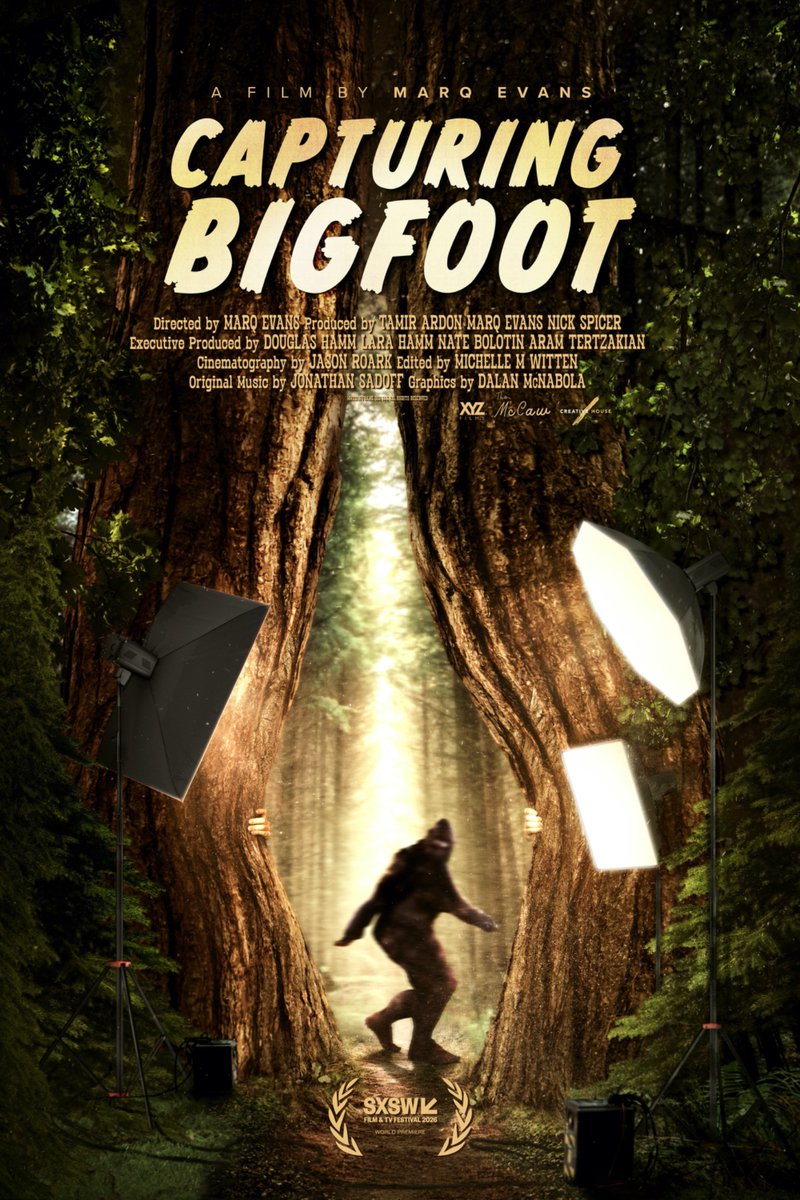
Bugs’ Lucky Capture Hypothesis: Reconciling the Patterson-Gimlin Film with the New Footage from Capturing Bigfoot
With all the recent discussion around the new footage in Capturing Bigfoot, I’ve been wrestling with how it relates to the Patterson-Gimlin Film (PGF).
As a Bigfoot experiencer, I start from the position that Sasquatch are real. At the same time, the biomechanical and forensic evidence has long convinced me that the figure in the PGF — known as Patty — is a genuine living hominid, not a suit.
The big question has been: if the PGF is authentic, what exactly is this newly revealed clip? Here’s my hypothesis:
The PGF captured one extraordinarily lucky daytime moment with a real creature (Patty), while the new footage appears to be a post-1967 human attempt to study and replicate her distinctive walk for potential follow-on projects. I build directly on Bill Munns’ forensic film analysis and add the human motivation layer.
I’m open to respectful discussion — let’s examine the evidence together.
The Lucky Capture Hypothesis
Core Premise
On October 20, 1967, at Bluff Creek, California, Roger Patterson and Bob Gimlin opportunistically filmed a real female Sasquatch — known as Patty — walking calmly away with her natural over-the-shoulder glance. As a Bigfoot experiencer, I accept that Sasquatch are real, intelligent, and elusive biological beings.
The Patterson-Gimlin Film captures one extraordinarily lucky daytime moment of a living relict hominid. Patty’s fluid muscle rippling under the skin, independent breast motion, concave armpit fold, unique conical head shape with sloping brow-to-back profile, compliant gait with a mid-tarsal break, seamless neck rotation, and non-human proportions remain impossible for 1960s suit technology.
These details, supported by photogrammetry, gait analysis, and expert comparisons, mark the PGF as authentic biology rather than fabrication. Same-day footprints with dermal ridges provide independent physical corroboration.
The New Footage (NF) in Capturing Bigfoot
The ~40-second clip, shot on 1966-manufacture Kodachrome II stock, shows a skinnier suited figure in the woods with a horseback rider resembling (but not necessarily being) Gimlin. The documentary presents this as a pre-1967 “dress rehearsal” proving a premeditated hoax.
Building directly on Bill Munns’ forensic analysis — after he physically examined the camera-original processed film — the NF is clearly a human suit with obvious tells: unnaturally white feet that don’t tone-match the ground like Patty’s, a cruder head shape, and inferior overall dynamics. Yet the gait (stride, arm swing, head turn, raised-foot sole display, and compliant flex) is too identical to Patty’s to be coincidence.
This points to deliberate post-PGF copying: someone studied the authentic footage frame-by-frame and trained to replicate her distinctive locomotion. Munns’ technical foundation is the starting point; what follows is my extension exploring the very human motivations behind it.
The Human Opportunism — Raw and Unflattering
Roger Patterson was the passionate showman with big documentary and feature-film dreams while facing terminal cancer. Al DeAtley was the wealthy, profit-minded brother-in-law and business partner who provided financial backing and reportedly expressed initial skepticism. After the lucky real capture, they didn’t stop at celebration. They saw the raw, shaky PGF as proof-of-concept but not polished enough for sustained success.
In classic flawed human nature — mixing ambition, greed, and opportunism — they used Patty’s gait and movement as the ultimate reference blueprint to test whether they could manufacture believable replicas. The NF was the proof-of-concept prototype, shot after 1967 and processed discreetly. It was designed to answer practical (and cynical) questions: Could they create controlled docudrama B-roll? Could they produce smoother, multi-angle promotional footage? And, more ambitiously, could they stage follow-on “encounters” or films convincing enough to keep generating revenue, lectures, licensing, and legacy for years?
With the real McCoy as template, upgraded reels could become the “best hoax ever” — reverse-engineered from actual biology and locomotion. This was not pure scientific pursuit; it was entrepreneurs spotting a once-in-a-lifetime opportunity and scheming how to maximize it financially and personally.
Why the Plan Never Fully Panned Out
The NF was developed and reviewed, but real-life friction intervened. According to accounts, Norm Johnson’s wife saw the obvious replica footage (with its suited figure mimicking Patty’s gait) and feared it could implicate her husband in fraud accusations if ever linked to the promoted-as-real PGF. She reportedly ordered it locked away in the safe.
Patterson died in 1972, removing the driving visionary. Legal rights disputes piled up, and once the original PGF began generating steady licensing income, the incentive to risk new material diminished. The canister remained sealed for decades until rediscovered after Johnson’s death and shared for the documentary.
Why This Hypothesis Holds
Building on Munns’ forensic work while adding the motivational layer, the Lucky Capture Hypothesis turns the new footage from a perceived threat into indirect support for Patty’s authenticity. Humans could copy the visible walk with direct reference material, but they still couldn’t replicate the underlying biology.
Burned-suit stories, family recollections, and the horseback staging all fit naturally as elements of post-capture replication experiments rather than proof the PGF itself was faked.
No grand conspiracy is required — just unflinching human nature. When flawed, ambitious people receive a genuine lucky capture on film, greed and opportunism often ride shotgun. The PGF remains powerful corroborative evidence of a real Bigfoot. The Lucky Capture Hypothesis simply explains the cynical human drama that tried (and ultimately failed) to build a longer-lasting revenue stream on top of that lucky moment.
The figure in the mystery footage is called “Norma” because the Capturing Bigfoot team named her after Norm Johnson — the Boeing film-lab employee who kept the 1966 reel locked in his safe for decades. Just as Patty takes her name from Patterson, Norma takes hers from Norm. The strong implication is that Johnson, with his film-processing access at Boeing, was involved on the side, which is why the footage ended up with him and stayed hidden until now.
An Ongoing Look at the Patterson-Gimlin Film Timeline
Milestone: Roger’s Pre-Patty Filming
I’ve been looking at the work Roger was doing before Bluff Creek. Skeptics point to his earlier artwork like the William Roe female Bigfoot drawing in his 1966 book, his documentary ambitions, and the Norma footage as evidence he was already staging what became the Patterson-Gimlin Film. The claim is that these pieces prove the October 20 sequence was planned.
The record shows he was filming a docudrama in May and June 1967 — cowboys, an old miner, a Native tracker, hunting Bigfoot. Bill Munns examined roughly 550 feet of that material. Some was shot on cameras other than the Cine-Kodak K-100 used at Bluff Creek; the aperture notches differ. Munns has specifically flagged one of those earlier rolls (Example #4 in his technical report) as showing a different aperture signature from the K-100, which further separates that footage from the camera that shot the Bluff Creek sequence. Other frames from the same period carry the K-100 notch. He was using multiple cameras on an ongoing project.
The Norma reel is separate. It is Kodachrome II with a 1966 manufacture code, shot on a K-100. Charles Pickle, who appeared in Capturing Bigfoot, has offered a film-condition opinion placing a possible exposure window between summer 1966 and summer 1967. Manufacture date is not shooting date, and no rental or personnel link ties it to the May 1967 Sheppard’s camera. The documentary frames it as a deliberate test film studied for flaws before Bluff Creek — echoing a 1979 letter from Peter Byrne. The footage has not, to my satisfaction, been shown to match the Bluff Creek sequence in suit morphology or gait in the way a rehearsal would require.
A Lucky Capture reading does not require that Roger had no prior interest, drawings, documentary plans, or other footage. It only requires that the October 20 sequence itself was unplanned. Prior work is consistent with someone already looking and filming. It becomes evidence of a hoax only if tied to a planned staging of the specific Bluff Creek event — same camera, same suit, same controlled setup. That link has not been established in the public record.
The gaps remain: exact dates and cameras for the earlier rolls, any connection between the Norma reel and the May rental, and whether any of it was intended as a rehearsal. Those points would need tighter documentation before the prior filming could be read as proof of a staged capture.
Please let me know what you think below 👇 Civil discussion is open and appreciated! Add details I’ve missed so we can get a clearer picture of what the public record shows. Does the pre-Patty work reveal a staged October 20 Patty sequence or does it simply show that Roger was active in the woods with a camera? 🎥
Is Bigfoot Cain?
A tall, dark-skinned, hair-covered wanderer told an LDS apostle in 1835 that he was. He said he could not die and that his mission was to destroy souls.
The Bigfoot connection came later.
“He Wore No Clothing, But Was Covered with Hair” — An 1835 Bigfoot Encounter?
A folk belief held by certain Latter-day Saints links Bigfoot to Cain, the biblical figure cursed to wander the earth after murdering Abel.
It traces to an account by early LDS apostle David W. Patten. While riding a mule in Tennessee in 1835, he described meeting a strange personage. The story was later recalled by Abraham O. Smoot, who heard it directly from Patten the same evening, and was published in Lycurgus A. Wilson’s 1900 biography of Patten. Spencer W. Kimball later quoted it in The Miracle of Forgiveness.
Smoot recorded Patten’s description this way:
“As I was riding along the road on my mule I suddenly noticed a very strange personage walking beside me. He walked along beside me for about two miles. His head was about even with my shoulders as I sat in my saddle. He wore no clothing, but was covered with hair. His skin was very dark. I asked him where he dwelt and he replied that he had no home, that he was a wanderer in the earth and traveled to and fro. He said he was a very miserable creature, that he had earnestly sought death during his sojourn upon the earth, but that he could not die, and his mission was to destroy the souls of men. About the time he expressed himself thus, I rebuked him in the name of the Lord Jesus Christ and by virtue of the Holy Priesthood and commanded him to go hence, and he immediately departed out of my sight.”
Patten told the family the being had represented himself as Cain. The description of a tall, hair-covered, dark-skinned wanderer who could not die eventually connected to Bigfoot in Mormon circles, especially after a cluster of sightings in South Weber, Utah, in 1980.
The LDS Church takes no official position on Bigfoot or on Cain’s ongoing fate. Most who know the story today treat it as interesting cultural folklore or a campfire tale rather than doctrine.
For the record, I don’t believe Bigfoot is Cain no more than I believe their entire species are the Nephilim. But the original encounter account is fascinating, and the way it traveled into cryptozoological lore is worth knowing.
What do you make of it?
@wired4wonder I've never known what to think of this case because I never got a UFO/alien vibe from it. It felt more like creatures from another dimension or reality to me.
(BTW, I love your rebranding!)
“He Wore No Clothing, But Was Covered with Hair” — An 1835 Bigfoot Encounter?
A folk belief held by certain Latter-day Saints links Bigfoot to Cain, the biblical figure cursed to wander the earth after murdering Abel.
It traces to an account by early LDS apostle David W. Patten. While riding a mule in Tennessee in 1835, he described meeting a strange personage. The story was later recalled by Abraham O. Smoot, who heard it directly from Patten the same evening, and was published in Lycurgus A. Wilson’s 1900 biography of Patten. Spencer W. Kimball later quoted it in The Miracle of Forgiveness.
Smoot recorded Patten’s description this way:
“As I was riding along the road on my mule I suddenly noticed a very strange personage walking beside me. He walked along beside me for about two miles. His head was about even with my shoulders as I sat in my saddle. He wore no clothing, but was covered with hair. His skin was very dark. I asked him where he dwelt and he replied that he had no home, that he was a wanderer in the earth and traveled to and fro. He said he was a very miserable creature, that he had earnestly sought death during his sojourn upon the earth, but that he could not die, and his mission was to destroy the souls of men. About the time he expressed himself thus, I rebuked him in the name of the Lord Jesus Christ and by virtue of the Holy Priesthood and commanded him to go hence, and he immediately departed out of my sight.”
Patten told the family the being had represented himself as Cain. The description of a tall, hair-covered, dark-skinned wanderer who could not die eventually connected to Bigfoot in Mormon circles, especially after a cluster of sightings in South Weber, Utah, in 1980.
The LDS Church takes no official position on Bigfoot or on Cain’s ongoing fate. Most who know the story today treat it as interesting cultural folklore or a campfire tale rather than doctrine.
For the record, I don’t believe Bigfoot is Cain no more than I believe their entire species are the Nephilim. But the original encounter account is fascinating, and the way it traveled into cryptozoological lore is worth knowing.
What do you make of it?
Headquarters had moved from New York to Kirtland, Ohio by early 1831 and remained there through 1835. Patten was ordained an apostle in Kirtland that February and was on a mission in the Paris, Tennessee area in the fall of 1835, preaching and helping establish new branches when the encounter is reported to have happened.
A dash cam, a rural road, and a figure that doesn’t look like a costume.
Late night, May 16, 2009, Lumpkin County, Georgia. A sheriff’s deputy is driving about 55 mph on a curvy rural road in the Frogtown area near the Chattahoochee National Forest. A civilian passenger is with him. Something large and dark bursts from the right and crosses directly in front of the patrol car. The deputy hits the brakes.
The audio is raw: “What the crap? What was that? Did you see that?” “Yes.” “Holy crap. What the heck was that?” “That was on 2 feet, wasn’t it?” “Yeah.” “Oh my goodness.”
They stop and search. The passenger reports the figure still moving back and forth off the road as the deputy scans with his light. The grainy video shows a tall upright walker crossing past the guardrail in long, fluid strides. Enhancements make the arm swing and gait clearer — the kind of movement that does not match a typical costume or a bear.
The sheriff later called it a hoax — two college kids in a gorilla suit. On a night that wasn’t Halloween, and with no photos or confessions to back it up, that explanation still has to carry the whole clip. North Georgia has a long history of reports. This one is fleeting, but the dash cam and the unscripted audio make it harder to dismiss than most.
What holds for me is the combination of those genuine reactions and the morphology. Two people who weren’t looking for Bigfoot that night sound genuinely alarmed. The figure is clearly bipedal, furry, and covering serious ground in a couple of seconds.
Where do you land — hoax, misidentified animal, or real Bigfoot in the headlights? 👇
#Bigfoot #Sasquatch
Did Meldrum Dump Patty?
That’s the claim some have floated after Marq Evans and Tamir Ardon showed him their mystery footage in November 2024 — that he knew the truth and no longer treated the Patterson-Gimlin Film as genuine.
The later record doesn’t support it.
In the April 2025 Backcountry Manifesto interview — roughly five months after that session — Meldrum walks through the biomechanics of the Bluff Creek trackway and the film itself with the same analytical posture he had used for years. He refers to the subject as “Patty” without qualification.
“…I’m quite confident in what I’ve described to you because you can watch it take place in the foot of Patty on the film. You can see her heel come up first and almost reach verticality. And if it was a stiff artificial foot, a rigid prosthetic, then the rest of her foot, given the orientation of the heel, would have to stick eight inches straight into the ground. But it’s not, you know. It’s just bent. It’s flexed, and that’s what we call the mid-tarsal break. … And that is the most fundamental distinction between a Sasquatch footprint and the human footprint.”
That is not the language of someone who had abandoned the film or Patty herself. It is the language of someone still treating it as a usable record of real anatomy and gait. The mid-tarsal break he points to on screen is the same feature he had long argued was difficult to reconcile with a costume or a stiff artificial foot.
Whatever Meldrum’s private reaction was in the moment — and the reports of discomfort about how the material was presented to him are relevant context — the subsequent public record does not support the claim that he gave up on the Patterson-Gimlin Film. He continued to analyze Patty as a genuine primate subject. The charge that he “knew the truth” and walked away from the film is difficult to square with the interview he gave afterward.
@MyMusicXMeMusic@BobRusbasan I consider that idea to be high heresy, but I wouldn't block you for considering it. I prefer being friendly and civil with everyone. None of us has all the answers.
The producers place the Meldrum screening in 2024. Their YouTube Short description states it directly:
“In making CAPTURING BIGFOOT, we had the honor of spending time with the late Dr. Jeff Meldrum – one of the most distinguished and credible names in the Bigfoot research field.
While filming in 2024, we showed him the now-infamous 1966 Norm Johnson mystery footage featuring the Norma creature. This clip from the film features his reaction to seeing the footage, filmed the day after we shared it with him for the first time.”
https://t.co/07cZTP7Vny
I’ll still dig on where I heard the more specific November date.
And isn't it scary that Gemini is quoting my post as a source? Yikes!!!
@MyMusicXMeMusic That reminds me of something I found sad. There was a guy who used to interact with me here and he blocked me presumably because I wouldn't go along with this view that Bigfoot are evil Nephilim. People who can't handle civil disagreement disappoint me.