AUREON UI Tutorial: How Do You Know a Transaction Really Happened?
A transaction record is a starting point. You still need to verify what happened on-chain.
In this tutorial, see how to:
→ Find an action in AUREON’s timeline
→ Open its transaction details and locate the hash
→ Check the transaction status, block, timestamp, and tokens
→ Search the hash on Robinhood Chain Explorer
→ Compare the on-chain record with AUREON’s transaction details
Don’t just trust the record. Check the proof on-chain.
More AUREON UI tutorials coming soon.
$AUREON
@Chainriffs Generational wealth needs more than tokens. AUREON is building the financial intelligence that helps AI agents manage capital with purpose.
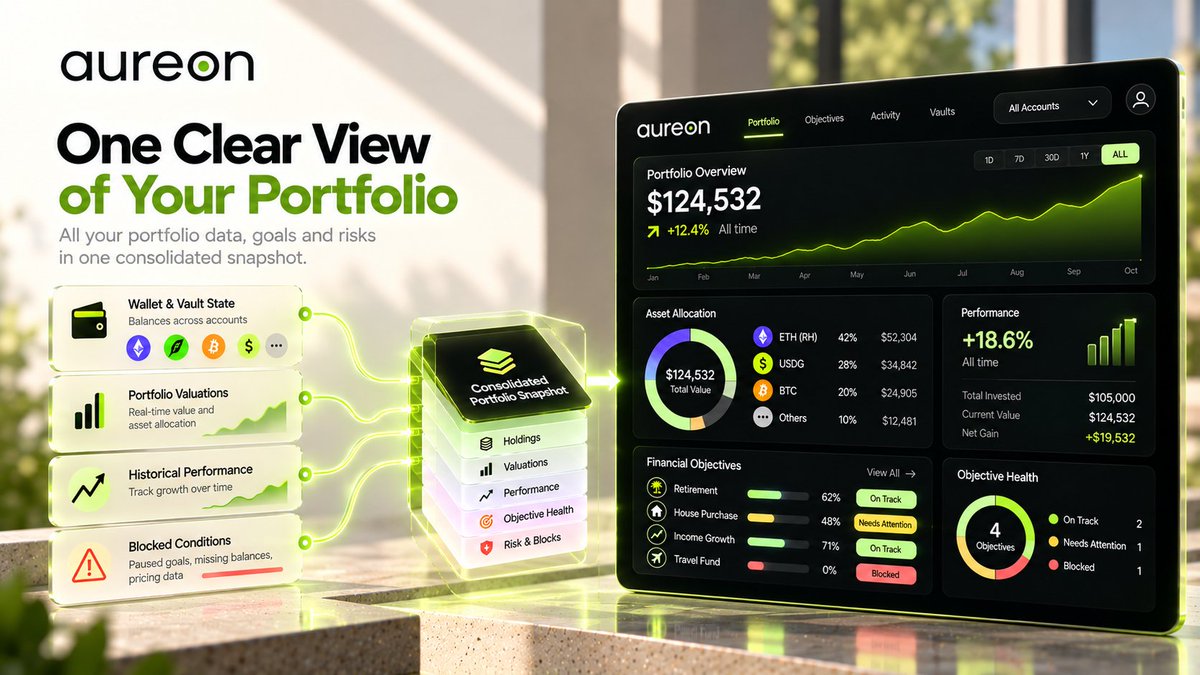
AUREON One Clear View of Your Portfolio.
Your portfolio is constantly changing. You need to know what your capital is worth, whether your financial goals are on track, and what needs attention.
Today, we strengthened AUREON’s portfolio intelligence engine:
→ Unified Portfolio Snapshot: Bringing holdings, valuations, performance history, and financial goal status into one consolidated view.
→ Consistent Goal Prioritization: Applying deterministic sorting so financial objectives appear in a stable, predictable order.
→ Precise Allocation Tracking: Measuring how holdings compare with target ranges, including tolerance thresholds and boundary checks.
→ Clear Portfolio Health States: Distinguishing goals that are on track, allocations that need attention, and cases blocked by paused objectives, missing balances, or incomplete pricing data.
The result is a more complete picture of your capital not just its current value, but how your portfolio stands against the financial goals you’ve set.
Better portfolio visibility. Clearer signals. More informed financial decisions.
$AUREON
AUREON Know What Needs to Change, Down to the Exact Amount.
When your portfolio moves beyond its financial goals, you need to know how much to adjust, which assets are involved, and what the proposed transaction will look like.
Today, we strengthened the engine behind those decisions:
→ Precise Rebalancing: Calculate excess exposure in dollars and convert it into the corresponding token quantity.
→ Smarter Transaction Sizing: Apply position limits and precision checks to prevent invalid or zero-value adjustments.
→ Clear Action Proposals: Prepare unsigned rebalance transactions with token amounts, valuations, and destination vault details.
→ Stronger Validation: Check transaction details, wallet identity, and vault destinations without mistaking validation for confirmed on-chain execution.
Every calculation matters when capital is involved.
We’re building AUREON to make portfolio adjustments more precise, proposals easier to review, and execution preparation more dependable.
From financial goals to precisely calculated next steps.
$AUREON
AUREON: Building the Logic Behind Capital Restoration
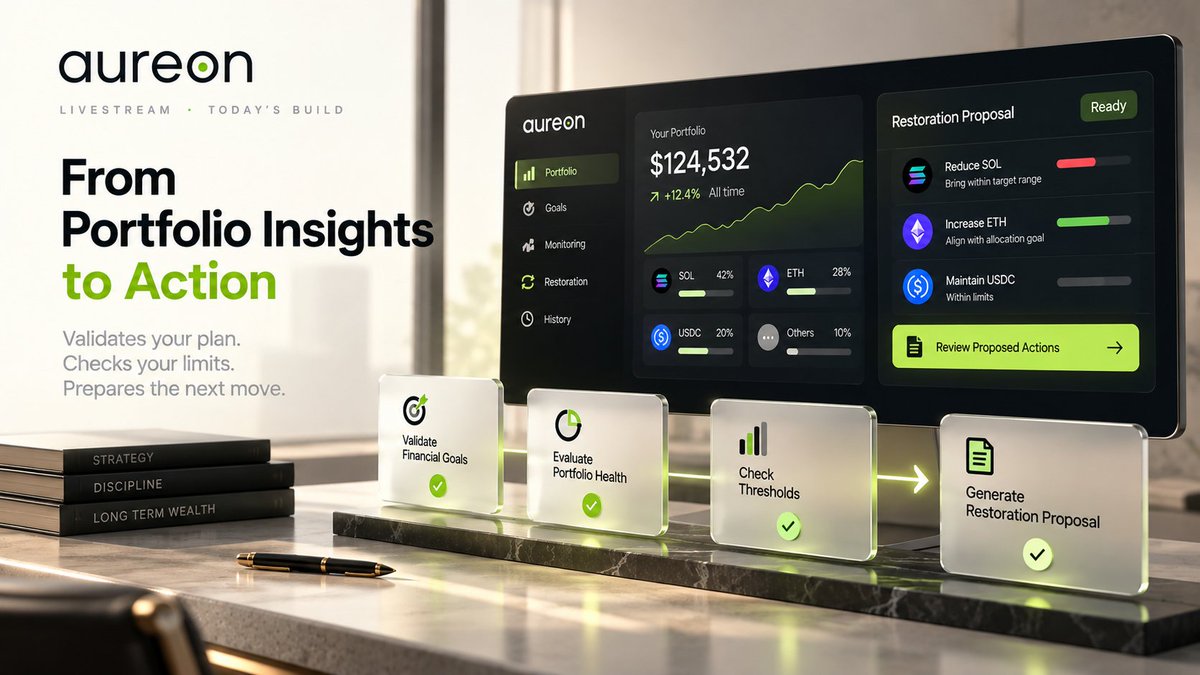
Today’s work focused on how AUREON evaluates a portfolio, validates financial rules, and prepares the next action when an allocation moves beyond its permitted limit.
What we built:
→ Constraint Validation: Ensuring active financial goals have correctly paired allocation limits before restoration begins.
→ Portfolio Health Evaluation: Distinguishing compliant allocations, blocked states, and conditions that qualify for restoration.
→ Precise Threshold Logic: Keeping allocations at their ceiling compliant and triggering restoration only when exposure exceeds the limit.
→ Transaction Proposal Pipeline: Generating structured, unsigned restoration steps without misrepresenting proposed actions as completed transactions.
The focus is on making portfolio restoration precise and predictable from checking the financial rules to preparing a proposed action for review.
Another core layer of AUREON’s capital management engine, built and moving forward.
$AUREON
AUREON Under the Hood of Living Capital
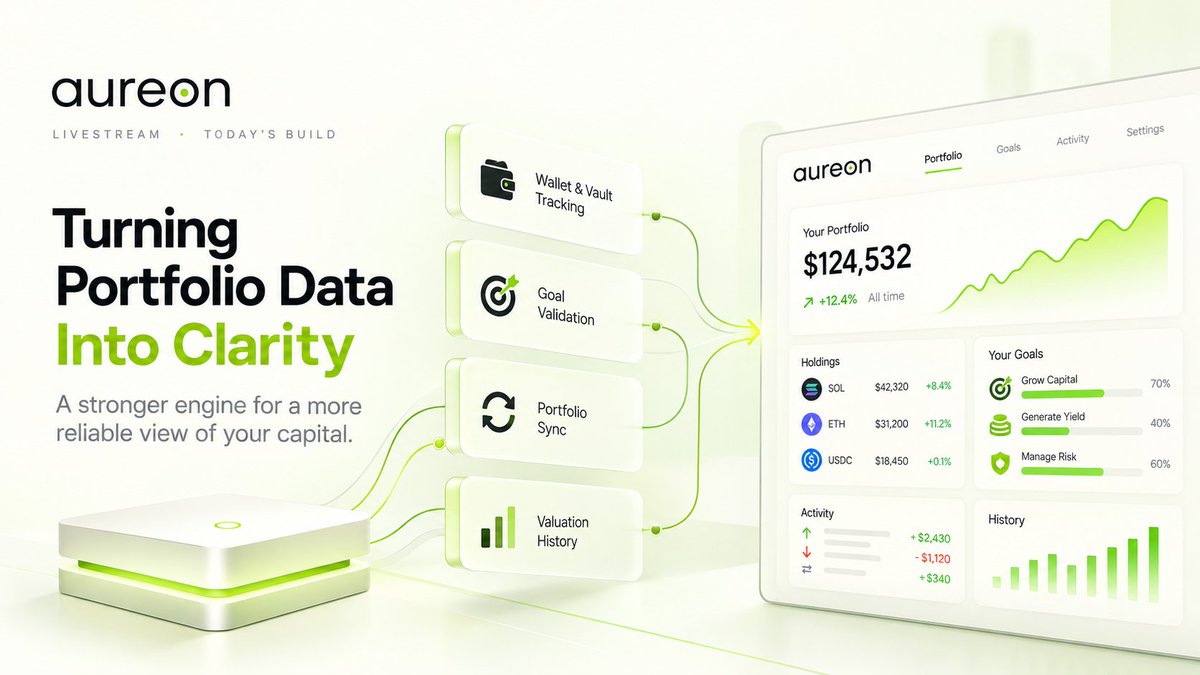
A portfolio isn’t just a balance. It’s a constantly changing picture of your capital and keeping that picture accurate takes serious engineering.
Today’s build focused on four pieces of that foundation:
01 / One Portfolio, One Clear State
Connected wallet, vault, and holdings data through a wallet-scoped management engine.
02 / Financial Goals That Don’t Clash
Added allocation-policy checks to prevent conflicting rules for the same asset.
03 / Holdings That Stay in Sync
Built a timestamp-driven pipeline to update portfolio holdings and recalculate valuations as the recorded state changes.
04 / A History You Can Trust
Strengthened daily valuation records, ensuring incomplete price data doesn’t get mistaken for a reliable portfolio snapshot.
This is the work beneath the interface: turning changing asset data into a consistent view of capital that users can actually make decisions with.
AUREON is building the financial infrastructure for capital that needs to do more than sit still.
$AUREON
AUREON UI Tutorial: Keep Your Capital on Track.
Your portfolio changes. Your financial goals shouldn’t get lost in the process.
In this tutorial, see how AUREON helps you:
→ View your portfolio and holdings
→ Check how your capital is performing against your goals
→ Keep track of changes in your portfolio
→ Understand where your money stands
The goal is simple: know what you own, what it’s worth, and whether your money is still working toward your plan.
$aureon
Today’s Build: Giving Every Portfolio a Reliable Source of Truth
If an asset’s price is missing, your holdings are outdated, or two financial goals conflict, you could end up with the wrong picture of your money.
Today, we worked on making AUREON’s portfolio data more consistent and reliable.
→ Wallet-Level Portfolio Tracking: Keeping your wallet, vault, and financial goals correctly linked so your capital is tracked in the right place.
→ Consistent Financial Goals: Preventing conflicting rules from creating competing plans for the same assets.
→ Reliable Portfolio Updates: Checking asset details and handling missing prices carefully, so incomplete information doesn’t give you a misleading picture of your money.
→ A Clear History of Your Capital: Recording daily portfolio values consistently, so changes over time can be tracked reliably.
The challenging part is making your holdings, asset prices, financial goals, and portfolio history work together even when the underlying data changes.
Alongside this work, we continued our UI demos and product testing to bring these capabilities into the actual AUREON experience.
The goal: know what you own, understand what your portfolio is worth, and see how your capital changes over time.
$aureon
A little late to the timeline, but we made the deadline.
AUREON is officially submitted to Colosseum’s Crypto World’s Fair.
Now back to building the future of agentic finance.
A missing asset price or conflicting financial rule can turn a portfolio adjustment into a costly mistake. AUREON must know when not to act.
Today, we worked on the logic that connects a user’s financial plan to what happens as their portfolio changes.
Here’s how it comes together:
→ You set your financial goals. AUREON validates your target allocations, acceptable limits, and profit-taking rules.
→ Your portfolio changes. AUREON updates its view of your holdings and balances, while recording daily portfolio valuations.
→ You need to know if an adjustment is needed. AUREON evaluates your portfolio against your defined rules. If prices are missing or valuations are unreliable, it blocks restoration calculations rather than relying on incomplete information.
→ Your plan calls for a change. When allocation or profit-taking conditions are met, AUREON prepares a reserve-restoration proposal for review before execution.
→ Your financial plan stays manageable. Checks for conflicting objectives help prevent incompatible rules from undermining the plan.
The difficult work is connecting every step your goals, live portfolio state, valuation history, and proposed actions so they operate as one consistent financial system.
Alongside this, we continued our UI demos and product testing to bring the experience closer to users.
$aureon