Mission Control just crossed ⭐️ 5,000 stars.
To celebrate, I pointed an AI agent at the entire open backlog and let it run:
• 18 issues triaged, 12 fixed
• 37 community PRs reviewed - every single one security-audited before merge
• caught 4 PRs trying to sneak in container-escape configs, hardening reversions & supply-chain regressions
• shipped net -3,000 lines (killed dead code, merged the good stuff)
One green PR. Full test suite passing.
Open-source AI agent orchestration, self-hosted, zero external deps 👇
Read @trq212's "Unreasonable Effectiveness of HTML" and shipped it into my agent control plane.
The trick that makes it safe: HTML is a render layer, never the source.
• JSON contracts stay canonical (hash-chained, machine-readable)
• HTML is build output → ~/.lacp/reports/, never committed
• No noisy HTML diffs, no broken provenance
Agents talk to each other in JSON. They talk to you in HTML.
Github repo in the first comment 👇
Most people use 1 model and call it “strategy.”
That’s single-threaded thinking.
I built a setup where 18 personas debate across Claude, GPT, Gemini, and local models before a decision ships.
Not for vibes:
- forced disagreement
- anonymized peer review
- kill criteria before execution
If you’re building in AI/crypto and making real bets, this removes many expensive blind spots.
Open source:
https://t.co/fHmkuh9Viy
A single LLM gives you one reasoning path dressed up as confidence.
The Council of High Intelligence gives you structured disagreement:
18 personas (Socrates, Aristotle, Feynman, Kahneman, Karpathy, Sutskever, Taleb, Torvalds…) deliberate across Claude, GPT, Gemini & Ollama.
> Anonymized peer review.
> Anti-conformity directive.
> Chairman's synthesis.
> Verdicts ship with kill criteria.
/council --triad strategy Should we open-source this?
/council --duo Microservices or monolith?
/council --full What's the right pricing model?
One install. Built on Karpathy's llm-council pattern + the 2026 MAD research (anonymization, anti-conformity, free-MAD trajectory scoring).
Github in first comment, 700 stars and growing👇
This a16z CLARITY breakdown is one of the best signal posts this week.
My takeaway for builders is simple:
This is not just “crypto policy news” - it’s infrastructure for where teams incorporate, ship, hire, and raise over the next 3–5 years.
What stands out:
1) It moves the U.S. from patchwork enforcement toward explicit market structure.
That reduces legal ambiguity tax, which has quietly been one of the biggest startup killers in crypto.
2) It recognizes a core truth many frameworks missed:
Companies and decentralized networks are not the same thing.
Trying to force network-native systems into pure company-era rules creates bad incentives and bad architecture.
3) It aligns innovation + consumer protection instead of pretending those are opposites.
Good builders get clearer rails.
Bad actors get less room to hide in gray zones.
4) It matters beyond “tokens.”
If regulation improves, expect second-order effects in stablecoin rails, on-chain market infra, creator economies, machine-to-machine payments, and AI x crypto coordination systems.
My addition:
Policy clarity does not automatically create product-market fit.
It creates permissionless focus.
The winners from here are teams that can convert legal clarity into trustworthy UX, distribution, and real retained usage.
So the play is:
- build in public but compliantly
- design for long-term user trust, not extraction loops
- stay close to policy trajectory while shipping weekly
- optimize for survivability + compounding, not narrative pumps
If CLARITY progresses, this will be remembered as a major unlock moment for U.S.-based crypto building.
Shipped a big update to xint - my X intelligence CLI for terminals & AI agents.
🪙 Truthful Grok credit onboarding (X Premium ≠ API access - most guides get this wrong)
💸 24h cache on follower diffs: $50 → $0 on repeat runs
🎯 --budget cheap|balanced|max model routing for Grok 4.3
👁 --dry-run cost previews before any API call
📈 xint costs forecast projects end-of-month spend
⚡️ ~60-80% monthly cost reduction for heavy users
Both the TypeScript and Rust binaries got it. 231 tests passing.
https://t.co/VeC1crQY8I
Run this test on yourself right now:
Take any workflow you ran today.
Remove the AI.
Does it still work?
If yes → you're AI-augmented.
If no → you're AI-native.
Most people get this wrong about themselves.
Claude Code and Codex don’t compete.
They compound.
One is your deep reasoning teammate.
One is your high-speed execution engine.
The edge is in orchestration, not model tribalism.
Open source Mission Control is live - and the response has been wild.
One place to dispatch tasks, monitor spend, and govern agent ops without glueing 10 tools together.
Repo: https://t.co/dpbCG20Jms
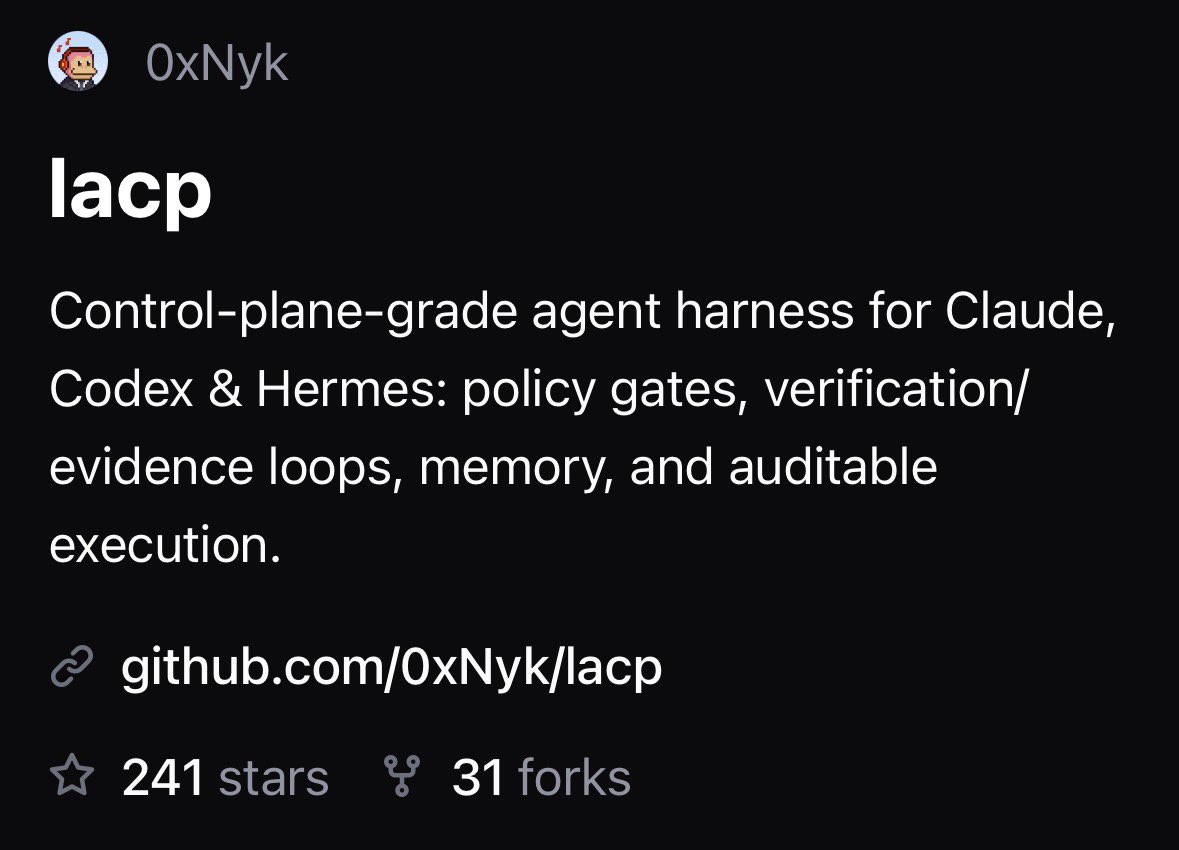
LACP is how we keep AI agents useful at scale:
not “more prompts” —
better control loops, memory discipline, and execution governance.
If you’re running multi-agent workflows in production, this is the layer that matters.
I don’t fear bigger teams anymore.
I fear smaller teams using agents better than us.
1 builder with taste + distribution can now outship 20 people stuck in meetings.
The game isn’t headcount.
It’s speed of learning.
Memory compounds faster than prompts.
What changed our output wasn’t “better prompting” - it was building the operating harness around the model:
Context, feedback loops, and execution discipline.
Ecosystem update: just merged 9 new resources into the awesome-hermes-agent list + bumped Hermes to v0.10.0
Highlights:
- SkillClaw - auto-evolves your skill library (705 stars)
- rtk-hermes - 60-90% token reduction on shell output - microsoft-workspace - Outlook/365 integration
- agent-android - LAN-first Android control (no USB/ADB)
- Detection & Media Forensics - new section with deepfake detection
Hermes v0.10.0 dropped with the Nous Tool Gateway
Still one of the most practical workflows I’ve shipped.
xint isn’t just “search X” - it turns bookmarks, threads, profiles, and trends into executable research loops.
The edge is not reading more.
It’s deciding faster with a cleaner context.