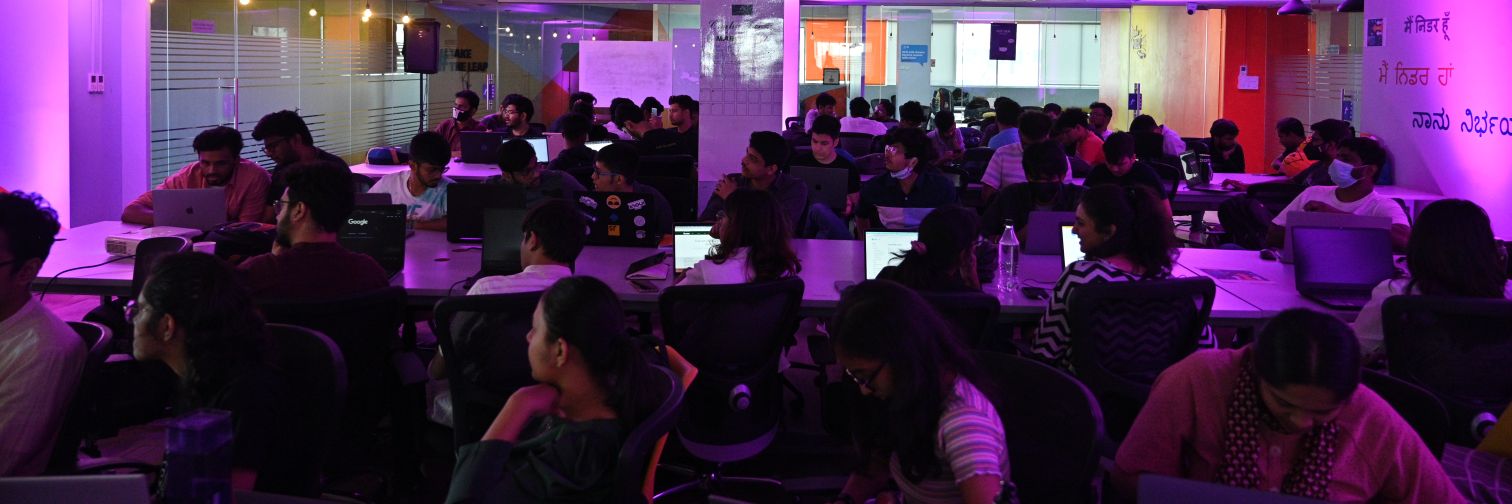
We're launching Claude Community Ambassadors. Lead local meetups, bring builders together, and partner with our team.
Open to any background, anywhere in the world.
Apply: https://t.co/DTQBAzgQug
Been seeing a lot of takes on how to protect against prompt injection.
It's a structural problem that can't be solved with filters or better prompting. The same thing that makes LLMs useful makes injection possible.
Instead, focus on negating the damage. Agents need strong isolation, limited access to secrets, and enough observability to know when an injection occurred. And when one does, blow up the agent's environment and start fresh.
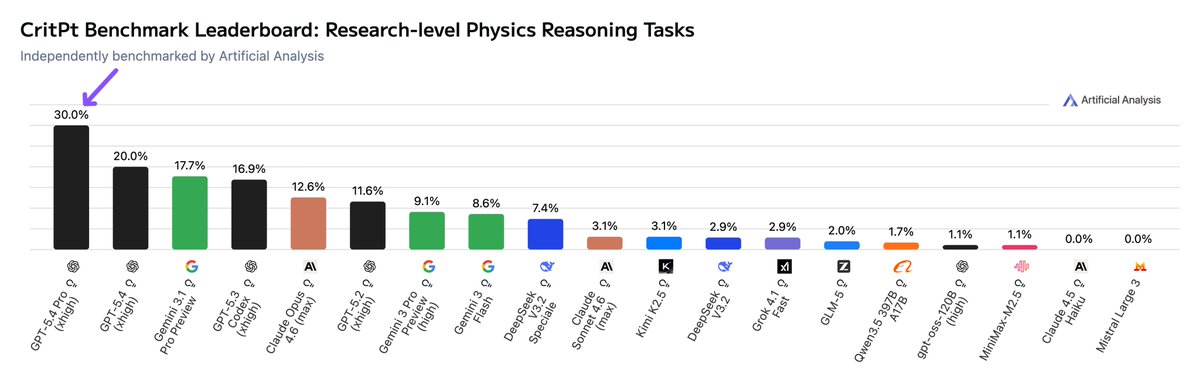
AI is progressing rapidly: GPT-5.4 Pro (xhigh) has achieved a massive 10 point gain in CritPt, a benchmark where the highest score was only 9% in Nov ‘25
This is the largest incremental gain we have seen from a single release. CritPt is a benchmark with a private dataset that tests performance on research-level physics reasoning tasks.
When CritPt was released in November 2025 the highest score was 9% (Gemini 3 Pro Preview). Only ~4 months later the highest score has more than tripled to 30%.
New on the Anthropic Engineering Blog: In evaluating Claude Opus 4.6 on BrowseComp, we found cases where the model recognized the test, then found and decrypted answers to it—raising questions about eval integrity in web-enabled environments.
Read more: https://t.co/oVCNyaiK5w
Twin goals of EF:
1. Usage of Ethereum - but usage of a type where users are actually benefiting from Ethereum's underlying properties
2. Resilience and decentralization of Ethereum - viewed holistically, focused on addressing points of weakness anywhere in the stack
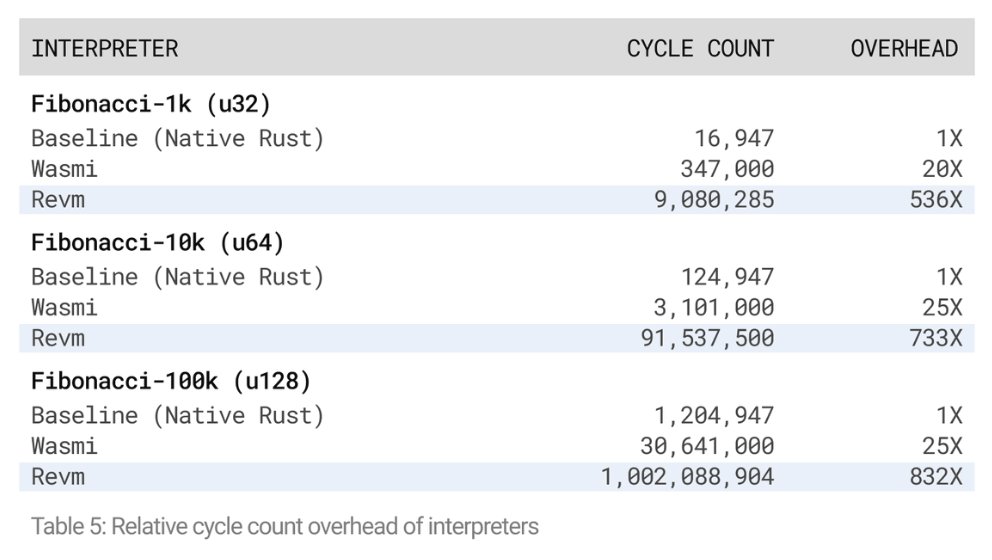
By the way, the recent @VitalikButerin proposal around replacing the EVM with RISC-V was based on results we found in this paper about the 800x provability overhead of EVM in SP1.
Some numbers from the paper:
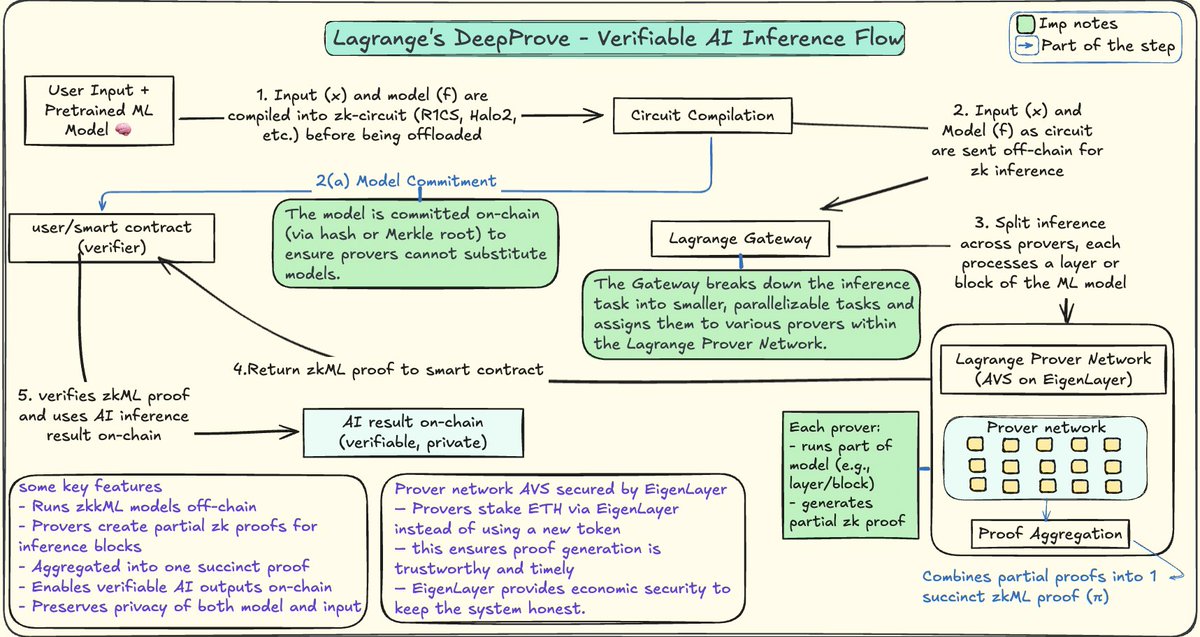
lagrange's DeepProve lays the groundwork for trustless AI using zkps, it brings zkML to life in Turing Roulette game (https://t.co/L5fjCp3PMq) where we can guess if we're chatting with a human or an AI & has generated over 200k proofs already
it's backed by a prover network AVS secured via @eigencloud that ensures every AI interaction is verifiable, tamper-proof & private
breakdown of @lagrangedev’s zkML architecture to understand how -
In a mostly open source industry like crypto, the only thing that really matters is speed of execution. Ideas are free. Expecting more and more vertical integration. Being an excellent, but ultimately, thin layer of the stack no longer sufficient.
Coded ZKP/FHE, a decentralized, collaborative, robust ZKP/FHE System
By:
- 0x1cc
🔗 https://t.co/30eKvknAP3
Highlights:
- The research introduces a method to break down complex ZKP/FHE tasks into smaller subtasks, distributing these across multiple nodes for parallel processing.
-Redundancy is added to the subtasks, meaning the original task's result can be reconstructed from a subset of the subtask results, enhancing the system's robustness against delays or failures.
-A (n,k) coded ZKP/FHE system is proposed, where a task is divided into n subtasks, and the completion of any k subtasks is sufficient to obtain the original task's result.
-This coded design significantly improves computation speed within ZKP/FHE systems and allows the system to tolerate the downtime or delay of n-k nodes, making it more robust.
-The coded ZKP/FHE system facilitates the creation of decentralized, collaborative, and resilient cryptographic operations, promising enhanced efficiency and reliability for applications like zkRollup and fheEVM computation.
ELI5:
Imagine you have a big puzzle to solve, but it's really hard to do it all by yourself. So, you decide to break the puzzle into smaller pieces and ask your friends to help you solve each piece. Some of your friends might be slow or even forget to solve their piece. To make sure you can still see the whole picture without waiting forever, you give out some extra pieces (redundancy) that can help you figure out the missing parts if some friends don't come through. This way, as long as you get enough pieces back, you can still see the whole picture. This is similar to what we're doing with complex math problems (ZKP/FHE tasks) in computers, making the process faster, more reliable, and allowing everyone to help out from their own computers.
"One bad signature will be able to drain your account on Ethereum after EIP-3074."
Yes; this is true. 3074 coauthor here! Let me put this concern to rest a bit before it gets more out of hand.
Fraud Proofs Are Broken
By:
- GCdePaula
🔗 https://t.co/BWmLyqB3JO
Highlights:
- Optimistic rollups rely on fraud proofs to ensure security, but current algorithms are vulnerable to Sybil attacks, affecting safety, speed, and decentralization.
-Three properties for analyzing permissionless interactive fraud proofs are safety, promptness, and decentralization, but achieving all three simultaneously is challenging.
-Permissionless Refereed Tournaments (PRT), Bounded Liquidity Delay (BoLD), and OP Stack’s Fault Proof System (OPFP) are three algorithms aiming for permissionless interactive fraud proofs, each with its own strengths and weaknesses.
-The 'proof of whale' attack is a significant threat to the safety of fraud proof systems, where a well-funded adversary can overwhelm honest validators by sheer financial force.
-Collaboration and open research are essential for improving fraud proof algorithms and ensuring the security and decentralization of optimistic rollups.
ELI5:
Imagine you're playing a game where everyone has to agree on the rules and the outcome of the game. But some players might try to cheat to win. In the world of online transactions, 'fraud proofs' are like a system that lets any honest player prove when someone is trying to cheat, ensuring that the game remains fair for everyone. However, this article explains that the current ways we try to catch cheaters have some weaknesses, making it possible for them to still get away with cheating in certain situations.
Blobs are live on Ethereum Mainnet!
The Dencun fork finalized without issues and the network has been running stably since then. We can see healthy blob propagation statistics (expect a deeper analysis over the next weeks).
Congrats to all the client teams and contributors!