Today’s Supreme Court decision effectively guts a key pillar of the Voting Rights Act, freeing state legislatures to gerrymander legislative districts to systematically dilute and weaken the voting power of racial minorities - so long as they do it under the guise of “partisanship” rather than explicit “racial bias.” And it serves as just one more example of how a majority of the current Court seems intent on abandoning its vital role in ensuring equal participation in our democracy and protecting the rights of minority groups against majority overreach.
The good news is that such setbacks can be overcome. But that will only happen if citizens across the country who cherish our democratic ideals continue to mobilize and vote in record numbers - not just in the upcoming midterms or in high profile races, but in every election and every level.
So, I built an AI Closeout Agent for GCs after meeting with an old General Contractor buddy last week.
I wanted to showed him a tool I had been building on the side to get his feedback.
His response: "Cool product. but, Maybe 40% of it would be useful to how my business operates today."
That flipped the whole meeting into a discovery session. I wanted to know more:
Where are you today? Where do you want to be? What sucks today thats keeping you from comfortably getting there?
The conversation kept circling back to one thing: Closeout & turnovers. Getting OFF a job is more work than the whole project.
This wasn't the first time I'd heard it. PMs and PXs are drowning in it. I've experienced this personally.
Today:
→ Warranty docs in email threads from 3 months ago
→ Product data in submittals from the start of the project
→ Crumpled inspection reports hand-delivered on a random Tuesday
→ Subs and vendors ghosting for weeks with substantial completion a month out and final payment on the line
Here's how the Closeout Agent works:
1. Upload existing project docs + connect your ERP or system of record
2. Agent pulls from specs, submittals, closed RFIs, procurement logs, schedule, and contract docs to generate the closeout tracking list
3. Syncs and links each sub/vendor by owned spec, scope, and required closeout doc
4. Builds a deficiency report of missing items
5. Drafts retrieval emails — you approve, it sends
6. Runs autonomous chase sequences to every sub and vendor until items land
A 3+ month grind turns into something a team sets up and starts tracking in minutes.
This is what AI tooling in construction actually looks like when it's pointed at the right problem. A real agent doing the work nobody wants to do.
I built a agentic workflow that turns my rough brain-dump feature and improvement roadmap "plans" into structured, trackable work.
& If you’re a non-technical solo founder like me building for production usage, this might be useful:
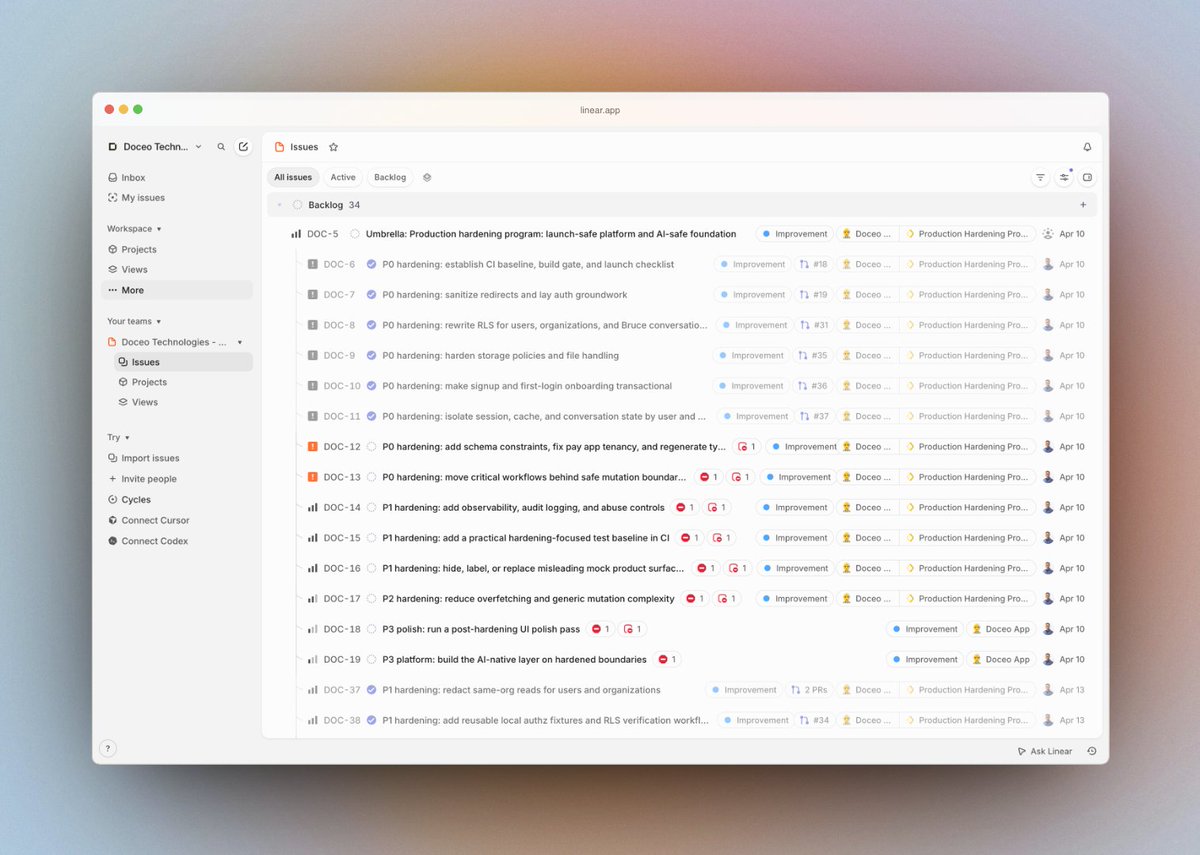
Instead of living in brain-dump docs, markdown files, and chat history, each feature and improvement plan becomes a set of scoped Linear issues with acceptance criteria, dependencies, blockers, and next steps.
From there, a coding agent can pick up a ticket on a daily execution schedule I've set up, follow the implementation plan, update the issue as it works, and push a draft PR to GitHub when it’s ready for review by a human or audit agent.
The biggest benefit for me is that I can step away for a few days and come back to a clear system I can jump back into without missing a beat instead of the chaos of a cold start.
I've moved from brain-dumped, reactive building to a more structured product and engineering workflow with a clear and detailed series of things to do as a non-technical builder.
If you want the doc for this 'Plan-to-PR' setup, hit my DMs and I’ll send it.
this OpenClaw bot finds $500k–$1.2M homes without pools, renders a pool into their backyard, and mails the owner a postcard showing the before/after, on autopilot...
here's how pool builders can close $50k+ deals with this system:
- scans satellite imagery for mid-market homes with empty backyards
- filters by lot size, sun exposure & recent ownership change
- pulls the homeowner direct from public records (not shared leads)
- renders a luxury pool dropped into their actual yard
- calculates build cost + home value lift for their specific zip
- generates a cinematic video of their backyard with the new pool
- prints a personalised postcard with the before/after + QR code
- drops it in the mail + hits them with retargeting
every step from sourcing to outreach is automated.
reply "POOL" + RT and i'll send you the full breakdown so you can build this too (must be following so i can DM)
🚨 Screen Studio charges $89 for this. Someone open sourced the entire thing for free.
It's called OpenScreen. 8,400+ GitHub stars.
You record your screen. It automatically transforms it into a polished, professional demo video.
Auto-zoom into clicks. Smooth cursor animations. Motion blur. Custom backgrounds with wallpapers, gradients, and shadows. Webcam overlays. Annotations. Timeline editing. Export in any aspect ratio.
The exact workflow that Screen Studio sells for $89 and Loom sells as a subscription. Free. No watermarks. No accounts. No subscriptions.
Here's what you get out of the box:
→ Full screen or window capture with system audio and mic
→ Automatic zoom that follows your cursor and clicks
→ Manual zoom with customizable depth and timing
→ Smooth motion blur on pan and zoom transitions
→ Animated cursor rendering with motion effects
→ Webcam bubble overlay with drag-and-drop positioning
→ Wallpapers, solid colors, gradients, or custom backgrounds
→ Text and arrow annotations layered over recordings
→ Timeline trimming and variable speed segments
→ Crop, resize, and export in any resolution or aspect ratio
→ Save and reopen projects anytime
Here's the wildest part:
A developer forked it and built an even more advanced version called Recordly. Full cursor animation pipeline. Native macOS and Windows recording. Zoom behavior that mirrors Screen Studio frame-for-frame. Audio tracks. Webcam overlays with zoom-reactive scaling.
Both are free. Both are MIT licensed. Both work on Windows, macOS, and Linux.
Download. Record. Export. Done.
100% Open Source. MIT License.
(Link in the comments)
I know Silicon Valley startups don't want to hear this.....
But the combination of someone in the trades with deep domain expertise and Claude Code will run circles around your generic software.
I talked to Cory LaChance this morning, a mechanical engineer in industrial piping construction in Houston. He normally works with chemical plants and refineries, but now he also works with the terminal
He reached out in a DM a few days ago and I was so fired up by his story, I asked him if we could record the conversation and share it.
He built a full application that industrial contractors are using every day. It reads piping isometric drawings and automatically extracts every weld count, every material spec, every commodity code.
Work that took 10 minutes per drawing now takes 60 seconds. It can do 100 drawings in five minutes, saving days of time.
His co-workers are all mind blown, and when he talks to them, it's like they are speaking different languages.
His fabrication shop uses it daily, and he built the entire thing in 8 weeks. During those 8 weeks he also had to learn everything about Claude Code, the terminal, VS Code, everything.
My favorite quote from him was when he said, "I literally did this with zero outside help other than the AI. My favorite tools are screenshots, step by step instructions and asking Claude to explain things like I'm five."
Every trades worker with deep expertise and a willingness to sit down with Claude Code for a few weekends is now a potential software founder.
I can't wait to meet more people like Cory.