@CalScherm@MdArchives Such a cool find! Would love to learn more about your research. I live in Talbot and do similar work Chesapeake Heartland: An African American Humanities Project at Washington College.
🔍 Excited to share this blog on my research journey! In my “Homecoming: Kent County” project, I dove deep into my family’s history to uncover stories of our rural roots and the pressing issues we face today. https://t.co/IktyZI7u6k
I’m excited to present my research on the architectural heritage of one of my hometown communities. It’s a blessing to work in a space that empowers me to share my perspective on places where I have deep roots.
https://t.co/6bh3Oh9bc4
What's the main difference between Classical and Gothic architecture?
Just look at the "capitals" — the decorative part at the top of a column. They tell you everything you need to know.
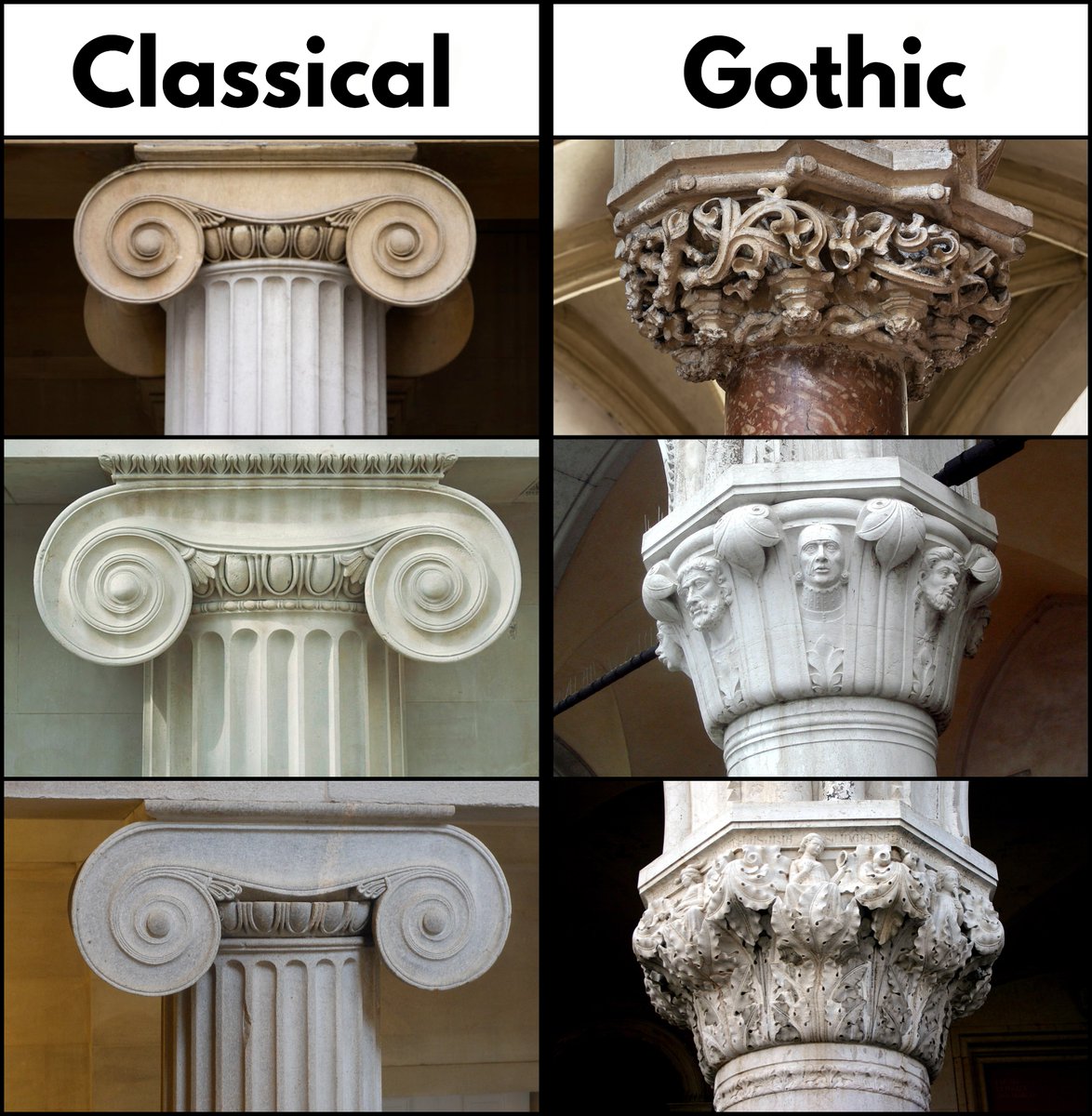
Classical capitals are all identical, but in Gothic architecture they are always different.
In Classical (and Neoclassical) architecture there are "Five Orders". The best way to explain these is as five different design models which include rules for the column, the capital, and the entablature above it.
Etruscan, Doric, Ionic, Corinthian, and Composite are the Five Orders, in ascending degree of complexity. Each have their own specific ornamentation and, in addition, highly precise measurements and proportions for each of their elements.
These models developed over time in the ancient world and were eventually codified by the likes of Vitruvius — you can still read his mathematical specifications. During the Renaissance, when Classical architecture was revived, the Five Orders were studied carefully and codified once again, creating a set of models which have been scrupulously imitated ever since.
The Classical capitals in the image below are Ionic; each is from a different building. Notice that their volutes (the swirls) and the egg-and-dart ornament between, are all essentially identical.
And so, whenever you build in the Classical (or Neoclassical) style and you use one of these Five Orders, the craftsmen and sculptors must submit to a design specified hundreds of years ago, and merely carry it out like a machine as precisely as they can.
But here's the thing: in Gothic architecture there were no such rules whatsoever.
Medieval stonemasons and craftsmen were free to design their capitals however they wanted. Maybe their work wasn't perfect, but they always had the creative freedom to pursue their own ideas and inspirations. There was never a strict blueprint imposed from above that they had to follow — they were treated like humans rather than machines.
Hence the capitals of Gothic architecture are always different, even within the same building. You'll find foliage and flowers of every kind, fantastical beasts, smiling or serious faces, ribald jokes and sacred scenes, and simple decorative fancies, all mixed in together. This resulted in a style of architecture that was inevitably varied, surprising, and full of life.
So the difference between Classical and Gothic architecture isn't just about their outward forms — of rounded or pointed arches, of pilasters and tracery, pediments and archivolts. The difference is one of fundamental mindset, of design philosophy, of socio-economic relationships, of the creative liberty and working autonomy of builders and artisans.
So, which do you prefer? Should artists and craftsmen be forced to imitate the pure and sophisticated work of a superior designer, or should they be trusted with the creative freedom to make their own designs, however strangely or imperfectly?
My colleagues and I recently shared the #ChesapeakeHeartland digital archive with K-12 teachers as resource for integrating local African American history into classrooms through the arts. Excited to see them put it to use!
#digitalhumanities#blackhistory#publichistory
A visit from renowned chef & restauranteur Alexander Smalls to the @WCStarrCenter in Chestertown, MD. A day spent discussing coastal #foodways, #culturalheritage, and place.
We are excited to share with the world, our Black Ecologies Zine. 64 pages of brilliance--poetry, fiction, essays, interviews, and original art by Alissa Diamond. This is a resource we hope you will consider using in classroom or community. @ISGRJRutgers https://t.co/aEVUEBKijd
Today @BlkPerspectives features @AustinMcCoy3's #HipHop50 Syllabus that "provides resources to understanding Hip-Hop Culture’s past and present." Read more: https://t.co/Hn734sfn2i