It’s the 2nd day of the World Cup. If you add a 0 behind the number 2, you’ll get 20 and that’s exactly the number of days since Arsenal won the league title.
🚀 HISTORY IS ABOUT TO BE MADE.
After years of anticipation, $SPCX finally begins trading on NASDAQ today.
🔹 IPO Price: $135/share
🔹 Capital Raised: $75 Billion
🔹 Valuation: $1.8 Trillion
🔹 Retail Demand: Over $70 Billion
This isn’t just the biggest IPO in history.
It’s the public debut of a company that has redefined space launches, built the world’s largest satellite internet network through Starlink, and sits at the center of Elon Musk’s expanding technology ecosystem.
The market isn’t simply valuing a rocket company.
It’s valuing exposure to three of the most powerful long-term themes in the world:
☄️ Space Infrastructure
🌎 Global Connectivity
🤖 Artificial Intelligence
Today’s trading session could become one of the most watched market events of the decade.
📈 What I’m expecting:
• Massive opening volatility
• Heavy institutional participation
• Aggressive retail demand
• Record-breaking trading volume
• Significant price discovery as bulls and bears battle over valuation
The biggest question facing investors today:
Is $1.8 trillion expensive…
Or will it look cheap in hindsight?
For traders looking to position before the market fully digests the IPO, Bitget opens rSPCX pre-market trading from 09:00 UTC.
🔥 Zero trading fees on Day 1
🔥 Start with as little as $10
🔥 Full NASDAQ Order Book access for Bitget VIPs
Whether you’re investing, trading, or simply watching from the sidelines, this is one of those rare moments when financial history unfolds in real time.
The countdown is over.
SpaceX goes public today.
Who’s bullish? 🚀📈
🚨 𝗖𝗥𝗔𝗭𝗬 𝗙𝗔𝗖𝗧: Each of England's last 10 goals in all competitions has been scored by either Harry Kane (5) or an Arsenal player, excluding own goals.
— @OptaJoe
I've been watching $XAU and $XAG closely ahead of today's CPI release, and one thing stood out immediately after the numbers dropped.
The market was expecting inflation to come in around 0.3%, but headline CPI printed at 0.5%, reminding traders that inflation pressures haven't completely disappeared yet.
At the same time, Core CPI came in at 0.2%, creating a mixed picture and explaining why markets are seeing heightened volatility right now.
Here's how I'm looking at it:
🔴 Hotter headline inflation typically pushes real yields higher, which can create pressure on Gold and Silver.
🟢 Softer core inflation can ease some of that pressure and support risk appetite.
That's why today's move isn't just about the CPI number itself , it's about how traders interpret what it means for future rate expectations.
Personally, I'm focusing less on predicting the direction and more on reacting to the opportunities that emerge once volatility settles.
Major macro events like CPI often create some of the best trading opportunities of the month, but they also move incredibly fast. Missing an entry by a few minutes can completely change a setup.
That's one reason Bitget CFD Copy Trading has been catching my attention. Instead of trying to monitor every tick, traders can follow experienced strategies and potentially capture opportunities as the market reacts.
If you're trading today's CPI volatility, Bitget's CFD Copy Trading Rally is worth checking out:
🔹Lost a copy trade? 500 traders can receive $50 compensation.
🔹Earn up to $888 from a $20,000 prize pool based on highest PnL.
📈 Trade your way toward volume milestones and earn up to $666 in rewards.
Join here 👇
https://t.co/muZzhDUgsd
Whether you're bullish or bearish after the CPI release, one thing is clear: volatility is back, and the market is finally giving traders something to work with. 📊🔥
Markets are heading into a highly event-driven session, and the setup is leaning heavily toward volatility rather than calm price action.
On the earnings side, $ORCL is reporting after the close, and the focus is shifting beyond headline numbers. The real driver is Oracle Cloud Infrastructure (OCI). Its growth trajectory has increasingly become a proxy for enterprise AI adoption, so any strength there could reinforce the broader AI infrastructure trade.
At the same time, attention is building around the anticipated $SPCX IPO. With discussions around multi-trillion-dollar potential valuation, the listing is being viewed less as a single stock event and more as a sentiment gauge for risk appetite in high-growth private tech entering public markets.
In parallel, the AI cycle is still creating structural pressure across memory and storage supply chains. Names like $MU and Seagate remain in focus as demand for high-bandwidth memory continues to outpace supply, keeping data center infrastructure as one of the strongest thematic drivers in the market.
What ties all of this together is volatility. Earnings releases, major IPOs, and AI-driven supply constraints are all acting as catalysts that can quickly shift positioning and sentiment across equities.
That’s also why extended market access matters in this environment. With 24/5 trading through Bitget Stock 2.0, traders don’t have to wait for the next session to react to developments , they can adjust exposure as information hits.
The key question now is which catalyst will dominate price action first: Oracle’s cloud performance, SpaceX listing sentiment, or continued strength in the AI memory trade.
#BitgetStocksUpgrade
$XAU has recently experienced one of its sharpest pullbacks in months, triggering a familiar split among traders: whether this is a dip-buying opportunity or the start of deeper downside pressure.
From a macro perspective, the move is not isolated. Gold and gold-linked assets like Tether Gold $XAUT typically respond to broader financial conditions rather than internal momentum alone. In most cases, weakness in gold coincides with strengthening U.S. dollar conditions and rising Treasury yields, both of which reduce the appeal of non-yielding assets like gold. When those macro drivers reverse, rebounds in gold can be equally sharp.
This is why experienced traders rarely treat gold as a standalone chart. The real edge comes from tracking the broader liquidity and rate environment, then aligning positioning accordingly rather than holding a fixed bullish or bearish bias.
In this kind of two-way volatility, CFDs become a practical tool because they allow full directional flexibility. Traders can go long on expected rebounds or short continued downside pressure without needing to own the underlying asset. This is particularly relevant in fast-moving macro regimes where sentiment can flip quickly.
One platform leaning into this flexibility is Bitget ( Bitget Official Website), which has expanded its Gold CFD offering with a focus on accessibility and cost efficiency.
Key features include:
Zero-Fee Mode for CFD trading (no commissions, standard spreads apply)
ECN Mode option for tighter spreads and commission-based execution
Up to 500x leverage across forex, metals, commodities, and oil
24/5 market access for continuous macro positioning
Ability to trade both upside and downside moves in gold
Switching modes is straightforward:
On mobile: TradFi → menu (top right) → Account Mode → Switch
On web: Account/Preferences → Account Mode → Switch between Zero-Fee and ECN
The broader idea is simple: in a market where gold is reacting heavily to macro signals rather than internal strength, the advantage goes to traders who stay adaptable, control costs, and maintain the ability to pivot quickly.
At this stage, the key question is less about whether gold will recover or extend its drop and more about which side of the move you’re actually positioned for when the next macro shift hits.
🚨Reports suggest Mikel Arteta’s number one midfield target this summer remains as Newcastle United’s Sandro Tonali.
The Italian midfielder, valued at around £100million by the Magpies, was offered to the Gunners late in the January window but no talks took place at the time.
Would you like to see Sandro Tonali under Mikel Arteta at the Emirates next season?👀
$ZEC dumped over 50% in the last 10 hours after a critical vulnerability was disclosed.
Here’s what happened ⬇️
• A researcher discovered a bug in Zcash's Orchard pool on May 29.
• The exploit could have allowed unlimited counterfeit ZEC to be created undetectably.
• The vulnerability existed since Orchard launched in May 2022.
• A full exploit was successfully tested on a private network.
• Due to Orchard's privacy features, it's impossible to cryptographically prove whether anyone exploited it before the fix.
• The issue was patched in an emergency response completed on June 2.
• Developers believe prior exploitation is unlikely but cannot guarantee it.
• A future network upgrade is being explored to verify the integrity of the Zcash supply.
The team being transparent and honest with this is very respectful and my stance on zec haven’t change
Some of the biggest market winners often emerge before the crowd fully notices them.
Right now, AI infrastructure, digital banking, data centers, and space technology are attracting significant investor attention. While most traders focus on the biggest headlines, several stocks are quietly building momentum through strong fundamentals, expanding revenues, and powerful market narratives. After reviewing Bitget’s newly expanded Stock 2.0 lineup, these are the names that stand out most to me.
🟢 $rNBIS: One of the strongest AI infrastructure plays currently on my radar. The stock recently reached $282.73 before pulling back to around $251, where it continues to hold above key technical levels.
Bull Case: If AI infrastructure demand remains strong and Nebius continues delivering hyper-growth, a break above the recent high could open the path toward $300-$350 over the coming months.
Base Case: The stock consolidates between $240-$280 as investors digest recent gains and wait for the next earnings catalyst.
Risk Case: If AI sentiment weakens or growth expectations cool, a pullback toward the $220-$240 range remains possible before the next major move higher.
Revenue has already surged 684%, and Jensen Huang’s comment that “Nebius will take care of you” has only strengthened the bullish narrative around the company.
Beyond rNBIS, several other stocks are showing notable momentum. rSOFI continues gaining attention after launching the first bank-issued stablecoin and announcing its Mastercard partnership, while delivering 134% profit growth in Q1. rSOXX remains one of the broadest AI infrastructure and semiconductor plays available, already up 35% year-to-date. Meanwhile, $rCOHR reported $1.81 billion in Q3 FY2026 revenue, benefiting from rising AI data-center demand, and rSNAP continues improving its fundamentals through revenue growth, cost reductions, and a recent S&P credit upgrade.
A few additional names are also worth keeping on the radar. rBB is up 173% YTD ahead of its June 25 earnings report, rAPLD continues benefiting from AI data-center expansion after securing a 15-year hyperscaler lease, and rRDW has surged 182% YTD following a new space greenhouse mission contract. Each of these companies is tied to a major growth narrative that could continue attracting capital if execution remains strong.
For traders looking to gain exposure to these opportunities, Bitget offers access to US stocks with fees starting from just 0.04%.
Bitget is currently rewarding eligible traders with FREE $rNVDA through its latest campaign:
https://t.co/y56iy2ZHqj
Markets reward those who spot trends early. Which stock from this list do you think has the best chance of outperforming over the next 6-12 months? 👇
#BitgetStocksUpgrade
Things you need to know about Bitget Stocks 2.0
1. What are the advantages?
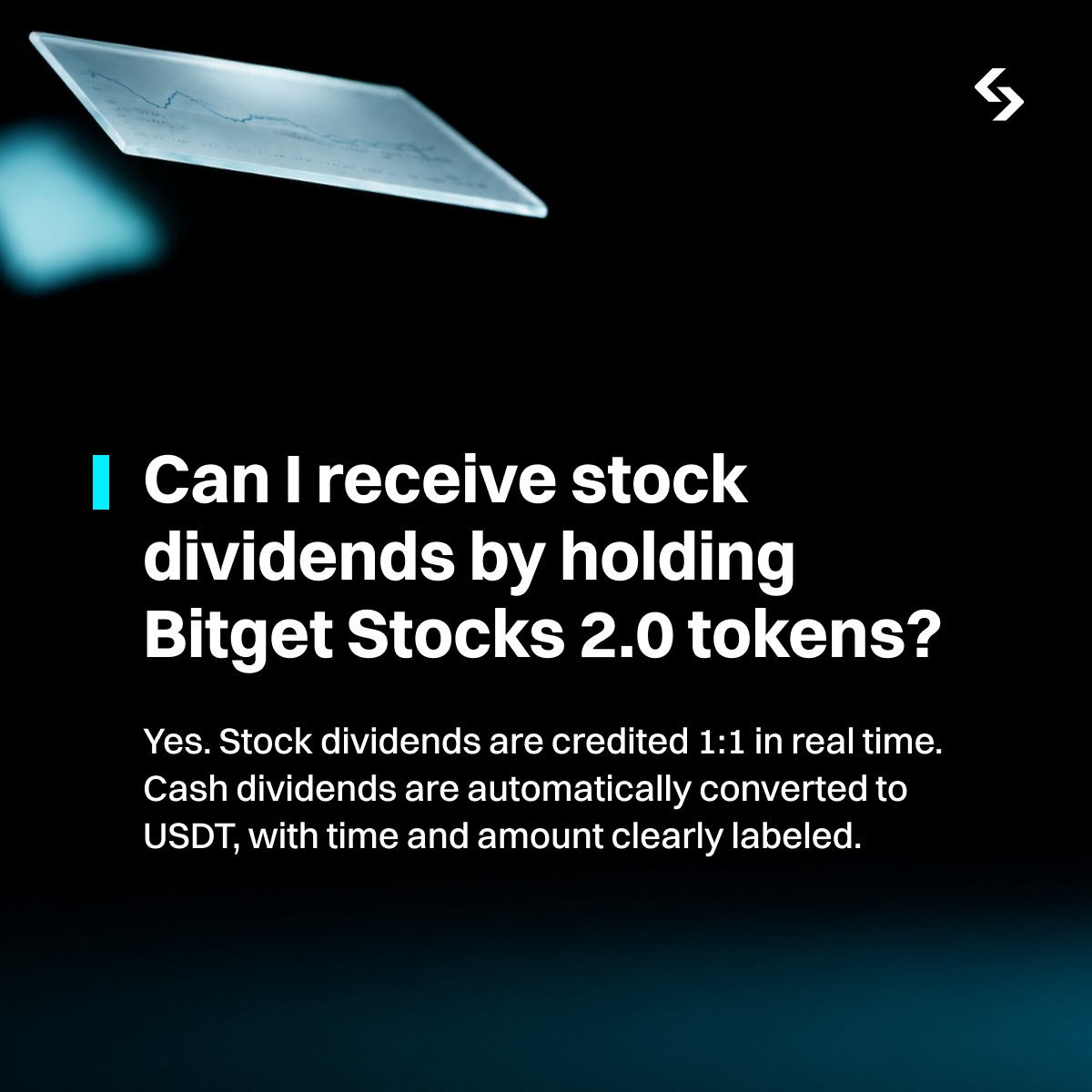
2. Can I receive dividends?
3. Are the other use cases?
Swipe right to know moreThings you need to know about Bitget Stocks 2.0
1. What are the advantages?
2. Can I receive dividends?
3. Are the other use cases?
Swipe right to know moreThings you need to know about Bitget Stocks 2.0
1. What are the advantages?
2. Can I receive dividends?
3. Are the other use cases?
Swipe right to know moreThings you need to know about Bitget Stocks 2.0
1. What are the advantages?
2. Can I receive dividends?
3. Are the other use cases?
Swipe right to know moreThings you need to know about Bitget Stocks 2.0
1. What are the advantages?
2. Can I receive dividends?
3. Are the other use cases?
Swipe right to know more.
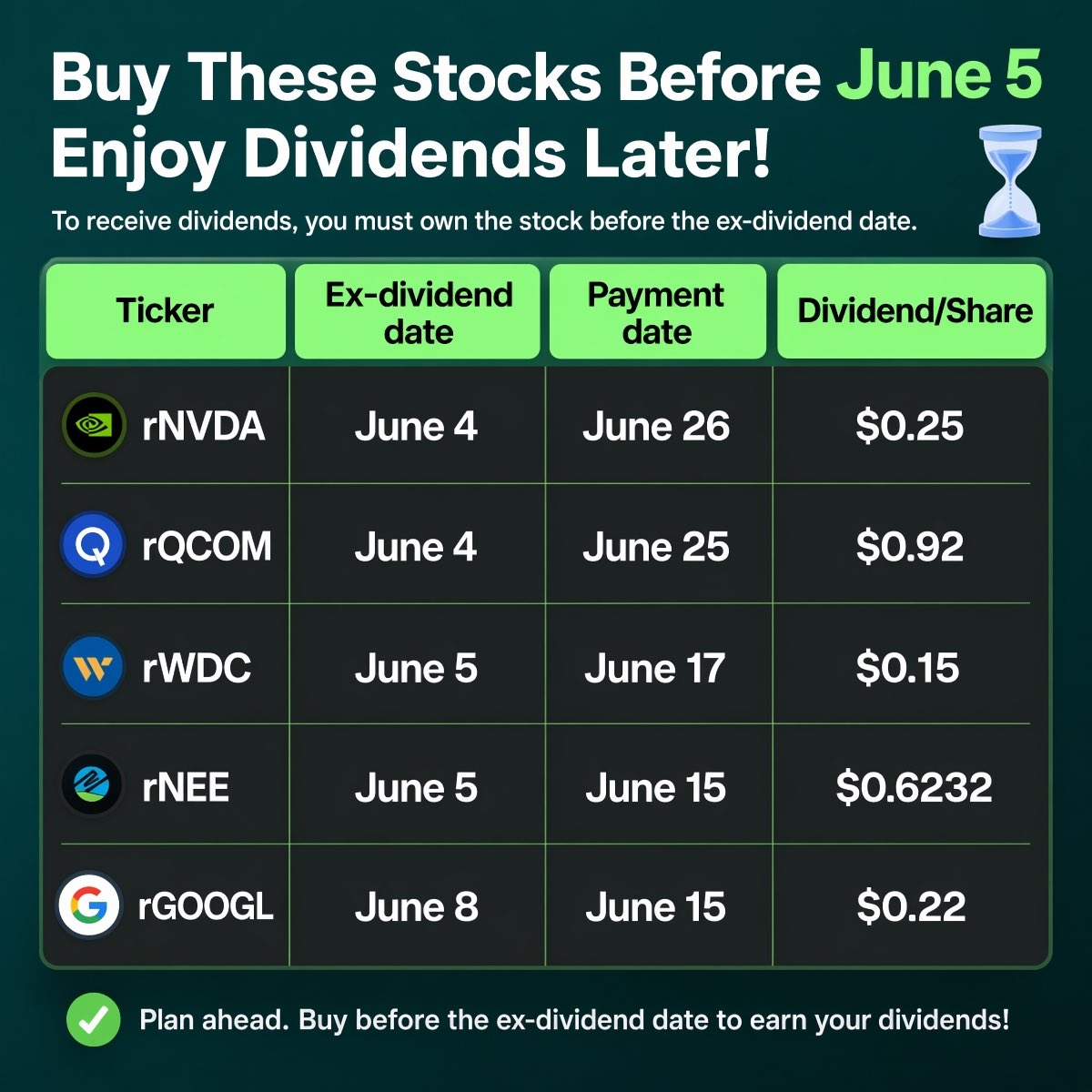
A lot of traders spend time watching price movements but overlook another date that can matter just as much: dividend eligibility. Over the next few days, several major stocks are approaching their ex-dividend dates, including $rNVDA and $rQCOM on June 4, rWDC and rNEE on June 5, and rGOOGL on June 8. For investors already interested in these companies, it’s a reminder that timing can sometimes add an extra layer of return beyond simple price appreciation.
The interesting thing is that dividend-paying stocks aren’t limited to traditional income sectors anymore. Some of the market’s biggest technology names are now returning capital to shareholders while still participating in major growth themes like AI, cloud computing, and digital infrastructure. That’s one reason many traders keep these dates on their radar, especially when volatility creates attractive entry points.
For those trading stock-backed assets, Bitget Stock 2.0 offers access with real stock depth, 1:1 asset backing, dividend coverage, and low trading fees. With NVIDIA’s ex-dividend date arriving today, traders who were already considering exposure may want to pay attention before the window closes. As always, the key isn’t chasing a dividend ,it’s finding quality companies you’d be comfortable holding even after the payout date passes.
One thing I’ve noticed is that most platforms keep trying to bridge traditional stocks with the crypto trading experience, but very few updates actually feel meaningfully different in day to day usage.
The Bitget Stock 2.0 rollout stands out a bit more because it introduces features that could realistically become part of a trader’s routine, especially within the wider Bitget ecosystem and the utility tied to $BGB.
What caught my attention most is the combination of dividends and collateral use. In most cases, stock holdings are fairly static, you either wait on price action or dividend distribution, so being able to also leverage positions adds a different layer of flexibility.
I also like the ability to fund and buy stocks directly with USDT without needing a separate traditional brokerage flow. For users already deep in crypto, that feels much more seamless.
The 24/7 market access is another practical shift, especially for traders used to always-on crypto markets.
From a structural point of view, liquidity being linked to NASDAQ and NYSE sources, along with 1:1 RWA-backed fractional access from $1, makes entry a lot more accessible.
After comparing a few core product features, and most importantly the fee structure, Bitget currently looks like one of the more competitive platforms for trading or investing in US stocks overall.
Overall, I’m less focused on the launch narrative and more interested in how people actually end up using the dividends and collateral mechanics over time.
Which feature would actually change how you trade the most 24/7 access, dividends, using stocks as collateral, or low-entry exposure from $1, and why? 👇
#BitgetStocksUpgrade
AI stocks just had one of their strongest months in recent memory, with some names doubling as investors raced to price in the next phase of the AI revolution.
Now the spotlight shifts to Jensen Huang and NVIDIA GTC Taipei.
Historically, $NVIDIA events don’t just move NVDA , they create ripple effects across the entire AI ecosystem. The companies enabling the infrastructure, architecture, and deployment of AI often end up seeing some of the biggest re-ratings afterward. That’s why I think the biggest opportunity may not necessarily be NVIDIA itself, but the companies positioned to benefit from the trends Jensen is likely to highlight.
Using GetAgent on Bitget, I asked which tech stocks are best positioned to benefit from the GTC Taipei event. The results were clear: ARM emerged as the strongest direct beneficiary, followed by QCOM, with AMD and INTC more likely to benefit from broader sector spillover.
That ranking makes a lot of sense.
If Jensen doubles down on AI PCs, edge AI, robotics, and power-efficient computing, ARM sits at the center of that conversation. Every new device category pushing AI closer to the user strengthens the value of ARM’s architecture. Unlike many AI plays that depend on winning market share, ARM benefits from the broader adoption of the ecosystem itself.
🎯 My prediction:
$ARM breaks above $500 before the market fully appreciates how important Arm-based computing is becoming in the AI era.
$QCOM is my second-highest conviction play. If GTC Taipei accelerates the AI PC narrative, I wouldn’t be surprised to see Qualcomm reclaim $280+ as investors rotate into companies with real exposure to on-device AI and edge inference.
The AI trade is evolving. We’re moving beyond simply buying GPU manufacturers and into identifying the companies powering the next layer of AI adoption. That’s where I think some of the biggest opportunities could emerge in the months ahead.
While everyone is focused on the announcements themselves, I’m focused on positioning for the narratives that emerge afterward. I’ll be staying positioned on Bitget and watching closely for where capital flows once Jensen takes the stage.
What’s your boldest GTC Taipei prediction? 👇