bottom of the list: showing people their broken streak. in one set of experiments, 45% kept going when the app pointed out the break vs 61% when it didn't. so chainday doesn't make a thing out of a missed day
ranked habit techniques by the evidence behind them. planning for obstacles came out on top: decide ahead of time what you'll do if something gets in the way
so in chainday the backup plan goes right above the habit, under the cue. on a bad day it's the first thing you see
cues ("after i turn off the alarm, i meditate") come next. a 2024 review of 642 tests found they help people actually do the thing, but there's less proof they make it automatic. that's why they're one tier down
@pcshipp I think it takes about 6 months before you get a good sense if your app will make money and to start getting organic traffic through Apple. You have to do some market research to see if there is demand for your App and what is the competition. Use something like Astro.
trying it myself, wish me luck
did market research in Astro and the demand is there. the hard part is getting into the top 10 for your keywords, that's where the money is
this Adam Lyttle video is how i learned to understand Astro
https://t.co/gTeB0L9V1c
gives you a good idea of how much demand there is before you build and how much money you might make with that demadn. i recommend all his stuff
"making money" is vague too. my realistic goal is $1k MRR within a year, $3k feels doable. to really get somewhere it probably needs to be 10x, 100x or 1000x better than the other apps
agree with the december/january take in the replies, new year is when people go looking for habit apps
here's the one i'm building
https://t.co/FMFI9eGUt2
you've probably heard it takes 21 days to build a habit. a ucl study (lally 2010) followed 96 people and found the median was 66 days, anywhere from 18 to 254
that gap is why a lot of people quit. if you expect 21 days, day 30 still feeling hard looks like failure. if you know it's closer to 2 months, day 30 is about halfway
knowing how long it takes helps you:
- keep going right when it's starting to work
- see how far along you are, which makes it easier to stick with
- give hard habits more time instead of thinking you're doing it wrong
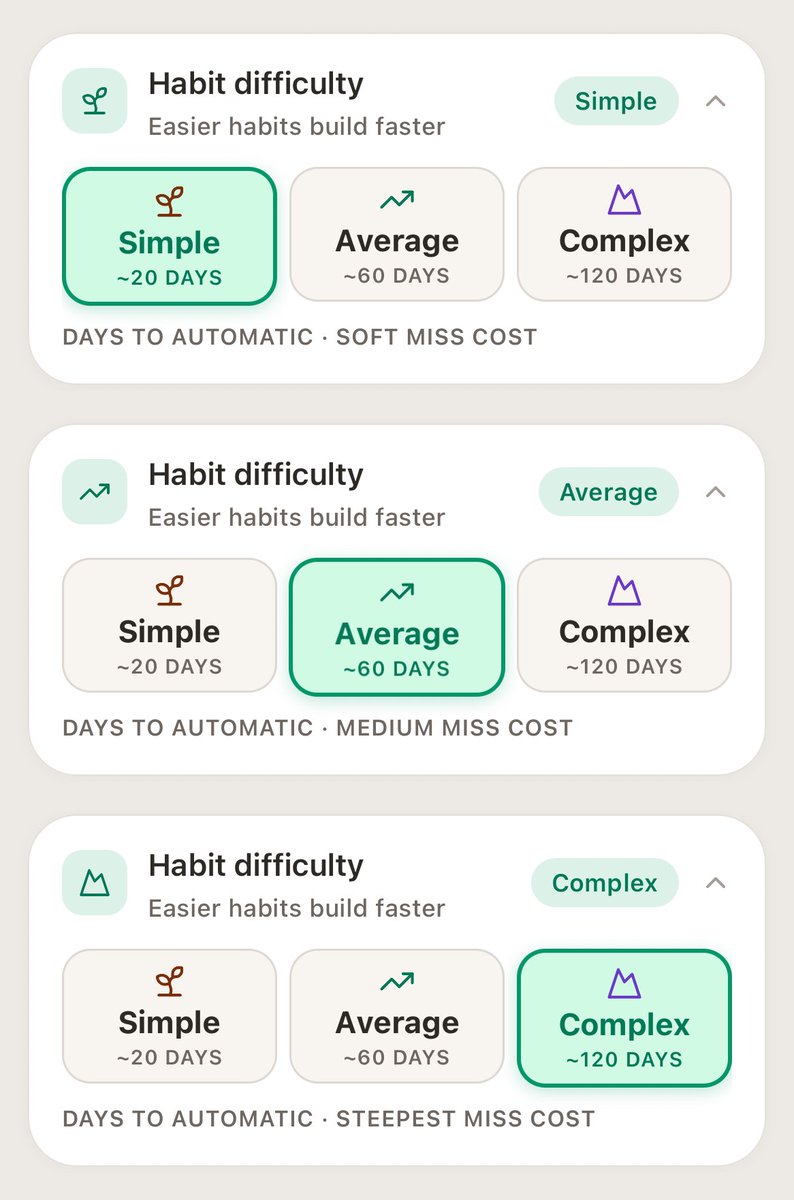
that's why chainday shows roughly how long your habit should take when you set it up: as fast as 20 days for simple stuff, 60 for average, 120 for hard ones like the gym
would you actually use this? does knowing the number help you, or is it just another stat you'd ignore
#buildinpublic
what keeps me going: my japanese happiness moment. that aha moment when something finally clicks. i rub my hands out of joy and feel like my japanese leveled up
today's: this card sat in reviews 2 weeks. i knew しない, but not せぬ or why an old form shows up here
what's yours
still working on the habit page in chainday
cue: what sets it off
habit: the thing you do
reward: what you get right after
who you're becoming: the bigger goal
would this layout make you more likely to do the habit, or is it too much
#buildinpublic