This is f*king insane. OpenAI co-founder Andrej Karpathy:
"Prompting is going away.
Delete everything, keep Graph."
In 1 hour he shows how to build Graphs, and why it's the only thing left standing at the end
LLMs → Prompts → Agents → Graphs
skip the agent and you're the one finishing every job by hand
skip the graph and every finished job is forgotten, so the next run starts from zero again
Bookmark and watch it today
Then read the article below ↓
the person who spent 6 years at apple working on apple watch is now building an ai agent that predicts migraine flare-ups and handles healthcare from start to finish. it connects wearables, medical records, labs and symptoms, then takes care of doctor appointments, prescriptions, insurance and medication delivery.
this is the future of healthcare.
If I were in my 30s or 40s right now and wanted to leverage AI to retire within 10 years, here's what I'd do:
1. Immediately form an LLC company. Not next month. Not once you're 'ready.' This week.
If I woke up tomorrow with $0 and no skills or connections, I'd become a clipper
You just need a phone and a little bit of a brain
Pick one niche, make an account, and learn to edit clips by checking whatever's already performing
Then post every single day, avoid making the same style that flops, remake what performs
30-60 days of that and $1000 in the bank is really the floor
All from posting clips off your phone
This is f*king insane. SpaceXAI engineer Lauren Tan (ex-Cursor):
"99% use Grok Bot at 1% of its potential.
I run 25+ agents with a Chief of Staff. They ship while I sleep."
In this 60-minute workshop, she shows the skills and checks behind agent teams that ship code
Grok Bot → /goal → /loop → Verification → Agent Teams
25 agents mean nothing if they can't verify their work
This free workshop beats most $650 agent engineering courses
Bookmark and watch it today
Then read how to build your first AI team with Grok Bot below ↓
holy sh*t. Karpathy's second brain pattern runs on Grok Bot now: stop explaining your life to AI from zero every chat, keep a wiki that writes itself
three bots in one group chat, each with its own memory:
the reader takes every link, PDF and voice note you drop and never edits it
the librarian rewrites every wiki page that source touches, usually 10 to 15 of them
the checker wakes up on a nightly routine and hunts contradictions, stale claims and pages nothing links to
→ you ask a question: the answer gets filed back as a page, so the brain grows from use, not only from reading
→ a new source contradicts an old page: the checker tags you instead of quietly overwriting it
→ a page goes 30 days without a fresh source: it gets marked unconfirmed
a second brain can sound sure while remembering the wrong thing
Reader collects. Librarian writes. Checker doubts.
every page has to show:
> the claim
> the source it came from
> the date it was last confirmed
paste this into Grok Bot:
"Build me a second brain with three bots in one group chat. Keep my sources untouched in raw/, maintain wiki/ yourself, file good answers back as pages and run a nightly check for contradictions. Show me the structure first. Do not create anything until I confirm"
start with one topic you actually work on, not your whole life
full setup below
I thought prompt engineering is dead, but the amount of miles I get out of this prompt just blows my mind.
It's particularly surprising because it is very plain language with no jargon whatsoever.
Meta Muse will probably create 1000+ millionaires
This is the most slept on arbitrage I’ve seen in years and it’s not even close.
Here’s how i’d build a 1 person business powered by AI/Muse with with $0 and 0 social following
+$274k so far from just spam deploying all day for the past 3 months
I seriously don’t get why people aren’t Dev’ing. It’s no different than the KOLs you glorify bundle raping all day
I have multiple tutorials showing exactly how I deploy on my page, and yet people would still rather gamble on new pairs
Sign up to proxima to learn with the link below
https://t.co/f0ahIH9oAd
I spent 48 hours in SF hanging out with billionaires, data labs and AI founders and execs running $1B to $100B companies.
My observations:
1. Sooo MANY stories of data brokers making like $2M a WEEK selling company data to labs. I can't tell if it's the beginning or a bubble, and I kept wondering which niches are left. Digging into it actively.
2. At dinner, someone asked the table, "If a new model drops next month, does your company get better or worse?" HALF the table went quiet! I think that's the best question to ask about any AI startup right now.
3. The bar people talk about now is hitting $1B in revenue in 12 months (I guess that's the new unicorn?). What I didn't hear much about is retention. AI revenue can come in fast and leave fast, and I think we're going to see a lot of stories of AI companies with huge revenue and terrible retention.
4. It's pretty clear we're living through the reinvention of the computer. The model is the CPU, the harness is the operating system, and skills and plugins are the apps. Thinking about it that way makes it easier to see where the whitespace is.
5. We're maybe 12 months from an agent that can watch you work for a week and then do your job without any instructions. The screen recording plus agent memory plus local model combination makes this possible right now.
6. Agent harnesses feel like the new GPT wrappers, in a good way, especially vertical ones. The best teams I talked to treat the model as swappable. One founder walked me through routing different models to different jobs: one for taste and visuals, a cheaper one for the everyday stuff, another for text.
They use prompts they can move across models over fine-tuning, and A/B test the output on what users actually do with it: do they edit it, export it, share it? A vertical harness is basically four things: the connectors for that industry's data, evals written by people who know the work, rules for what the agent can and can't touch, and a clean screen for a human to review. The model is maybe 20% of it.
7. There's a lot of reverse engineering going on/cloning going on more than I've ever seen. People are decompiling software and rebuilding it with agents, and someone showed a suite of like 10 apps that are worth $5B+ each all that he cloned open source. Me and everyone are still thinking through what it means when software gets this easy to copy.
8. My guess is the value moves to data. If the software can be rebuilt quickly, what's worth paying for in a legacy SaaS company is the years of customer data and workflows inside it. Some SaaS companies are secretly data companies.
Gets me thinking about how do you truly value data for this saas companies? Like if we were buying these dying saas companies at 2x ARR before (as example), maybe there is a better metric. Idk, just thinking out loud here.
9. It feels like a good chunk of legacy software won't make it to the agentic era, especially anything built around people clicking through a lot of screens.
10. Every company I talked to wants to pipe its internal data into one place and expose it to agents through MCP. Then they look at the data and realize it's a mess: five versions of the same customer, old Slack channels, PDFs nobody can search. Cleaning that up feels like a big consulting opportunity!
11. A lot of founders are building the basic building blocks for agents: APIs, data layers and tools. Some of the companies I saw barely have a UI because the main user is an agent. I really believe the startups that build primitives to this agentic era will do extremely well. Building blocks is the best way to think about it.
12. Labs can get plenty of training data, but it's harder to get real examples of agents failing inside companies. Whoever has those logs has something valuable.
13. Someone running a big consumer company told me the next fight is over memory. The model that remembers the most about you wins, and the smartest model matters less than people think.
14. Physical AI came up a lot. Astra I think was the first model that got people into AI can actually do CAD, and I think a lot of people are thinking what does vibe manufacturing really look like. The line I keep thinking about came from a robotics founder: the hardest problems in AI are deployment problems now, not research problems. Their robots work on their own, call a human when they get stuck, and every one of those calls becomes training data.
15. Cybersecurity companies are having a moment and are actually cool companies to build now, especially the ones that clean up after a breach. Every agent with access to your systems is a new door into your company, and a lot of those doors were left open.
16. Some startups are worth more dead than alive now. A shutdown company with 5 years of Slack, email and code can get paid for licensing all of it. I wouldn't be surprised if founders start factoring that into when they shut down.
17. People are starting to talk about monetizing the agent web. It feels really early, but when the most popular user of the internet is an agent, what startups should you be building?
18. I think agent insurance is coming. Once an agent makes an expensive mistake, insurers will want audits before they cover anyone.
19. Several people said the hire they want most is someone with taste who can write evals. The models are getting good at generating ideas, so the hard part is judging which ones are good.
20. New trend I observed: startup raises VC, uses venture dollars to become a creator, startup fails, founder falls back on being a full-time creator and incubates other products bootstrapped.
21. Getting SIGNIFICANT distribution is HARD right now. Founders are sponsoring buses, buying billboards like crazy and throwing parties with famous DJs to get noticed. Kinda feels dotcom era in that sense.
Attention is what's scarce! The growth guy going viral sharing his UGC strategy from Wispr Flow is a good example. It's the sauce everyone wants, and I truly believe there are probably only 50 people on the planet who know how to scale these types of businesses efficiently in this era.
Always good to get that dose of SF. I felt sooo lucky to have such an incredible trip during such an incredible time in building businesses. Surreal in so many ways.
Happy to be home and locked in.
Until next time!
He creado PokéBonk, un survivors-like 3D de Pokémon (si, otro mas xD)
Inspirando fuertemente en Megabonk (a nivel mecánicas de mundo y sobre todo verticalidad del mundo 3D) mezcladas tematicamente con mecanicas de siempre que ofrece Pokémon.
Aquí os dejo el tráiler.
so here’s a fun thought, we all know pumpfun is still in the middle of their RICO case
we also know that unnamed “lead KOLS” are involved in the RICO case as defendants, & their deadline to answer the complaints is in a few days
we also know that pumpfun’s t&c’s on their website quietly added potential KYC requirements
what if the added KYC requirements combined with the massive callout rewards these “kols” have received are a huge chess move by pumpfun to take these retards down with them in the RICO case? use them as pawns to get a lighter punishment while the low IQ “kols” get snitched out & take the majority load of everything?
the size of the callout rewards to these accounts was disproportionally suspicious to the actual value they provide, tbh it looked like straight up money laundering/tax evasion to me thru the pawns who took the deal
obviously this is all a long shot of happening, but what if…?
+$600 dollars Dev’ing in 3 minutes (shortened to 1 minute) with proxima
Legit anyone can sit here doing this all day and make 10k+ a day easily
Sign up below. Life changing.
https://t.co/YJievhJihV
If you’re not winning, start dev’ing.
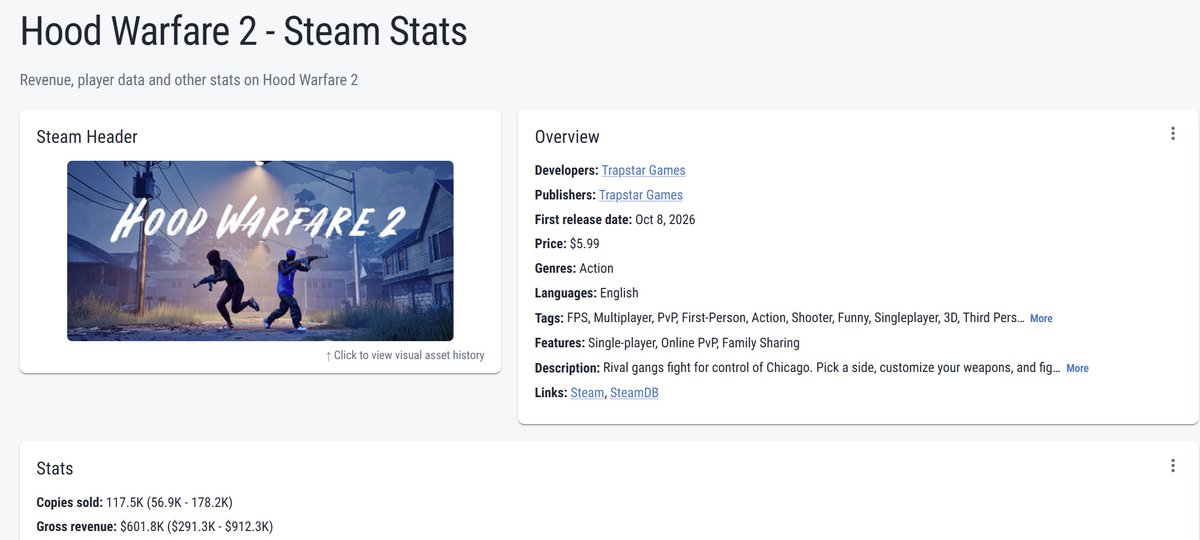
Hood warfare 2 has made (estimate) of $600k+ in revenue. minus steam's share, that is about $480k or so in USD they have made. The game cost $5 by the way.
With that being said, dont listen to people who say "dont use asset store assets" and "dont use ai in code"
just ship the game, make sure it is affordable and fun, and love what you do.